
You’re a few months from ERAS season. Everyone around you is talking about “submitting that abstract,” “my PI,” and “the poster I’m taking to SGIM.”
You? Your school barely has a functioning IRB, there are no big NIH grants, and the “research office” is basically one overworked faculty member who mostly handles QI paperwork.
You’re staring at your CV. Under “Research,” you’ve got…maybe a summer project that never went anywhere. Or nothing at all.
And you’re thinking: Is my application dead in the water?
No. Not even close. But you do need to be deliberate.
This is the playbook for when you do not have a traditional research-rich environment but still need a competitive residency CV—especially for IM, EM, FM, peds, psych, and even some of the more competitive fields if you’re smart about it.
Step 1: Be Honest About What Your Target Specialty Actually Cares About
First thing: stop catastrophizing before you’ve checked what actually matters.
Some specialties do heavily weight formal research (Derm, Rad Onc, competitive academic IM programs, Plastics, ENT, Neurosurgery). Others mostly want evidence that you can think critically, improve systems, teach, and work on a team.
Here’s the reality: a lot of programs just want to see you built something beyond showing up to clerkships.
| Specialty Tier | Research Importance | What They’ll Accept Instead |
|---|---|---|
| Derm / Rad Onc / Plastics | Very High | Real research or bust |
| Competitive Surgical (ENT, Ortho, NSGY) | High | Strong QI, case reports + great letters |
| Academic IM / Cards-track | High | QI, clinical research, strong scholarly projects |
| Community IM / EM / Peds / FM | Moderate | QI, teaching, leadership, solid clinical evals |
| Psych / Neuro / OB-GYN (most) | Moderate | Anything showing initiative and scholarship |
If you’re going after Harvard Derm and you have zero research, I’m not going to sugarcoat it: that’s a problem. You will probably need a research year somewhere else.
But if you’re applying IM, EM, FM, peds, psych, OB at solid programs? You can absolutely build a strong, “this person did stuff and thinks like a clinician-scholar” CV without PubMed entries.
Your goal: create evidence of scholarship, initiative, and impact, even if the heading on the CV says “Quality Improvement,” “Educational Projects,” or “Leadership” instead of “First-Author Publication.”
Step 2: Exploit the One Scholarly Goldmine Almost Every School Has – QI and Clinical Projects
If your school is weak in research, I’d bet money it has:
- A hospital that’s always behind on some quality metric
- An overworked attending who grumbles about discharge summaries/UTI protocols/diabetes control every day
- A QI or patient-safety committee that meets, complains, and barely has student involvement
This is your lane.
How to turn basic QI into real CV currency
Here’s the sequence that works, even in low-resource settings:
Find a pain point you actually see on the wards.
Examples I’ve seen turned into posters:- Poor documentation of vaccination status in admitted patients
- Inconsistent DVT prophylaxis in certain services
- Delayed antibiotic administration for sepsis
- Terrible discharge med reconciliation in older adults
Grab a willing mentor, not a “researcher.”
You do not need a PI. You need a clinically respected attending or chief who:- Cares about the problem
- Will let you use their name / co-author
- Will sign off on presenting this work
Do a simple pre–post or descriptive project.
Don’t reinvent methodology. A basic, credible QI structure:- Measure baseline (chart review of 50–100 patients)
- Implement one simple intervention (template, checklist, education, EMR reminder)
- Re-measure
- Calculate change and show a before/after chart
Package it, even if it never becomes a paper.
You can list these as:- “Institutional QI Project – [Title] – Poster at Local Quality Forum”
- “Institutional Presentation – [Dept Grand Rounds]”
It absolutely counts under Scholarly Activity.
If you have even 3–4 months before ERAS, you can reasonably get one solid QI project off the ground and finished enough for a poster or internal presentation.
Step 3: Case Reports and Case Series – Low-Infrastructure Scholarly Wins
Your hospital does not need big grants to have weird patients. It already has them. You just walked past three on rounds this morning.
If your school does not have a strong research culture, case reports are your most underused weapon.
How to actually get a case report from “that was weird” to CV line
Develop the habit of flagging interesting cases.
Ask yourself:- Rare condition?
- Common disease with an unusual presentation?
- Severe complication of a common treatment?
- A diagnostic puzzle that required real cognitive work?
Pitch it to the attending immediately, not 3 weeks later.
Words you should literally say:
“Dr. X, this case of [X] with [Y finding] seems unusual. Would you be open to working with me on a case report or short write-up?”Target journals that actually publish case reports.
Do not chase JAMA. You want:- Specialty-specific case report journals
- Society journals with “Case Reports” sections
- Student or resident journals
Have a simple, repeatable structure.
- Abstract
- Introduction (2–3 paragraphs)
- Case description
- Discussion (what’s unique / what we learn)
- Brief conclusion
If you can’t get it published in time: submit it as a poster.
Local hospital research day. Regional society meetings. Even if the abstract is “under review,” it lives in ERAS under “Submitted.”
Case reports are how I’ve seen students from very low-research schools walk into residency with 2–3 PubMed-indexed pieces and a couple of posters—because they were the only ones who bothered to ask, “Can we write this up?”
Step 4: Teaching, Curriculum, and Education – The Most Underrated CV Category
Programs love people who can teach. Many PDs would rather have a resident who built a teaching tool than someone who pipetted in a lab for two summers and never finished a project.
Here’s what “real” scholarly education work looks like on a CV:
- Designing a workshop for MS1s on EKG basics and delivering it for 3 semesters
- Creating a short, structured bedside teaching module for interns on “Approach to Acute Shortness of Breath”
- Building a focused Anki deck or handout set that your school actually adopts for a clerkship
- Running near-peer anatomy review sessions before exams, with attendance data and feedback
How to structure this so it doesn’t look like fluff
You want to turn vague “I tutored” into “I built and delivered a reproducible teaching product.”
For each educational thing you do, aim to have:
- A clear title: “Small Group Session: Practical Interpretation of ABGs”
- Defined audience: MS2s on IM block, incoming interns, etc.
- Frequency: monthly, once per block, recurring annual session
- Feedback or outcomes: “Average rating 4.7/5 from 32 students”; “Used by entire clerkship cohort”
If you have time, present it:
- At your school’s education day, if one exists
- At a regional medical education conference (many accept student-led work)
That’s how it goes from “I taught a thing” to “Scholarly teaching project presented at X.”
Step 5: Leadership That Actually Means Something (Not Just Titles)
A lot of students list “President, XYZ Club” and it means nothing. Program directors have been burned by title collectors.
You need leadership with evidence of outcomes.
Here’s what I’ve seen make a PD’s eyes stop glazing over:
- You ran a free clinic night and increased patient volume, created new protocols, or added a new service (e.g., women’s health night, medication reconciliation for complex patients)
- You were class rep and actually fixed something: changed a test scheduling policy, redesigned an evaluation form, advocated successfully for shelf accommodations
- You built a peer-support or “near-peer mentorship” program and can show numbers: matched 40 MS1s with MS3/4 mentors, tracked engagement, improved survey metrics
If you’re going to list leadership in a low-research application, anchor it like this:
- What problem existed
- What you actually did (not just “coordinated”)
- What changed (numbers, satisfaction, uptake, something)
Leadership + measurable change = impact. Impact is what PDs want to see.
Step 6: Conferences and Posters: Your Multipliers
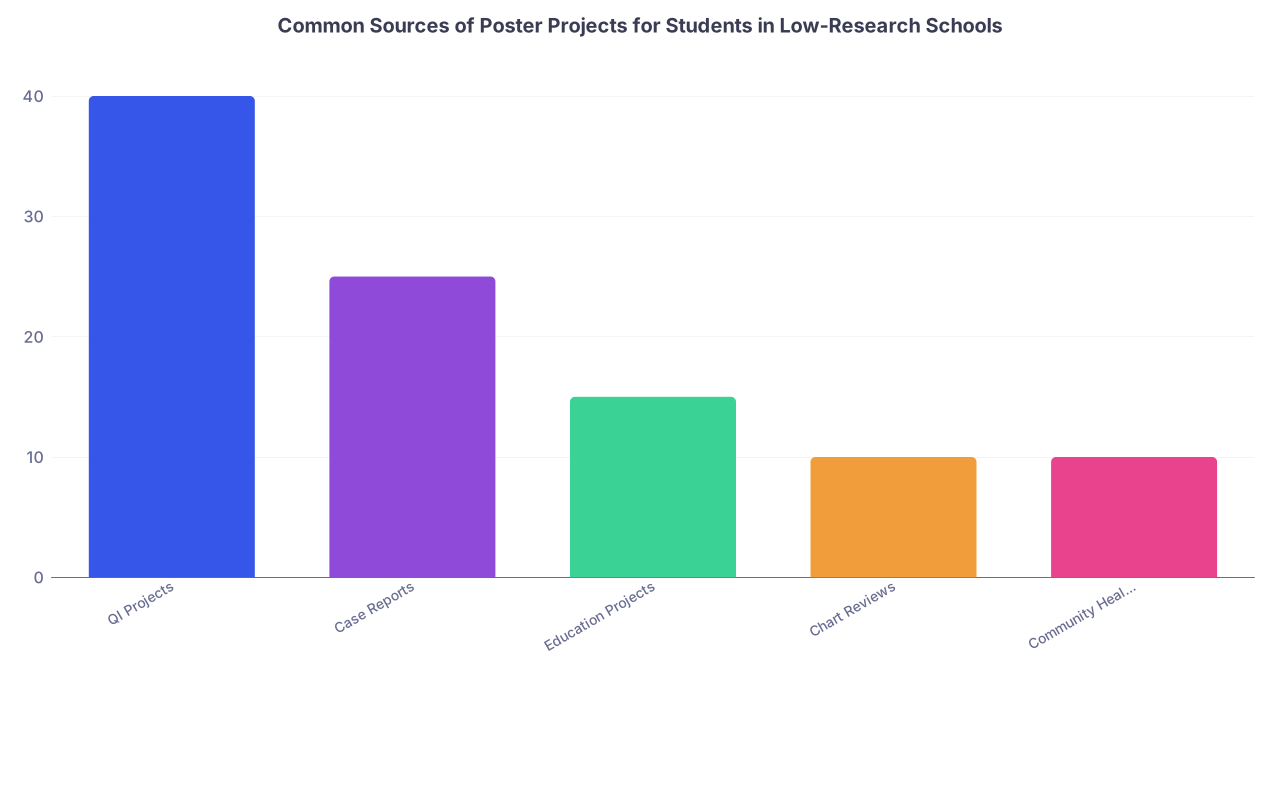
Posters and presentations are the “currency” programs immediately recognize as scholarly activity, even if your school is research-poor.
You do not need R01-level science to get a poster. You need a half-decent project and the will to submit.
| Category | Value |
|---|---|
| QI Projects | 40 |
| Case Reports | 25 |
| Education Projects | 15 |
| Chart Reviews | 10 |
| Community Health Projects | 10 |
Real numbers? No. But that bar chart is pretty close to what I’ve seen in real programs.
Where to submit if you have limited time and support
Look for:
- Regional specialty meetings (regional ACP, AAFP, AAP, ACEP, APA, etc.)
- State or city-wide consortiums (often “Student and Resident Research Day”)
- Institutional research day – low bar, but counts
- Virtual conferences (cheap, fast, and most PDs do not care that it’s virtual)
You don’t need a national podium talk. Five posters at small/local meetings = a very respectable “Scholarly Activity” section on ERAS, especially coming from a school that has almost no infrastructure.
Step 7: How to Strategically Use “Other Scholarly Work” on ERAS
ERAS has multiple buckets. Use them.
You’re trying to avoid the blank “Research Experience” problem. But you can populate:
- “Publications and Presentations”
- “Volunteer and Extracurricular Experiences”
- “Leadership”
- “Teaching”
A QI project might show up as:
- Experience: “Quality Improvement Intern – Department of Medicine”
- Publication/Presentation: “Improving DVT Prophylaxis Adherence in Hospitalized Medical Patients – Poster at X Meeting”
A case report:
- Experience: “Student Researcher – Department of Neurology”
- Publication/Presentation: “Smith J, You Y, et al. Title. Journal. Year.”
An educational project:
- Experience: “Co-Creator – MS2 Cardiology Small Group Curriculum”
- Presentation: “Implementation of a Student-Led Cardiology Small Group Curriculum – Poster at School Education Day”
Think in projects, then break each project into multiple CV lines (role + output) without lying or inflating.
Step 8: When You Truly Have Almost Nothing and You’re Close to ERAS
Let’s be brutal: it’s June. You submit ERAS in September. You’ve got basically no research and only generic volunteer stuff.
You still have a few realistic plays.
1. Micro QI with a guaranteed poster
Some departments basically hand out easy QI for residents and students to present at their local research day. You need to find the person who runs that.
Ask explicitly: “Do you have a small QI project I can help with that’s likely to become a poster for the upcoming research day?”
Focus on:
- Limited data set
- Quick intervention (education session, template, checklist)
- Simple before/after outcome
Even if data collection runs into the fall, you can still list:
- “Ongoing QI project – submitted for presentation to X Research Day”
Is that ideal? No. Does it look way better than a blank section? Yes.
2. Rapid-turnaround case report
If you’re on a subspecialty elective or IM wards now, be hyper-aggressive about spotting cases. Tell your resident:
“I’m actively looking for a case to write up. If you see anything unusual, can you loop me in early?”
Write it efficiently, target a case-report-friendly journal, and even if acceptance comes late, you can enter it as “Submitted.”
3. Education-lite project
If your school is small, they’re often shockingly open to last-minute teaching ideas.
Example I’ve seen work in a few weeks:
- You create a 1-hour targeted workshop for pre-clinicals (e.g., “Interpreting Basic CXR for MS1s”)
- You run it once or twice
- You collect a quick survey (“Was this helpful?” Likert scale)
- You present it at your school’s internal day or just list it as a structured teaching experience
It’s not MedEd gold, but it moves you out of the “nothing scholarly at all” category.
Step 9: If You’re Aiming High-Research Fields From a Low-Research School
This is the harder conversation.
If you’re set on Derm, Rad Onc, Plastics, ENT, Neurosurgery, or super-academic IM and your school has almost no research, your realistic options:
Take a dedicated research year at a bigger institution
- Email faculty at major centers
- Look for funded research fellowships (Derm often has them)
- Accept that you’ll probably move, be paid very little (or not at all), but get multiple abstracts/papers
Use away rotations strategically
- For some surgical subspecialties, away rotations + 1–2 meaningful projects at that institution matter more than home-school research status
- While you’re on away, be the student who says:
“Is there any project I can help push across the finish line in the next 3–6 months? Data analysis, writing, anything.”
Be brutally honest and adjust your target
There’s a point where wanting a certain specialty is running directly against the reality of your application. If you are from a low-research school, have no research year, and want a hyper-competitive field, you either:- Put in the time (extra year, big-name institution), or
- Pivot to something where your other strengths (clinical evals, leadership, QI) will be enough
What does not work: “I’ll apply anyway and hope they see my passion.” They won’t. They see numbers and products.
Step 10: Make Your Personal Statement and Letters Back Up Your Non-Research Story
If your CV is lighter on research, don’t pretend you’re a frustrated basic scientist in the personal statement. Align the story.
You want to sound like:
- Someone who cares deeply about patient care, teaching, and systems improvement
- Someone who used a limited environment to still produce real work
- Someone who finishes what they start
Concrete moves:
- Mention one or two projects briefly in your personal statement as examples of initiative and impact, not a flex about how academic you are
- Ask letter writers who can explicitly say:
“Despite limited formal research infrastructure at our institution, [Name] sought out and led meaningful QI and educational projects that improved patient care / resident education.”
Program directors can read between the lines. When a PD sees “QI poster, local presentations, strong teaching,” they recognize: this student didn’t have a research factory behind them—and still did something.
That actually plays well.
Quick Visual: Where to Invest Your Time

| Step | Description |
|---|---|
| Step 1 | Limited Research School |
| Step 2 | Consider research year at big center |
| Step 3 | Prioritize QI and case reports |
| Step 4 | Focus on teaching and leadership |
| Step 5 | Submit posters to regional meetings |
| Step 6 | Target Specialty |
Final Tight Summary
- You can build a strong residency CV from a low-research school by stacking QI projects, case reports, education work, and real leadership into tangible outputs (posters, presentations, implemented changes).
- Focus on projects you can actually finish in your environment, then multiply each project into multiple CV lines (role + product).
- For truly research-heavy specialties, you probably need a research year at a stronger institution; for most others, disciplined, impact-focused work from your current setting is enough to make you competitive.