
If You Took a Research Year: Structuring the CV So It Looks Intentional
Did you take a “quick” research year that somehow turned into a messy list of half-finished projects and random side gigs… and now you need to put it on your ERAS CV like you planned it this way all along?
Good. Let’s fix it.
I’m going to assume a few things about you:
- You stepped out of the regular med school timeline for 6–24 months
- You did some combination of research, maybe a degree, maybe clinical work, maybe tutoring or scribing
- You’re worried programs will see “gap” or “couldn’t match” instead of “purposeful professional development”
You’re not trying to lie. You’re trying to make your timeline coherent. There’s a difference.
Here’s exactly how to structure your CV and ERAS experiences so your research year looks deliberate, strategic, and aligned with your specialty choice.
Step 1: Decide the Story First, Then Build the CV Around It
If you just start entering every little thing into ERAS, you’ll end up with chaos. You need a narrative first.
Your research year needs a headline in your own mind before you touch the CV.
A few examples of clean narratives:
- “Dedicated research year in cardiology to build academic foundation before IM residency.”
- “Transitional year focused on surgical outcomes research and advanced procedural exposure.”
- “Formal research year to deepen experience in health services research and complete a master’s degree in public health.”
Pick your version. It should answer three questions:
- Why did you take the year?
- What did you focus on?
- How does it connect to your residency specialty?
If you can’t answer those yet, you’ll have trouble with the CV and even more trouble in interviews.
Once you’ve got your headline, every entry on your CV either:
- Supports that story directly, or
- At least doesn’t contradict it.
If something has no connection, it either gets:
- Cut
- Combined into a broader role
- Or put way down the priority list (not in the top 10 ERAS experiences)
Your CV is not your diary. It’s a structured argument that you used that year well.
Step 2: Anchor the Year With One Primary Role
The biggest mistake people make: listing five part-time things and nothing that looks like a “home base.”
Programs hate scattered. Scattered reads as unfocused, or worse, flailing.
You need one anchor experience that makes your year look like a position, not a drift.
Examples of good anchors:
- Research Fellow, Department of Neurology, University X
- Postgraduate Researcher, Orthopedic Surgery, Institution Y
- Clinical Research Coordinator, Emergency Medicine, Hospital Z
- MPH Candidate (Clinical Effectiveness Track), School of Public Health
If you did multiple projects with the same PI or department, consolidate.
On ERAS, that means:
- One “Research Experience” entry as your main research role
- Sub-bullets under it for each major project
- Separate “Publications/Presentations” entries that point back to this time
Do not do this:
- 4 separate research experiences with tiny time blocks:
- “Chart review in stroke patients” (3 months)
- “Case series in epilepsy” (4 months)
- “Database project in neuroimaging” (2 months)
To programs, that looks like you bounced around. Instead, make it:
“Research Fellow, Department of Neurology, University X (July 2023 – June 2024)”
Then bullets:
- Led retrospective chart review on acute stroke interventions (submitted to Stroke)
- Collaborated on epilepsy case series examining long-term seizure outcomes
- Assisted with neuroimaging database analysis on white matter changes in MS patients
You create continuity.
Step 3: Use Dates and Overlaps Strategically
The timeline itself is loaded. Programs look for these things:
- Was there any true “gap” with nothing?
- Does the research year flow logically from MS3 to MS4 or from prior non-match?
- Does the timing line up with application season?
Be precise. But also smart.
General rules:
- If research was your main job and everything else was minor, make research full-time and overlap others as part-time.
- Do not stack so many overlapping full-time experiences that it looks impossible (you didn’t work 3 full-time jobs).
- Avoid unexplained 3+ month gaps with nothing listed. Either:
- You were working on a long-term project under the same position (fine)
- Or you need to be honest and label what you did (family leave, illness, dedicated Step studying, etc.)
If you had a messy timeline, you can often clean it by consolidating under a single umbrella role with sub-responsibilities.
For example:
Instead of:
- 09/2023–11/2023: Volunteer scribe
- 11/2023–03/2024: Research assistant
- 03/2024–07/2024: Data analyst
You can (if true) rewrite as:
- 09/2023–07/2024: Clinical Research Assistant, Department of Emergency Medicine
- Clinical exposure via scribing in ED
- Data analysis for sepsis outcomes project
- Assisted with protocol development and database management
Same work. Less chaos. More intentional.
Step 4: Put the Research Year Where Programs Expect It
On ERAS, your “research year” doesn’t get a special label. It’s just part of your experiences.
Your job is to make it extremely clear that:
- This was a dedicated year
- It was full-time or close
- It was aligned with your specialty
So:
- Use the “Experience Type” as Research (or Education if you did a degree).
- Put it high in your experience list—ideally top 3, definitely top 5.
- Use the title to your advantage. Don’t write “Took a year off for research”. Write “Research Fellow, Department of X”.
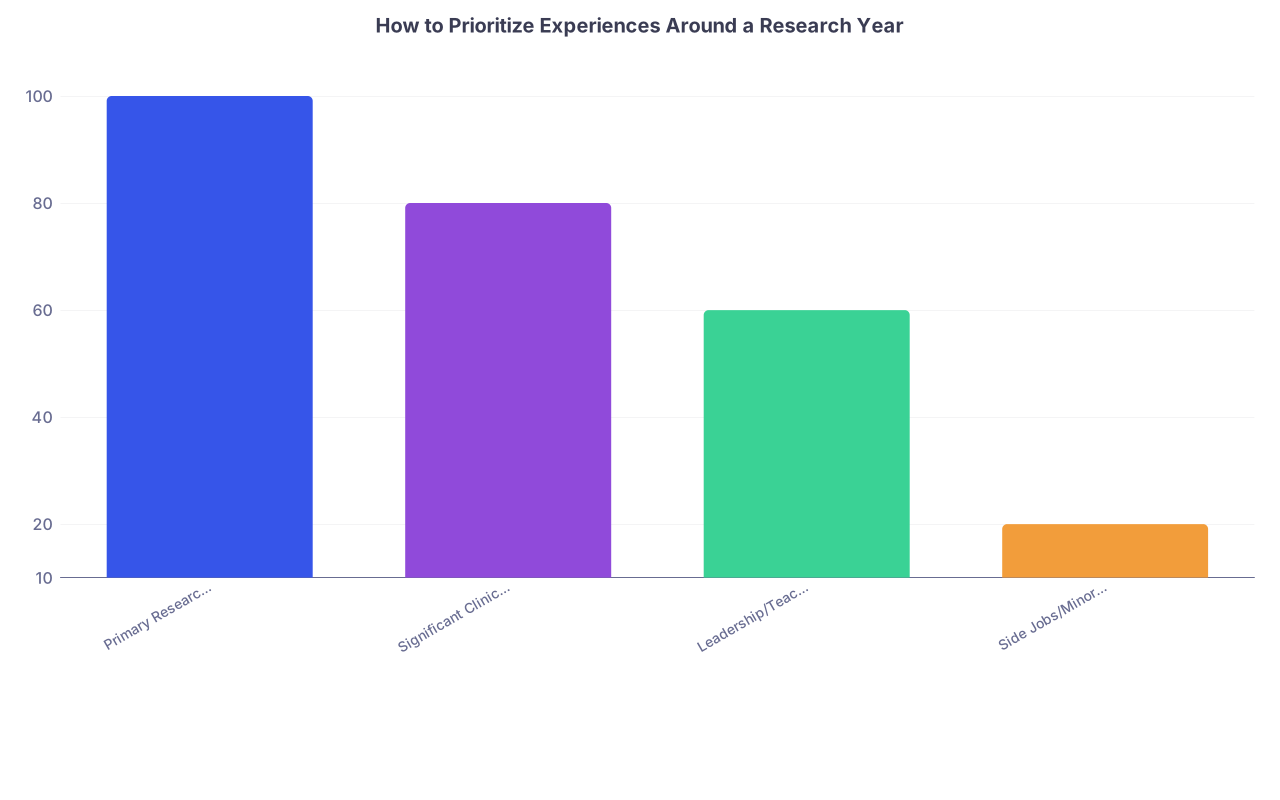
| Category | Value |
|---|---|
| Primary Research Role | 100 |
| Significant Clinical Role | 80 |
| Leadership/Teaching | 60 |
| Side Jobs/Minor Volunteering | 20 |
Think in tiers:
- Tier 1: Your main research year role
- Tier 2: Any sustained clinical work during that year (moonlighting as a scribe, part-time clinic assistant, etc.)
- Tier 3: Teaching, mentoring, leadership roles that ran alongside
- Tier 4: One-off stuff, sporadic volunteering, short gigs – if there’s space and it adds something, fine; if not, cut
If your research year was 80% research and 20% something else, the CV should reflect that proportional weight.
Step 5: Write Bullets That Sound Planned, Not Random
The language you use either screams “I just did whatever came up” or “I had a structured role with defined responsibilities and outcomes.”
You want the second.
Bad bullets:
- “Helped with data entry for various projects.”
- “Attended lab meetings.”
- “Worked on multiple projects in cardiology.”
Those sound like you wandered the lab hoping to be useful.
Better bullets:
- “Designed and executed retrospective cohort study on heart failure readmissions under Dr. X, including protocol drafting and IRB submission.”
- “Managed data cleaning and analysis for 300+ patient PCI registry using R and STATA.”
- “Coordinated weekly research meetings, tracked project milestones, and prepared abstracts for national cardiology conferences.”
Same job. Different impression.
Concrete details that help your case:
- Numbers: sample sizes, number of projects, # of abstracts or manuscripts
- Tools: STATA, R, REDCap, Python, Qualtrics, etc.
- Skills: IRB process, protocol design, database management, statistical analysis
- Outcomes: submitted, accepted, presented, under review (and where)
Avoid over-selling. Nobody believes the M3 “single-handedly led multi-center trial” story. But they do believe:
- “Primary author on [X] abstract submitted to [Y]”
- “Contributing author on 3 manuscripts, one accepted to [Journal]”
Step 6: Align the Research Year With Your Chosen Specialty
If you took a research year in a specialty different from what you’re now applying to, you need to be careful but not apologetic.
Programs are looking for alignment. Your job is to connect the dots.
Three common scenarios:
1. Same specialty research year (easy mode)
Example: You did ortho research and you’re applying to ortho.
Your CV should scream:
- Depth in that specialty
- Increasing responsibility
- Real outputs (posters, publications, presentations)
You list:
- Main research role (anchor)
- Publications/presentations clearly tagged
- Any clinical exposure you had (clinic, OR observation, call shifts) under that same department if possible
2. Adjacent specialty research year
Example: You did neurology research and you’re applying to psychiatry.
You don’t hide it. You frame it.
Emphasize:
- Overlapping patient populations (e.g., dementia, brain injury, psych comorbidities)
- Skills that matter to your target field (patient interviews, outcomes research, brain-behavior work)
- The deliberate pivot: “Exposure to X made me realize I was most drawn to Y”
On the CV, it’s still your main role. In the personal statement and interviews, you explain the shift.
3. Unrelated specialty research year
Example: You did dermatology research and now you’re applying family medicine or anesthesia because you didn’t match or changed course.
This is where structure matters even more.
Make the research year show:
- Professionalism
- Productivity
- Commitment over time
- Transferable skills: outcomes research, QI, clinical workflow, patient counseling, etc.
You’re not erasing the year. You’re proving that even when your trajectory changed, you used that time well and matured.
Step 7: Handle Publications and “In Progress” Projects Correctly
A research year almost always ends with a graveyard of “almost done” things.
On the CV, you cannot just invent publications. But you also do not underplay meaningful work.
Use clean categories:
- Published / In Press
- Accepted / In Press
- Submitted
- In Preparation (only for things that are genuinely near submission and where you made a real contribution)
If a project is truly early, keep it as a bullet under your main research experience, not in the publications section.
Don’t list ten “in preparation” papers. That looks ridiculous. Pick the ones that are actually in motion and significant.
If you’re second, third, or later author – that’s fine. Just be consistent with order and journal style.
Step 8: If You Also Did Clinical Work, Integrate It Properly
If during your research year you:
- Worked as a scribe
- Did part-time clinical assistant work
- Volunteered in a clinic
- Took on per diem shifts in something clinical
That’s good. It shows you did not completely disconnect from patient care.
But don’t let small jobs overshadow your main narrative.
Place clinical roles right after your main research role if:
- They were substantial (6+ months, real hours each week)
- They’re relevant to your specialty
For example:
- “Per Diem ED Scribe, Community Hospital” with bullets:
- “Documented physician-patient encounters for 15–20 patients per shift in a high-volume ED.”
- “Observed evaluation and management of acute [specialty-relevant conditions].”
- “Developed familiarity with ED workflows and interdisciplinary communication.”
That supports your readiness for residency more than another vague “volunteer” listing.
Step 9: Use Structure to Make the Year Look Planned
Here’s what an “intentional” research year usually looks like on paper:
| Section | Entry Type |
|---|---|
| Experience #1 | Research Fellow |
| Experience #2 | Clinical Role (if any) |
| Experience #3–4 | Teaching/Leadership |
| Publications | 1–5 entries |
| Presentations | 1–4 entries |
Then in the dates, you see:
- Research Fellow – 07/2023 to 06/2024
- Scribe – 09/2023 to 05/2024 (Part-time)
- Tutor – 08/2023 to 12/2023 (Part-time)
Everything is anchored by that Fellow role. The other items orbit it.
Here’s a quick way to visualize how your year should feel:

| Step | Description |
|---|---|
| Step 1 | Research Fellow 12 months |
| Step 2 | Main Projects |
| Step 3 | Clinical Role part time |
| Step 4 | Teaching or Tutoring |
| Step 5 | Publications |
| Step 6 | Posters and Abstracts |
If your current draft CV does not look anything like that, you probably need to:
- Merge scattered projects under one umbrella role
- Reorder experiences so the main research position is on top
- Trim weaker, unrelated, or redundant entries
Step 10: Common Pitfalls That Make a Research Year Look Accidental
I’ve seen these kill otherwise strong applications:
Vague titles
“Research” or “Volunteer” tells programs nothing. Use real titles: “Research Assistant,” “Research Fellow,” “Clinical Research Coordinator.”No supervisor / no department listed
Not listing your PI or department makes the role look less legitimate. Always include supervisor and institution.Microscopic time blocks
Dozens of 2-month roles read as instability. Combine under one long-term position when it’s the same team or department.Bullet points that just describe tasks, not outcomes
“Entered data” is weak. “Managed REDCap database for 250-patient registry; contributed to 2 abstracts” is stronger.No tangible output at all
Sometimes it happens. But if after 12 months you truly have zero abstracts, posters, presentations, or at least manuscripts in preparation, you need to at least emphasize process skills, independence, and complexity of the work.
Step 11: What If the Year Was Actually a Recovery / Personal Crisis?
Sometimes the research year is the socially acceptable label for:
- Burnout
- Family illness
- Your own health problem
- A prior non-match
You don’t need to disclose every detail on the CV. But you do need factual accuracy.
If you did some research but also had major life events, structure it like this:
- List the research position with accurate dates and responsibilities
- If there’s a major true gap (no work, no school), that’s often addressed better in the personal statement or advisor letter than micromanaged on the CV
- Do not invent full-time research you clearly didn’t do. That backfires.
Programs are actually pretty understanding when the story is honest and the last 6–12 months show stability, productivity, and readiness.
Step 12: Final Sweep – Does It Look Like a Job or Like Drift?
At the end, print your CV or export your ERAS PDF. Look at the research year section and ask:
If I knew nothing about this person, would I think:
- “They took a structured research year position and got a lot out of it”
or - “They kind of disappeared from training and did some random things”
You’re aiming for the first. The details that create that impression are simple:
- One clear main role across most of the year
- Specific responsibilities with skills and outcomes
- Logical alignment with your chosen specialty
- Some evidence of productivity (abstracts, posters, manuscripts, or at least serious ongoing work)
- Minimal fragmentation into tiny, disjointed entries
If you can’t tell, have a faculty mentor or resident in your specialty glance at it. Tell them: “Does this look like a purposeful research year, or like I just floated?”
You’ll get an honest read in 30 seconds.
Key Takeaways
- Your research year needs an anchor: one main role, clear dates, concrete responsibilities, and visible outputs.
- Consolidate scattered projects; use titles, bullets, and ordering to sell a coherent, specialty-aligned story.
- If the year was messy in real life, you do not rewrite history—but you do structure it so programs see professional growth, not chaos.