
The assumption that a CV full of short-term roles automatically makes you look flaky is lazy thinking—and you can beat it.
If you’ve bounced between labs, jobs, or volunteer gigs every few months, you’re not doomed. But you are on the hook to control the story. Program directors are busy and a little cynical. If you don’t frame this well, they’ll do it for you—and their version won’t be kind.
Here’s how to handle this specifically for residency applications, when you’ve got multiple short-term, part-time, or stop‑and‑start roles and you’re worried it screams “unstable.”
Step 1: Diagnose What Kind of “Short-Term” Problem You Actually Have
Not all brief roles are equal. Before you change your CV, you need to know what you’re up against.
Ask yourself three questions:
- How many roles are under 6 months?
- Do they overlap (e.g., 3 part-time things at once) or are they sequential (start–stop–start over)?
- Are there unexplained gaps in between?
Now put yourself in a PD’s head for 15 seconds. They scan ERAS, not study it. Here’s what they’re looking for and what your pattern might signal:
| Pattern | What it may signal to PDs |
|---|---|
| Many overlapping short roles, same year | Hustle or chaos, depending on framing |
| Sequential 3–6 month jobs with gaps | Instability, firing, or indecision |
| Several 8–12 week projects with clear end | Normal academic/project-based work |
| Multiple “1–2 month” entries without context | Flakiness or padding the CV |
If your roles were:
- Summer research, 8 weeks
- OSCE standardized patient, occasional per diem
- Scribe for 4 months between Step exams
- Multiple 1–3 month volunteer gigs
That can be framed as normal in medicine. The problem isn’t the length—it’s the presentation.
Step 2: Stop Listing Every Micro‑Gig as a Separate Job
One of the biggest mistakes I see: people treat every little thing like a standalone “position” with its own dates and bullet list. That’s how you create the illusion of chaos.
Your job is to consolidate.
Here’s the rule: if experiences are similar in function, time period, or setting, group them.
Example: Grouping Clinical and Non-Clinical Roles
Let’s say you have:
- 2 months as a medical assistant
- 3 months as a scribe
- 4 months as a health coach
- All spread over one year while waiting to apply
Instead of this mess:
- Medical Assistant, Clinic A, Jan–Feb 2023
- Medical Scribe, ED B, Mar–May 2023
- Health Coach, Program C, Aug–Nov 2023
You do this:
Clinical Experience (Part-Time), Various Sites — Jan 2023–Nov 2023
- Medical Assistant – Clinic A (2 months, primary care)
- Medical Scribe – ED B (3 months, emergency medicine)
- Health Coach – Program C (4 months, chronic disease management)
Now it looks like one continuous, structured period of clinical engagement. Same truth. Very different impression.
When You Shouldn’t Group
Do not group if:
- One role is a major anchor experience (e.g., 2-year research job) and the others are tiny.
- One role is problematic and hiding it will raise eyebrows in interviews (“So what were you doing from Jan to June?”).
Use grouping to clean noise, not to bury landmines.
Step 3: Control the Dates So They Read as Continuity, Not Chaos
You can’t change reality, but you can change formatting.
Three practical moves:
- Use month–year, not exact days. ERAS already does this, but on a separate CV, don’t be weirdly precise (“March 3–June 27”). That invites over-analysis.
- Extend the umbrella date range for grouped experiences. You’re not lying if something happened in that window.
- Clarify in the description if something was truly episodic or PRN rather than a full-time role that abruptly stopped.
Example of better dating for multiple roles:
Clinical and Community Activities, Various Locations — 2021–2023
Rather than three separate entries with on/off dates.
Underneath, you specify durations briefly. One line each. No one needs start and end dates for every tiny role.
Step 4: Re‑Label Roles So They Look Intentional, Not Random
Titles matter. “Volunteer,” “Intern,” and “Observer” are vague and cheap if overused.
You want your short-term roles to fit into coherent buckets that make sense for residency:
- Clinical Experience
- Research Experience
- Teaching and Mentoring
- Leadership and Administration
- Community Outreach and Advocacy
Do this especially if you wore multiple hats in one institution.
Example:
Bad:
- Volunteer, Hospital X – 2 months
- Volunteer, free clinic – 3 months
- Volunteer, vaccination clinic – 1 month
Better:
Community Health and Clinical Outreach, City Y — 2021–2022
- Free Clinic Volunteer – longitudinal patient intake and vitals (3 months)
- Hospital Volunteer – inpatient patient navigation and family liaison (2 months)
- Vaccination Clinic Assistant – mass immunization logistics and patient education (1 month)
To a PD, that reads as: interest in community health + exposure to systems of care. Not: chronic inability to commit.
Step 5: Write Bullets That Emphasize Depth, Not Duration
You can’t hide that something lasted 3 months. But you can show those 3 months weren’t fluff.
Your bullets need to punch above their weight:
- Focus on outcomes, ownership, or skills, not tasks.
- Use numbers when you can.
- Link to residency-relevant competencies: communication, systems-based practice, QI, leadership, teaching.
Weak bullet for a 3-month research position:
- “Assisted with data collection and chart review.”
Stronger:
- “Completed chart abstraction for 230+ patients and independently cleaned dataset that was used in an accepted abstract at [Conference Name].”
Weak bullet for a 2-month volunteer gig:
- “Helped with patient check-in and vitals.”
Stronger:
- “Performed intake and vitals for ~20 underserved patients per shift and flagged high-risk cases to supervising clinician, improving throughput in a clinic with no full-time nursing staff.”
Now your “short” roles look intense and purposeful. Hell, some long roles look less substantive than that.
Step 6: Use a Summary Line to Tie Short-Term Roles Into a Narrative
Most applicants underuse the description field in ERAS. For someone with multiple short stints, that field is where you save yourself.
At the top of your description, before bullets, you can write a one-sentence “framing” line:
- “Series of short-term, project-based roles undertaken during dedicated research year before residency applications.”
- “Part-time clinical and teaching roles balanced with full-time medical school curriculum, focused on underserved care and patient education.”
- “Multiple summer and elective experiences intentionally chosen to explore academic and community-based approaches to internal medicine.”
That one line tells the reader: this wasn’t random. This was an intentional sampling of environments.
Then your bullets back it up.
Step 7: Know When to Compress or Cut
This will sting, but it’s true: not every thing you did deserves a line.
If you have:
- Ten experiences under 1 month,
- None particularly impressive,
- All basically the same type of work,
You’re better off compressing.
Example:
Instead of listing five 1-day health fairs as separate entries, create:
Health Fair and Screening Events, Various Sites — 2021–2023
- Participated in multiple one-day community screening events providing BP checks, basic counseling, and referral information in collaboration with local organizations.
That’s blunt, honest, and takes one slot. PDs understand not every activity is year-long; they just don’t want padding.
If something is extremely short (1–2 days) and doesn’t add anything unique—no leadership, no special skill, no connection to your narrative—strongly consider leaving it off entirely.
More lines does not equal stronger applicant. PDs know a stuffed CV when they see one.
Step 8: Handle Red Flag Short-Term Roles Head-On
There are certain short-term entries that trigger curiosity:
- A paid job that ends abruptly with no obvious reason.
- A residency or job you left quickly.
- A research position at a big-name place for 2 months with no outputs.
If you have one of these, do two things:
Explain the structure honestly in the description.
- “Completed a pre-defined 8-week summer research fellowship funded by X foundation.”
- “Short-term research assistant position during Step study period.”
Spell out that it was meant to be short.
Be ready with a calm, direct explanation in interviews.
Three beats:- What happened.
- What you learned.
- How it shaped your path going forward.
What you don’t do: get defensive, overtalk, or blame others.
Example for a terminated or short employment:
“I started that role expecting it to be longer-term, but the position funding was pulled after three months. I used the opportunity to pivot into [next role], where I was able to continue working with [similar patient population/skill]. It also made me more proactive about asking upfront about expectations and funding, which helped me choose more stable roles later.”
Simple. Non-dramatic. Mature.
Step 9: Match the CV Story to Your Personal Statement and LoRs
If your CV says: “I sampled multiple short roles to explore emergency medicine, critical care, and EMS systems,” then your personal statement should not read like you woke up one day and randomly picked EM.
You sync them.
Personal statement:
- Acknowledge breadth: “I sought out multiple short-term roles in [X, Y, Z] to understand how acute care is delivered across settings.”
- Then pivot to focus: “Those experiences consistently drew me to [core theme—team-based acute care, rapid decision-making, etc.].”
Letters of recommendation:
- Ask letter writers to describe you as reliable and consistent specifically if your timeline is choppy.
- Someone writing: “Despite only working with us for 3 months, [Name] quickly became a dependable member of the team and took on responsibilities normally reserved for long-term staff” is gold for you.
The people reading your file look for pattern consistency. If CV + PS + letters all tell the same story—“this person used short roles to gain breadth, then committed”—you’re fine.
Step 10: Specific Scenarios and What to Do
Let’s walk through a few common messes.
Scenario 1: The “I Needed Money and Took Whatever Job” Year
You graduated, didn’t match, or delayed applying. Ended up with:
- 2 months as a scribe
- 3 months as a lab tech
- 1 month tutoring
- 2 random non-clinical jobs (barista, retail)
How to frame it:
Group the medically relevant work:
Clinical and Academic Roles, City Z — 2022–2023- Medical Scribe – urgent care (2 months, part-time)
- Lab Assistant – basic science lab (3 months)
- MCAT/Science Tutor – premed students (1 month)
Put the non-clinical jobs briefly under a single header if you include them at all:
Employment to Support Application Year, City Z — 2022–2023- Worked in service roles to fund exam fees and application costs while maintaining part-time clinical and academic involvement.
Does that make you look unstable? Not really. It makes you look like someone who hustled to pay their bills and still stayed engaged in medicine.
Scenario 2: Tons of Short Research Projects
Common for people at research-heavy schools:
- 3 months in one lab, 4 in another, summer fellowship, one QI project, etc.
Rather than a scattered lab graveyard:
Research and Quality Improvement, Institution X — 2020–2023
- Cardiovascular Outcomes – mentored by Dr. A; contributed to data analysis for a retrospective cohort (6 months, part-time)
- ICU QI Project – developed and implemented a checklist to reduce central line infections (4 months, part-time)
- Summer Research Fellowship – 8-week funded project on [topic], resulting in a poster at [Conference].
First line of description:
“Series of mentored, project-based research experiences undertaken throughout medical school, each with a defined aim and timeline.”
Now it looks deliberate and progressive.
Scenario 3: Short-Term Clinical Roles Across Multiple Countries
International graduates get dinged for this if it looks like “medical tourism.”
If you did 2–4 week observerships in multiple places:
Don’t:
List 8 separate observerships in 6 countries as though you were staff.
Do:
Clinical Observerships and Electives, Various Sites — 2021–2023
- Internal Medicine – 4 weeks, Hospital A, USA
- Cardiology – 3 weeks, Hospital B, USA
- General Medicine – 4 weeks, Hospital C, Country Y
Framing line:
“Short-term observerships to understand differences in healthcare delivery in U.S. and international systems while preparing for U.S. residency.”
Short, honest, clear.
Step 11: Quick Visual Check — How Your CV Feels on First Scan
This is underrated. Open your CV or ERAS printout and pretend you have 30 seconds.
Look for:
- Too many separate entries with 1–3 month durations in bold.
- Repeated words like “Volunteer” 10 times.
- Choppy date patterns: Jan–Mar, Apr–May, Jun–Jul, with gaps.
- No clear “big” experiences anchoring your story.
Then ask: could I reasonably explain this to a slightly skeptical attending in 2–3 sentences without rambling?
If not, fix:
- Group.
- Rename sections.
- Trim and compress.
- Add one-sentence framing intros.
You’re not hiding. You’re clarifying.
Step 12: When to Explicitly Reassure About Stability
If you’ve changed paths (another residency, another career before medicine, major break), it can help to directly address “stability” once—usually in your personal statement.
One sentence can defuse the whole worry:
- “Although my early career consisted of several short-term roles as I explored different healthcare settings, committing to internal medicine has been a sustained and focused decision over the last three years.”
Then you prove it with:
- Longer current roles.
- Consistent volunteering.
- Ongoing research or teaching.
The solution to looking unstable is not pretending the past didn’t happen. It’s showing the trend: your more recent trajectory is steady and aligned with your chosen specialty.
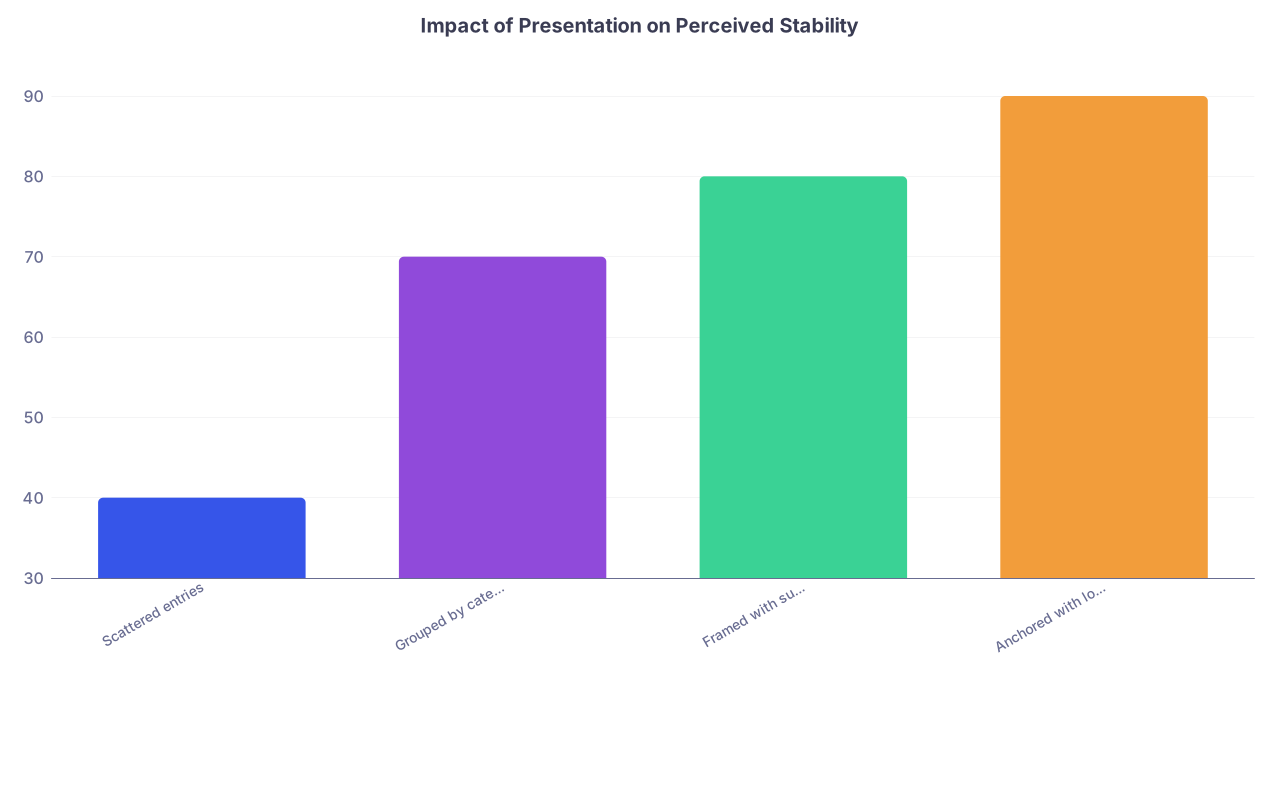
| Category | Value |
|---|---|
| Scattered entries | 40 |
| Grouped by category | 70 |
| Framed with summary | 80 |
| Anchored with long-term roles | 90 |
Step 13: Tighten the Rest of the Application to Support the Story
Two last practical moves:
Current Activities Section (ERAS or equivalent):
Highlight one or two ongoing, longer-term things. Even if you’ve had a choppy history, “Current: 18 months volunteering at X clinic” changes the feel immediately.Interview Prep:
You will be asked some version of:- “Tell me about your path since graduation.”
- “I see a number of shorter positions. Can you tell me about that?”
Practice a 60–90 second answer. Chronological, honest, calm. End with where you are now and why this specialty/program is the right next step. No apologies. No oversharing.

| Step | Description |
|---|---|
| Step 1 | Multiple short roles |
| Step 2 | Group by theme |
| Step 3 | Clarify dates and structure |
| Step 4 | Add framing lines |
| Step 5 | Align PS and letters |
| Step 6 | Practice explanation |
| Step 7 | Coherent stable story |
The Bottom Line
Three things matter more than the raw number of short-term roles:
- Pattern and framing beat duration. Group roles, create continuity, and explain the structure so it looks like intentional sampling, not chaos.
- Substance over span. Make each short role look dense with responsibility, impact, or learning—then cut the fluff.
- Trend toward stability. Anchor your recent years with longer, ongoing experiences and sync your CV, personal statement, and letters to show you’re now focused and consistent.
You can’t rewrite your past. But you can absolutely rewrite how a program director understands it.