
What do you actually put on your CV when the biggest gap on it is: “Did not match”?
Let’s not sugarcoat this. You applied. You interviewed (or maybe you barely got any interviews). And on Monday of Match Week, you opened that email and saw: “We are sorry to inform you…”
Now you’re staring at a CV that clearly did not get the job done and you need to make it stronger in 6–12 months. Not in theory. In reality. With your actual life, finances, visa status (maybe), and limits.
This is the “what now” guide.
I’ll walk you through what to change, what to add, what to hide, and what absolutely needs to be different when you apply again.
Step 1: Get Clear on Why You Did Not Match (So Your CV Fixes the Right Problem)
Before you start throwing research and observerships and random jobs onto your CV, you need a hard answer to this question:
Was your problem numbers, portfolio, timing, behavior, or targeting?
Here’s the breakdown I use when I look at reapplicants’ files.
| Main Issue | CV Priority Fix |
|---|---|
| Low scores / multiple fails | Exams + clinical strength |
| Weak US/clinical experience | Hands-on roles, USCE |
| Thin or unfocused CV | Depth in 1–2 areas |
| Poor letters of rec | New, stronger LORs |
| Wrong specialty targeting | Realignment of narrative |
If you’re not sure, here’s a rough triage:
If you had no interviews:
- Usually: numbers, red flags, or wildly unrealistic application list.
- CV fix: strengthen objective parts (exam scores, US clinical, recent activity) and align to safer programs/specialties.
If you had a few interviews but no rank or all rejections:
- Usually: weak letters, thin clinical profile, or your story did not match the specialty.
- CV fix: stronger clinical work, better LORs, tighter narrative.
If you had multiple interviews but did not match:
- Often: interview performance or rank list strategy more than CV.
- CV still matters, but parallel: fix interviewing and get mentors involved in your ranking next time.
Do not skip this reflection. Otherwise you’ll waste a year doing things that look “busy” on paper but do not actually address your real deficits.
Step 2: Decide Your Path for the Gap Year (What Goes at the Top of the New CV)
Your biggest CV question right now: What do I do this year that programs will respect?
Here’s the harsh truth: “Studied and reapplied” is not a position. You need a role.
The best options, roughly in order of impact on your residency CV:
| Option | How Programs See It |
|---|---|
| Prelim / transitional year | Very strong |
| Full-time US clinical job | Strong |
| Research position | Strong to moderate |
| Non-US clinical practice | Moderate (varies by field) |
| Observership-heavy year | Weak to moderate |
1. Prelim or Transitional Year
If you’re SOAPing or planning for next cycle and you can land a prelim IM, surgery, or transitional spot, that goes at the top of your CV as current PGY-1. It instantly solves:
- Recency of clinical experience
- Letters of recommendation
- Proof you can function in a residency environment
If you do this, your CV headline becomes:
- “PGY-1 Preliminary Internal Medicine Resident, [Hospital Name], [Dates]”
Not “Unmatched applicant.” That matters.
2. Full-Time Clinical Job (US)
If prelim isn’t realistic, second best is a hands-on clinical job in the US, if you’re allowed to work:
- Hospitalist scribe
- Clinical research coordinator (with direct patient contact)
- Medical assistant in a specialty related to your target field
- ED scribe
- Case management roles that actually involve inpatient work
Key: You want roles where attendings and residents see you working. That’s how you get the kind of LOR that says, “I see this person functioning like an intern.”
3. Research Position (Especially Academic Centers)
Research is good. Clinical research + patient interaction is better.
Aim for:
- 1–2 first- or second-author manuscripts accepted or at least submitted before ERAS opens
- Concrete outputs you can list: abstracts, posters, QI projects, database work
This is especially valuable for:
- Competitive specialties (derm, ortho, radiology, ENT, etc.)
- Applicants pivoting into academic internal medicine, neurology, PM&R, etc.
But it must be real work with deliverables. A “research volunteer” title for a year with nothing to show is a red flag, not a flex.
4. Clinical Practice in Home Country (For IMGs)
If you’re an IMG and in your home country now, working as a physician there is better than sitting idle.
Programs will ask, “What did you do when you did not match?” You want to be able to say:
- “I continued seeing patients full time, leading a clinic / managing a ward, and improved my procedural and clinical decision-making.”
Pair that with 1–2 US observerships in the months leading up to reapplication.
Step 3: Rebuild the CV Section by Section (What Changes, What Stays, What Gets Cut)
You do not just “add a new section” and resend. Your CV should evolve.
Let’s go through the main parts.
Header & Summary
Your identity line needs to change from “4th year medical student” or “Recent graduate” to something current.
Bad:
“John Smith, MD – Unmatched residency applicant”
Better:
“John Smith, MD – Clinical Research Fellow, Department of Medicine, University Hospital”
or
“Priya Patel, MBBS – Internal Medicine Hospitalist Scribe, City Medical Center”
If you use a brief summary (optional but useful for reapplicants), it should:
- Name your target specialty
- State your current role
- Emphasize your main improvements this cycle
Example:
Internal medicine residency reapplicant currently working full time as a clinical research fellow at a tertiary academic center. Strengthened US clinical experience, completed two quality improvement projects, and obtained new letters from US IM faculty.
Education Section
This usually does not change much, but:
- Add graduation date if it wasn’t there
- Correct any typos or inconsistencies
- If you were previously vague about class rank or honors because they were mediocre, that’s fine. You don’t need to invent anything now.
Do not overcompensate by suddenly padding this section. The real action will be in recent experience.
Professional Experience / Clinical Experience
This is where your gap-year plan lives, and it should move to the top of this section.
Structure:
- Current role(s) — Prelim year, job, research, clinical practice
- Recent US clinical experience (if any) — Sub-I’s, electives, observerships
- Previous experience from during med school — Clerkships, leadership roles
For each new role, you want 3–5 specific bullet points that signal:
- Responsibility
- Clinical exposure
- Collaboration with residents/faculty
- Outcomes (what changed, improved, or was produced)
Bad bullet:
“Assisted with research projects and clinical care.”
Good bullet:
“Coordinated care for 10–15 hospitalized internal medicine patients daily as part of a resident-led team; independently pre-rounded and presented to attending.”
Another good one:
“Abstracted and analyzed data for a 500-patient heart failure registry, resulting in a first-author poster at the [Conference Name] Annual Meeting.”
If your previous CV had a wall of vague bullets, clean it up. One strong bullet is better than three generic ones.
Step 4: Add Real Output: Research, QI, Presentations, Teaching
Programs care about one thing with academic work: did you finish something?
You should have clear subsections like:
- Publications
- Abstracts and Posters
- Presentations
- Quality Improvement Projects
- Teaching / Mentoring
Publications
Only list:
- Published articles
- Articles “in press”
- Manuscripts “under review” (careful—don’t list 8 “in preparation” manuscripts; it looks desperate)
Format consistently:
Smith J, Lee A, Patel R. Title. Journal Name. 2025;14(2):123-130.
If you had no publications last cycle, aim for at least:
- 1–2 posters
- 1 submitted manuscript
If your work is still in progress by ERAS opening, list accepted abstracts clearly as such.
Quality Improvement
Even a small but real QI project can look good:
- “Reduced average time to antibiotics in suspected sepsis from 180 to 90 minutes through protocol redesign and nursing education sessions.”
- “Implemented medication reconciliation checklist in discharge workflow, decreasing documented medication discrepancies by 25%.”
Again—concrete outcomes.
Teaching
If you’re in a role where you can supervise students, new scribes, junior doctors, or even run board review sessions, put it in.
Programs like seeing you take responsibility and explain medicine to others.
Step 5: Deal With the “Gap” and the Unmatched Status Head-On
Attempting to hide that you did not match is dumb. Programs know. They see your prior ERAS submissions and NRMP history if they want to.
Your strategy isn’t to hide. It’s to control the narrative.
On your CV, your “gap” year shouldn’t look like a gap at all. It should look like:
- 07/2024 – Present: Clinical Research Fellow, X
- 08/2024 – Present: Hospitalist Scribe, Y
- 06/2024 – 09/2024: Observership, Z
If you did have a few empty months (logistical issues, personal reasons), that’s fine. But:
- Do not leave a 9–12 month block with nothing on it.
- Even part-time roles, structured study with teaching, or volunteer clinical work is better than an empty calendar.
How to phrase it to programs, briefly (this will show up more in your personal statement, but your CV should be consistent):
“After not matching in the 2024 cycle, I began a full-time clinical research and patient-facing role in internal medicine to strengthen my skills, gain additional mentorship, and improve my application for the upcoming match.”
That’s a clean, adult explanation. Own it.
Step 6: Align Your CV With Your Specialty (Or Pivot Intentionally)
If you reapply to the same specialty, your CV needs to scream commitment, not confusion.
Example: internal medicine reapplicant
You want:
- Current or recent IM-related clinical work
- IM attendings writing new letters
- Projects that make sense in IM (heart failure, diabetes, hospital throughput, etc.)
- A story of continuity: your old experiences + new year all aim at IM
If you’re pivoting specialties (say, from surgery or radiology to internal medicine, psych, FM, etc.), you must fix the mismatch:
- Re-order your CV so that anything related to the new specialty moves up
- Add at least one strong experience in the new field (observership, job, short contract, research)
- Trim experiences that only emphasize your old specialty if they confuse your narrative
You’re not erasing your past. You’re curating. They should look at your CV and say, “Ok, they’re clearly serious about this new field.”
Step 7: Use the CV to Support Stronger Letters, Not Just Look Prettier
Your improved CV should directly lead to better letters of recommendation.
Translation: choose roles where someone can watch you work closely for at least 2–3 months and then write:
- “Shows intern-level reliability and ownership of tasks.”
- “Integrates feedback quickly and independently follows through on patient care tasks.”
- “Excellent communicator with the team, supports co-residents, and handles stress well.”
That means:
- Don’t spend all year in scattered 2-week observerships where no one really knows you.
- Avoid roles where the attending barely interacts with you.
- Target 2–3 substantial relationships with faculty in your target specialty.
On your CV, the description of the role should give the letter writer something to “hang” their narrative on. If you list:
“Managed pre-rounding, wrote progress notes, called consults, and communicated with patient families under resident supervision.”
Your letter writer can truthfully expand that. That synergy matters.
Step 8: Clean Up Formatting, Redundancy, and Amateur Moves
Some of you didn’t match partially because your application looked sloppy. I’ve seen:
- Three different fonts in one CV
- Objective statements like “I am a hardworking and passionate physician looking for a challenging position…” (useless)
- 20 bullet points under “Hobbies”
- Listing “using the internet” or “watching movies” as interests
You’re not a college sophomore. Fix the basics:
- Single font, clear headings, consistent date format
- Reverse chronological order within each section
- Max 2–4 bullets per position, focusing on impact, not chores
- Hobbies section: 2–4 specific things that show you’re a real person (long-distance running, classical piano, soccer coaching, etc.)
Your CV should feel like something an attending would be okay forwarding to a colleague without embarrassment.
Step 9: Timeline – When You Need This New CV Ready
Here’s the rough timeline if you’re applying for the next cycle:
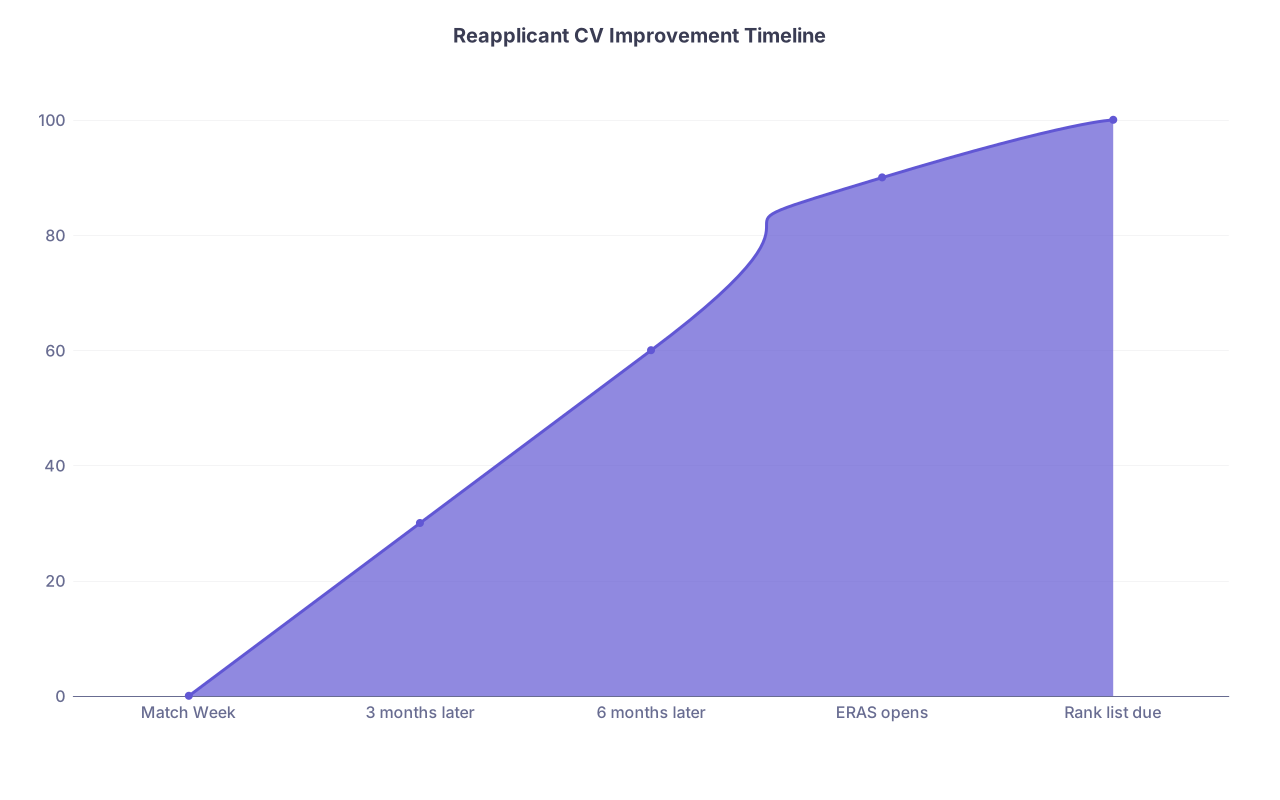
| Category | Value |
|---|---|
| Match Week | 0 |
| 3 months later | 30 |
| 6 months later | 60 |
| ERAS opens | 90 |
| Rank list due | 100 |
Think in phases:
March–April (post-Match)
- Honest post-mortem: why you did not match
- Secure a concrete role (job, prelim, research, etc.)
- Rough draft of new CV with placeholders
May–August
- Actually do the work that will go on the CV
- Get early outputs: small QI, abstract submissions
- Ask for at least one letter by late summer
August–September (ERAS opening/submit)
- Finalize CV with updated titles, roles, and outputs
- Make sure everything on the CV is verifiable and recent
If you are more than one cycle out (2+ years since graduation), the bar is higher. You need continuous, believable medical involvement on that CV to combat the “out of training too long” bias.
Visualizing Your CV Structure
Here’s a simple layout I’d use for a reapplicant:

| Step | Description |
|---|---|
| Step 1 | Header and Contact |
| Step 2 | Summary - optional |
| Step 3 | Education |
| Step 4 | Professional and Clinical Experience |
| Step 5 | Research and QI |
| Step 6 | Teaching and Leadership |
| Step 7 | Awards and Honors |
| Step 8 | Hobbies and Interests |
You don’t have to reinvent the structure. You need to strengthen the content.
Two Things You Must Avoid This Cycle
Looking identical to last year + one random observership.
Programs notice when your CV is basically copy-paste from last cycle. You need at least one big new anchor: real job, prelim year, substantial research position, or heavy, documented clinical practice.Trying to “CV your way” out of a score problem without addressing it.
If your Step 2 was weak or you had fails, you may need:- A strong Step 3
- Concrete, hands-on current clinical performance
- Possibly adjusting your specialty or program tier
CV improvements don’t erase red flags. They show growth and current competency.
FAQs
1. Should I list my unmatched status or previous application cycle explicitly on my CV?
No. You do not put “Unmatched 2024” as a line item. Programs will infer from your graduation date and prior submissions. Your CV should focus on what you are doing now and what you have built since. You can acknowledge being a reapplicant in your personal statement or interviews, but the CV itself is not the place to headline your failure. It’s the place to headline your response to it.
2. How many new experiences do I need for my CV to “look different” as a reapplicant?
For most people, you need at least one major anchor experience (prelim year, full-time job, research fellowship, substantial home-country practice) plus 1–3 concrete outputs (poster, QI project, teaching role, strong new LORs) that come directly from that anchor. If I put your last year’s CV next to this year’s and they look 90% the same, that’s a problem. If there’s a clear new top section showing a year of meaningful work, you’re in good shape.
3. Is a research-only year enough to fix my CV if I lack US clinical experience?
For some specialties (radiology, neurology, IM at academic centers), a strong research year can help a lot—if it includes clinical exposure and strong mentorship from faculty who will vouch for your work ethic and clinical thinking. For fields like family medicine or community internal medicine, pure research with no patient contact often carries less weight than hands-on roles. If you’re already short on US clinical experience, try to make your research role at least partially patient-facing or pair it with some structured clinical work so your CV doesn’t scream “I haven’t touched a patient in 2 years.”
Key points:
- Your new CV must clearly show what changed since you did not match—one major anchor role + real outputs.
- Align everything on the page with your chosen specialty and your honest weaknesses from last cycle.
- Do not leave the year blank. Your “didn’t match” year should read as one of the most productive, focused years of your medical life.