
The way your CV is structured quietly screams whether you’re reliable, gritty, or a walking red flag.
Program directors will never say it as bluntly as I’m about to, but I’ve watched them do this for years. They glance at a CV for under a minute and make gut calls they’ll defend for the rest of the season. That “quick skim” is not random. They’re using your CV as a proxy for: Will this person show up, grind when it sucks, and stay out of trouble?
Let me walk you through what they actually see when they look at your CV—and how to fix the parts that are silently killing you.
How PDs Really Read Your CV (Not How You Think)
First hard truth: nobody reads your CV top to bottom the first time. They pattern-recognize.
Here’s the rough sequence I’ve seen on countless selection committee afternoons:
- Education timeline – any gaps, odd transitions, leaves.
- Exams and distinctions – Step failures, AOA, major scholarships.
- Longitudinal stuff – anything that lasted >1–2 years (research, jobs, leadership).
- Leadership and work – positions of responsibility, not just titles.
- Activities: research, volunteering, teaching, “other”.
- Then, and only then, the fluff: random one-off events, short courses, etc.
They’re running three silent filters in their head:
- Does this person show reliability over time?
- Have they demonstrated actual grit and follow-through, or just check-box chasing?
- Are there red flags I’d be stupid to ignore?
Your job is to make those three answers: yes, yes, and no.
What Your CV Signals About Reliability
PDs are obsessed with reliability because unreliable residents blow up services, create patient risk, and burn attendings. They use your CV to predict: if I give this person a pager and 60 patients, will things actually get done?
1. Timeline Consistency: Gaps, Leaves, and Drift
Long story short: unexplained gaps look bad. They suggest chaos, burnout, or avoidance.
If you have:
- A mysterious “2020–2021: Personal time” with no explanation.
- A semester off with nothing listed.
- Multiple “transfers” between institutions without clear logic.
Here’s what a PD hears in the back of their mind: “Risk.”
You don’t need to spill your life story, but you do need coherent narrative in the entries themselves. For example:
- “2019–2020: Medical Leave – Returned to full-time clinical duties; completed all core clerkships without delay.”
- “2017–2018: Family Responsibilities – Primary caregiver; resumed medical school with no further interruptions.”
That’s not oversharing. That’s signaling: I had a disruption, I handled it, and I got back on track.
What looks reliable on a CV timeline:
- Straight progression with clear degrees and training dates.
- Any interruption that’s explicitly defined and then clearly resolved.
- No vanishing summers with zero productive activity.
2. Longitudinal Activities: The Quiet Reliability Test
Here’s a secret: PDs care more about “2019–2023: Clinic volunteer, 4 hrs/week” than “Poster at National Conference X.”
Why? Because continuity is the closest you can get, on paper, to evidence of reliability.
A CV that shows:
- 3–4 years in the same free clinic.
- A multi-year research project that led to multiple outputs.
- The same teaching role each semester for several years.
…triggers a very specific PD comment: “This person sticks with things.”
Compare two entries:
- “Volunteer, various events, 2019–2023.”
- “Longitudinal volunteer, Student-Run Free Clinic, 2019–2023; weekly evening shifts; trained and supervised junior volunteers.”
The second one screams reliability. The first screams “I showed up occasionally when it was convenient.”
If your CV is currently a graveyard of 3-month stints, fix it by:
- Extending at least 1–2 activities into genuine longitudinal commitments (even if you’re starting late).
- Grouping related involvement under one evolving role rather than scattering them.
You’re not just listing what you did. You’re manufacturing a visible track record of showing up.
How Your CV Proves (or Exposes) Grit
Grit isn’t a buzzword for PDs. It’s survival currency. Residency is 3–7 years of doing hard things when you’re tired, behind, and occasionally humiliated. PDs use your CV to guess: will this person crumble when it isn’t Instagram-worthy?
1. The “Arc” of Your Activities
PDs like arcs. Beginning, effort, payoff.
Example of a weak, non-gritty research record:
- “Research Assistant, Cardiology, 2022–2023.”
- “Poster Presentation, Local Conference, 2023.”
No sense of struggle. No sense of growth.
Compare that with:
- “Research Assistant, Cardiology Outcomes Lab, 2021–2023. Joined ongoing project on heart failure readmissions. Learned data extraction, later led sub-analysis on high-risk populations. Co-authored manuscript under review and presented poster at regional conference.”
Same lab. Same basic output. But the wording shows progression: started low, shouldered more, saw it through.
That’s what grit looks like on paper.
You should be asking of each major activity: does this look like I stayed, learned, then carried more weight? Or does it look like I just showed up long enough to get a line?
2. Turning Weakness into Grit
PDs absolutely notice academic trouble. A Step 1 fail, a repeated course, a clerkship remediation. That part is not optional. The trick is what comes after.
Here’s an archetype I’ve seen go from “auto-cull” to “we should at least interview”:
- MS2: Step 1 fail.
- MS2–MS3: Immediate retake with significant improvement.
- MS3: Strong clerkship evaluations, high Step 2 score.
- CV shows consistent tutoring/TA work after that, often in the subject they struggled with.
You know what committees say in those rooms?
“He got hit hard, then overcorrected in the right direction. That’s someone who can take a punch.”
If you’ve got academic blemishes and your CV after that point is flat, scattered, or less rigorous, PDs interpret that as: pressure broke you and you never really recovered.
You can’t erase the hit. You can only build a comeback narrative in the years that follow:
- Lean into teaching roles.
- Lean into consistent, demanding activities (not just more clubs).
- Lean into improvement in parallel domains (e.g., stronger clinical grades after the failure).
, Step/Exam History, Research Output, Leadership Positions, One-time Awards](https://cdn.residencyadvisor.com/images/articles_svg/chart-how-pds-informally-weight-cv-signals-3224.svg "How PDs Informally Weight CV Signals")
| Category | Value |
|---|---|
| [Longitudinal Roles](https://residencyadvisor.com/resources/cv-improvement-residency/the-cv-green-flags-that-make-faculty-argue-to-interview-you) | 35 |
| Step/Exam History | 25 |
| Research Output | 15 |
| Leadership Positions | 15 |
| One-time Awards | 10 |
The Red Flags PDs Won’t Tell You They’re Looking For
Let’s talk about the uncomfortable part. The silent “absolutely not” pile.
Most of the obvious red flags you already know: professionalism violations, repeated failures, legal issues. What you probably don’t know is how mild some of the triggers can be that shove you into the risk bucket.
1. The “Too Much, Too Shallow” CV
One PD I worked with called this the “Christmas tree CV” – looks dazzling from far away, but each ornament is a cheap little plastic thing.
It looks like this:
- 18 “leadership positions” lasting 3–6 months each.
- 10 research projects, almost no abstracts, no papers, no continuity.
- 12 volunteer experiences, all short-term.
On paper, you intended to show you’re involved. What a PD reads is: this person chases titles and bails as soon as the shine wears off. That’s a reliability problem disguised as overachievement.
If this is you, you need to consolidate and reprioritize. Pick the 5–7 most meaningful, longest, and most productive things. Shrink or cut the rest.
A curated, coherent CV beats a cluttered one every time.
2. Leadership That Sounds Fake
Here’s one of those behind-the-door lines I’ve heard too many times:
“This is classic ‘made-up’ leadership.”
They’re talking about entries like:
- “Founder and President, Wellness Interest Group (2 members, no events).”
- “Co-chair, Student Collaboration Committee (monthly email, no clear output).”
On their own, these aren’t fatal. But when your only leadership is “I started something that never did much,” it becomes a subtle red flag. It suggests you like the identity of being a leader more than the work of leading.
Real leadership on a CV looks like:
- Defined scope.
- Clear responsibilities.
- Concrete outcomes.
“Co-leader, Peer Teaching Program; recruited and scheduled 15 tutors, created 10-session Step 1 review series attended by 80+ students.” That reads like leadership. The title is almost irrelevant at that point.
3. Strange Job and Location Patterns
PDs notice when:
- You bounced between three schools.
- You were at one institution, then a totally different one, then back.
- You had a pre-med work history with frequent 3–4 month jobs.
They aren’t judging you for having to work. They’re judging instability without explanation.
If your path is nontraditional or choppy, do this on your CV:
- Make sure dates are clean and continuous—no mystery months.
- Give your roles context: “Contract position,” “Seasonal,” “Grant-funded role that ended.”
- Show at least one multi-year anchor somewhere: same clinic, same lab, same employer.
Without that anchor, the pattern screams: transience.

How to Reshape Your CV to Signal Reliability and Grit (Starting Now)
You can’t change your past, but you can absolutely change how it looks to a PD. And you can add the kind of evidence they’re actually looking for.
1. Build or Highlight One Anchor Activity
If your CV feels scattered, you need an anchor. One thing that runs multiple years and carries responsibility.
Good anchors:
- Long-term clinic or community service.
- A sustained research position with clear advancement.
- A teaching or tutoring role that spans semesters or years.
- A paying job with increasing responsibilities.
If you’re short on time before applications:
- Choose one activity you’re already in and formalize it. Take ownership of a piece. Become the scheduler, the educator, the coordinator.
- Change the CV description to reflect sustained involvement and responsibility, not just presence.
For example, instead of:
“Volunteer, Homeless Shelter, 2023–present.”
Evolve it into:
“Volunteer Coordinator, Homeless Shelter, 2023–present. Started as weekly volunteer; now schedule and train 15 student volunteers, track attendance, and liaise with site supervisor.”
PD sees the progression and the timeframe. Reliability plus grit.
2. Rewrite Entries to Show Process, Not Just Outcome
Most students write CV bullets like they’re labeling photos. “What was this?” instead of “What did I actually do and become?”
You want each significant entry to show:
- What you started as.
- What you did.
- How you grew or what came out of it.
Weak: “Research Assistant, 2022–2023. Collected data for study on diabetes outcomes.”
Stronger: “Research Assistant, 2022–2023. Started entering data for ongoing diabetes outcomes study; later conducted chart review independently, helped design data collection tool, and presented findings at institutional research day.”
That last bit? That’s grit. Shows you didn’t just park in the lowest-level task.
3. Clean Up Your Dead Weight
You’re afraid to delete things because you think more lines = stronger applicant. PDs do not think that way. They’re trained to scan for patterns, not count bullets.
You should ruthlessly trim:
- One-off health fairs and single-day events, unless you led them or they’re unusually significant.
- Very short research projects that produced nothing and show no progression.
- Redundant roles that don’t add new dimensions (e.g., five similar “member” positions in different student groups).
If an entry doesn’t help answer: “Is this person reliable? Do they have grit? Are they safe?” then it’s clutter.
Clutter dilutes your message. A clean CV reads as confident and intentional. A cluttered one reads as insecure.

| Step | Description |
|---|---|
| Step 1 | Open CV |
| Step 2 | Check education timeline |
| Step 3 | Look for recovery pattern |
| Step 4 | Scan for longitudinal roles |
| Step 5 | Risk flag |
| Step 6 | Assess leadership and responsibilities |
| Step 7 | Evaluate research and outputs |
| Step 8 | Overall gut check - reliable or risky |
| Step 9 | Any gaps or failures |
| Step 10 | Strong rebound? |
Specific Problem Patterns – And How to Fix Them
Let’s walk through a few archetypes I see all the time.
The High-Achiever With Subtle Red Flags
Profile:
- High Step 2.
- Multiple publications.
- Short-term leadership roles, many committees, lots of “co-” titles.
- No single activity >1 year except medical school itself.
PD interpretation: Smart, productive, but maybe a sprinter, not a marathoner. Might flake when bored.
Fix:
- Identify any activity you kept doing more than a year and expand that story.
- On your research entries, highlight continuity: same mentor, ongoing project, progressive responsibilities.
- Cut 2–3 of the least meaningful “co-chair/committee member” roles that don’t add substance.
The Nontraditional Applicant With a Choppy Past
Profile:
- Career change, multiple jobs before med school.
- Transfer or LOA during med school.
- CV looks like puzzle pieces from different lives.
PD interpretation: Interesting, but is this person stable enough for our program?
Fix:
- Normalize the timeline with clear dates and roles—no vague “2016–2018: Various jobs.”
- Emphasize any long-term job or responsibility (even if non-medical) where you showed up consistently.
- If you had a leave, mark its start/end cleanly and show solid performance after returning.
The “Nice But Forgettable” CV
Profile:
- Average to good scores.
- A few activities, nothing long, nothing major.
- No major red flags, but nothing that stands out.
PD interpretation: Safe, but not compelling. Filler.
Fix:
- Take your most meaningful activity and deepen the description: spell out impact, responsibilities, and growth.
- If you’ve taught or mentored at all, upgrade that: specify hours, frequency, number of students.
- Make sure at least one activity showcases grit: working while in school, caring for family, building something from scratch.
You’re trying to move from “neutral” to “this person has shown they can handle hard things.”

Formatting and Structure Tricks That Change How You’re Perceived
I’ve seen mediocre content look solid just because of clean structure. I’ve seen good content buried under chaos and get tossed.
Clear Categories Make You Look Organized (and Safe)
A strong residency CV usually separates into obvious sections:
- Education
- Exams / Honors (if applicable)
- Research and Scholarly Activity
- Clinical and Community Service
- Teaching and Mentoring
- Leadership and Employment
- Interests (optional but humanizing)
Put your strongest “reliability and grit” content higher in the stack. If your anchor is your long-term volunteer work, that should not be buried under ten minor poster presentations.
Dates and Titles: No Games
PDs get suspicious when:
- Dates are listed as just years with no months when there’s obviously overlap.
- Titles sound inflated (“Director,” “Chief,” “Executive”) for student-run things with no context.
- There’s excessive bolding, italics, or weird formatting that feels like you’re trying to distract.
Keep it simple:
- Month/Year–Month/Year (or “Month/Year–Present”).
- Consistent format for all entries.
- Honest, clear titles with strong description lines.
| CV Pattern | PD Inference |
|---|---|
| 3+ year same activity, growing role | Reliable, promotable, low-risk |
| Many short roles, no clear anchor | Chases titles, low follow-through |
| Gap with clear explanation and rebound | Faced adversity, likely has grit |
| Gap with no explanation | Unstable, possible professionalism |
| Strong academics but flat activities | Book-smart, unknown reliability |
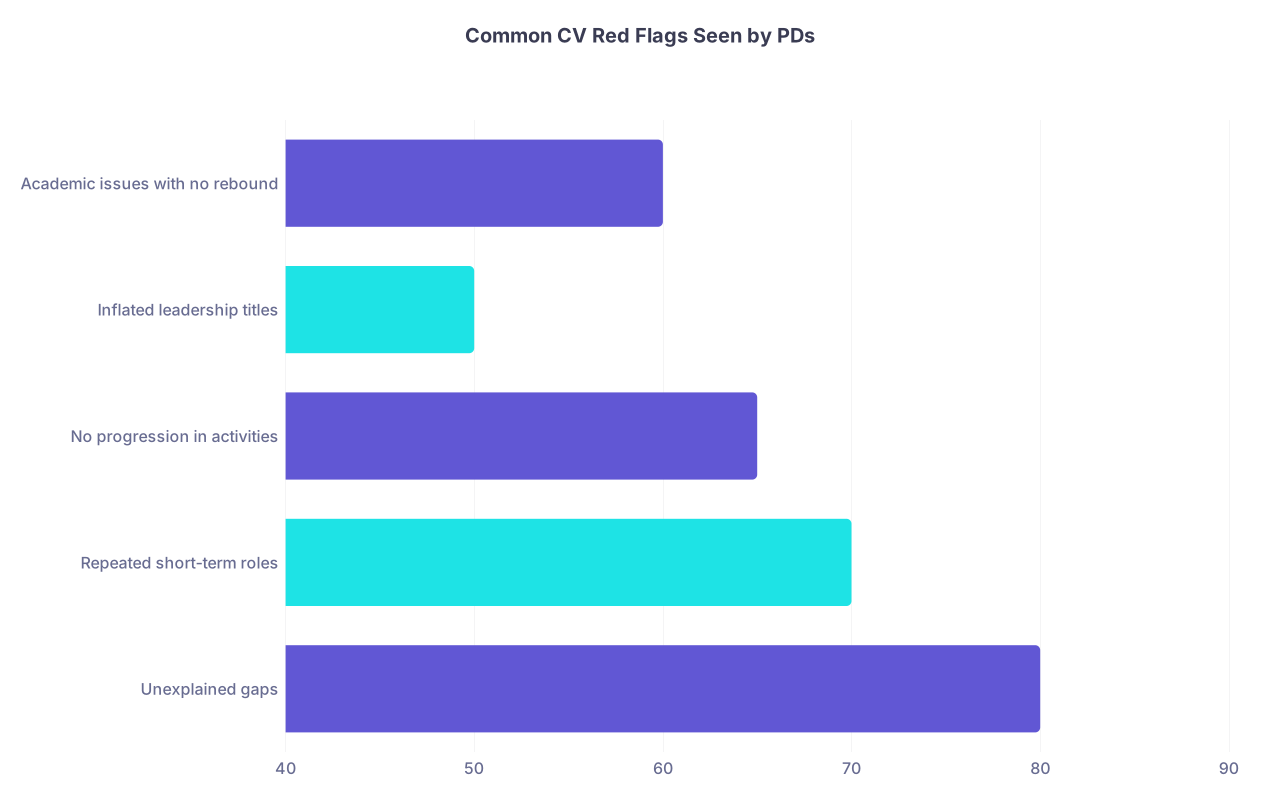
| Category | Value |
|---|---|
| Unexplained gaps | 80 |
| Repeated short-term roles | 70 |
| No progression in activities | 65 |
| Inflated leadership titles | 50 |
| Academic issues with no rebound | 60 |
If You Still Have Time Before You Apply
If you’re 6–18 months from submitting, you can do more than just reword things. You can actually change the underlying story.
Concrete moves that change how your CV reads:
- Pick one existing activity and commit through application season. Show up regularly. Take on higher responsibility. Make sure your future description can honestly say: “Led,” “Coordinated,” “Trained,” or “Supervised.”
- Ask your research mentor for more ownership. Volunteer to handle a sub-project, a dataset, or an abstract. You’re trying to create visible progression: assistant → contributor → presenter/author.
- Start or deepen a teaching role. Step tutoring, anatomy TA, junior medical student teaching. Teaching is a huge reliability and grit signal because it implies preparation, accountability, and communication skills.
- If you’ve had a stumble (Step fail, LOA), double down on strong, steady commitments now. PDs look at what you did after the hit more than the hit itself.
You’re not just “stacking activities.” You’re deliberately building a narrative of: I stick, I grow, I recover.

FAQ: What Your CV Tells PDs About Reliability, Grit, and Red Flags
1. Should I include short, one-time volunteer events on my CV?
You can, but they don’t help much. One-time events rarely move PDs unless they’re unusually significant (major disaster response, founding a large event, national-level recognition). If your CV is crowded, those are the first things to cut. They don’t prove reliability or grit; they just show you showed up once.
2. How do I handle a leave of absence or gap on my CV without oversharing?
State it plainly in the education timeline with neutral, factual language. Something like “Leave of absence for health reasons; returned to full-time coursework and completed all remaining requirements on schedule.” Then let your post-return record do the talking: strong grades, steady commitments, no further disruptions.
3. Is it better to have more research projects or one long research project with strong output?
One long, serious research relationship beats five shallow ones every time. PDs look for progression and completion: did you stay, take on more complex work, and see something through to presentation or publication? Multiple half-baked projects look like you lose interest or chase quick lines for your CV.
4. How many leadership roles should I have for my CV to look strong?
There’s no magic number. One or two real leadership roles with clear responsibility and outcomes are plenty. Ten flimsy titles with no measurable impact make you look worse, not better. PDs care what you did more than what you called yourself.
5. Do hobbies and personal interests matter for reliability and grit?
Indirectly, yes. Endurance sports, long-term music study, competitive gaming, serious artistic pursuits—all these can hint at discipline and long-term commitment. They won’t save a red-flag CV, but they can nudge a borderline application into “this person likely has follow-through.” List them briefly and honestly, especially if they’re multi-year commitments.
Years from now, you won’t remember every line you agonized over on your CV. You’ll remember whether you told a coherent, honest story about who you were becoming—and whether you chose to look safe and glossy or real and resilient. PDs can tell the difference.