
You are on ERAS, staring at your CV for the fifth time this week. Your Step scores are solid. Class rank respectable. You have research, leadership, some teaching. On paper, you think, “I should be competitive.”
Yet interview season is sputtering. A few invites from safety programs, radio silence from the places you actually want. You start wondering if there is some obvious problem you are missing—or worse, a subtle one that program directors see and you do not.
You are probably not being sunk by one catastrophic flaw. More often it is death by a dozen quiet CV red flags that admissions committees instantly recognize and applicants somehow keep repeating every year.
Let me walk you through the landmines.
1. The “All Activity, No Substance” CV

One of the fastest ways to look weaker than you actually are: long activity lists with almost no depth.
I see this pattern constantly:
- 18 “experiences”
- 10 of them under 3 months
- No clear progression
- Vague descriptions like “participated in” or “helped with”
Program directors read those bullets and think: “This person shows up, but do they actually do anything?”
Red flags in this category:
- Dozens of short-term, low-commitment roles (committee member, general volunteer, minor leadership title).
- Activities that look obviously checkbox-driven (“community service” with no continuity or clear interest).
- Every role described with the same bland verbs: “assisted,” “helped,” “participated.”
How to avoid this:
- Ruthlessly prioritize. You are not rewarded for listing every 2‑hour event you ever attended.
- Emphasize longitudinal things: multi-year clinic involvement, a leadership role that progressed, research you stuck with.
- Use impact verbs: led, created, implemented, organized, improved, analyzed. If you cannot write a specific outcome or contribution, that activity is probably fluff.
If your CV reads like a collection of cameos instead of a story of growth, programs notice. And they do not reward it.
2. Inflated Titles and “Leadership Theater”
Nothing raises suspicion faster than titles that do not match reality.
Typical problems:
- “Founder and CEO” of something that is clearly a small, informal student project.
- “Director” of a club with three members and no documented activity.
- “Chief Research Officer” for a single PI’s lab.
You might think fancy titles make you look impressive. Experienced reviewers think something else: “Is this person exaggerating everywhere?”
Tell-tale signs of leadership inflation:
- Title sounds corporate or executive, but the description is thin.
- High-level title with minimal hours listed.
- Multiple “president” or “founder” roles that overlap heavily in time.
How to fix this:
- Use realistic, conventional titles: President, Co‑President, Coordinator, Committee Chair.
- If you truly built something from scratch, say “Founder” but back it up with specific outcomes: membership numbers, projects completed, sessions organized.
- Be ready to explain your role concisely and honestly in interviews. If you feel nervous trying to describe what you actually did, the title is probably inflated.
Do not play games with titles. You are not fooling the people who read 1,000+ CVs a year.
3. Sloppy, Inconsistent, or Unprofessional Formatting
Programs will not tell you this, but I will: sloppy CVs get mentally downgraded within seconds.
Common visual red flags:
- Different fonts and font sizes across sections.
- Inconsistent date formats (e.g., “09/2021 – 5/22 – Present”).
- Random bolding and italicization with no clear pattern.
- Typos in headings or institution names.
You might think, “They care about my content, not my formatting.” No. Residency means charting, orders, notes, discharge summaries. Attention to detail is part of your job. Your CV is their first data point.
At minimum, maintain:
- One font, two sizes (e.g., 11 pt text, 12–13 pt section headers).
- One date format used everywhere (e.g., “Aug 2022 – May 2023”).
- Consistent bullet style and indentation.
If the visual structure of your CV feels chaotic, it quietly signals “this person will write messy notes and confusing handoffs.” They will not say that out loud. They just rank you lower.
4. Research Red Flags: Noise, Not Signal
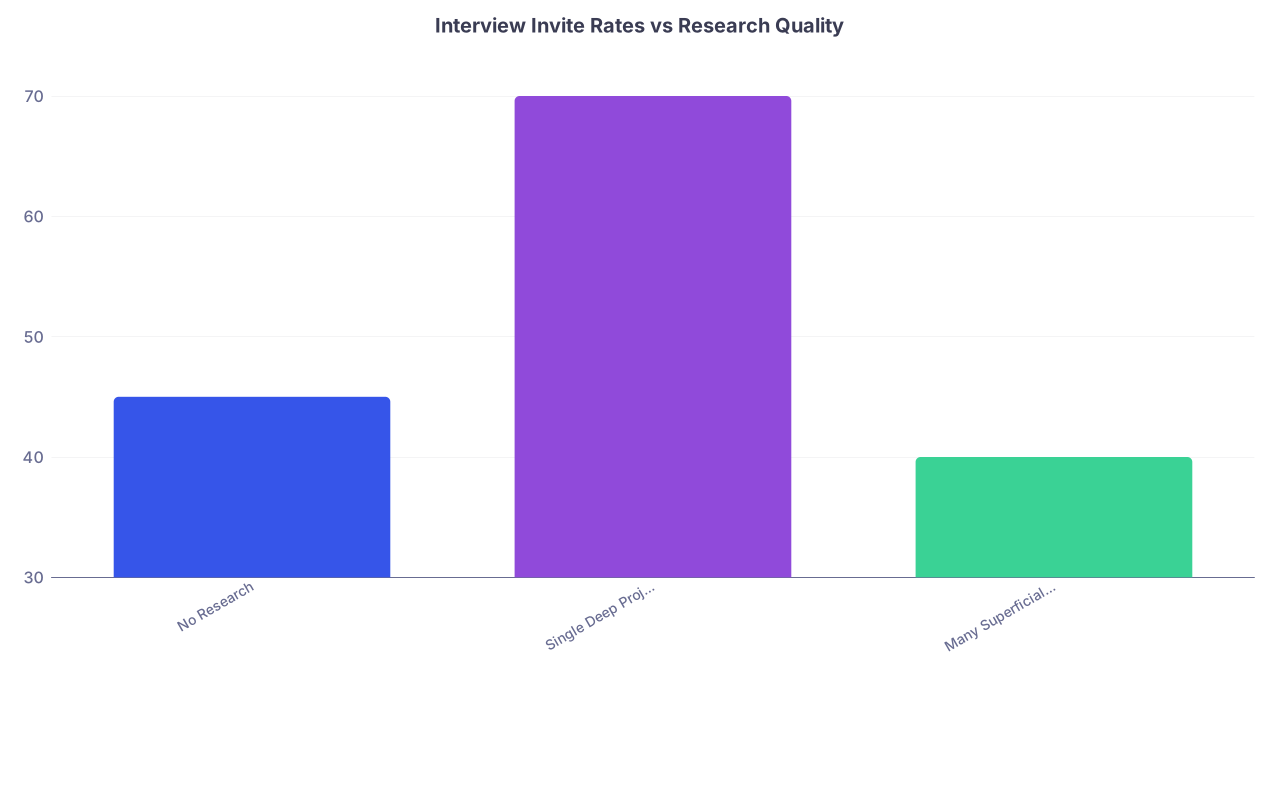
| Category | Value |
|---|---|
| No Research | 45 |
| Single Deep Project | 70 |
| Many Superficial Projects | 40 |
Research is where strong applicants quietly sabotage themselves.
Big problems I see:
- Ten “works in progress,” zero completed outputs.
- Obvious “CV padding” posters—same project split into multiple near-duplicate abstracts.
- Fake or misleading authorship positions.
Specific red flags:
- “Manuscript in preparation” for a project that started two months ago.
- “Submitted” or “under review” listed for everything, year after year.
- You cannot clearly explain your actual role in the project during interviews.
Here is how programs read that:
- Many unfinished projects = unreliable, does not follow through.
- Endless “submitted” with no acceptances = over-reporting or unrealistic.
- Vague research descriptions = probably doing grunt work, not genuine engagement.
How to avoid this:
- Focus on 1–3 real projects where you contributed meaningfully.
- Be conservative with status labels. If it is not submitted, do not claim it is. If it is not accepted, do not call it “publication.”
- In your bullets, specify what you did: “Designed data collection tool,” “Performed chart review of 200 patients,” “Conducted statistical analysis using R.”
One well-done project you can speak about intelligently is more valuable than eight “pending manuscripts” that never see daylight.
5. Gaps, Abrupt Disappearances, and Timeline Weirdness
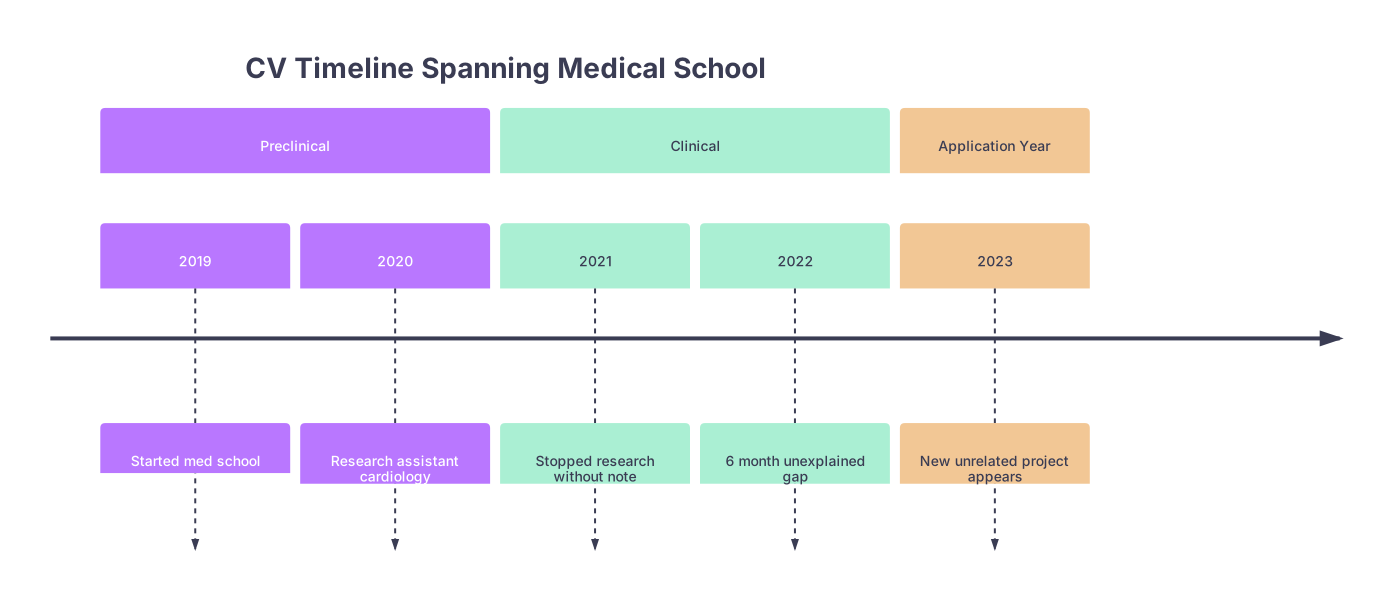
| Period | Event |
|---|---|
| Preclinical - 2019 | Started med school |
| Preclinical - 2020 | Research assistant cardiology |
| Clinical - 2021 | Stopped research without note |
| Clinical - 2022 | 6 month unexplained gap |
| Application Year - 2023 | New unrelated project appears |
Nothing makes reviewers squint harder than unexplained gaps or abrupt stops in your CV timeline.
Examples:
- Nine months of “nothing” between activities.
- Longstanding research or leadership that suddenly vanishes with no follow-up role or explanation.
- A whole academic year where you list no involvement in anything.
Do people take leaves, get sick, have family emergencies, or struggle with burnout? Of course. That is not the problem. The problem is pretending nothing happened and expecting committees not to notice.
Red flags to them:
- Unexplained inactivity suggests potential professionalism or performance issues.
- Gaps without context leave space for worst-case assumptions.
- Projects that vanish mid-stream raise questions about reliability.
Better alternatives:
- If you took an official leave, make sure it is consistent across your application and be prepared to address it calmly and briefly in your personal statement or interviews.
- If you pivoted interests, show continuity in effort even if the topic changed.
- Use the description section of a subsequent activity (or your PS) to concisely acknowledge major shifts: “After a personal health issue in 2021, I returned to full-time rotations in Jan 2022…”
Silence invites suspicion. Brief, straightforward explanations reduce it.
6. The “Everything but the Specialty” Problem
You say you want internal medicine. Your CV shows:
- Random surgical research.
- Pediatrics volunteering.
- Orthopedic interest group leadership.
- No internal medicine-specific anything.
Programs notice that mismatch fast.
This red flag shows up as:
- Zero activities actually anchored in the specialty you are applying to.
- A CV that looks like you discovered your chosen field three weeks ago.
- Heavy involvement in a completely different specialty with no narrative bridge.
How this reads to PDs:
- “Backup specialty” vibes.
- Possible flight risk (they match with you and you later try to switch).
- Lack of genuine interest in their field.
How to fix it:
- You do not need 10 IM activities to apply IM. But you need at least a few clearly related experiences—clinic, elective, research, QI project, or longitudinal interest group.
- If you switched interests late, make sure your personal statement and experiences clearly explain why and how.
- Do not hide your prior interests, but connect the dots. Show how those experiences prepared you for the specialty you now want.
Programs want people who are reasonably sure they want to be there. Your CV either supports that or undermines it.
7. Overloaded “Hobbies” That Scream Inauthentic
The hobbies section is supposed to humanize you. Many applicants turn it into a credibility trap.
Common mistakes:
- Listing 8–10 hobbies, all of them serious or elite-sounding: “triathlons, gourmet cooking, classical piano, competitive powerlifting, international travel, chess tournaments, podcasting, algorithmic trading.”
- Using corporate-speak: “optimizing personal productivity,” “content curation,” “market analysis.”
- Copy-paste personality: everyone suddenly loves “fitness, travel, and trying new restaurants.”
What PDs think when they see this:
- There are not enough hours in the week for this to be true at any meaningful level.
- This person is trying to impress, not be real.
- Interview risk: they will pick one and drill down. If you cannot talk about it for 5 minutes with concrete examples, you are exposed.
Better approach:
- 2–4 hobbies you actually care about.
- Specific and grounded: “Trail running (10–15 miles/week),” “Home espresso brewing,” “NBA analytics,” “Trying regional noodle dishes.”
- You should be able to speak naturally and in detail about each one without scrambling.
Fake well-rounded is worse than simply real.
8. Unprofessional Email, Contact Info, or Online Presence
Sounds trivial. It is not.
Major red flags:
- Email like “[email protected],” “partyking88@,” “cutegirlmedstudent@.”
- Phone number that does not work or goes to a chaotic voicemail greeting.
- LinkedIn profile that contradicts your ERAS CV.
- A quick Google search that surfaces unprofessional public content (open social media with questionable posts, public fight threads, etc.).
People on selection committees are human. If something looks off, they talk about it.
Fix this immediately:
- Use a clean, neutral email: firstname.lastname@something.
- Make sure voicemail is professional, short, and your mailbox is not full.
- Check that any public professional profile (LinkedIn, research gate) roughly matches your CV.
- Lock down or clean up your public social media.
You do not get points for being normal here. You only lose points for being sloppy or bizarre.
9. Vague, Buzzword-Heavy Descriptions
This one is epidemic.
Activity descriptions full of:
- “Worked to improve healthcare delivery…”
- “Promoted awareness regarding health disparities…”
- “Engaged in interdisciplinary collaboration and leadership…”
And yet, no concrete actions, no numbers, no outcomes.
Selection committees skim that and think: “This could be literally anyone.” Your work becomes forgettable.
To avoid this dead zone:
- Replace buzzwords with specifics.
- Use numbers when possible: “Organized 8 free clinics over 12 months, serving ~200 patients.”
- State your actual role: “Coordinated scheduling for 15 volunteers,” “Developed survey instrument and collected 120 responses.”
- One or two sentences per activity is enough—dense and clear beats long and fluffy.
Your CV should read like a record of real things you did, not like an abstract written by a committee.
10. Misaligned Strengths and Weaknesses on the Same Page
| Strong Signal | Conflicting Red Flag |
|---|---|
| High research output | Poorly written, error-filled CV |
| Leadership positions | Short durations, no continuity |
| Strong academics | Repeated Step exam attempts without context |
| Advocacy/service focus | Very little actual longitudinal volunteering |
| Interested in IM or FM | CV dominated by surgical subspecialty exposure |
Sometimes the red flag is subtle: your own CV contradicts itself.
Examples I have seen:
- A “detail-oriented” applicant with obvious typos and inconsistent formatting.
- Someone claiming “strong commitment to underserved care” with a single 4‑hour health fair listed.
- Applicant presenting as “research-oriented future academic” with one short case report and nothing else.
These contradictions create doubt more than any single deficiency. They make reviewers wonder what else is misrepresented.
Your fix:
- Decide what your real strengths are and make sure the CV supports them.
- If something is aspirational (you want to become more research-oriented), do not present it as current reality.
- Align your personal statement themes with what actually shows up on your CV.
You are not writing marketing copy. You are presenting evidence. If your story and your evidence do not match, committees always believe the evidence.
11. Overcrowded CVs That Try to Hide Weakness
Here is a quiet, ugly pattern: applicants who know they have some weaker metrics (marginal scores, a fail, remediation) try to bury them under a massive pile of activities.
The CV ends up:
- 7–8 pages long.
- Every minor role inflated into an “experience.”
- No clear hierarchy of what matters.
Experienced faculty recognize this. They will look at your transcript and score report anyway. Overstuffing your CV does not erase those limitations. It only adds a new concern: poor judgment.
The better strategy:
- Accept that your metrics are what they are.
- Highlight a few strong, authentic areas: one meaningful leadership role, one solid research or QI project, real service involvement.
- Show maturity, self-awareness, and growth in your personal statement and interviews rather than trying to “CV your way out” of reality.
You cannot distract serious programs with noise. They are not that easily fooled.
12. How to Audit Your CV for Red Flags

Before you send anything to ERAS, do a harsh audit.
Ask yourself:
- Does this look like a human being with coherent interests and growth over time, or a desperate box-checker?
- If a PD skimmed this for 60 seconds, what three words would come to mind?
- Are there any claims I would feel nervous defending in an interview?
Practical steps:
- Print your CV. Flaws are easier to see on paper than on screen.
- Use a highlighter to mark:
- Super-short activities (<3 months).
- Titles that sound grander than the description.
- “Manuscript in preparation / under review” items.
- Circle any section where:
- Dates mysteriously disappear.
- Activities stop abruptly.
- There is a long period with no entries.
- Trim or rewrite:
- Delete obviously fluff entries.
- Re-title inflated roles.
- Tighten vague descriptions into concrete, verifiable contributions.
Then—this part matters—have someone who does not love you read it. A resident, attending, dean’s office advisor. Ask them directly: “Where are the red flags? What makes you hesitate?”
You may not like what you hear. Listen anyway.
FAQs
1. How long is too long for a residency CV?
For most applicants, anything beyond 3–4 pages starts to look suspicious unless you have substantial prior career, advanced degrees, or significant research output. If you are a traditional US MD/DO senior with a 7‑page CV, committees usually assume padding. Focus on relevance and impact, not page count.
2. Should I include activities from before medical school?
Yes, but selectively. Significant, sustained pre‑med experiences (multi-year jobs, military service, teaching, major research) can stay. Short-term college clubs and random volunteering from six years ago can usually go. If pre‑med content dominates your CV as a 4th‑year med student, that is its own quiet red flag.
3. Is it better to leave off weak or unfinished research projects?
If your role was minimal, the project never progressed, or you cannot clearly explain what you did, leave it off. One or two solid, explainable projects look far better than five hazy ones. Reviewers can smell “CV filler” research very quickly.
4. How do I handle a leave of absence or academic difficulty on my CV?
Do not hide it. Make sure dates and timelines on your CV align with your official record. Use your personal statement or an additional comment section to give a brief, mature explanation focusing on insight and growth, not excuses. Programs are far more forgiving of openly addressed issues than of things they have to dig out and guess about.
Key points: Most CV red flags are not dramatic lies. They are patterns—exaggeration, vagueness, clutter, and mismatches between what you claim and what you show. Clean those up, tell a coherent story, and your existing strengths can finally speak for themselves.