
Common Research CV Errors That Make You Look Less Credible
What do program directors actually say to each other after looking at a questionable “research-heavy” CV?
“Either this person is spectacular… or they’re padding like crazy.”
If you’re applying to residency with research on your CV, you’re walking a credibility tightrope. Done right, it makes you look serious, rigorous, and coachable. Done wrong, it makes people raise eyebrows and start double-checking everything you wrote.
Let’s keep you out of that second category.
1. Inflated Titles That Scream “Overstated”
This one gets you labeled as untrustworthy faster than a typo.
Common offenders:
- “Co-PI” on a student summer project
- “Lead author” on something where you were one of eight med students
- “Project manager” when you just sent a few reminder emails
If your title doesn’t match your actual role, people who do research for a living can smell it instantly.
Red flags program directors notice
- A second-year med student listing “Principal Investigator” on multiple projects at a big-name institution
- “Lab director” or “Project supervisor” when you were a rotating student
- Overuse of “lead,” “senior,” “director,” “co-PI,” “manager” with no explanation
I’ve seen PDs literally say: “If they’re exaggerating here, where else are they exaggerating?”
How to avoid this
- Use realistic, common titles:
- “Research assistant”
- “Student researcher”
- “Clinical research intern”
- “Data abstractor”
- If you really had a larger role, explain it in the bullet, not the title:
- Bad: “Co-PI – Prospective cohort study on sepsis outcomes”
- Better: “Student researcher – Designed data collection tool and coordinated chart review for prospective sepsis outcomes study”
If your role was essentially “student in the lab,” just call it that. Humble and accurate beats fancy and suspicious.
2. “Publications” That Aren’t Actually Publications
This is a big one. When you blur the line between what’s truly published and what’s not, you look either naive or dishonest. Neither helps you.
Common mistakes:
- Calling a poster a “publication”
- Listing an abstract as a full paper
- Putting “submitted” or “in preparation” in the same section as peer-reviewed articles
- Treating a preprint like a final, peer-reviewed accepted paper (without labeling it)
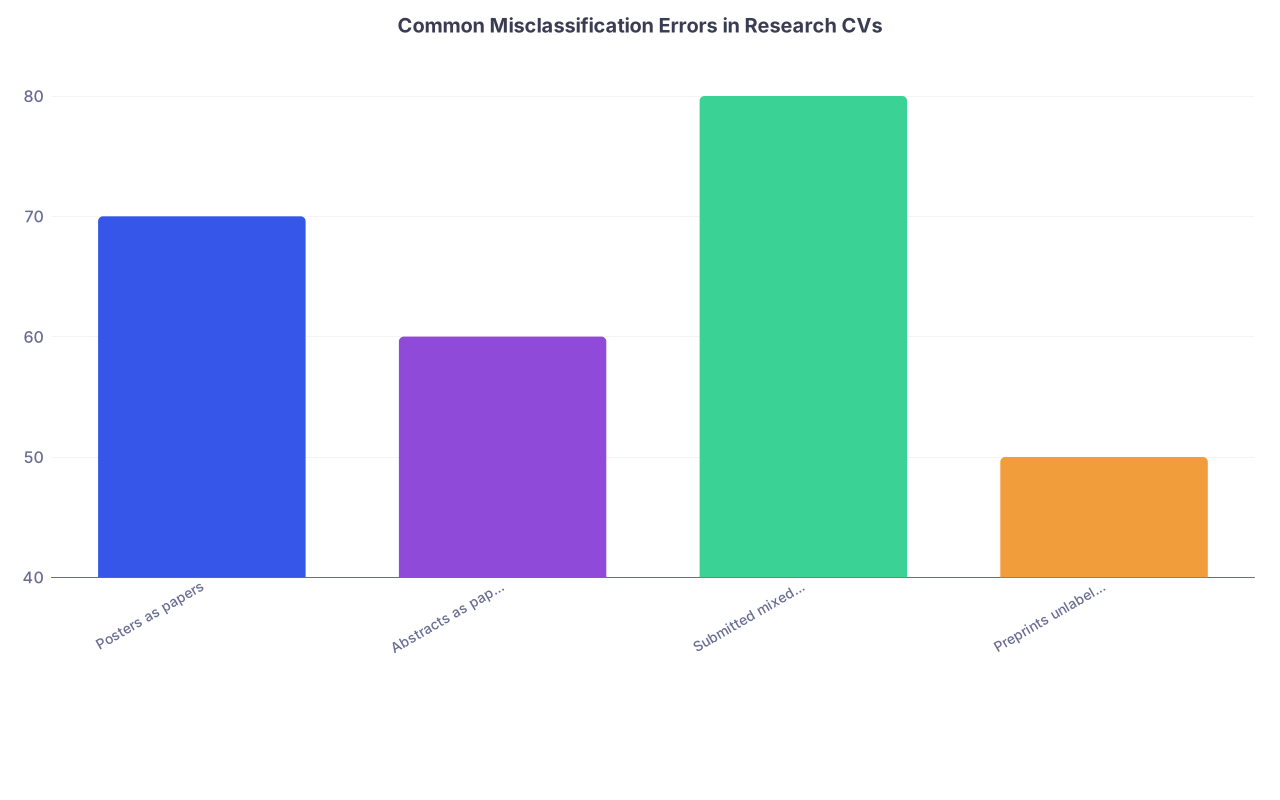
| Category | Value |
|---|---|
| Posters as papers | 70 |
| Abstracts as papers | 60 |
| Submitted mixed with published | 80 |
| Preprints unlabeled | 50 |
Those numbers reflect how often I see these exact errors. Way too often.
How your sections should actually look
Separate them clearly. Like this:
- Peer-reviewed journal articles
- Manuscripts accepted or in press
- Manuscripts submitted
- Abstracts
- Posters and oral presentations
- Preprints
Not all CVs need all of those, but the hierarchy matters.
What not to do
- Do not put:
- A submitted manuscript under “Publications”
- An abstract-only item as if it’s a full article
- Do not omit the journal status:
- Write “Manuscript submitted” or “In preparation” clearly
Example:
Wrong:
“Smith J, You A. Outcomes after bariatric surgery. JAMA. 2024.” (actually just submitted)Right:
“Smith J, You A. Outcomes after bariatric surgery. Manuscript submitted to JAMA, 2024.”
Yes, it looks less impressive. That’s the point. It’s honest. And honest is what gets you ranked higher.
3. Author Order Games and Name Confusion
If your CV creates doubt about whether you were truly an author, you’ve already lost ground.
Common problems:
- Different name formats across items (sometimes with middle initial, sometimes without, sometimes maiden name, sometimes not)
- Not bolding or underlining your own name when there’s a long author list
- Using inconsistent author order for the same paper in different locations
- Listing works where you’re actually not an author (this happens more than you think)
Simple fixes
- Pick one consistent name format that matches PubMed:
- Example: “You A” vs “You AB” — stick to one format that’s in the published version
- Bold or underline your name in every citation:
- “Smith J, You A, Lee R. …”
- Don’t reorder authors to make yourself look better. Ever.
If your ERAS publications don’t match what someone sees when they search PubMed, they will question all of it.
4. “In Preparation” Overload: The CV Equivalent of Vaporware
This one drives faculty crazy.
A CV with:
- 1–2 real publications
- 9–12 “In preparation” manuscripts
…looks like someone who either doesn’t understand how slow publication is or is intentionally bloating the CV.
“In preparation” literally means: We’re working on it, but nobody has agreed to review it, let alone publish it.

Reasonable guidelines
- 1–3 “In preparation” items? Fine.
- 8–15? People assume you’re counting any half-baked idea as “almost a paper.”
Better structure:
- Put “In preparation” in its own subsection, at the bottom of your research section.
- Only list projects where:
- You have a solid draft, and
- All authors are aware and agree it’s moving toward submission
If your “in preparation” items vanish when someone asks about them, you’ve just torched your credibility live, in an interview.
5. Ignoring The Timeline (And Making Your Story Suspicious)
Your research timeline should make sense. If it doesn’t, people notice.
Examples of suspicious patterns:
- You list 5 publications all in one year, but your CV shows no research experience before that.
- You claim a multi-year RCT as your project, but you list research dates of just 3 months.
- Your start and end dates overlap in absurd ways (e.g., 5 full-time research positions in the same year while also being a full-time student).
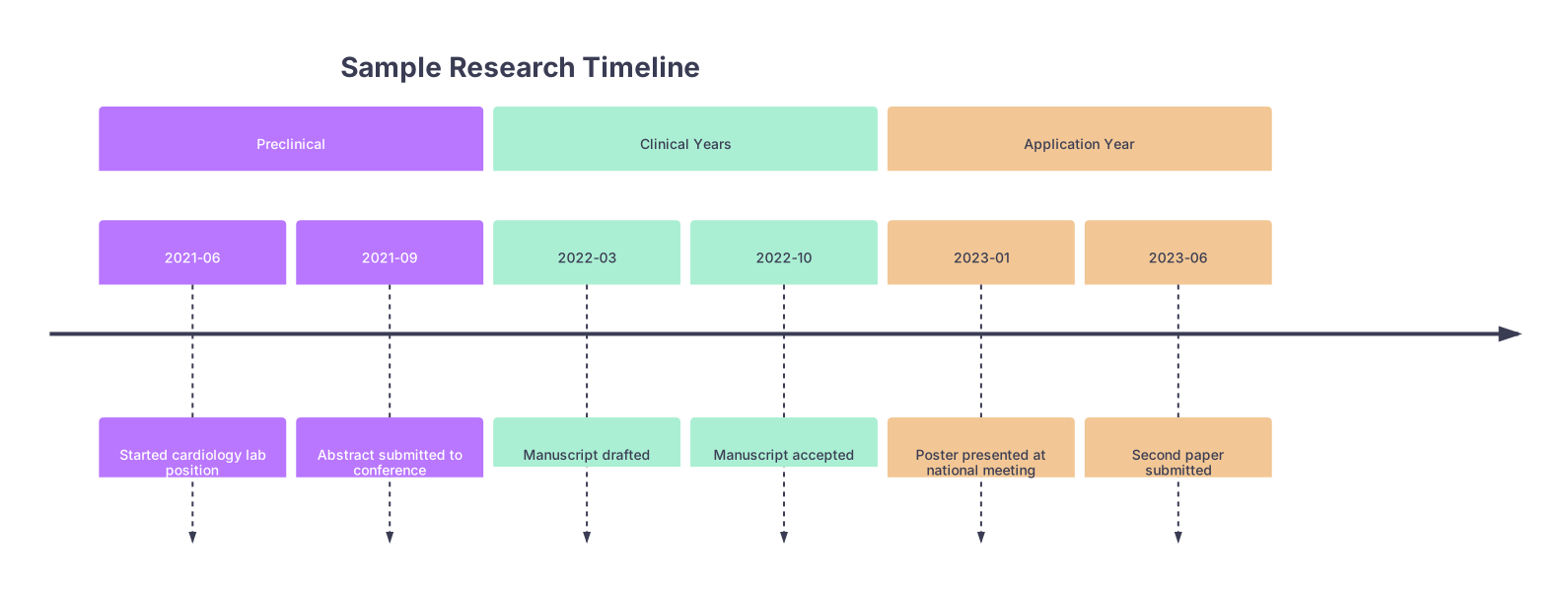
| Period | Event |
|---|---|
| Preclinical - 2021-06 | Started cardiology lab position |
| Preclinical - 2021-09 | Abstract submitted to conference |
| Clinical Years - 2022-03 | Manuscript drafted |
| Clinical Years - 2022-10 | Manuscript accepted |
| Application Year - 2023-01 | Poster presented at national meeting |
| Application Year - 2023-06 | Second paper submitted |
Your entries should allow someone to reasonably follow what you did and when.
How to avoid timeline contradictions
- Always include month/year for research roles, not just years.
- If a project was sporadic (e.g., 5 hours/month), state that in the description:
- “Intermittent involvement (approx. 5 hrs/month) during MS2–MS3.”
- If you joined a project late:
- Don’t imply you were there from concept to publication if you only helped with data collection or editing.
It’s better to look like a small but honest contributor than a fake “long-term project architect.”
6. Sloppy, Inconsistent Citation Formatting
You’d be surprised how often this alone gets mentioned after a file review.
Not because anyone needs AMA-perfect formatting. But because sloppiness in research entries reads as sloppiness in general.
Common sloppiness:
- Some entries have journal names; others don’t.
- Some include DOI; others don’t.
- Some list year and volume; others only year.
- Different citation styles randomly (APA here, Vancouver there, made-up elsewhere).
| Type | Example |
|---|---|
| Clean, solid | Smith J, **You A**, Lee R. Title. J Clin Oncol. 2023;41(2):123-130. |
| Sloppy | You A, Smith J. Title, JCO 2023 |
| Misleading | You A. Title. JCO. 2023. (actually only an abstract) |
What to do instead
- Pick ONE style (AMA is standard in medicine) and stick to it.
- Every item should, at minimum, include:
- Authors (with your name highlighted)
- Full title
- Journal or conference name
- Year
- Volume/issue/pages if published
Is it annoying? Yes. Does it matter? Also yes.
7. Over-describing Minor Work, Under-describing Major Work
Another credibility killer: your descriptions don’t match the apparent importance of the work.
Examples:
- A major first-author paper with this description: “Assisted with study.”
- A small retrospective chart review with 4 lines of heroic-sounding text, buzzwords, and “led all aspects” language.
Faculty pick up on this mismatch immediately.
Calibrate your descriptions
Ask yourself:
- What did I actually do for this project?
- Could I explain that clearly if someone cold-asked me in an interview?
Reasonable description for a non–first-author paper:
- “Conducted chart review of 200 patients and performed preliminary data analysis in R.”
Reasonable description for first-author work:
- “Designed study protocol, oversaw data collection from two hospital sites, performed multivariate analyses, and drafted the manuscript as first author.”
If you had a big role, show it. If you had a small role, own it. There’s respect in both—there’s suspicion only in pretending.
8. Treating Quality and Relevance As Afterthoughts
Another subtle way to look less credible: listing every microscopic thing you ever touched, while burying what actually matters.
I’ve seen CVs where:
- Screened patients for an underpowered QI project gets the same space as a first-author paper in a solid journal.
- Five case reports in obscure journals are front and center, while a substantive clinical trial contribution is list item #14.
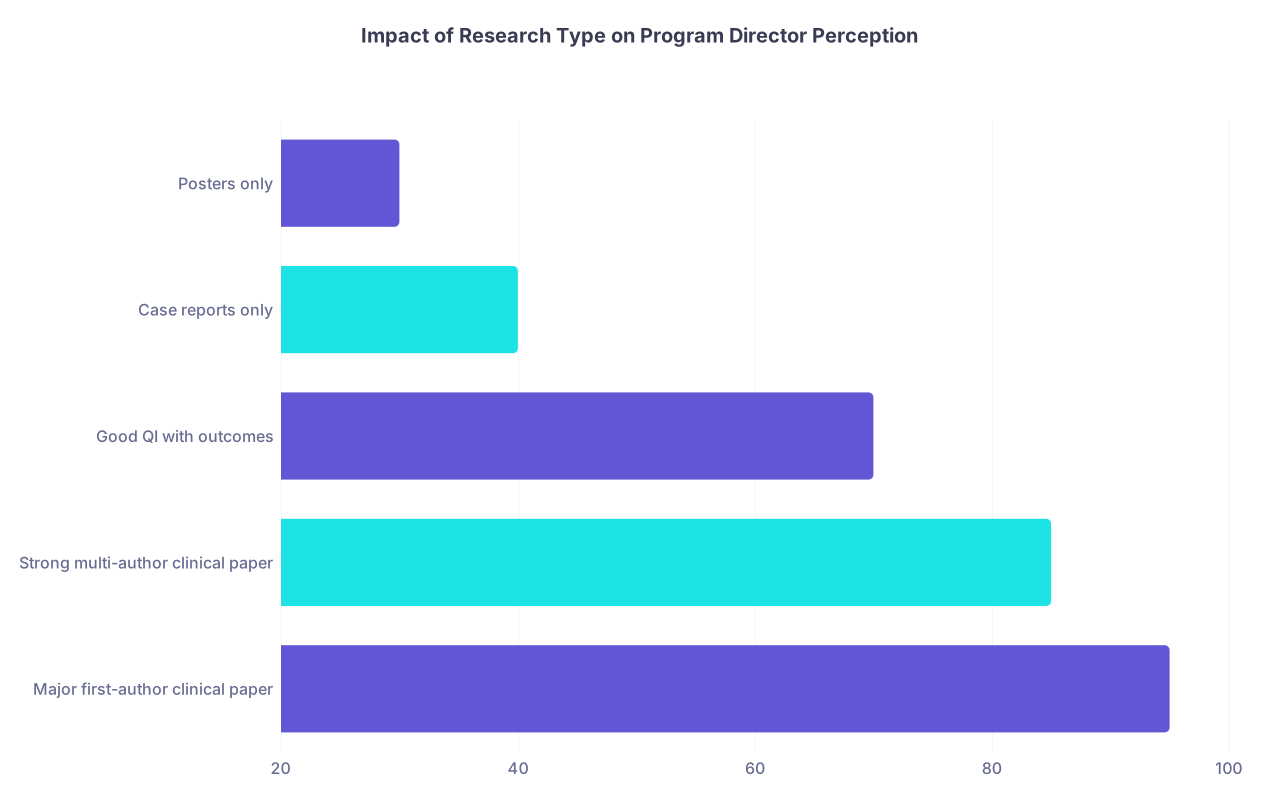
| Category | Value |
|---|---|
| Major first-author clinical paper | 95 |
| Strong multi-author clinical paper | 85 |
| Good QI with outcomes | 70 |
| Case reports only | 40 |
| Posters only | 30 |
Do not confuse quantity with strength.
How to fix it
- Order your research entries by importance, not alphabetically or randomly:
- First: peer-reviewed clinical papers (especially in your specialty)
- Then: solid abstracts/posters at major meetings
- Then: QI and institutional presentations
- If something is weak, you don’t need three bullet points under it. One is enough.
Your CV should be curated, not a data dump.
9. Leaving Gaps You Can’t Defend in an Interview
Here’s where a lot of people get exposed.
Interview scenario I’ve watched:
- CV lists “Retrospective study of septic shock outcomes – ongoing.”
- Interviewer: “Tell me about the patient population and your primary endpoint.”
- Applicant stares, stumbles, or gives a totally vague answer.
The unspoken conclusion: “They slapped their name on this and barely know what it is.”
Before you submit your CV, test yourself
For each research item, you should be able to answer, without bluffing:
- What was the study question?
- What was the design (retrospective, prospective, RCT, cross-sectional, etc.)?
- Rough sample size?
- Your actual role?
- One specific thing you learned from it?
If you can’t do that, either:
- Remove the item, or
- Ask your mentor for a quick refresher and read the abstract/manuscript before interviews.
Do not let your research section become a trap that makes you look like you’re faking involvement.
10. Forgetting That People Will Look You Up
This is the part people underestimate.
Faculty:
- Search PubMed
- Look at Google Scholar
- Sometimes check your LinkedIn or institutional profile
If your CV doesn’t match what’s publicly visible, red flag.

Common mismatches
- CV lists 3 “accepted” manuscripts that aren’t in PubMed or on journal sites months later.
- Different spelling or ordering of your name makes it impossible to verify anything.
- Journal name is slightly wrong or ambiguous (e.g., “JAMA” vs “JAMA Network Open” vs some unrelated journal).
How to protect yourself
- Before you submit:
- Google yourself. Check PubMed for your name.
- Make sure your citations are accurate and discoverable.
- If a paper is accepted but not yet indexed, label it clearly: “Epub ahead of print” or “Accepted, not yet indexed.”
Do not rely on “they probably won’t check.” Many do.
FAQ (Exactly 4 Questions)
1. Should I remove all “in preparation” manuscripts from my CV?
No, but you should be ruthless. Keep only those where a draft actually exists and all authors are actively working toward submission. More than 2–3 “in preparation” items starts to look like padding, especially if your truly completed work is thin. Put them in a separate “Manuscripts in preparation” section at the end of your research list.
2. Is it okay to list myself as second author if the final paper reordered authors?
You must list the authors exactly as they appear in the final, published version. If the order changed, your CV must reflect that, even if you originally expected to be second. Anything else is misrepresentation. You can still explain your contribution in an interview, but you may not rewrite reality on your CV.
3. Do case reports and small posters actually help my residency application?
They help a little, but not as much as applicants want to believe. Case reports, especially in low-impact journals, aren’t game-changers. They show that you can follow through on something, which is good, but if your CV is 90% case reports dressed up as “major publications,” it looks inflated. They’re fine to include—just don’t oversell them or let them crowd out stronger work.
4. How many research items are “enough” for a competitive residency?
There’s no magic number, and anyone who gives you one is guessing. Programs care more about:
- The quality and relevance of your best 1–3 projects
- Whether you can intelligently discuss what you did and what you learned
- Whether your story matches what your letters say
One strong, legitimate, first-author clinical project can outweigh ten shallow, inflated entries. Aim for truth, coherence, and depth—not volume.
Two things I want you to walk away with:
- Your research section is not a scoreboard; it’s a credibility test. A shorter, honest list beats a bloated, suspicious one every time.
- If you can’t defend it in an interview, don’t put it on your CV. Program directors remember the applicants they can trust. Be one of them.