
The fastest way to poison a residency application is not a low Step score. It is a CV that looks padded, exaggerated, or fake.
Program directors are not guessing about this. They have a sixth sense for embellished CVs because they have seen thousands of them, year after year, from the same medical schools and the same applicant pools. They know what is realistic and what is fantasy.
You cannot outsmart that pattern recognition with a few “strategic” adjectives.
This is the one mistake that does not just hurt you. It destroys trust. And once trust is gone, your file goes in the quiet pile no one talks about: the automatic “no.”
Let me walk you through the CV traps that get spotted immediately—and how to fix them before they sink your application.
The Red Flag Patterns PDs See Every Day
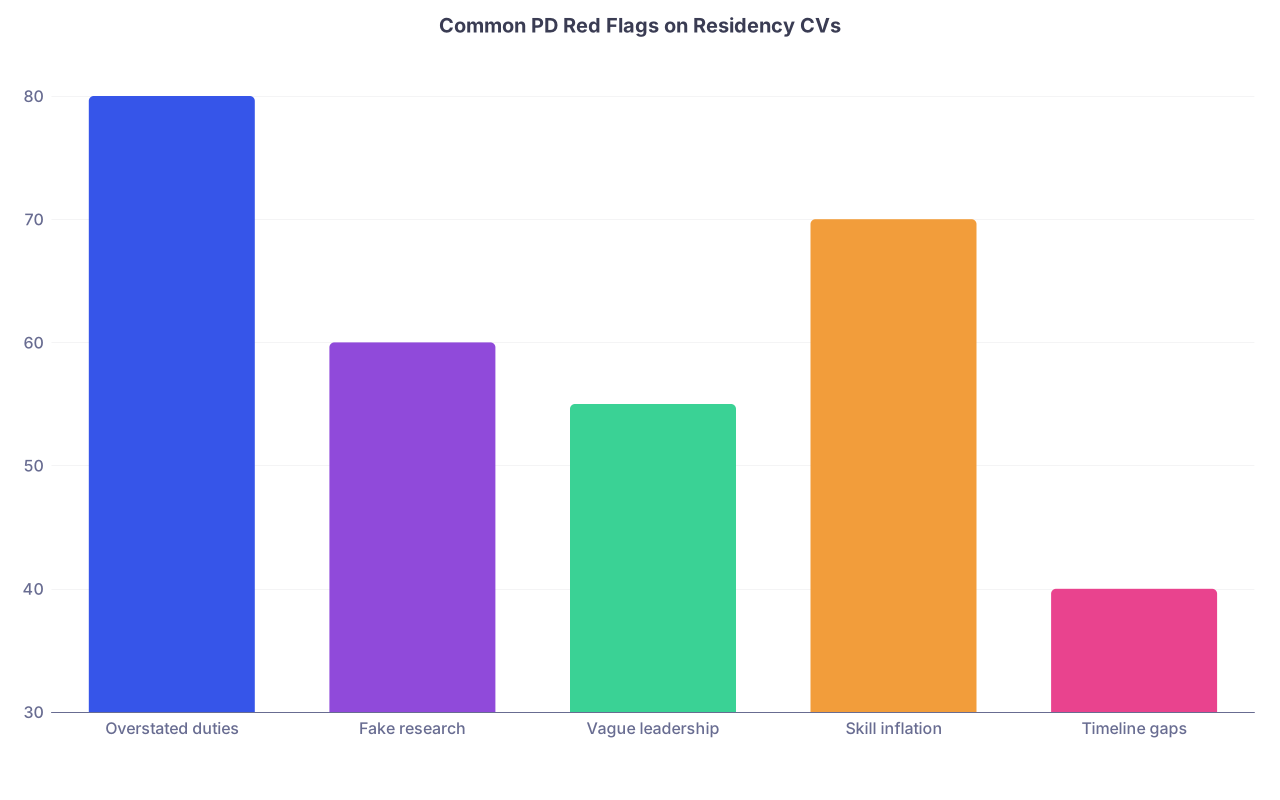
| Category | Value |
|---|---|
| Overstated duties | 80 |
| Fake research | 60 |
| Vague leadership | 55 |
| Skill inflation | 70 |
| Timeline gaps | 40 |
There are very specific patterns that make PDs—and faculty reviewers—raise an eyebrow. They are not subtle.
I have sat in rooms where a PD flips through a stack of applications and mutters:
- “Here we go again, everyone is ‘lead author’ now.”
- “No way this person did all of this in one year.”
- “If this ‘project’ were real, I would have heard of it.”
Here is what gets flagged fast.
1. Overloaded, Impossible Timelines
If your CV reads like you were a full‑time researcher, full‑time tutor, part‑time clinic manager, conference organizer, and wellness committee chair all at once—people will not be impressed. They will be suspicious.
Common offenders:
- 10+ “ongoing” research projects in 18 months.
- Multiple “10–15 hours/week” commitments stacked on top of full‑time clerkships.
- Longitudinal involvement listed as “4 years” when the reality was one summer and a few follow‑up emails.
How PDs detect it:
- They scan dates vertically and see everything overlapping.
- They check the intensity of activities against typical clinical schedules.
- They compare you to prior applicants from your school—your dean’s letter often summarizes your real major commitments.
The problem is not ambition. The problem is physics. There are 168 hours in a week. When your CV implies 300, they stop trusting all of it.
How to avoid this:
- Be conservative with “hours/week.” If it fluctuated, list the typical or peak period and skip hero numbers.
- If something was sporadic, call it “intermittent involvement” or “project-based participation,” not a weekly role.
- If you had a burst of activity and then fade‑out, list clear date ranges for active periods (e.g., “06/2022–08/2022, 05/2023–06/2023”).
2. Inflated Research Roles and Fake “Authorship”
This is the most common CV fantasy. And PDs are brutal about it.
Red flag phrases:
- “Lead author” on 5–6 projects without any accepted manuscripts, just “in preparation.”
- “Principal investigator” as a medical student with no formal protocol or IRB.
- “Senior author” on anything when you are not faculty.
- “Randomized controlled trial” that exists only as a half‑finished survey.
PDs and faculty reviewers are often active researchers. They know exactly how long it takes to:
- Design a legitimate study
- Get IRB approval
- Collect and clean data
- Analyze and write a paper
- Submit, revise, resubmit
They can smell fantasy timelines and fake titles instantly.

What triggers suspicion:
- Many projects labeled “manuscript in preparation” or “submitted” with no journal names, no co-authors, no realistic pipeline.
- A medical student listed as “PI” with no mentor mentioned, no IRB number, and no institutional context.
- High‑level study types (RCTs, meta‑analyses) without any evidence of presentations, posters, or co‑authors.
How PDs verify:
- Google your name and one or two “publications” or “presentations.”
- Check PubMed or conference programs for your claims.
- Mentally cross‑reference the research productivity culture of your school.
If they can not find anything, they assume the worst: embellishment or outright fabrication.
How to avoid this:
- Use accurate roles: “data collector,” “chart reviewer,” “co-investigator,” “student researcher.”
- Only call something a “manuscript” if there is an actual drafted document, not just an idea and a title.
- For ongoing projects, use language like:
“Retrospective chart review on X. Responsibilities: data extraction and database maintenance. Anticipated abstract submission to [conference] 2025 with Dr. Y.” - Do not list yourself as “PI” unless your institution formally recognizes that role and you actually wrote and owned the protocol. When in doubt, you are a “student investigator” or “co-investigator.”
3. Vague, Inflated Leadership Positions
Another classic: turning routine participation into a grand leadership title.
Problem phrases:
- “Founder and CEO” of a simple student group or WhatsApp study chat.
- “Director” of any initiative with three friends as the only members.
- “Chair” of multiple committees that basically never met.
- “National leadership role” in an organization where you attended a few Zoom calls.
PDs and residents have been part of real leadership. They know what comes with it: meetings, budgets, email traffic, deliverables, conflict. When your “leadership” section reads like a LinkedIn influencer page, it sets off alarms.
| Type | Suspicious Version | Credible Version |
|---|---|---|
| Student group | Founder and CEO of Cardiology Initiative | Co-founder of Cardiology Interest Group |
| Committee role | National Director of Education | National education subcommittee member |
| Event planning | Conference Chair for Major Symposium | Coordinator for 1-day student-run symposium |
| Tutoring | Chief Academic Officer, USMLE Division | Peer tutor, Step 1 review sessions |
How this backfires:
- In interviews, you are asked, “Tell me what you actually did as ‘Director’?” If your answer is light—one email, one meeting, then nothing—that disconnect is devastating.
- Over‑titled roles make you look insecure and image‑driven instead of service‑driven.
How to fix it:
- Use plain titles that match reality: “co-founder,” “committee member,” “organizer,” “volunteer coordinator.”
- In the bullet points, show impact with one or two specific outcomes instead of big titles:
- “Organized 3 panel events with an average attendance of 40 students.”
- “Coordinated 15 volunteers to staff free clinic sessions twice monthly.”
The truth—stated clearly—is more impressive than a fake empire.
Skill Inflation and Buzzword Stuffing
Everyone suddenly “proficient in” everything. PDs hate this section when it is overblown.
Common mistakes:
- Listing advanced procedural skills you only observed once.
- Claiming “proficient” or “fluent” in a language where you can barely handle a basic clinical encounter.
- Throwing in buzzwords: “AI,” “machine learning,” “bioinformatics,” “SQL,” “R,” after a three‑hour online course.
Here is what PDs think when they see that kind of list:
“This person has no realistic self‑assessment. They will overstate their capabilities in patient care too.”
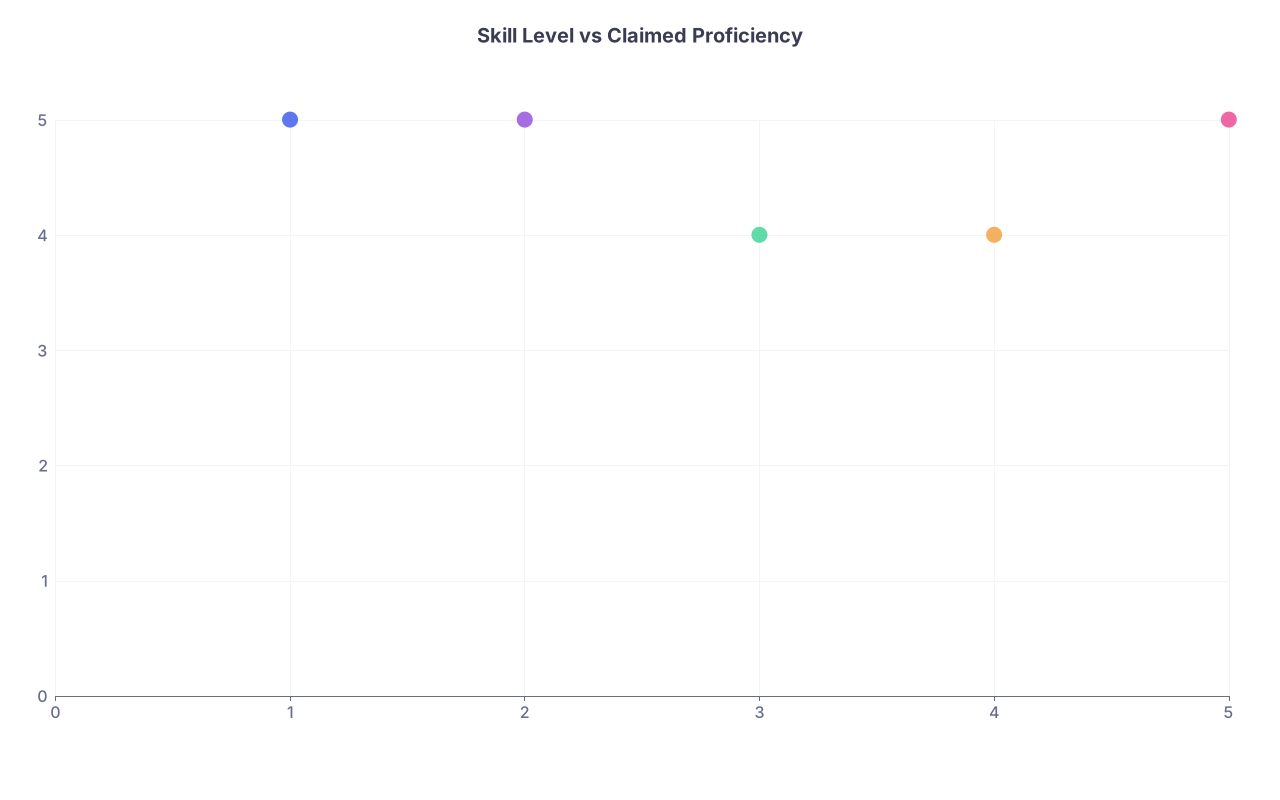
| Category | Value |
|---|---|
| Student A | 1,5 |
| Student B | 2,5 |
| Student C | 3,4 |
| Student D | 4,4 |
| Student E | 5,5 |
(Imagine: actual skill on x-axis, claimed proficiency on y-axis. Too many students are Student A and B.)
Language skills
Program directors particularly resent inflated language claims. Clinics rely on language skills for real patients.
Do not say:
- “Fluent in Spanish” if:
- You can do greetings and ROS, but freeze when someone talks fast.
- You need an interpreter for anything nuanced or emotionally charged.
Better:
- “Conversational Spanish – able to conduct basic history and physical with occasional interpreter assistance.”
And if you are not comfortable handling a full, complex encounter alone, do not label yourself fluent. Interviewers will sometimes test you briefly in that language. It is painful when the reality does not match the CV.
Procedural skills
If you list:
- “Proficient in central line placement, lumbar puncture, intubation” as a medical student with 0–2 supervised procedures, you look unsafe. Not impressive. Unsafe.
Better structure:
- Basics (ok to list): blood draws, IV placement, Foley insertion, simple suturing, I&D, casting/splinting—if you have done them multiple times under supervision.
- For more advanced procedures, if you must mention them, be precise:
- “Assisted with 5 central line placements; observer role with 2 intubations.”
If the wording suggests you can perform procedures independently and you clearly cannot, PDs will question your judgment.
Technical/data skills
Do not add:
- “Proficient in R, Python, SQL, machine learning” if your only experience is running a few canned scripts someone gave you.
Instead, write:
- “Basic familiarity with R for data cleaning and descriptive statistics in one research project.”
- Or skip the buzzwords entirely if they are shallow. PDs are not hiring a data scientist. They are hiring a resident who is honest.
The Soft-Number Problem: Exaggerated Impact and Scope
You know these bullet points:
- “Improved clinic efficiency by 50%.”
- “Reduced wait times by 30%.”
- “Increased membership by 300%.”
- “Saved the institution $100,000 annually.”
These are rarely true. And PDs know it.
The instant they see huge percentage improvements with no baseline, no numbers, no context, they mentally discount everything else you wrote.

What is wrong with these claims:
- You usually did not control the system enough to generate that change.
- Even if there was improvement, it was probably multi-factorial.
- Almost never did a student independently measure, track, and validate the number.
Better approach:
- Use descriptive outcome language that is honest and still strong:
- “Helped implement a new triage form that decreased bottlenecks, as reported by clinic staff.”
- “Created sign-up processes and social media posts that increased event attendance from ~15 to ~40 students per session.”
- If you have numbers, make them traceable:
- “Developed patient education handouts used in approximately 50 clinic visits per month over 6 months.”
If you cannot clearly explain in an interview:
- How you measured the change
- What the baseline was
- What exactly your contribution was
—then your numbers are too aggressive. Dial them down or remove them.
Shadowing, Volunteering, and the “Hero Narrative”
Another place applicants quietly exaggerate: simple experiences turned into heroic sagas.
Patterns that look bad:
- Listing shadowing as “clinical externship” or “assistant.”
- Turning routine volunteer shifts into “coordinated care of underserved population.”
- Writing bullet points more suitable for an attending physician.
Examples of overreach:
- “Managed complex internal medicine patients in busy hospital setting.” (You were a third‑year student on rounds.)
- “Provided primary care services to underserved patients.” (You checked vitals and handed out clipboards.)
- “Independently evaluated and treated ED patients.” (No, you presented to the resident.)
These make PDs nervous. Over‑claiming clinical autonomy is a major professionalism red flag.
Better wording:
- “Shadowed attending in outpatient clinic; observed management of chronic conditions and patient counseling.”
- “Assisted with intake, vitals, and patient flow in free clinic under supervision of resident physicians.”
- “Performed histories and physicals under direct supervision; presented assessments and plans to residents and attendings.”
You do not need to sound like an attending to impress anyone. You are a student. That is exactly who they are trying to hire.
Time Inflation: Hours and Duration Lies
This one is simple. And deadly.
Inflating:
- Total hours (50–100 becomes “200+”).
- Duration (3 months becomes “1 year”).
- Frequency (“monthly” meeting becomes “weekly”).
PDs have a decent mental model for what normal looks like for:
- Research hours for a typical student at your school.
- Clinic volunteering patterns.
- Longitudinal elective structures.
When your hours radically exceed plausible limits, they question your integrity.

| Step | Description |
|---|---|
| Step 1 | Read CV line |
| Step 2 | Question credibility |
| Step 3 | Move on |
| Step 4 | Hours realistic? |
| Step 5 | Align with other data? |
Avoid these pitfalls:
- Do not reverse engineer hours from what “sounds impressive.” Start from reality.
- If you are unsure, estimate modestly and round down.
- For long-running roles with variable hours:
- “Approximately 80 total hours over 2 years.”
- Or “2–4 hours/month for 18 months.”
Nobody is rejecting you because you volunteered 60 hours instead of 300. They will reject you for lying about it.
“Everyone Pads a Little” – No, They Do Not
This is the dangerous myth passed down by bitter MS4s on group chats.
No, not “everyone” pads.
Plenty of top applicants have very straightforward, unembellished CVs.
And guess what? PDs like them. A lot.
They like:
- Concrete verbs: “organized,” “assisted,” “participated,” “helped implement.”
- Modest framing: “co-author,” “student member,” “volunteer.”
- Honest scope: “small project,” “pilot effort,” “local event.”
They will absolutely take the honest, solid candidate with a normal CV over the “superstar” whose CV reads like a press release.
You think you are “catching up” to stronger peers by polishing the truth. You are not. You are making yourself untrustworthy.
How to “Strengthen” Your CV Without Lying
You do not need embellishment. You need clarity, framing, and specificity.
Three simple fixes:
Replace vague hype with specific facts
- Instead of: “Significant contributor to major research initiative”
Use: “Abstract co-author on single-center study of X; responsible for data collection on 50 patients.”
- Instead of: “Significant contributor to major research initiative”
Edit your verbs down to reality
Watch for verbs that imply authority or independence: “managed,” “directed,” “ran,” “oversaw,” “supervised,” “designed” (in isolation).
Ask: did I actually own this, or did I help with it?Adjust:
- “Helped design”
- “Assisted with implementation of”
- “Contributed to development of”
Anchor your experience to setting and team
PDs like seeing structure:
- “Under supervision of Dr. X, participated in …”
- “As part of a team of 5 volunteers, I …”
- “Within a student-run interest group, organized …”
That framing signals: this person understands their role, chain of command, and scope.
The Interview Reality Check
Everything on your CV is fair game in an interview. Exaggeration comes out fast when someone who actually works in that field asks probing questions.
Classic reveals:
- You listed “systematic review on topic X” → they ask, “Walk me through your search strategy and inclusion criteria.” Silence.
- You wrote “lead author on manuscript in preparation” → “What is the primary outcome?” You stumble.
- You said “fluent in Spanish” → interviewer switches languages for one question. You panic.
PDs do not need to catch you in an outright lie. If you consistently sound vague about your supposedly major experiences, they will silently downgrade your file.
A safe test:
If I asked you, for each line on your CV:
- “Tell me exactly what you did, step by step.”
- “What part was your idea?”
- “What was the hardest part?”
- “What would your mentor say about your role?”
—could you answer confidently, without scrambling or hand‑waving?
If the answer is no, the line is probably inflated.
Final Warnings: What Actually Gets You Burned
Three things you must not do. Not even a little.
Fabricated publications or presentations
- Listing “accepted” abstracts that were never submitted.
- Giving nonexistent journal names or fake “under review” status.
- Making up conferences.
These are easily verified. If you are caught, it is not “bad form.” It is academic dishonesty. Some programs will report it.
-
- Claiming officer roles you never held.
- Upgrading “member” to “chair” or “director.”
Your MSPE (dean’s letter) and sometimes your school advisor letters will contradict you. Quietly. But decisively.
Lying about dates or enrollment status
- Hiding leaves of absence.
- Moving graduation dates.
- Covering failed attempts or repeat years with fake time blocks.
ERAS, transcripts, and MSPE tend to expose this. When they do, no one argues about your Step score or your “passion” for the specialty. The conversation is over.
The Short Version: How Not to Torch Your CV
Keep these core principles in mind:
- If you would be nervous defending it in detail to a skeptical attending, do not write it.
- Honest, modest language beats inflated titles and fake metrics every time.
- PDs are not looking for superheroes. They are looking for residents they can trust. Your CV is their first test of that.
Get the basics right. Cut the padding. Your real work is enough—if you stop trying to make it look like something it is not.