
Most residency applicants quietly sabotage themselves with their own wording.
Not their scores. Not their school. Their verbs.
You have real achievements. But if you describe them badly, programs will never see them. I have watched strong applicants get treated like average ones because their roles sounded trivial, passive, or fake on paper.
Let me show you the traps that ruin good experiences—and how to fix them before your ERAS goes out.
The Core Problem: You Sound Like a Volunteer Flyer, Not a Resident Colleague
The biggest mistake is writing your CV like a generic undergraduate resume.
Residency programs are asking one question as they skim your experiences:
“Can I trust this person as a junior doctor on my team?”
They are not impressed by:
- “Helped with…”
- “Participated in…”
- “Assisted with…”
- “Exposed to…”
Those phrases scream: observer, not doer.
Here is the uncomfortable truth:
If your bullet point could describe a high school volunteer, it is undermining you.
Examples of role descriptions that hurt you:
- “Shadowed physicians in the internal medicine clinic”
- “Volunteered at health fair”
- “Assisted with data collection for research project”
- “Participated in quality improvement initiative”
If I am a PD skimming quickly, my brain files all of that under: unskilled helper, low responsibility.
What you should be doing instead:
- Make your responsibility level obvious
- Make your actions concrete
- Make your impact measurable when possible
If your wording hides those, your real achievements never make it to the reader.
Mistake #1: Hiding Behind Passive, Vague Verbs
This is the most common and the most damaging.
Red-flag verbs that weaken your roles
If most of your bullets start with these, you have a problem:
- Helped
- Assisted
- Participated
- Involved in
- Worked on
- Exposed to
- Responsible for (without specifics)
- Attended
They make you sound replaceable.
Bad:
- “Assisted with patient care in busy emergency department”
- “Helped physicians with clinic workflow”
- “Participated in research on heart failure outcomes”
Why this is a problem:
- No one knows what you actually did.
- No sense of autonomy, judgment, or skill.
- Sounds like you watched other people do the real work.
Stronger alternatives that highlight agency
You want verbs that imply:
- Decision-making
- Ownership
- Initiative
- Repetition, not one-offs
Better verbs:
- Led
- Coordinated
- Managed
- Organized
- Implemented
- Developed
- Conducted
- Designed
- Created
- Taught / Mentored
- Analyzed
- Presented
- Standardized
- Streamlined
Better:
- “Coordinated flow of 20–30 patients per shift in emergency department intake area, prioritizing triage and transport”
- “Implemented a streamlined check-in system that reduced waiting time by approximately 15 minutes per patient”
- “Conducted retrospective chart review of 250 patients with heart failure, abstracting and analyzing clinical outcomes”
You probably did more than you are currently giving yourself credit for. Stop writing like you were invisible.
Mistake #2: Describing Tasks, Not Responsibility or Impact
Residency leadership does not care that you:
- “Filed paperwork”
- “Entered data”
- “Called patients”
- “Set up rooms”
Those are tasks. Anyone can do them. High school volunteers do them.
The question is:
- What were you trusted with?
- What changed because you did it?
Convert task lists into responsibility + impact
Weak (pure task):
- “Entered patient data into EMR”
- “Called patients with appointment reminders”
- “Set up exam rooms for clinic days”
Stronger (responsibility + why it mattered):
- “Entered clinical data for 500+ patients into EMR with <1% error rate, enabling accurate reporting for quality metrics”
- “Managed pre-visit outreach to 60–80 patients weekly, decreasing no-show rate from ~25% to ~18%”
- “Standardized exam room preparation checklist used by 6 volunteers, improving on-time start of clinic sessions”
You are not lying. You are framing.
I have seen students leave huge leadership under the carpet because they never mention:
- Numbers (how many patients, how big the team, how often)
- Changes (reduced, increased, improved, standardized)
- Trust given (sole coordinator, primary contact, lead organizer)
If your bullet could apply equally well to a 2-hour shift you did once, it is badly written.
Mistake #3: Making Significant Roles Sound Trivial
You have done more than you think—but your own wording trivializes it.
Common offenders:
- Teaching roles
- Long-term volunteer commitments
- Leadership in free clinics
- Research that actually got published or presented
Teaching that sounds like nothing
Weak:
- “Tutored medical students in anatomy”
- “Taught first-year medical students in physical exam course”
Program reads: side gig, probably ad hoc, low accountability.
Better:
- “Led weekly small-group anatomy review sessions (6–8 M1 students) for 2 semesters; created structured practice exams and answer keys”
- “Served as clinical skills preceptor for 8 M1 students, observing and providing feedback on >25 standardized patient encounters”
Now it sounds like:
- Repeated
- Structured
- Evaluative
- Educational
Free clinic roles flattened into generic “volunteer”
Weak:
- “Volunteered at student-run free clinic”
- “Assisted with patient intake at free clinic”
Better:
- “Served as primary student clinician at student-run free clinic twice monthly, obtaining histories, presenting to attending, and documenting visits”
- “Coordinated interprofessional team workflow at free clinic (med, nursing, pharmacy students), managing 10–15 patient visits per evening”
If you were functioning at all like a junior intern, say so explicitly. You are not bragging; you are clarifying.
Mistake #4: Over-inflating Titles While Under-describing Work
Another trap: fancy titles with hollow content.
Residency programs do not care that you were:
- “President”
- “Co-founder”
- “Director”
- “Chair” unless the description proves it meant something.
The “leadership by title only” mistake
Bad combo:
- Title: “President, Internal Medicine Interest Group”
- Bullet: “Organized events and meetings for members”
That tells me nothing. Frankly, it makes me suspicious.
Stronger:
- “President, Internal Medicine Interest Group”
- “Secured 8 faculty speakers and coordinated 6 lunchtime sessions on career planning and subspecialties (average attendance 40+ students)”
- “Created a 4-week M2–M4 mentorship program now used by 3 other specialty interest groups”
Now the title is backed with substance:
- Specific numbers
- Measurable activity
- Sustainable initiative
Do not inflate scope; do specify scale
You do not need to pretend you ran a health system. Just anchor your role with:
- Frequency (weekly, monthly, one-time)
- Scale (number of people, patients, charts, events)
- Duration (for 1 year, across 3 semesters, over 18 months)
| Aspect | Weak Wording | Strong Wording |
|---|---|---|
| Frequency | Helped at clinic | Staffed clinic monthly for 18 months |
| Scale | Worked with patients | Managed intake for 12–15 patients per shift |
| Impact | Assisted with project | Implemented change that cut wait times by 20% |
| Autonomy | Helped physicians | Independently obtained histories before precepting |
If you cannot show scale, the role will sound smaller than it was.
Mistake #5: Writing Like an Observer, Not a Participant
Residency is about doing. Not spectating.
Yet half of ERAS entries read like tourism brochures:
- “Exposed to diverse patient populations”
- “Observed procedures in the OR”
- “Shadowed various specialties”
For preclinical or early undergrad, fine. For a residency application, this is sand in your gears.
Convert “I watched” into “I actively contributed”
Ask yourself:
- What did I actually do in that setting that involved thinking, deciding, or creating?
Weak:
- “Observed cardiothoracic surgeries and learned about patient care”
Stronger:
- “Shadowed cardiothoracic surgery team for 4 weeks; pre-rounded on patients daily, reviewed imaging and lab trends, and presented concise updates to resident preceptor”
Yes, you still shadowed. But now:
- You show clinical reasoning
- You show active participation
- You sound like someone who can function on a team
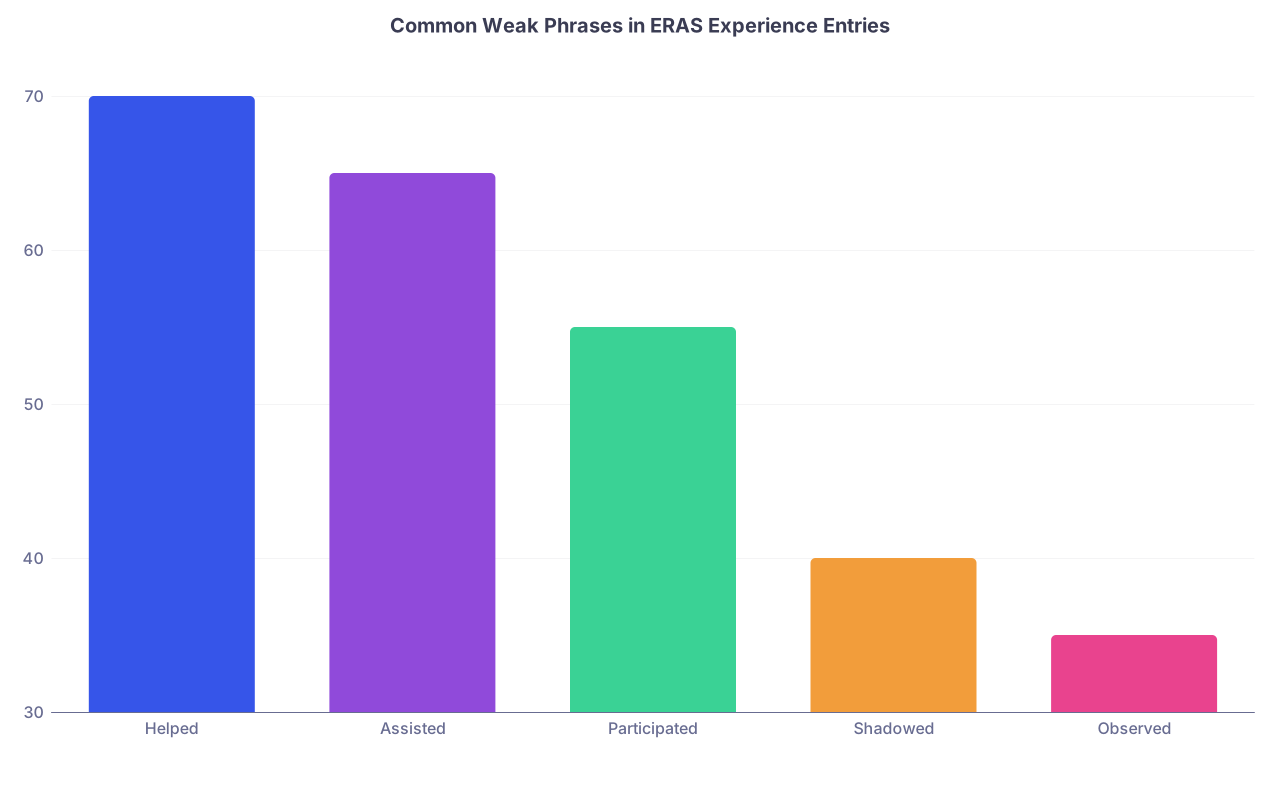
| Category | Value |
|---|---|
| Helped | 70 |
| Assisted | 65 |
| Participated | 55 |
| Shadowed | 40 |
| Observed | 35 |
Numbers hypothetical, but I promise you the proportions are not far off in the average application batch.
Mistake #6: Using Generic, Copy-Paste Bullets Across Multiple Roles
PDs notice repetition.
When three different experiences all say:
- “Improved communication skills”
- “Learned teamwork in multidisciplinary settings”
- “Developed leadership skills”
you sound canned and shallow.
The “same bullet, different header” problem
I have seen this pattern many times:
- Research assistant position
- Volunteer coordinator role
- Tutoring job
All described with:
- “Developed leadership and teamwork skills”
- “Improved communication with diverse populations”
- “Enhanced organizational abilities”
None of those tell me what you actually did. And they are interchangeable.
You need specificity that could not belong to any other role.
Bad repetition:
- “Developed leadership skills by working with a team of volunteers”
- “Developed leadership skills by coordinating study group”
- “Developed leadership skills by collaborating with peers on research”
Better:
- Research: “Maintained REDCap database of 300+ records; trained 4 new team members on data entry protocol”
- Volunteer: “Scheduled and supervised 15 volunteers per event, troubleshooting last-minute staffing gaps”
- Tutoring: “Designed and ran exam review sessions for 20–25 students, collecting feedback and adjusting format each block”
See the difference? Each bullet is anchored in tasks, scale, and context.
Mistake #7: Burying the Most Impressive Part at the End (or Not Mentioning It)
You would be shocked how often the gold is in the second or third bullet—or not there at all.
I have had conversations like this:
Me: “Did anything come out of that research?”
Student: “Oh, yeah, we got a poster at ATS and a manuscript accepted last month.”
Me: “Where is that on your CV?”
Student: “I just wrote ‘assisted with data collection.’”
That is self-sabotage.
Lead with the outcome when you have one
Order matters. PDs skim. Your first bullet should not be:
- “Entered data into spreadsheet”
if later you mention:
- “Co-author on abstract presented at national conference”
Reorder:
- “Co-author on abstract accepted to ATS 2025 (poster presentation) on COPD readmission predictors”
- “Conducted chart abstraction for 220+ patients and maintained study database with >98% completeness”
If there is a:
- Publication
- Poster
- Platform presentation
- Award
- Protocol you wrote
- Clinic process change implemented
it belongs early and clearly.
Mistake #8: Overstuffing Each Role With Fluff
The opposite problem also exists: trying to say everything and communicating nothing.
CV entries bloated with phrases like:
- “Various tasks as needed”
- “Etc.”
- “And much more”
- “Including but not limited to…”
Stop. This is not an Amazon job description.
Aim for 2–4 sharp bullets per key role
Each bullet should pass this test:
- Could a stranger tell what I did and why it mattered?
If a bullet is:
- Abstract (“handled logistics”)
- Buzzword-heavy (“facilitated synergies between stakeholders”)
- Redundant (same point as another bullet)
Cut or rewrite.

| Step | Description |
|---|---|
| Step 1 | Write initial bullet |
| Step 2 | Add specifics - what, how many, how often |
| Step 3 | Add result or why it mattered |
| Step 4 | Keep bullet |
| Step 5 | Too vague? |
| Step 6 | Impact clear? |
You are aiming for clarity, not poetry.
Mistake #9: Wording That Raises Red Flags About Professionalism
Some descriptions do more than undersell you. They raise quiet concerns.
Things that make PDs nervous:
- Overclaiming clinical responsibility (“Independently managed ICU patients” as a student)
- Casual or unprofessional tone (“Did a bunch of charting and random tasks”)
- Inappropriate humor or sarcasm
- Language that sounds like you ignored supervision or scope of practice
Stay honest about your level
Bad:
- “Managed patients in clinic and made final treatment decisions”
- “Performed procedures independently” (when you mean as a student under supervision)
Better:
- “Performed focused histories and physical exams, formulated assessments and plans, and presented to attending for final decisions”
- “Performed venipuncture and IV placement on 30+ patients under resident supervision”
You want to sound capable and trustworthy, not reckless or inflated.
Mistake #10: Ignoring How Program Directors Actually Read Your CV
Here is the part most applicants forget: your document is being read fast, by a tired physician, skimming on a screen.
They:
- Notice strong verbs
- Catch numbers
- Respond to outcomes
- Ignore fluff and generic language
Think in terms of skim value, not self-expression.
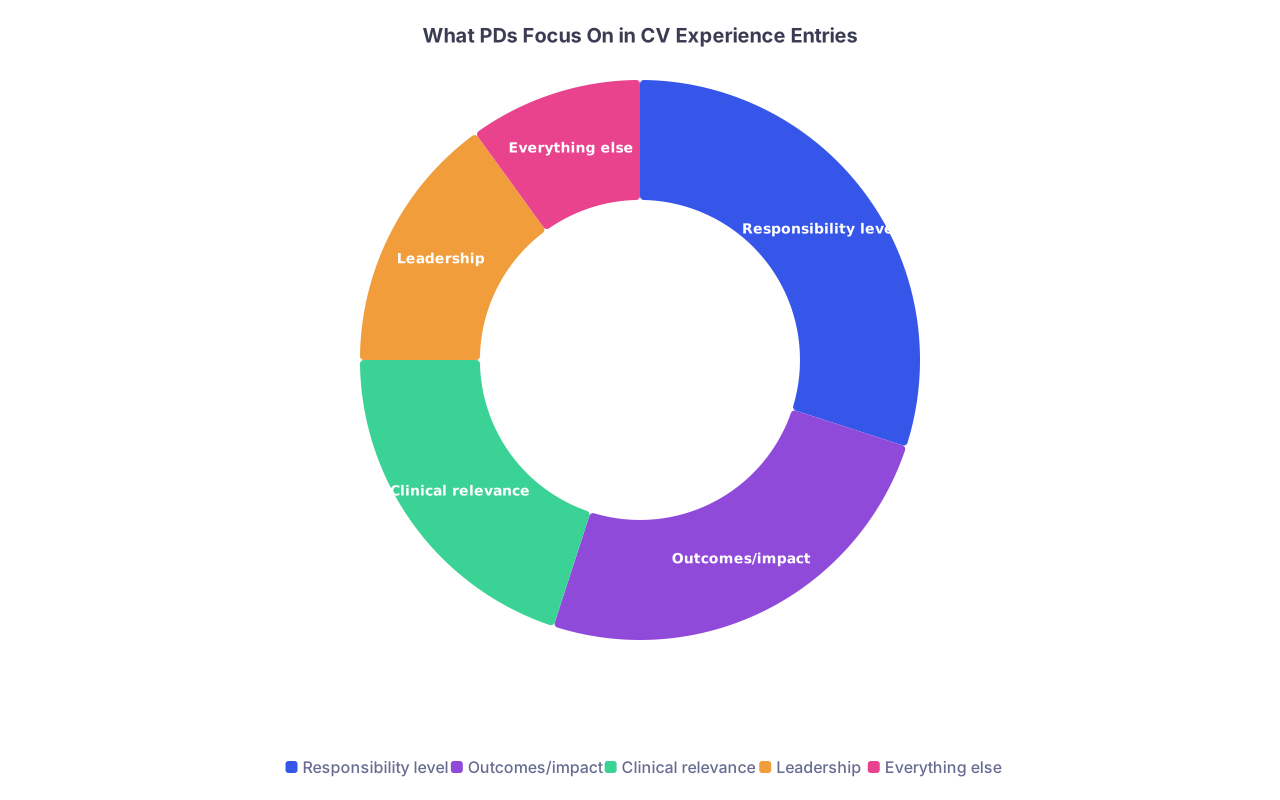
| Category | Value |
|---|---|
| Responsibility level | 30 |
| Outcomes/impact | 25 |
| Clinical relevance | 20 |
| Leadership | 15 |
| Everything else | 10 |
Again, hypothetical numbers, but directionally right.
Design your entries so those categories jump out.
Practical Rewrite Examples
Let me show you three common roles, written poorly and then correctly.
Example 1: Research Assistant
Weak:
- “Assisted with cardiology research project”
- “Entered data and helped with analysis”
Stronger:
- “Research assistant on cardiology outcomes study; abstracted data from 250+ HF admissions into REDCap database”
- “Performed preliminary statistical analysis (logistic regression) under mentor supervision using R”
- “Co-authored abstract accepted for poster presentation at ACC 2025”
Example 2: Student-Run Clinic
Weak:
- “Volunteered at student-run clinic helping underserved patients”
- “Worked with other students and attendings”
Stronger:
- “Served as primary student clinician at student-run internal medicine clinic twice monthly, obtaining full histories and focused exams for 6–8 patients per shift”
- “Presented patients to attending physician and documented visits in EMR under supervision”
- “Created standardized patient education handouts in English and Spanish for hypertension and diabetes management”
Example 3: Teaching Role
Weak:
- “Tutored first-year students in physiology”
- “Helped students prepare for exams”
Stronger:
- “Peer tutor for M1 physiology course (2 semesters), leading weekly review sessions for 5–7 students”
- “Developed practice questions and case-based discussions aligned with course objectives; average student course scores increased by ~8 points compared with prior exam”
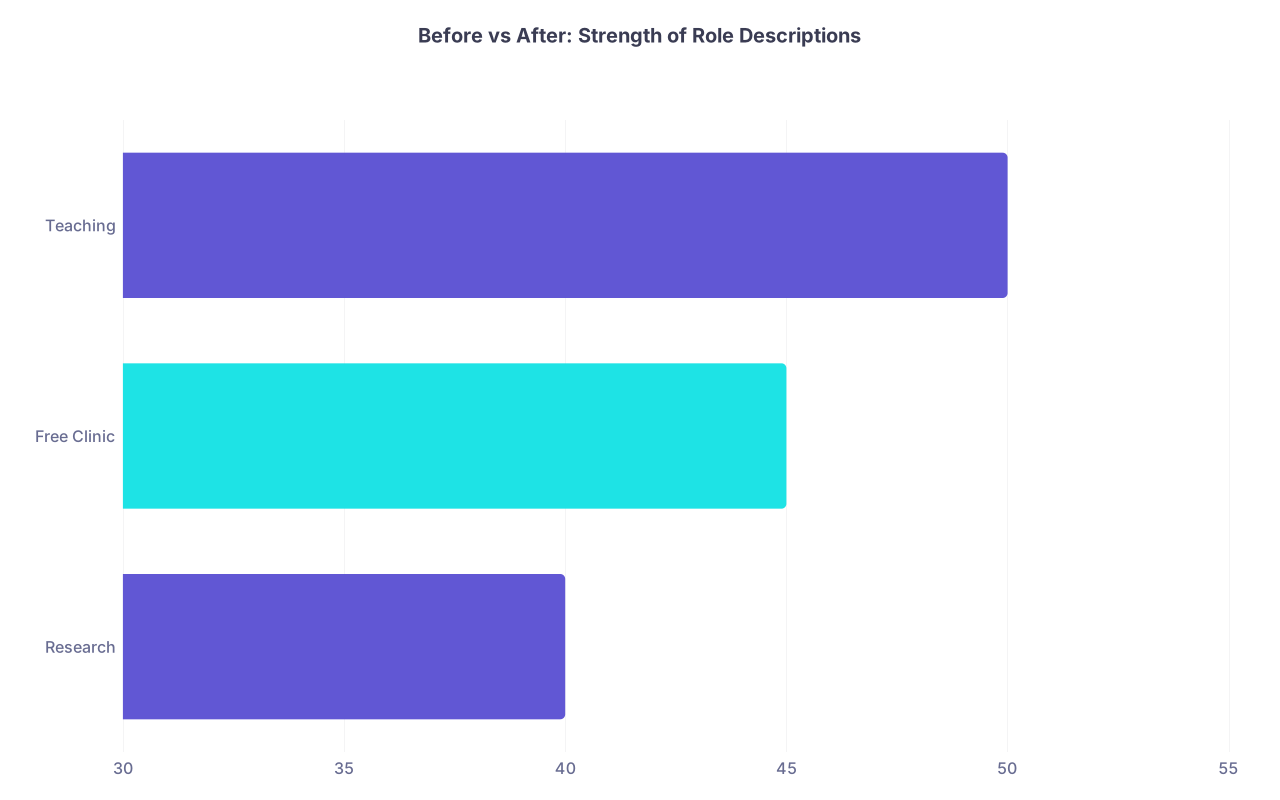
| Category | Value |
|---|---|
| Research | 40 |
| Free Clinic | 45 |
| Teaching | 50 |
(Think “strength score” jumped from maybe 20/100 to 60–70/100 with better wording.)
Quick Checklist Before You Finalize Your ERAS CV
Go through each major experience and ask:
Do my bullets start with weak verbs like “helped,” “assisted,” or “participated”?
Replace with action-oriented verbs that show ownership.Can a stranger understand what I actually did?
If not, add specifics: what, how many, how often, for how long.Does at least one bullet show impact or outcome?
A change, a product, an award, a presentation, a new process.Do my leadership titles have concrete evidence behind them?
If you write “President,” I want to see coordination, initiatives, numbers.Is my clinical involvement honest about supervision and scope?
Show autonomy without pretending you were an attending.
If you fix those five areas, you will already be ahead of a large chunk of the applicant pool.

FAQs
1. How long should my descriptions be for each ERAS experience?
Keep it lean and sharp. For most significant roles:
- 1–3 bullets is enough
- Each bullet 1–2 lines, not a paragraph
If you need 6 bullets to explain what you did, you are probably repeating yourself or adding filler. Prioritize responsibility, impact, and clinical relevance; cut generic “skills” language.
2. What if my role really was mostly “helping” and not independent work?
Then be honest but still specific. You can say:
- “Supported resident team by pre-rounding on 3–4 patients daily and preparing note templates”
- “Assisted with recruitment by calling 20–30 patients weekly to screen for eligibility”
You are not required to sound heroic. You are required to be clear. Specific support work still shows reliability, attention to detail, and consistency.
3. How do I handle observerships or pure shadowing on my CV?
Do not oversell them as clinical roles. Instead, frame them transparently with emphasis on exposure and any active components:
- “Completed 4-week observership in internal medicine clinic; pre-visit chart reviews and daily case discussions with attending about diagnostic reasoning and management choices” If it was literally following silently and watching, consider whether it belongs at all—or keep the description very short.
4. Should I list every small volunteer activity or only major roles?
Stop padding. PDs care more about depth and continuity than volume. A few sustained roles (12+ months, or clear responsibility) described well beat ten “helped at event” entries. If an experience does not allow you to show responsibility, reliability, or initiative, it can be combined or omitted.
5. Is it okay to reuse similar wording across different roles?
Some repetition is unavoidable (e.g., “led,” “coordinated”), but copy-paste bullets are a bad idea. Each role should have at least one bullet that could only describe that experience. If you see the same sentence under three positions with minor tweaks, you are diluting your impact and sounding generic.
Remember:
- Weak verbs and vague wording quietly erase your real achievements.
- Specific actions, clear responsibility, and concrete outcomes make programs see you as a future colleague, not a generic volunteer.
- Your experiences are probably stronger than they look right now—stop letting bad wording undermine them.