
Most residency programs are not “reading” your CV. They’re searching it.
Let me be blunt: a shocking number of interview decisions are made because your CV either lights up certain keywords… or it doesn’t. And those keywords are not random. They’re baked into spreadsheets, search boxes, and committee culture at every program that gets more applications than they can sanely review.
You want insider truth? This is it: if your CV doesn’t trip the right filters, the quality of your story, your “passion,” your character — all of that never even makes it to the room.
Let me walk you through how this actually works behind the door you never see.
What Really Happens to Your CV After You Click Submit
Most applicants imagine someone at a program pouring coffee, opening their ERAS packet, and thoughtfully reading every line.
That person does not exist.
Here’s the usual sequence at mid-to-large programs:
- Coordinator or chief resident exports ERAS data to Excel or some clunky database.
- Program director and a couple of faculty agree on quick filters: Step scores, home school priority, visa status, maybe a GPA cut if they care about that.
- Once they’ve chopped off the bottom of the pile, they start searching within what’s left.
And “searching” is literal. Control+F. Or filters in a spreadsheet column. Or a simple query: show me everyone with X.
That’s where keywords come in.
Sometimes it’s as crude as:
researchchiefpublicationquality improvementleadership
Other times it’s more specialty-specific:
- For EM:
EMS,ultrasound,airway,simulation - For surgery:
case report,surgical oncology,laparoscopic,robotic - For psych:
addiction,psychotherapy,community outreach,trauma - For competitive IM:
R01,first author,NEJM,JAMA,cardiology,GI
Are they running some massive NLP-based AI filter? No. It’s much dumber than that at most places. They literally type a word into search and see who lights up.
So if your CV has:
“Worked on a study but not published yet”
instead of:
“Clinical research assistant – prospective cohort study in cardiology”
you’ve just turned off a light that needed to be on.
The Core Keywords: What Almost Every Program Hunts For
There are certain words that will always get a little bump in attention, across almost all fields. They function like green flags in a sea of gray.
1. “Research” (but not just the word)
Programs don’t just want the word “research” plastered everywhere; they want it in the right places and tied to something real.
They search for:
researchclinical researchbasic sciencetranslationaloutcomes researchepidemiology
Then they dig deeper for:
first authorco-authorposteroral presentationabstractpublication
If your CV says:
“Participated in research projects with a faculty mentor.”
That’s weak. Compare it to:
“Clinical research assistant, heart failure outcomes – designed data collection tools, enrolled 120+ patients, co-authored abstract accepted to ACC annual meeting.”
Same real life. Totally different keyword profile.
2. “Leadership” and Its Cousins
Programs are paranoid about residents who crumble, cause drama, or require handholding. Leadership terms are shortcuts they use to guess who will handle responsibility.
They search for:
chief(class chief, chief tutor, chief TA, anything with “chief” in front of it)president(interest group, student org, national group)foundercoordinatordirectorleaderchairboard membercommittee
If your CV says:
“Member, Internal Medicine Interest Group”
you’re wallpaper.
If it says:
“President, Internal Medicine Interest Group – organized 8 faculty panels, increased membership from 40 to 95 students”
now you light up for president, organized, faculty, panels.
3. “Teaching” and “Mentoring”
PDs know: good teachers often become good seniors and solid attendings. So teaching language hits a nerve.
They look for:
tutorteaching assistantTApeer mentorcurriculumsmall group facilitatorlecturerdeveloped teaching materialsworkshop
Compare:
“Helped classmates with physiology”
versus:
“Peer tutor in physiology – led weekly small-group sessions for 6–8 first-year students, created review problem sets and practice exams.”
One of these is a story; the other is a search hit.
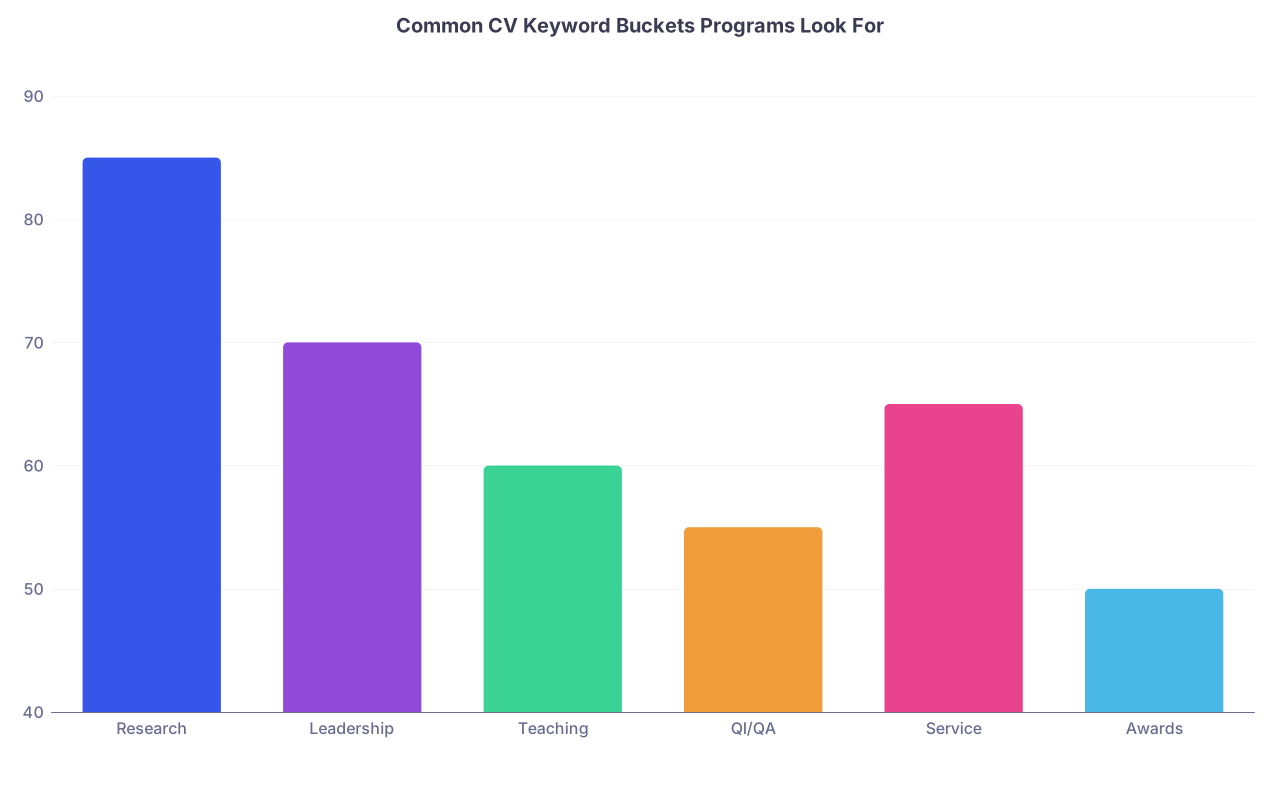
| Category | Value |
|---|---|
| Research | 85 |
| Leadership | 70 |
| Teaching | 60 |
| QI/QA | 55 |
| Service | 65 |
| Awards | 50 |
Specialty-Specific Triggers: What Different Programs Actually CTRL+F
Not all keywords are equal in every specialty. Here’s how insiders actually skim.
Internal Medicine (especially academic or competitive IM)
Big IM programs (think MGH, BIDMC, UCSF, Michigan) are unapologetically research-heavy.
They search for:
research,clinical research,outcomes,retrospective,prospectivefirst author,publication,NEJM,JAMA,Lancet,Circulation,Gastroenterologycardiology,oncology,hepatology,GI,pulmonary,critical carequality improvement,QI project
I’ve sat in those rooms. Someone filters the list for “first author” and they literally say, “Sort by that.” Then they browse that subset first for interview slots.
If your IM-oriented CV doesn’t have research and some flavor of QI, you’re already playing from the back row.
General Surgery
Surgeons are predictable. They love grit and output.
They look for:
surgery,surgical oncology,vascular,trauma,acute carecase report,case series,retrospective chart reviewoperative,microsurgery,laparoscopic,roboticcall schedule,procedural,technical skillsleadership,chief,trauma team,OR,surgical ICU
They don't need poetry. They want receipts that you have lived in the OR and didn’t run away.
“Shadowed surgeons” doesn’t move the needle. “Surgical research fellow – completed 3 case series and 2 first-author abstracts in trauma surgery” does.
Emergency Medicine
EM cares about chaos tolerance, systems thinking, and certain niche interests.
Common filters:
emergency department,ED,EM,EMS,prehospitalultrasound,POCUSairway,resuscitation,simulation,SIMtoxicology,disaster medicine,global healthshift work,triage,ED throughput,flow
If you’ve done ultrasound electives, sim teaching, or EMS ride-alongs, those words better be explicitly in your bullet points.
Psychiatry
They’re reading for emotional intelligence, insight, and a specific flavor of experience.
They search for:
mental health,psychiatry,addiction,substance use,traumacommunity outreach,underserved,homelessness,LGBTQ+psychotherapy,CBT,DBT,group therapyneuroscience,brain imaging(for research-heavy programs)
That vague “volunteered at a shelter” line? Worthless. “Weekly volunteer, community mental health drop-in center – facilitated group discussions for patients with chronic psychotic disorders” actually hits.
Pediatrics, Family Med, OB/GYN, etc.
They all have their flavors, but the principle is the same: they hunt for signals that match their daily life.
- Peds:
children,adolescents,camp,education,advocacy,vaccination,NICU - FM:
primary care,continuity clinic,community health,rural,underserved,preventive care - OB/GYN:
women's health,reproductive health,LARC,family planning,global health,laparoscopic
If your CV never says the actual words of the population or setting you claim to love, no one believes you.

How Systems and Humans Actually Use These Keywords
There are two separate forces at work: the software filters and the human search habits.
ERAS And Local Filters
ERAS exports your data. Programs pull it into:
- Excel
- RedCap or some home-grown database
- Custom dashboards built by the hospital IT or a research-minded faculty member
Then they:
- Sort by Step 2 CK (or Step 1 if they still have it)
- Filter out non-graduates beyond some year threshold
- Mark home students, internal rotators, prelim vs categorical
- Then they add columns like: “Research?”, “Leadership?”, “Red flag?”
Those yes/no columns are often filled in by a chief or resident after a 30–60 second skim of your CV and personal statement.
And here’s the crucial bit: keywords determine whether that skim becomes a “Yes” or a “No” in those columns.
If your bullets are:
“Participated in volunteer activities. Attended meetings. Helped with organization.”
you won’t get flagged as leadership. If they see “President,” “Founder,” “Director,” they click “Yes” without thinking twice.
Humans Skimming Under Pressure
I’ve seen a PD scroll through PDF CVs with one hand on the arrow key and the other on Ctrl+F.
They say things like:
“Search ‘publication’… okay, these five. Add.”
“Any with ‘QI’ or ‘quality improvement’? We need some for our projects.”
“See who has ‘chief’ somewhere.”
The goal is not fairness; it’s damage control. They’re trying not to drown in 3,000 applications for 12 spots.
Your job is to make your CV search-friendly in their language, not yours.
How to Rewrite Your CV To Light Up the Filters
Now we’re at the part you can actually control.
You do not need to fabricate experiences. But you absolutely must translate them into the language that triggers interview decisions.
1. Rename and Reframe Existing Experiences
You’d be amazed how many CVs bury high-yield stuff under weak labels.
Instead of:
“Volunteer – Hospital”
Try:
“Volunteer – inpatient medicine unit, academic hospital”
Now you’ve got inpatient, medicine, academic hospital.
Instead of:
“Student representative”
Try:
“Class representative – elected liaison between administration and 120 classmates”
Now you have elected, liaison, class representative.
2. Use Bullet Structure That Surfaces Keywords Early
Program folks skim the first few words of each line.
Bad:
“Assisted with various aspects of data entry and analysis for a research project about heart failure patients.”
Better:
“Clinical research assistant – heart failure outcomes; performed data collection, chart review, and basic statistical analysis in 150+ patients.”
“Clinical research assistant” is doing heavy lifting here.
Aim for this pattern:
Role – context; 2–3 specific actions with concrete numbers if possible.
3. Stop Hiding Under Vague, Soft Language
Words like “exposed to,” “interested in,” “passionate about” are useless.
Compare:
“Interested in global health and underserved populations.”
versus:
“Global health elective – 4 weeks in rural clinic, managed continuity care for underserved adults with hypertension and diabetes.”
One is a thought. The other is evidence.
4. Add the Missing Keywords You Actually Deserve
If you did something that counts as “teaching,” but you didn’t say the word “tutor,” you just missed a filter.
Examples:
- If you helped preclinical students with anatomy as a peer: call it
Peer tutor – anatomy - If you led sessions for new volunteers: call it
Volunteer trainerorOrientation leader - If you built materials: use
developed curriculumorcreated teaching materials
You’re not lying. You’re labeling. There’s a difference.
| Type | Weak Line | Strong, Keyword-Rich Line |
|---|---|---|
| Research | Helped with research project | Clinical research assistant – cardiology; enrolled patients, performed chart review, co-authored abstract |
| Leadership | Member, student group | President, student internal medicine interest group; organized 6 faculty panels |
| Teaching | Helped classmates study | Peer tutor – physiology; led weekly review sessions for first-year students |
| QI | Worked on hospital project | Quality improvement project – reduced ED wait times by 15% through new triage protocol |
| Service | Volunteered at clinic | Volunteer – free community clinic; provided longitudinal primary care for underserved |
The Underused Goldmine: QI, QA, and Systems Words
Most students massively underplay quality improvement.
Program directors, especially in IM, EM, FM, and surgery, are under constant pressure to “move the needle” on metrics: door-to-balloon times, readmissions, falls, CLABSIs, you name it.
So when they see:
quality improvementQI projectPDSA cycleprocess maproot cause analysisdriver diagramoutcomesmetric
they pay attention.
You don’t need a publication. If you participated in a small resident-led QI project, call it what it is:
“Quality improvement project – reduced missed follow-up appointments by 10% through redesigning discharge instruction workflow; created process map, collected baseline data, and monitored outcome metrics.”
That line hits quality improvement, reduced, metrics, workflow. It screams: this person gets systems.
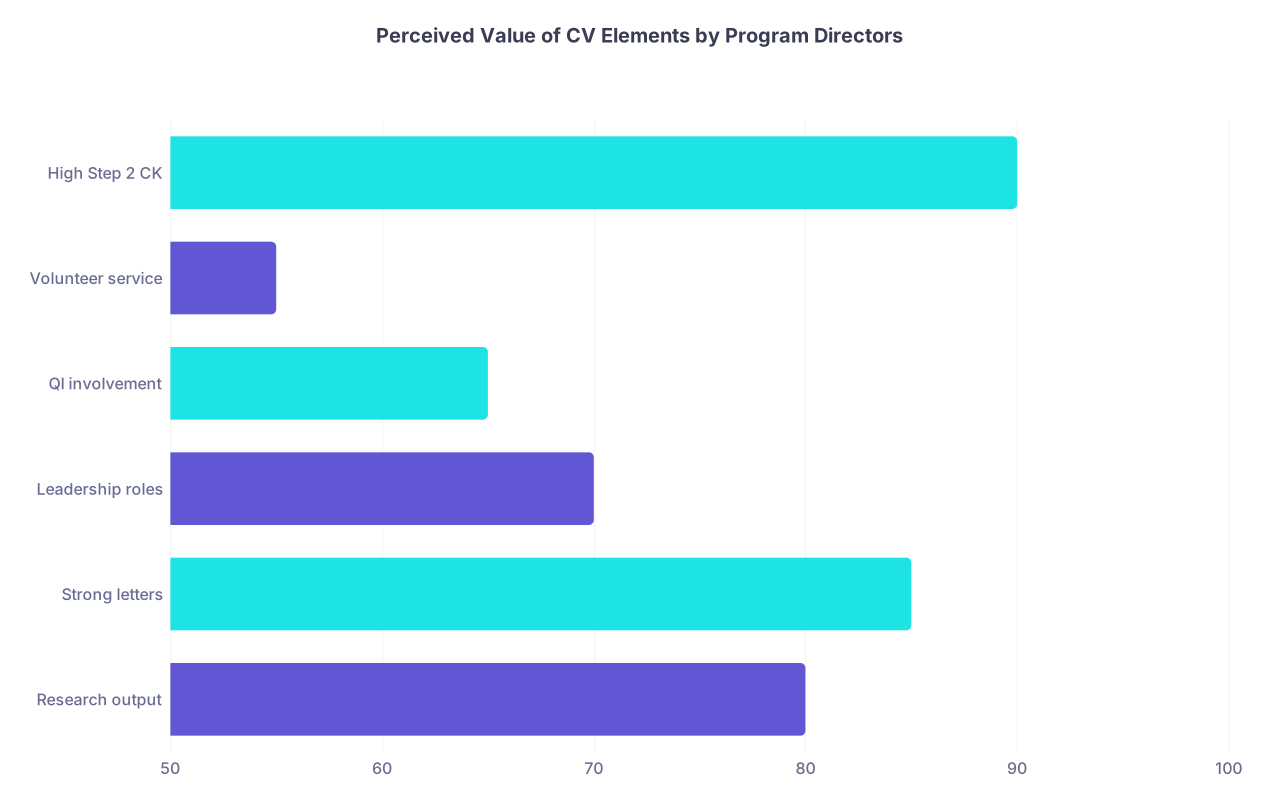
| Category | Value |
|---|---|
| Research output | 80 |
| Strong letters | 85 |
| Leadership roles | 70 |
| QI involvement | 65 |
| Volunteer service | 55 |
| High Step 2 CK | 90 |
Red Flags and Dead Words That Quietly Hurt You
Some words and patterns make reviewers suspicious, even if you think they sound good.
1. Overinflated Titles
You’re a student, not a “Medical Director of…” anything.
Calling yourself “Director” of a 3-person student club you barely ran looks ridiculous. Use Founder, President, or Coordinator realistically. Faculty can smell exaggeration from the hallway.
2. Purely Generic Verbs
If your bullets are a graveyard of:
- “Assisted with…”
- “Participated in…”
- “Involved in…”
you sound like you stood in the back of the room and held a clipboard.
Swap them for real actions:
led,organized,developed,created,analyzed,taught,implemented,designed,coordinated
Those words map better to the leadership, teaching, and initiative traits they’re screening for.
3. Empty Filler Activities
Half the CVs I’ve seen have lines like:
“Attended weekly lecture series on X”
“Member, national medical association”
These add almost nothing unless you played a role. Don’t waste space with passive attendance. Use your real estate for things that can be defended in an interview and that trip their mental filters.

Implementation: How To Rehab Your CV in 48 Hours
If you’re serious, here’s how to systematically retrofit your CV to the hidden filters.
Step 1: Inventory Your Experiences
Open your current CV and list, on a scratch pad, every activity under:
- Research
- Leadership
- Teaching
- QI/QA
- Service / outreach
- Specialty-specific exposure (ED, OR, clinic, global health, etc.)
You’ll realize you actually have more in each bucket than your CV suggests.
Step 2: Translate to Keyword-Rich Labels
Rename roles and experiences using accurate but higher-yield descriptors:
- Change “Volunteer – clinic” to “Volunteer – free primary care clinic”
- Change “Shadowing” to “Clinical observer, internal medicine inpatient service”
- Change “Helped with student orientation” to “Orientation leader – incoming medical students”
You’re not changing what you did. You’re changing the label to match what programs search.
Step 3: Rewrite Bullets With Real Actions and Outcomes
For each entry, write 1–3 bullets that:
- Start with a strong verb
- Include one or two high-yield keywords naturally
- Mention numbers or outcomes when you can (patients, sessions, events, improvement percentages)
Then prune. It’s better to have 20 excellent, filter-friendly lines than 50 fluff lines.
Step 4: Sanity Check Against Your Target Specialty
Ask: if a PD in my field filtered my CV for:
researchleadershipteaching- [specialty]-specific words
would I pop up more than once in each category?
If not, you’ve got more work to do.

| Step | Description |
|---|---|
| Step 1 | Download current CV |
| Step 2 | Identify research leadership teaching QI service |
| Step 3 | Rename roles with accurate keyword rich titles |
| Step 4 | Rewrite bullets with strong verbs and outcomes |
| Step 5 | Check for specialty specific terms |
| Step 6 | Have resident or mentor review for realism |
| Step 7 | Upload updated CV to ERAS |
FAQ (exactly 4 questions)
1. Won’t stuffing keywords into my CV make it look fake or forced?
If you’re just dumping buzzwords with no substance, yes, it’ll look fake and you’ll get exposed the moment someone asks, “Tell me about this project.” But what I’m talking about is different: labeling your real work in the language programs actually understand and search for. If you did a QI project, call it “quality improvement.” If you taught, call it “peer tutor.” As long as you can explain it calmly and concretely in an interview, you’re fine.
2. How many research experiences do I need for this keyword stuff to matter?
One solid, clearly described research experience is infinitely better than five vague lines about “helping with projects.” For many fields, having at least one real research role labeled properly (clinical research assistant, research fellow, co-author) is enough to trigger the research filter. For highly academic IM or certain surgical subspecialties, more is better, but clarity and output matter more than raw count.
3. I don’t have any leadership roles. Is it worth trying to spin small things as leadership?
Don’t invent, but do stop minimizing what you actually did. If you ran a small volunteer team, coordinated schedules, or organized events, that’s leadership. Label it: Volunteer coordinator, Event organizer, Small group leader. What crosses the line is calling yourself “director” of something that obviously wasn’t. Programs aren’t stupid. Be accurate, but stop underselling.
4. Do programs really use Ctrl+F on CVs, or is that an exaggeration?
They really do. I’ve literally watched PDs and chiefs search for “research,” “QI,” “chief,” “ultrasound,” whatever their pet interest is that year. Not at every single program, but at enough mid-to-large programs that ignoring this reality is naive. When you’re staring at thousands of applications, search becomes survival. Your CV either shows up in those searches or it doesn’t. That’s the game.
Remember:
Most programs are scanning, not reading.
Keywords get you from the pile to the room.
Translate your real work into their language, and you stop being invisible.