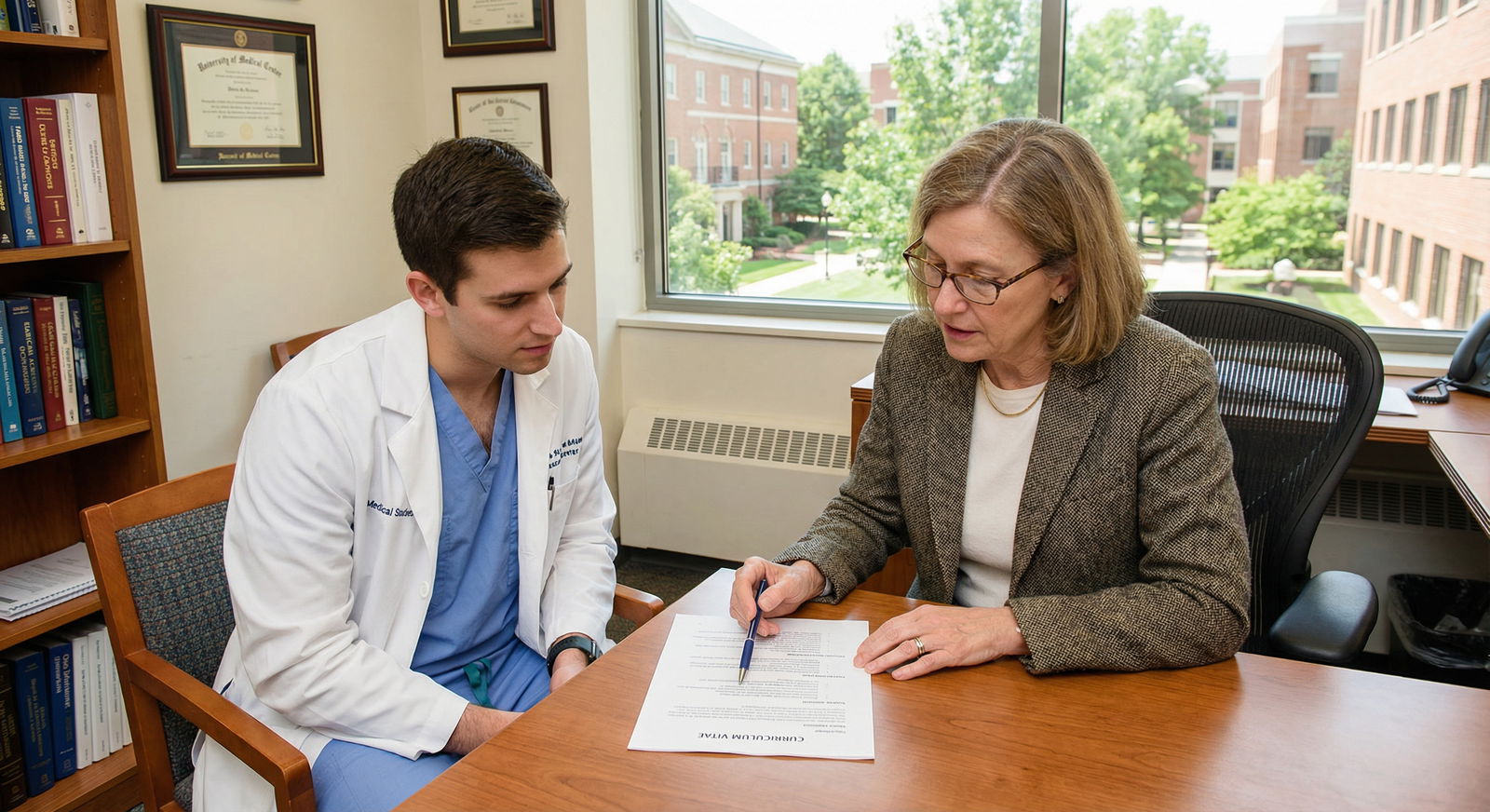
Last fall, I watched a program director slam his pen down in the middle of a ranking meeting. “We’re not skipping this kid,” he said. “Did you actually read his CV?” The applicant’s Step score was average. No home-field advantage. But three lines on that CV had turned one quiet faculty member into a bulldog on his behalf.
You think it’s all about Step scores and class rank. That’s the story students tell each other. But behind those closed doors, I’ve watched faculty fight—actually fight—to get certain applicants into the interview pile. They’re not doing it because someone had a 270. They’re doing it because specific, very recognizable “green flags” on a CV scream: This person will make our lives easier, our service safer, and our residency better.
Let me walk you through what really triggers that reaction.
How CVs Are Actually Read In Selection Meetings
Here’s the first truth you will not hear on Reddit: most faculty are skimming your CV at first pass. Brutally fast. We’re talking 20–40 seconds per applicant when stacks are high.
There are usually three types of people in the room:
- The program director: has seen 3,000 CVs, trusts patterns, gets impatient quickly.
- The “workhorse” faculty: clinically busy, joins selection to keep residents strong, focuses on who will function on the wards.
- The “academic” faculty: cares about research, presentations, “fit” with departmental priorities.
Each of them is scanning for very specific green flags that match what they care about. When more than one of those flags shows up on a single CV—you jump from “decent” to “Why are we not interviewing this person?”
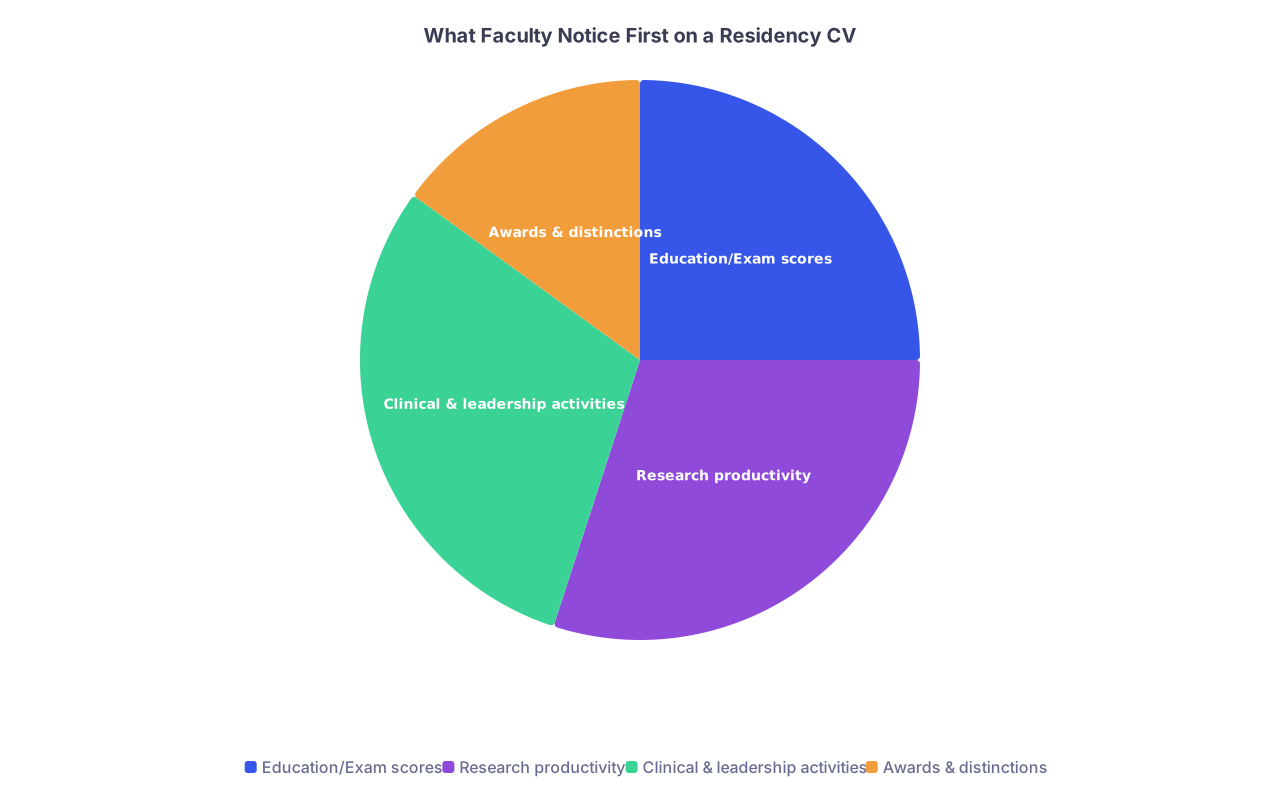
| Category | Value |
|---|---|
| Education/Exam scores | 25 |
| Research productivity | 30 |
| Clinical & leadership activities | 30 |
| Awards & distinctions | 15 |
You don’t need all of these. But you do need at least one area that’s obviously strong and structured in a way that makes those strengths impossible to miss.
Green Flag #1: Evidence You Can Actually Do The Job Day 1
You’d be surprised how many “great applicants” look useless on paper when you ask: can this person function on call at 2 a.m. without melting down?
The CV lines that make clinically-oriented faculty perk up are very specific.
Longitudinal, real responsibility (not just shadowing fluff)
A line like:
“Clinical assistant, county HIV clinic – 2 years, weekly sessions. Independently managed patient intake, histories, follow-up counseling under attending supervision.”
That’s a green flag. It tells us: this person showed up, week after week, in a real clinic, where people depended on them.
What does not impress anyone:
“Shadowed various specialties – 300 hours”
That screams “checkbox filler.” No responsibility, no continuity, no proof of reliability.
If you’re still in school and your CV is full of hop-in-hop-out experiences, fix that. Pick 1–2 clinical settings and commit. Longitudinal > scattered.
Leadership tied to patient care or systems
Faculty don’t care that you were treasurer of five different clubs. They care if you did something that affected how care is delivered.
The lines that make people in the room pause:
“Student coordinator, ED follow-up program – Created tracking process for 30+ weekly high-risk discharges, reduced no-show rate from 40% to 22% over 10 months.”
or
“Developed and implemented weekend handoff checklist for inpatient pediatrics, adopted by 3 services.”
That’s gold. That’s: “This person sees problems and fixes them.” The same mindset that will fix that broken sign-out system nobody has time to touch.
You want to make faculty argue for you? Turn your “leadership” from title collection to outcomes. Show that something changed because you were there.
Real teaching experience
Teaching experience is not just some “nice to have.” Resident programs run on peer teaching. Programs need residents who can teach med students and interns without being a disaster.
Green-flag lines look like:
“Course director, student-led Step 1 review – Designed 6-week curriculum, led 20+ hours of sessions, materials archived and reused by subsequent classes.”
or
“Small-group facilitator, MS1 anatomy – Twice weekly, 12 weeks, led 8-student group; received top-decile teaching evaluations.”
Now, a secret: if your CV shows you can teach reliably, older faculty who hate “babysitting” will silently push your application up. They know they’ll be dumping med students on you. They want someone who can handle that and not complain every day.
Green Flag #2: Research That Looks Like You’ll Actually Finish Projects
Research isn’t just about publications. It’s about whether you look like the kind of person who finishes what you start.
Faculty don’t say, “Does this applicant have research?” They say, “Can this person help me get papers out?”
The mistake students make is thinking “more lines = better.” That just makes your CV look padded. What impresses faculty is signal, not noise.
Signs of a finisher, not a dabbler
Here’s what gets attention:
- Multiple outputs from the same project (poster → oral → paper).
- Increasing responsibility: “assistant” → “co-author” → “first author” or “project lead”.
- Work that is clearly carried through over years, not one summer.
A line like:
“First-author manuscript under review at Journal of Hospital Medicine; project began as QI poster presented at SHM 2023.”
That’s a green flag. We see evolution, perseverance, deliverables.
Contrast that with:
“Chart review project (in progress)”
“Case report (in progress)”
“Basic science project (data collection)”
All “in progress.” That’s code for “This will never see daylight.”
If you’re 6–12 months out from applying, ruthlessly prioritize finishing one or two projects. Kill the others. One first-author anything beats five “in progress” nothing-burgers.
Specialty-aligned, but not fake
Programs like to see that your research at least sort of aligns with the field. But we also know when something is obviously staged.
If you’re applying to internal medicine and your CV shows:
“3 first-author abstracts in heart failure outcomes, 1 co-author paper in JACC”
That’s huge. You become “the HF research kid” in the room. People remember that.
But here’s the nuance: you don’t need 10 cardiology projects to match into IM. One solid specialty-aligned project + some general research is more than enough. The key is showing:
- You can work with a mentor long term.
- You can navigate IRB, deadlines, revisions.
- You actually get to a poster/presentation/manuscript.
| Profile Type | Research Pattern |
|---|---|
| Weak | Many projects listed as 'in progress', no outputs |
| Moderate | 1–2 posters, short-term engagement, no clear follow-through |
| Strong | 1 longitudinal project with poster + manuscript, plus 1–2 smaller roles |
On selection committees, I’ve seen this exact conversation:
“Their Step is a little low for us.”
“Yes, but did you see their QI project? They pulled off an actual reduction in CLABSIs and got it published. That’s not trivial.”
And just like that, you move from “maybe” to “we should at least meet this person.”
Green Flag #3: Evidence You’re Not a Problem Resident Waiting To Happen
Nobody on a selection committee wants to deal with the resident who’s always “in drama.” The question quietly driving a lot of the discussion is: Will this person be a problem?
Certain CV signals answer that in your favor.
Sustained commitment to something hard
Not ten activities. One or two that required grit.
Examples that calm faculty down immediately:
- 8+ years of competitive athletics (especially at college level).
- Long-standing work experience through med school (especially night shifts, CNA, EMT, scribe).
- Military service, serious caregiving responsibilities, or significant prior career.
These things say: “I can show up tired. I can show up when it’s not fun. I don’t disintegrate under stress.”
If you worked as an EMT for three years, do not bury that in “Other Work Experience” as a throwaway line. That’s a major green flag. Flesh it out:
“Emergency Medical Technician, urban EMS – 3 years, 20–30 hours/week while full-time student. Managed high-acuity pre-hospital care, coordinated with ED teams.”
You’re telling us: “Yes, I know what real 3 a.m. chaos looks like. I’ve survived it.”
Clean, coherent story without random reinventions
Faculty get suspicious of CVs that look like the applicant reinvents themselves every 6 months. Completely disjointed shifts in interest, tons of clubs, nothing sustained.
A faculty member said this straight out in a meeting once: “I don’t want a resident who’s going to ‘find themselves’ during residency. I want the one who already shows they can commit.”
Your job with the CV is to show coherence:
- Your interests line up in a plausible way (doesn’t have to be perfect).
- You don’t have 15 “leadership positions” that last 4 months each.
- You chose a direction and stayed with it long enough to produce something.
When your CV tells a clean story, people trust you more. Trusted = safer to rank high.
Green Flag #4: Leadership That Actually Means Something
Here’s a secret that will annoy you: half the “leadership” lines on most CVs get ignored. We’ve all seen “President, XYZ Club” from schools where the club has 4 members and meets twice a year.
What makes faculty actually care is not the title. It’s scope and consequence.
Leadership with measurable impact
The magic formula is: Role → Scope → Action → Outcome.
For example:
“Co-founder, Student-Run Free Dermatology Clinic – Built referral pathway from community FQHC, recruited 6 derm faculty volunteers, 120+ uninsured patients seen in first year.”
That’s a green flag. You did something bigger than yourself. You rallied people, moved systems, helped actual patients.
Compare that to:
“Vice President, Dermatology Interest Group – Organized lunch talks and panels.”
Nice, but not green-flag material. Everyone does that.
The question in faculty heads is: Can this person function as a senior resident and eventually as faculty? Strong, outcome-focused leadership on your CV answers that now.
Leadership related to the specialty or residency life
If I’m in EM and I see:
“Led redesign of ED triage process at student-run clinic, implemented 3-level acuity system, reduced average wait times by 25%.”
You immediately jump ahead of someone with “President of Running Club” plus generic stuff.
When you’re choosing what to build and highlight pre-application, lean toward:
- Projects that touch patient flow, safety, handoffs, education, or access.
- Roles where you’re coordinating multiple stakeholders (students, admins, attendings).
- Things that show you weren’t just decorating your CV—you were running things.
Green Flag #5: Polished, Professional, and Ruthlessly Organized CV
This one sounds trivial. It isn’t. Faculty read sloppiness as a personality trait.
Nobody articulates it like this, but here’s what actually happens: If your CV looks chaotic, filled with typos and copy-paste formatting, people quietly question how you’ll write notes, follow up labs, or manage care plans.
I’ve literally heard, “If they can’t format a CV, how are their H&Ps going to look?”
Signals of a serious, detail-oriented person
These things sound basic, but I promise you they are real differentiators:
- Consistent formatting of dates, locations, and roles.
- Bullet points that start with strong verbs and actually describe what you did.
- No spelling errors in institutional names, journals, or faculty names.
- Logical grouping of experiences (research, leadership, work, clinical).

You want a subtle but real green flag? Make your CV look like it belongs to a junior colleague, not a frazzled student.
One more detail: don’t overstuff. Ten lines per experience with fluff verbs (“assisted,” “helped,” “participated in”) makes you look insecure. Two to four sharp bullets with concrete actions and outcomes looks confident.
Green Flag #6: “This Person Is One of Us” Signals
No one likes to admit this, but it happens in every room: faculty respond strongly to “this person feels like our people.”
I’m not talking about nepotism. I’m talking about recognizable shared signals that scream “fit.”
Home program and meaningful local involvement
Programs are always more comfortable ranking someone highly if they already know how that hospital runs.
Your CV should make this blindingly obvious if it’s true:
“Sub-internship, Department of Surgery, University of X – 4 weeks, worked on Blue Team with Dr. Y, involved in daily sign-out, independently managed 6–8 patients.”
Plus:
“Member, Department of X M&M Planning Committee – Helped design case-selection rubric, presented 2 cases.”
When that shows up on a CV, the conversation sounds like:
“Oh, this is the student who helped with that M&M redesign. They already know our system. They’ll hit the ground running.”
If you’re at your home institution and you’re invisible to the department, that’s a missed opportunity. Fix it early, not in fourth year.
Specialty identity that feels real, not performative
Faculty can smell performative “passion” a mile away. What feels real is a pattern:
- 2–3 years of involvement with that specialty’s interest group or clinic.
- 1–2 research or QI projects relevant to the field.
- A teaching or outreach activity tied to that specialty (e.g., stroke education, diabetes group visits, trauma prevention workshops).
The CV for a truly convincing future neurologist, for example, looks something like:
- Longitudinal neurology clinic involvement.
- Neuro research with at least one output.
- Participation in stroke/QI projects.
- Maybe teaching or advocacy around neuro topics.
It does not need to be perfect. But it needs to look like more than “I decided on neurology three months ago and tried to retrofit my CV.”
How To Retroactively Add Green Flags (Even If You’re Late)
Let’s talk timing, because some of you are already in M3/M4 and panicking.
No, you cannot build four years of depth in 6 months. But you can upgrade your CV from forgettable to “someone in the room will speak up for you.”
Here’s how I’ve seen late-stage students successfully do that.
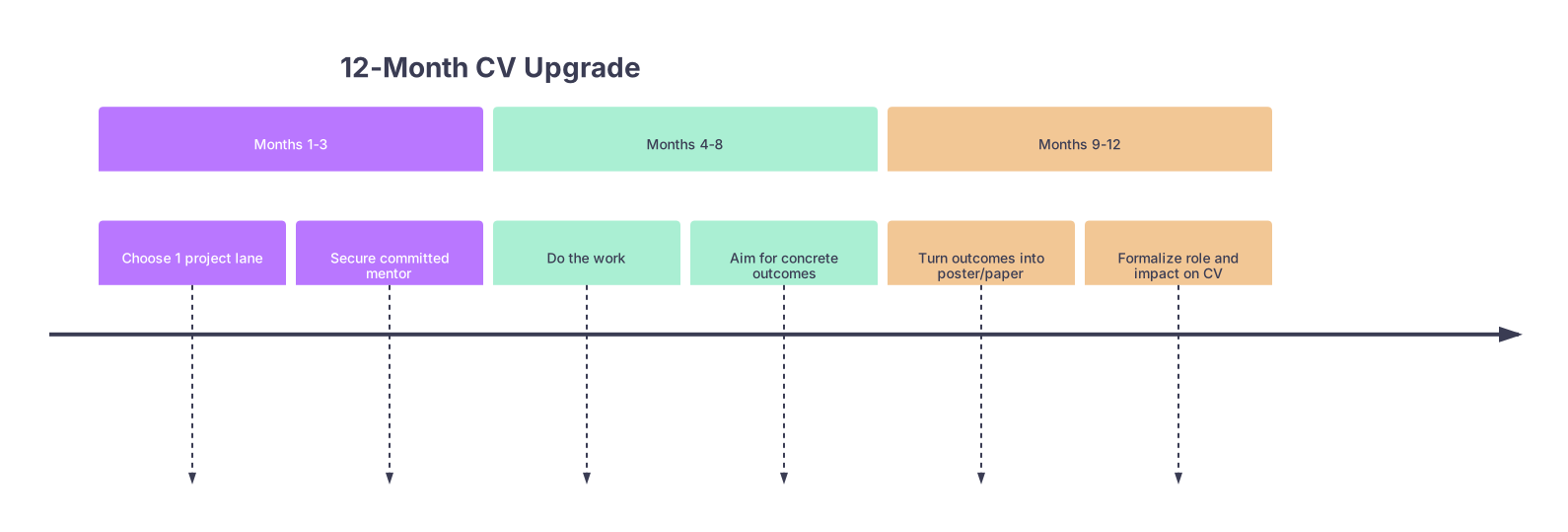
Strategy if you’re 12–18 months from ERAS
Pick ONE main lane and go hard:
- A real QI or research project with a high likelihood of completion.
- A longitudinal clinical or teaching role with visible responsibility.
- A leadership project that changes an actual process or clinic.
Then you document outcomes ruthlessly: numbers, duration, scale.
Strategy if you’re 6–9 months from ERAS
You do not have time for a brand-new RCT. Stop pretending you do.
Focus on:
- Plugging into a nearly-finished project that needs data cleaning, analysis, or writing.
- Taking on a high-responsibility role in an existing clinic/program and making one measurable improvement.
- Tightening and rewriting your existing CV to emphasize impact over activity lists.
I’ve seen students in this window:
- Join a mentor’s stalled manuscript, do the grunt work, and earn middle authorship in time for ERAS.
- Take over a chaotic sign-up process for a free clinic and cut no-shows by 20% in 4–5 months—beautiful QI line.
- Turn 20 sloppy, redundant CV entries into 8 sharp, coherent ones that read like an actual narrative.
Strategy if you’re 1–3 months from ERAS
At this point, the heavy lift is storytelling and cleanup, not new content.
Your best moves:
- Rewrite every bullet for clarity, action, and outcomes.
- Group experiences to show strengths (e.g., combine small roles under “Community Outreach” with 1–2 meaningful bullets).
- Make any “informal” roles formal: if you’ve essentially been leading something without a title, get the title retroactively and clean documentation.
You can still add mini-green flags:
- Short but intense teaching roles (board review sessions, near-peer teaching).
- A discrete micro-project with obvious deliverable (e.g., creating a resident resource guide, standardizing a checklist).
Will that save a catastrophically weak application? No. But it can be the margin between “borderline” and “fine, let’s interview them.”
How Faculty Actually Argue For You In The Room
Let me translate what “green flag” really means in practice.
In a selection meeting, these are the phrases you want people using about you, based on your CV alone:
- “This one looks like they’ll function on day one.”
- “They actually finish what they start.”
- “They’ve already been doing the kind of work we need here.”
- “They’ve handled real responsibility and didn’t implode.”
- “I could see them as a chief resident in a few years.”
Every single one of those sentences can be triggered by how you present your experiences.
A research-heavy PD will fight for you if:
“Look, their Step is 230, but they’ve got 2 first-author posters and a manuscript under review in exactly my area. I want them.”
A clinically-focused associate PD will fight for you if:
“They’ve worked 30 hours a week as a CNA through med school and led QI in their inpatient unit. They’ll carry the service.”
A teaching-oriented faculty will fight for you if:
“They’ve been running the MS1 physiology review series for 2 years, with documented outcomes. That’s exactly the type I want around our students.”
Your job is to give at least one of those people ammunition in your CV.
Key Takeaways
- Faculty don’t fall in love with “busy” CVs. They argue for applicants who show depth, responsibility, and completion—especially in clinical, research, or leadership domains tied to real outcomes.
- The most powerful green flags are longitudinal commitment, finished projects with tangible outputs, and roles where you clearly made something better.
- Even if you’re late, you can upgrade your CV by tightening the story, emphasizing impact, and finishing one or two meaningful projects instead of scattering your efforts.