
The way your CV is actually discussed in rank meetings would make most applicants uncomfortable.
Not because anyone hates you. Because by the time we’re ranking, your CV is no longer your story — it’s a data object competing against 30 other data objects on a screen. And people will summarize months or years of your life in a single off-hand sentence that decides whether you land in the “top third” or “drop them.”
Let me walk you into that room and show you exactly how your CV lives or dies — and what you should be doing now to change that conversation in your favor.
What Really Happens in Rank Meetings
Picture this.
It’s 6:30 pm in a windowless conference room. Everyone is tired, clinics ran late, and we’ve already argued about 40 applicants. On the screen: a massive spreadsheet pulled from ERAS exports and internal notes. Columns for name, school, Step scores, clerkship comments, research, “red flags,” interview score, and three useless columns someone insisted on but no one reads.
Your CV? It’s not being read line-by-line. It’s distilled into a few talking points.
Here’s the rhythm:
One of three things usually happens when your name comes up:
Instant “yes, move them up.”
Someone says, “Oh, that’s the Hopkins sub-I who closed the loop on every patient. Keep them high.” The room nods. Nobody is re-reading your CV. It’s already encoded in people’s heads as “that strong Hopkins sub-I.” You’re safe.Neutral shrug and quick scan.
Program director: “Who interviewed them?”
Resident: “Yeah, solid, nothing weird, liked them, good team vibe.”
Attending: half-glances at your CV summary: “Research is fine, no red flags, middle third.”
You live or die based on how many “wow” candidates we’ve already got.Someone remembers something they didn’t like.
“Is this the guy who complained about work hours during lunch?”
“This is the one with the unexplained year off and no clear reason.”
No one rescues you. They move you down quietly.
Your actual multipage CV? At this stage it’s a memory and a few pulled data points. That’s why how you build and frame your CV months earlier matters far more than you think.
How We Actually Read Your CV Before Rank Day
Let me be blunt: most faculty do not read every line of every CV. They triage.
In practice, your CV is skimmed in a very predictable order:
- Header / Education – School, graduation year, degrees.
- Exam scores / transcripts – Now more Step 1 pass/fail focus moves to Step 2.
- Experiences – Clinical, leadership, research. Only the top 3–5 items get real attention.
- Gaps / weirdness – Anything that looks off in your timeline.
- Patterns – Does this look like a consistent person, or a chaotic one?
If an attending has 12 applicants to interview that day, they are not treating your CV as sacred literature. They’re trying to answer a few core questions fast:
- Can this person handle our workload without falling apart?
- Are they going to be safe with patients?
- Will they make our lives easier or harder at 2:00 a.m.?
- Is there anything special enough here that we’d fight for them on rank night?
Everything else is noise.
So you don’t optimize your CV for detail. You optimize it for conversion: turning a 30–60 second skim into a clear, memorable impression.
The Four Lenses: How Your CV Is Really Judged
In rank meetings, nobody says, “Let us evaluate the domains of your curriculum vitae in a holistic manner.” They grunt out things like:
- “Workhorse.”
- “Research gunner but quiet.”
- “Super green, needs handholding.”
- “Probably chief material.”
- “Risky.”
Behind those comments are four unconscious lenses. If you’re smart, you’ll build your CV to hit these cleanly.
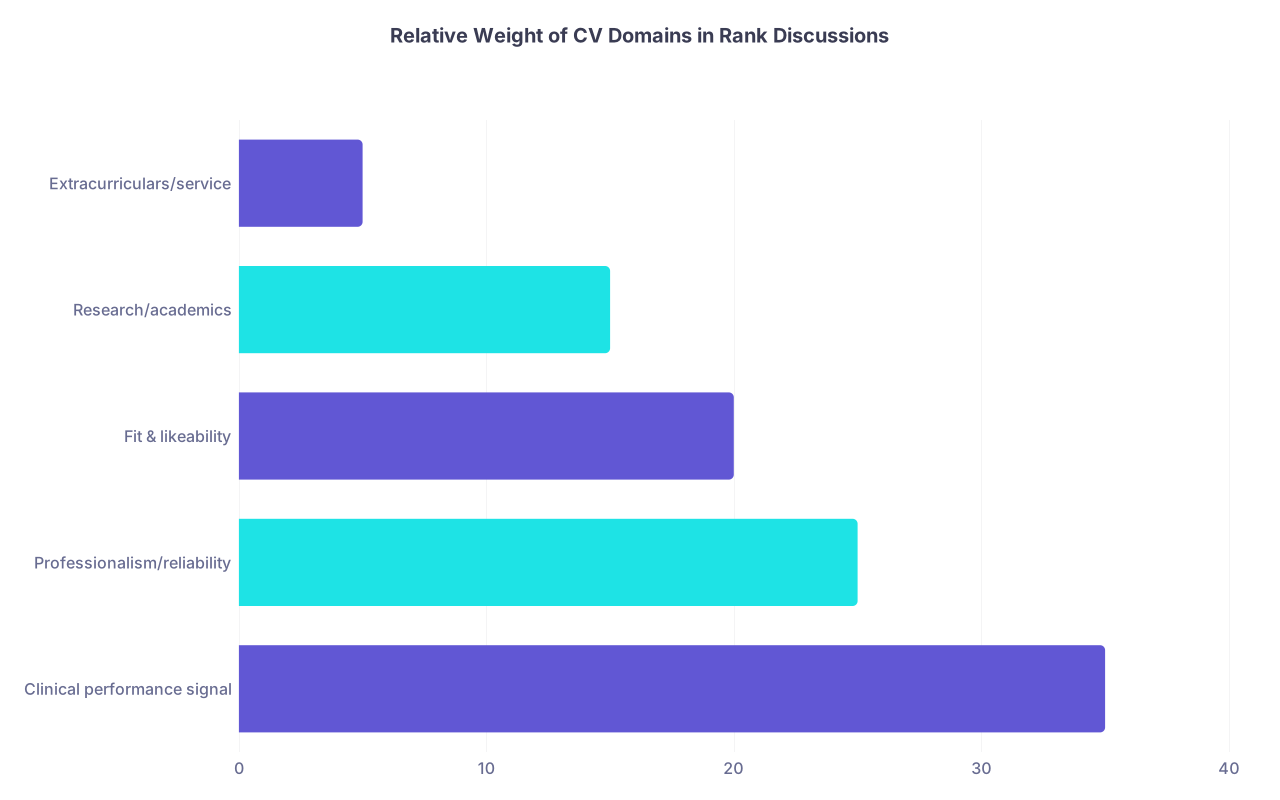
| Category | Value |
|---|---|
| Clinical performance signal | 35 |
| Professionalism/reliability | 25 |
| Fit & likeability | 20 |
| Research/academics | 15 |
| Extracurriculars/service | 5 |
1. Clinical Signal: Can You Do the Work?
This is the big one. When we look at your CV with a clinical lens, we’re asking: Is this someone I’d trust alone with a cross-cover pager by October?
What feeds that impression:
- Sub-I / acting internship sites and comments
- Any mention of “took ownership,” “independent,” “ran the list,” “excellent notes”
- Prior clinical work: scribe, nurse, paramedic, tech, MA
- Procedures or settings that prove you’ve actually seen real patients, not just simulation labs
Two CVs illustrate the difference:
Applicant A:
“Internal Medicine Sub-Internship, University Hospital.”
No details. No bullets. Just a line.
Applicant B:
“Internal Medicine Acting Internship, University Hospital
– Managed 8–10 patients daily; wrote independent notes co-signed by residents
– Led pre-rounds and presented on new admissions; recognized by team for thoroughness”
When we’re in the rank meeting and someone says, “This person actually functioned like an intern on their sub-I,” they’re talking about Applicant B. Applicant A disappears into the spreadsheet.
2. Professionalism & Reliability: Are You a Risk?
Nobody wants to rank a future “problem resident.” The anecdotes that kill you are almost never about your Step score. They’re about reliability. People have long memories for that.
How your CV gets used here:
- Gaps and leaves – If unexplained, they become a whispered, “Why the year off?” in rank meetings.
- Pattern of short, random commitments – Twelve 1-month activities over four years with nothing sustained makes you look flaky.
- Leadership roles – Not the title; whether you held it long enough to matter and whether you actually did something.
If I see:
“Student Interest Group – Member (1 month)” repeated 10 times with different groups, I read that as: loves joining, hates follow-through.
But if I see:
“Free Clinic Coordinator (2019–2023)
– Scheduled 40+ student volunteers each month
– Implemented new triage workflow that reduced wait times by 30%”
In the meeting I’ll say, “They actually ran stuff. Not just a checkbox person.”
3. Fit and Likeability: Will We Want You Around?
This starts on the interview day. But your CV seeds the narrative.
People latch onto hooks. A clean, coherent CV gives them a ready-made story:
- “This is the veteran who worked two jobs through med school.”
- “This is the former software engineer who rebuilt our call sign-out tool.”
- “This is the local kid who wants to stay here long-term.”
Those hooks often come from:
- Long-term commitments that match the program’s population or mission
- Region ties (don’t bury those)
- Language skills with actual use in clinic, not just “conversational Spanish (Duolingo)”
- Clear evidence of team roles rather than solo-hero achievements
In the room, if nobody remembers who you are, you slide to the statistical average. Invisible applicants do not get bumped up at the last second. They get quietly sacrificed when someone says, “We can’t rank everyone this high.”
4. Academic & Research Signal: Can You Advance the Program?
Here’s the blunt truth: research is a lever, not a trophy.
At research-heavy places, your CV is scanned for:
- First or second-author publications in solid journals
- Meaningful poster/oral presentations
- Continuity with a mentor we respect (“Oh, they worked with Dr. X, that lab is intense.”)
At community or service-heavy programs, the bar is lower:
- Any coherent project you saw through to completion
- Grants, QI projects, or presentations at local/regional meetings
What kills you is the fake research CV: 12 “projects,” zero outputs, all “in progress.”
On rank night, that turns into: “Lots of noise, nothing finished.” Translation: this person may never finish a QI project or academic requirement as a resident. Risk.
What People Actually Say About Specific CV Elements
Let’s get painfully specific. I’ve heard variations of each of these during ranking.
Research Sections
- “Fifteen projects, one poster? They don’t finish things.”
- “Two first-author pubs in med school? That’s a machine. They’ll pad our academic numbers.”
- “Two case reports from third year? Fine for a community program, but not enough for us.”
How to weaponize this:
Group and order your research for impact, not chronology.
Put the completed, impressive work at the top under a clear heading. Bundle the truly “in progress” stuff in a smaller section and cap it. Don’t list every half-baked chart review that never got IRB.
| CV Style | Faculty Reaction |
|---|---|
| 2 strong pubs | "Finisher, reliable" |
| 10 in-progress | "Doesn't complete" |
| 1 poster only | "Adequate, not strong" |
| None listed | "Neutral/OK in some" |
Volunteer and Service
Here’s the dirty secret: 80% of volunteer sections read exactly the same to us.
“Health fair volunteer.”
“Free clinic volunteer.”
“Student-run community event.”
What stands out:
- Duration of involvement
- Ownership (did you just show up, or did you run the thing?)
- Evidence you understand the population cared for by our program
On rank day, you want to hear something like, “This is the person who ran the refugee clinic for three years and speaks Arabic; they’re perfect for our patient population.” That does not come from a laundry list of 10 vague activities.
Leadership
We do not care about titles. We care about work.
“President, Student Council” by itself is meaningless. Everyone is “president” of something nowadays.
But:
“Student Council President (2021–2022)
– Led restructuring of peer tutoring program, expanding participation from 15 to 60 students
– Negotiated with administration to fund wellness initiatives for clerkship students”
Now, in the meeting someone can say, “They actually negotiated with admin; they’ll help us with resident committee work.”
Hobbies and Interests
You think this section doesn’t matter. It does more than you realize, but in a very specific way.
Hobbies are used for:
- Interview small talk
- Gauging whether you’re a human being or a Step robot
- Occasionally pushing you up or down if something really resonates (or really alarms)
But in rank meetings, only the memorable or odd ones surface:
- “That’s the rock climber who’s been to 20 national parks; super grounded.”
- “This is the semi-pro gamer who kept talking about streaming instead of anything clinical.”
- “Ultra-marathon runner, very disciplined.”
If your hobbies read like ChatGPT wrote them — “Running, reading, traveling” — nobody will mention them. You’re wasting valuable real estate.
How to Rebuild Your CV So It Works in That Room
Let’s stop being abstract. Here’s what you should actually do to change what’s said when your name pops up.
1. Front-Load Signal, Bury the Noise
Your ERAS CV is long. The rank spreadsheet is not. You have to make it easy for us to pull the right story.
Reorder and rephrase so that your top:
- 2–3 clinical experiences
- 1–2 leadership roles
- 1–3 research/academic outputs
- 1–2 service commitments
convey a coherent identity.
Example coherent identities:
- “Serious clinician with strong ownership and teaching potential.”
- “Research-heavy, but surprisingly normal and collaborative.”
- “Service-oriented, Spanish-speaking, perfect for safety-net hospital.”
If your CV shows a bit of everything, but nothing deep, the identity becomes: “Generic med student, no obvious angle.” Those get lost in the middle.
2. Write Bullets That Sound Like What We Say
You want your bullets to be convertible into the kind of one-liners faculty throw out in the room.
Bad bullet:
“Participated in patient care as part of a multidisciplinary team.”
Nobody repeats that sentence out loud.
Strong bullet:
“Assumed responsibility for daily management of 6–8 inpatients; independently wrote plans that frequently went unchanged by resident and attending.”
On rank night that becomes: “They basically wrote full plans; strong clinical judgment for a student.”
Train yourself: every bullet should pass the “would someone actually say this about me?” test.
3. Clean Up the Red Flags Before You Submit
Here’s where people get burned.
Anything that makes us pause and say, “Wait…what happened here?” will cost you spots unless:
- It’s explained clearly in your application
- You have a plausible, mature narrative ready on interview day
- You’re consistent across PS, CV, and interview
Common landmines:
- Unexplained leaves or time off – Even for good reasons, if you’re vague, the worst assumptions win.
- Inconsistent dates – Sloppy or dishonest? Either one is bad.
- Lots of started-but-abandoned roles – Explains why programs call you “flighty.”
If you’ve got a rough patch — failed exam, LOA, personal crisis — it’s survivable. But only if your CV around it screams, “I stabilized and then thrived.” Continuity and upward trajectory are your friends.
Timing: When Your CV Actually Matters Most
People focus on the wrong moment. They obsess over what happens in the 2-hour rank meeting and ignore the 6 months before that.
Here’s the real sequence:
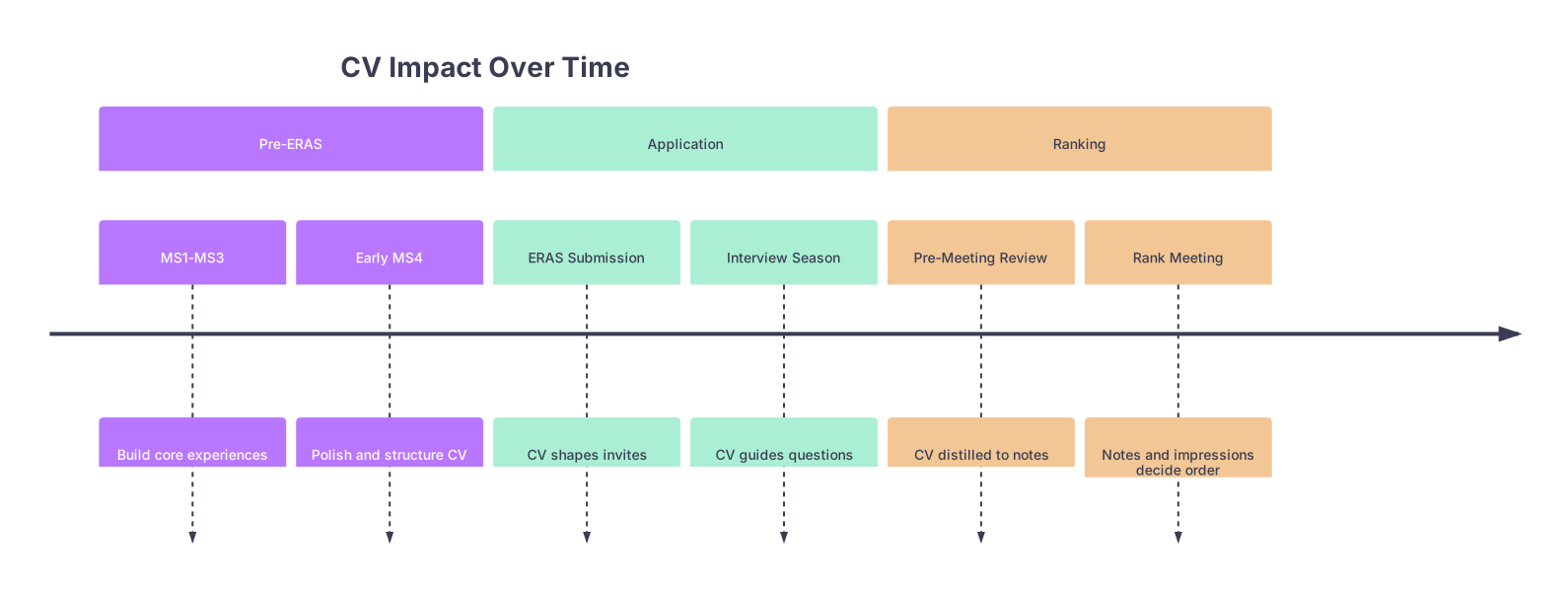
| Period | Event |
|---|---|
| Pre-ERAS - MS1-MS3 | Build core experiences |
| Pre-ERAS - Early MS4 | Polish and structure CV |
| Application - ERAS Submission | CV shapes invites |
| Application - Interview Season | CV guides questions |
| Ranking - Pre-Meeting Review | CV distilled to notes |
| Ranking - Rank Meeting | Notes and impressions decide order |
You influence the rank room by:
- What you did during M2–M4
- How you framed it in ERAS
- How you talked about it on interview day
By the time we’re arguing about your rank, the CV is not being “re-evaluated.” It’s being remembered. Or forgotten.
How Different Programs Talk About the Same CV
Not all programs weigh your CV the same way. Let me pull back the curtain on three archetypes.
| Program Type | What They Look For First |
|---|---|
| Academic powerhouse | Research, letters, test scores |
| Large county/safety-net | Grit, language, service |
| Community program | Reliability, team fit |
Academic Powerhouse (think: MGH, UCSF, Penn-level)
Conversation style:
- “Any first-author?”
- “Who wrote their letter?”
- “Do they have staying power for fellowship?”
Your CV needs:
- Clear research productivity
- Strong institutional or mentor names
- Evidence of academic trajectory (not just random one-offs)
Safety-Net / County / Mission-Driven
Conversation style:
- “Have they worked with underserved populations?”
- “Do they actually speak Spanish/another language and use it?”
- “Are they going to burn out on our patient volume?”
Your CV needs:
- Long-term service with similar populations
- Real language use in clinic
- Evidence you know exactly what you’re signing up for
Community / Balanced Programs
Conversation style:
- “Are they normal?”
- “Are they going to complain or work?”
- “Will they leave for fellowship immediately, or actually stay invested?”
Your CV needs:
- Stability, local or regional ties if you have them
- Sane, relatable interests and hobbies
- Some but not overwhelming research (too much can read as “flight risk”)
If you’re smart, you’ll subtly tilt the framing of your experiences in ERAS to match the programs you’re targeting — without lying and without rewriting your entire CV.
A Quick Reality Check: What You Can Still Change
You might be reading this late — MS4, ERAS already looming. You do not have time to reinvent yourself. But you can still meaningfully change how your CV plays in that room.
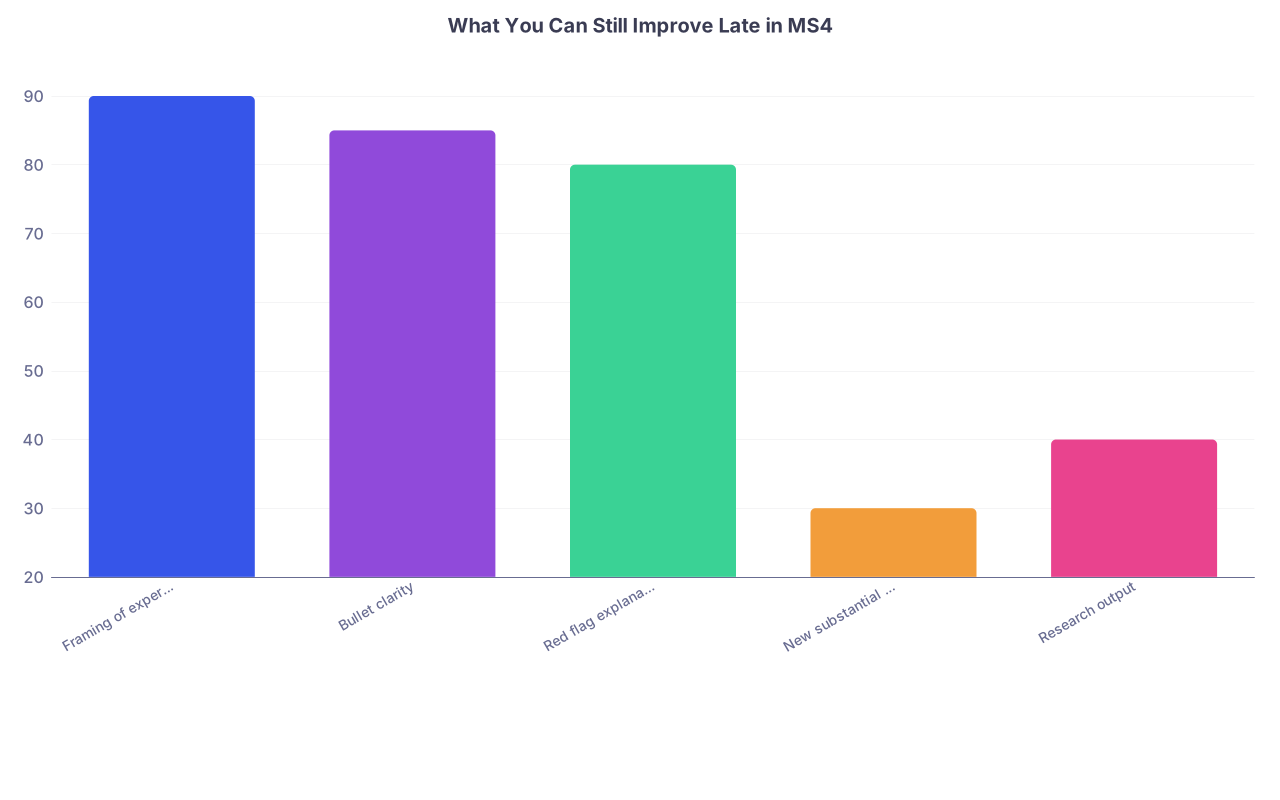
| Category | Value |
|---|---|
| Framing of experiences | 90 |
| Bullet clarity | 85 |
| Red flag explanation | 80 |
| New substantial activity | 30 |
| Research output | 40 |
You can:
- Rewrite your bullets so they sound like real, strong endorsements.
- Reorder sections to spotlight a coherent identity.
- Get faculty or residents to read your CV and literally tell you what they would say about you in a rank room. Then rewrite until what they say matches what you want.
- Address gaps directly rather than hoping people won’t notice. (They will.)
You probably cannot:
- Magically create substantial new long-term service or leadership.
- Pump out three first-author publications in four months.
- Erase a pattern of flakiness. But you can show that you stabilized.
Do not waste time chasing cosmetic tweaks while ignoring glaring narrative problems.
FAQs
1. How much does my CV actually matter compared to my interview?
Your CV gets you in the door and shapes expectations; your interview confirms or contradicts the story. For most programs, the ranking equation looks roughly like: interview performance + letters + CV signal + exam performance. If your interview is amazing but your CV is chaotic or weak, you’ll climb a bit but not to the top. If your CV is strong and your interview is mediocre-but-not-bad, you often still land solidly in the middle or upper-middle.
2. Should I list every small activity, or only the major ones?
List fewer, better-developed experiences. In rank meetings, nobody cares that you went to four different health fairs once each. They care that you ran a clinic for two years, or led a committee, or saw a project through to publication. If an experience doesn’t add to a clear narrative — clinician, leader, researcher, service-oriented — it’s clutter. Clutter makes it harder for us to see what you’re actually good at.
3. Are “in progress” research projects worth including?
Only if there is something tangible to show and a realistic endpoint. One or two substantial ongoing projects with IRB approval and a clear dissemination plan are fine. Ten “retrospective chart review, data collection in progress” lines make you look unserious. On rank day, those get translated as “won’t finish anything.” Err on the side of fewer, more meaningful projects.
4. How do I handle a bad year or a leave of absence on my CV?
Own it and frame it. A vague gap will hurt you more than a clearly explained one. Use your application (and, if needed, a short, factual note in the CV or experiences) to say what happened in professional language, what you did to address it, and how you performed afterward. Rank meetings are surprisingly forgiving when there’s obvious recovery and sustained performance after a rough patch. What scares people is unexplained instability.
You now know what’s actually being said when your name comes up in that cramped conference room.
Your next move is simple: go back to your CV, line by line, and ask yourself, “If a tired attending had 30 seconds with this, what one sentence would they say about me in a rank meeting?” If you don’t like the answer, rewrite until you do.
Once that’s done, we can talk about how to make your interviews reinforce that same story — so the CV, the conversation, and the letters all push you up the list instead of fighting each other. But that’s a strategy for another night.