
You are staring at your ERAS “Experiences” page. The counter says 32 entries.
Research, QI projects, five “leadership roles,” six tutoring gigs, four community clinics, three student org boards, two advocacy campaigns… and you are still thinking of adding more.
Somewhere along the way you absorbed a dangerous idea: more lines = stronger application.
This is how applicants quietly sabotage themselves.
Let me walk you through how overloaded CVs hurt you, how programs actually read that chaos, and how to fix it before it costs you interviews.
How Program Directors Actually Read Your CV (Not How You Think)
First reality check: nobody is reading your CV like it is your LinkedIn.
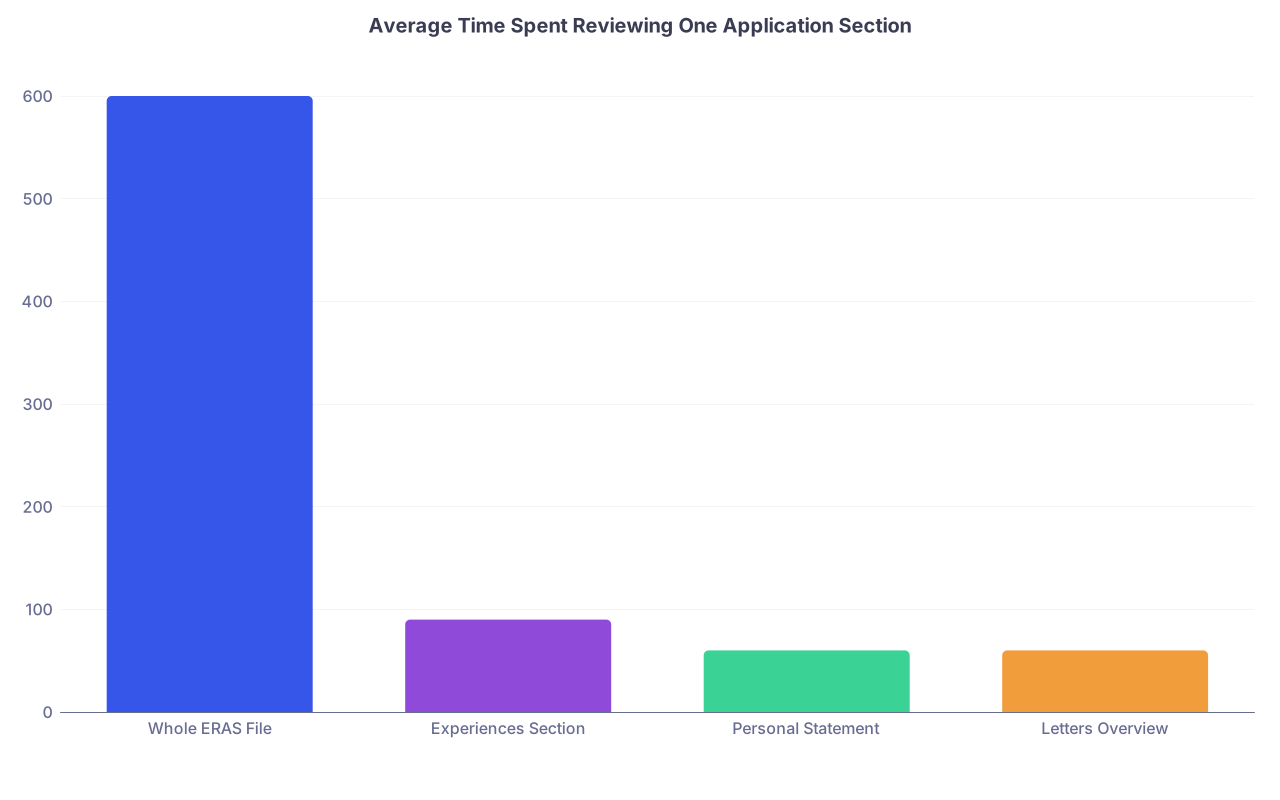
| Category | Value |
|---|---|
| Whole ERAS File | 600 |
| Experiences Section | 90 |
| Personal Statement | 60 |
| Letters Overview | 60 |
That “Experiences” section? If you are lucky:
- 60–90 seconds total
- Skimming for:
- Depth vs fluff
- Consistency of story
- Red flags (inflated roles, dishonesty, randomness)
When you overload your CV, here is what happens on their side:
They stop trusting your judgment.
If you list everything, you are telling them you cannot prioritize. Residency requires ruthless prioritization.They assume half of it is padding.
If you have 28 activities vs someone with 10 solid ones, the burden is on you to prove your list is not noise. Most applicants fail that test.They miss the actually impressive parts.
Buried research that led to a publication. Real leadership. Long-term service. All diluted by “member,” “participant,” “volunteer – 1 day event.”
I have sat in meetings where someone literally said:
“Too much stuff. I do not believe they did all of this meaningfully.”
That is the reaction you must avoid.
The Most Common “Overloaded CV” Mistakes
You are probably committing at least two of these. Some people manage all of them.
1. Listing Every Single Thing You Ever Touched
You volunteered one afternoon at a health fair.
You attended a single committee meeting.
You joined six organizations and never did anything beyond paying dues.
And they are all on your CV.
This is how you signal:
- “I care about checking boxes more than doing real work.”
- “I think you are too naive to notice I padded this.”
If the description starts with “Attended…” or “Participated in…” and ends there, it probably does not belong.
Blunt rule:
If you cannot talk about it for 2–3 coherent minutes in an interview without reaching, it should not be on your CV.
2. Fragmenting One Role Into Five Separate Entries
Example I see all the time:
- “Student-Run Free Clinic – Volunteer”
- “Student-Run Free Clinic – Shift Leader”
- “Student-Run Free Clinic – Quality Improvement Member”
- “Student-Run Free Clinic – Spanish Interpreter”
Four ERAS entries. One actual activity.
This is a classic move from applicants trying to make their page look longer. Programs notice. It reads as either:
- You are gaming the system, or
- You have not learned to synthesize information, which is a genuine problem in residency.
Better: one consolidated entry, with bullet points or brief sentences showing progression and roles.
3. Overblown Titles and Inflated Roles
This one is a massive red flag.
- “Director of Clinical Operations” → You scheduled volunteers for the clinic.
- “Chief Research Coordinator” → You consented patients and entered data.
- “Lead Educator” → You gave two review sessions before exams.
People in residency know exactly how these roles work. When your title does not match your level (MS1 “director,” “chief,” or “executive” anything), it erodes trust.
Once your credibility is in question on one entry, readers start doubting the rest of your file. That is poison.
4. Five Research Projects, Zero Output
Another pattern:
- “Research Assistant – Oncology”
- “Research Assistant – Cardiology”
- “Research Assistant – Emergency Medicine”
- “Research Assistant – Quality Improvement”
- “Research Assistant – Global Health”
Years of “assistant” with no:
- publications
- posters
- presentations
- concrete deliverables
That looks like:
- You chase lines on a CV instead of finishing work.
- You have poor follow-through.
- You care about starting more than finishing.
Program directors much prefer:
- One or two projects that clearly went somewhere
- A poster, abstract, or at least a defined outcome
over five abandoned efforts.
5. Random, Unrelated Activities That Break Your Story
You are applying to Internal Medicine with a supposed interest in outpatient primary care.
But your activities list includes:
- Anesthesia interest group leadership
- One random ortho research project
- A short plastics observership
- A month of “innovation hackathon” work with no clinical tie-in
The message: you have no real direction. You are chasing whatever looks shiny or “prestigious.”
No, you do not need a perfectly linear life story. But if your CV screams “career tourism,” it weakens your application narrative.
Why “More Activities” Actually Backfires
Let me be explicit about how this hurts you.
1. You Dilute Your Strengths
Suppose you have:
- Long-term clinic involvement
- Strong research with a first-author abstract
- A solid teaching role
These three could genuinely shape an appealing profile.
But you bury them under:
- 12 short-term volunteering experiences
- 6 passive memberships
- 5 “attended conference” entries
- 4 generic “community outreach” one-off events
Result: No single strength stands out. You look busy, not capable.
2. You Increase the Chance of Inconsistencies
The more lines you add, the higher the risk of:
- Date overlaps that look impossible
- Hours estimates that make no sense
- Descriptions that contradict each other
- Typos and sloppiness
Reviewers are very attuned to this. When they find inconsistencies, they do not patiently resolve them; they question your reliability.
3. You Set Yourself Up to Fail During Interviews
Overloaded CV = more landmines.
Interview questions you invite:
- “Tell me about this committee – what did you actually accomplish?”
- “You list ‘Lead Coordinator’ here. What did you lead specifically?”
- “You said you spent 10 hours per week on this for 3 years. How did you balance that with your clerkships?”
If your answers sound hesitant, vague, or rehearsed:
- They assume padding.
- They assume exaggeration.
- They assume you wrote what you thought they wanted to hear.
That is how strong Step scores get quietly overridden by “concerns about integrity” in closed-door ranking meetings.
Depth vs Breadth: What Programs Actually Prefer
Let us put some structure around this.
Most residency programs are not impressed by sheer quantity. They care about:
- Maturity
- Reliability
- Ability to finish things
- Coherent interest in their field
| Profile Type | Activities Count | Typical Impression |
|---|---|---|
| Deep, Focused | 8–14 | Serious, trustworthy |
| Balanced | 15–20 | Busy but believable |
| Overloaded | 21+ | Padding, scattered |
Of course there are exceptions (MD/PhD, non-trads with prior careers, true super-achievers). But if you are a typical US MD/DO student, hitting 25–30 entries is not impressive. It is suspicious.
Program directors repeatedly say they want:
- Sustained involvement (≥1–2 years in something meaningful)
- Progression of responsibility (member → coordinator → leader)
- Concrete outcomes (poster, curriculum built, workflow improved)
- Alignment with specialty (not perfect, but understandable)
Breadth does not win against depth. Unless you are applying to “Varied Experiences Residency” (which does not exist).
How to Clean Up an Overloaded CV Before You Submit
So what do you do if your ERAS page already looks like a scrapbook?
Time to cut. Aggressively. Here is how, step by step.

| Step | Description |
|---|---|
| Step 1 | Start with full CV |
| Step 2 | Group related activities |
| Step 3 | Remove trivial or one day events |
| Step 4 | Eliminate passive memberships |
| Step 5 | Check for inflation in titles |
| Step 6 | Align with specialty story |
| Step 7 | Limit to high impact experiences |
Step 1: Group Related Activities
If you have:
- Multiple roles within the same clinic
- Different positions in the same student organization
- Several related tasks under one research umbrella
Combine them into a single, well-written entry.
This shows:
- Growth over time
- Organizational skills
- Honesty about what is actually one experience with multiple phases
Step 2: Delete Low-Impact, One-Off Activities
Be ruthless with:
- Single-day health fairs
- One-time shadowing days
- Events where your role was “attended” or “participant”
- Things you barely remember
Ask yourself:
- Did I contribute something non-trivial?
- Is this aligned with my overall narrative?
- Would I be comfortable being grilled on this in a high-stakes interview?
If the answer is no, it is not worth a line.
Step 3: Remove Passive Memberships
“Member, Internal Medicine Interest Group.”
“Member, Surgery Club.”
“Member, AMA, ACP, ACPM, APHA…”
Membership lists are almost meaningless unless:
- You held a leadership role
- You helped plan events
- You created initiatives
- You did sustained work under that umbrella
Otherwise, it is white noise. Programs know med schools push students to sign up for everything. They are not fooled.
Step 4: Fix Inflated Titles and Descriptions
Scan for words that scream exaggeration:
- Director
- Chief
- Executive
- Founder (when it is really just you and a friend)
- Lead (when no one actually reported to you)
Then:
- Adjust titles to be honest and clear
- Rewrite descriptions to match what you truly did
- Remove buzzwords that imply more authority than you had (strategic, executive, organizational restructuring, etc.)
If you feel a little uncomfortable reading the entry aloud to an attending, it is probably still overstated.
Step 5: Align With Your Specialty Story
You do not need everything to be specialty-specific, but you do need a coherent picture.
Applying to:
- Psychiatry? Prioritize mental health work, longitudinal patient contact, advocacy, communication-heavy roles.
- Surgery? Prioritize procedural exposure, OR research, durability, QI, teamwork in high-stress settings.
- Pediatrics? Emphasize work with children, teaching, patience, family communication.
You can keep a few unrelated things that show you are a human being (music, sports, serious non-medical volunteering), but the core of your CV should not fight your stated interests.
Writing Stronger, Leaner Experience Descriptions
You have trimmed the list. Now the descriptions themselves need to stop sounding like fluff.
Bad pattern I see constantly:
- “Worked collaboratively in a team to improve patient care.”
- “Attended weekly meetings to discuss important clinical topics.”
- “Helped coordinate various events to promote wellness.”
This is filler. It says nothing.
Stronger approach:
- Start with your role and scope.
- Add one or two concrete actions.
- Include one measurable or specific outcome when possible.
Example – weak vs strong:
- Weak: “Director of community outreach, organized multiple events.”
- Strong: “Coordinated monthly blood pressure screening events at a community clinic, recruiting and scheduling 15 student volunteers per session and tracking >300 screenings over 6 months.”
No need to write novels. Just be specific and believable.
When a “Busy” CV Is Actually a Red Flag for Burnout
One thing applicants forget: program directors are not just picking high achievers. They are picking people who will not crash and burn 6 months into intern year.
An overloaded CV can quietly communicate:
- You do not know how to say no
- You overextend yourself to impress others
- You are at high risk for burnout
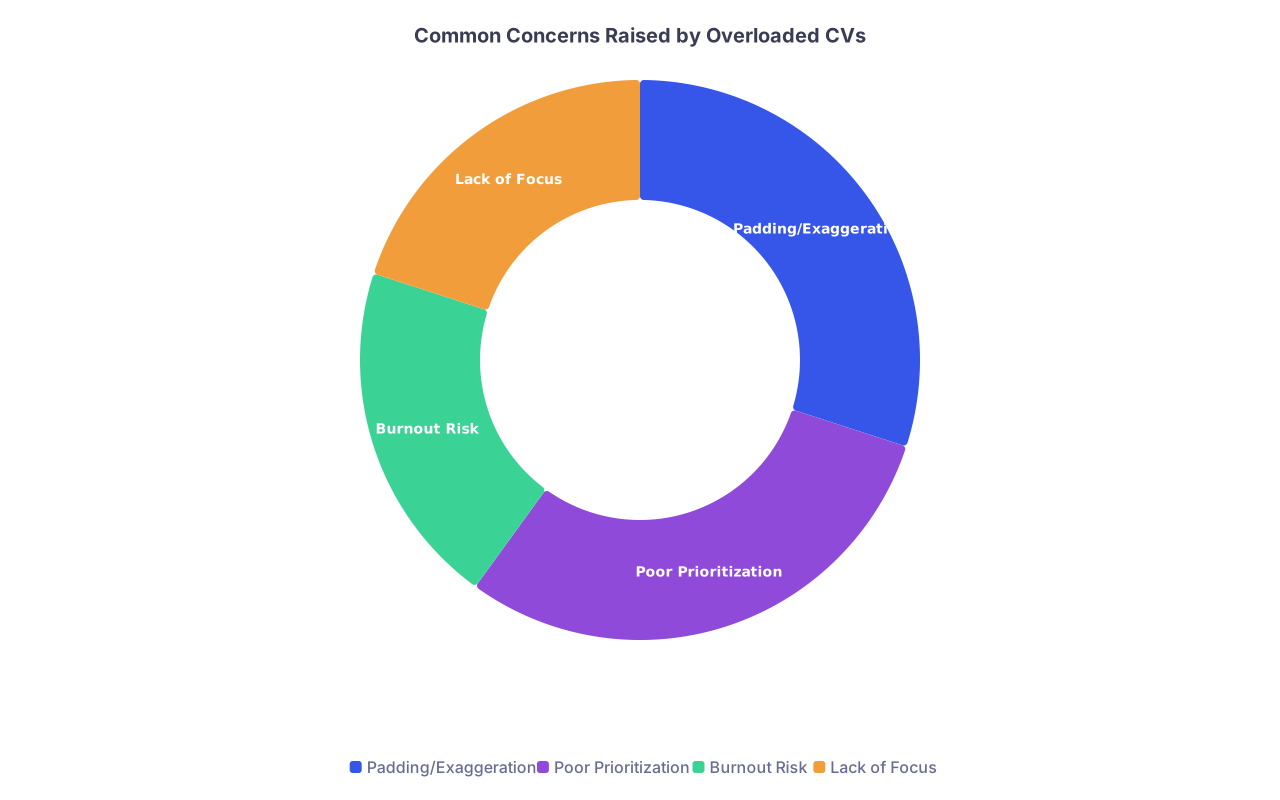
| Category | Value |
|---|---|
| Padding/Exaggeration | 30 |
| Poor Prioritization | 30 |
| Burnout Risk | 20 |
| Lack of Focus | 20 |
I have heard variations of this around selection committee tables:
- “If they needed 30 activities to feel okay about themselves, how are they going to handle having to drop things as an intern?”
- “This student seems unable to prioritize. That is a huge issue on wards.”
You want your CV to show:
- You choose your commitments carefully
- You stick with them
- You accomplish things without collecting 25 side quests
How Many Activities Is “Too Many”?
No magic number, but some guardrails help.
For a typical, non-MD/PhD applicant:
- Clinical experiences: 3–6 solid entries
- Research: 1–3 meaningful projects
- Leadership/teaching: 2–5 entries
- Service/volunteering: 2–5 entries
- Other (hobbies, work): 1–3 entries
If you are creeping past low 20s, ask yourself why. Genuine productivity or fear-based padding?

Some people will legitimately have more — serious prior careers, extensive research, or dual degrees. That is fine if:
- Each entry is meaningful
- You can talk about all of it smoothly
- It tells a coherent story rather than looking like noise
If you are adding something just because the box is empty and you are anxious leaving it blank, that is exactly what you should not add.
Getting a Reality Check (Before It Is Too Late)
Final step: get an external, honest pair of eyes.
Ask:
- A resident in your target specialty
- A trusted attending who reads applications
- A mentor who has sat on selection committees
Do not ask, “Does this look okay?”
Ask, “What would you cut if this were your CV and you wanted to look serious and focused?”
And then actually cut those things.
If three different people say, “You have way too many activities,” that is not a personality difference. That is feedback you ignore at your own risk.

Two Final Things To Remember
- An overloaded CV does not make you look impressive. It makes you look unfocused, insecure, and sometimes dishonest.
- A lean, honest, well-curated set of experiences with real depth and clear outcomes will do more for your residency application than 30 scattered lines ever will.
If you are spending more time adding lines to your CV than actually doing meaningful work, you are already making the mistake. Stop padding. Start pruning.