
The way most people “update” their CV when changing specialties is lazy and gets them filtered out.
You cannot just add “interested in [new field]” and hope for the best. If you’re moving from surgery to radiology, from psychiatry to neurology, from IM to anesthesia—your CV has to argue a case for that switch. On its own, without you in the room.
I’m going to walk you through how to do exactly that.
Step 1: Get Clear On Your Story Before You Touch the CV
If you are changing direction within medicine, your CV has only three jobs:
- Prove you’re serious about the new field
- Reassure them you’re not a problem applicant
- Show you bring something extra from your original track
You cannot do that if your own story is fuzzy.
Sit down and answer these blunt questions on paper. Not on your phone. On paper.
- What specifically pulled you away from your initial field? (Not “I like lifestyle.” That’s a death sentence.)
- What concretely drew you toward this new specialty? (Patients, procedures, mindset, diagnostic style, team environment.)
- When did this interest start and how has it shown up in your actions over time?
- What have you already done to explore or commit to the new field?
If your honest answers are basically: “I did not get the spot I wanted, and this seems okay,” then you have work to do before touching the CV. You need experiences—electives, observerships, projects—to make the pivot look intentional, not desperate.
We’ll come back to that.
Step 2: Rebuild Your CV Structure Around the New Field
Your old CV is organized around your old path. It probably screams “future surgeon” or “psych-bound” from the first third of the page.
You’re going to flip that.
Top of your CV should now be:
- Identification + Contact
- Education
- Clinical Experience – prioritized for the new specialty
- Research / Scholarly Activity relevant to the new field
- Additional Clinical / Work Experience
- Leadership / Teaching
- Skills & Certifications
- Interests (optional, but can be useful for “humanizing” you)
Notice what’s missing: no “Objective,” no vague “Career Statement.” Save that for your personal statement. CV = evidence, not argument.
Now, inside each section, your job is to:
- Move new-field-relevant items up
- Rewrite descriptions so they highlight transferable skills and themes that match the new specialty
- Softly de-emphasize the old specialty “identity” without hiding your past
Step 3: Rewrite Clinical Experience With a New Lens
This is where most people blow it. They leave old rotation descriptions as “3rd year core surgery rotation: assisted in X cases.” That just brands you as “the surgery guy who bailed.”
You’re going to reframe.
Example: Switching from Surgery to Radiology
Old version (surgery-focused):
General Surgery Sub-Internship, University Hospital
- Assisted in >60 major abdominal procedures including Whipple, colectomy, cholecystectomy
- Managed floor patients including post-op complications, fluid management, TPN
- Performed bedside procedures including suturing, I&D, central line placement under supervision
Rewritten for radiology:
General Surgery Sub-Internship, University Hospital
- Independently reviewed pre- and post-operative CT and MRI with residents to correlate imaging findings with operative anatomy and outcomes
- Collaborated with radiology during daily case planning for complex hepatobiliary and colorectal cases, reinforcing understanding of cross-sectional anatomy
- Documented clinical-imaging correlation in post-op notes, improving recognition of complications on follow-up imaging
Same rotation. Very different signal.
You’re not lying. You’re choosing which 10% of what you actually did to foreground.
Example: Switching from Psychiatry to Neurology
Old (psych-leaning):
Inpatient Psychiatry Rotation
- Managed 8–10 patients with mood and psychotic disorders
- Led daily psychotherapy groups
- Coordinated discharge planning and community resources
New (neuro-leaning):
Inpatient Psychiatry Rotation
- Evaluated patients with overlapping psychiatric and neurologic presentations including functional neurologic disorder, neurocognitive disorder, and seizure vs psychogenic events
- Performed detailed mental status and cognitive examinations, incorporating MoCA and MMSE to differentiate neurocognitive impairment from primary mood disorder
- Collaborated closely with Neurology service on complex diagnostic cases, improving comfort with multidisciplinary workups
Same rotation, different headline.
Your rule: for every major clinical entry, ask:
- How can I highlight decision-making, thinking style, and skills that map onto my new specialty?
- Where did I collaborate with the new field or use tools they care about (imaging, EEG, hemodynamics, behavioral plans, etc.)?
Step 4: Turn Old Research Into “New Field” Currency
If you’ve got research in the old field, you do not hide it. You repurpose it.
Programs care about:
- Can you complete projects?
- Can you present and publish?
- Do you understand basic study design, stats, and academic professionalism?
Whether your paper was in orthopedic outcomes or ED workflow—those skills transfer.
Example: Ortho research → PM&R or Anesthesia
Original:
Research Assistant, Orthopedic Surgery
- Retrospective review of outcomes following ACL reconstruction
- Collected and entered data for 200+ patients
- Presented poster at Regional Orthopedic Conference
Reframed for PM&R:
Research Assistant, Orthopedic Surgery
- Retrospective analysis of functional outcomes following ACL reconstruction, focusing on return-to-sport timelines and long-term mobility
- Managed and analyzed dataset of 200+ patients using SPSS, emphasizing functional status metrics relevant to rehabilitation
- Presented poster at regional conference, gaining experience communicating musculoskeletal outcomes to multidisciplinary clinicians
Reframed for Anesthesia:
Research Assistant, Orthopedic Surgery
- Evaluated postoperative outcomes and pain control following ACL reconstruction, with attention to analgesic protocols and recovery trajectories
- Managed large clinical dataset, collaborating with statistics team to analyze perioperative variables
- Presented findings at regional conference, strengthening skills in evidence-based discussion of surgical outcomes and perioperative care
Same project, tailored emphasis.
If you have zero research near your new field, you need at least one meaningful thing—case report, QI project, retrospective chart review—that touches your target specialty. Even a small, well-described case report can do a lot of signaling.
Step 5: Fix the Timeline Problem (So You Don’t Look Like a Red Flag)
Every specialty switch has two landmines:
- Gaps (months with nothing obvious)
- “Why did you leave?” questions
Your CV should not leave the reader confused about what you were doing during:
- The year you tried to match into your original specialty
- The period after you did not match, or decided to switch
- Time in a preliminary year or other training
You handle this by being clean and factual in your entries. No drama. No over-explaining. Just:
- Dates
- Position
- Institution
- 2–4 bullet points of what you actually did
Example: You did a prelim surgery year, now applying to Internal Medicine
Create an entry:
Preliminary Surgery Resident, PGY-1
City Medical Center, July 2023 – June 2024
- Managed 12–18 inpatients on general surgery and trauma services, including pre- and post-operative care
- Developed strong skills in acute management of sepsis, GI bleeding, and postoperative complications in coordination with medicine and ICU teams
- Participated in weekly morbidity and mortality conferences and interdisciplinary rounds
- Completed required didactics and simulation curriculum
Don’t add, “Left program due to change in career goals.” That belongs in your personal statement or during interviews, not as a line in the CV.
Your CV’s job is to show continuity, professionalism, and growth. Not to litigate your entire life story.
Step 6: Add Targeted New-Field Experiences Quickly
If you’re early in the pivot, your CV may be embarrassingly thin for the new specialty. That is fixable, but you have to be explicit and intentional.
You need at least three types of evidence:
- Direct clinical exposure to the new field
- One scholarly/academic or QI activity touching the new field
- Proof of mentorship or professional integration in the new community
How to create these fast (3–6 months window)
- Ask for an elective/sub-I in the new field, even if it’s late
- Set up a 1–2 week observership if electives are impossible
- Say to a faculty member: “I’m switching from X to Y. I need a small but meaningful project that can be realistically completed in 3–4 months. I’ll do the grunt work.”
- Volunteer to help with chart reviews, protocol write-ups, teaching slides, patient education materials—anything that attaches your name to the specialty
- Get on a committee, journal club, or teaching activity in that department
Then you name these things clearly on the CV:
Neurology Elective – Stroke Service
Community Hospital, April 2025
- Participated in acute stroke evaluations in ED and inpatient settings
- Observed and assisted with NIH Stroke Scale assessments
- Joined daily rounds and case discussions emphasizing localization and imaging correlation
Quality Improvement Project – Radiology Turnaround Times
- Collaborating with Radiology department to analyze ED CT turnaround times and identify workflow delays
- Presenting recommendations to department leadership, focusing on interventions to improve acute care imaging efficiency
You’re building a paper trail that says: “This person did not wake up last week and decide to apply here. They’ve been moving in this direction.”
Step 7: Letters and Mentions That Support the CV Story
Your CV and letters have to sing the same song.
If you’re switching from, say, EM to Anesthesia, and every strong letter is from EM people saying “future emergency physician,” that’s a problem. Not fatal, but messy.
You want:
- At least 1–2 strong letters from your new field, even if you’ve known them for only a few months
- One prior-field letter that emphasizes transferable qualities (work ethic, clinical judgment, composure) without locking you into that field’s identity
- Mentions on your CV of roles and collaborations that match what those letter writers will describe
Tell your new-field letter writers directly:
“I’m applying to [specialty]. I previously aimed for [old specialty], but I’ve pivoted and have been doing [X, Y, Z] to commit to this field. I’d really appreciate if the letter could speak to my suitability for [specialty] and the work I’ve done here.”
Most attendings actually respect a well-argued pivot if you’re honest and organized.
Step 8: Use a Skills & Procedures Section Wisely
If your original field is procedure-heavy and you’re moving to something different (or vice versa), this section can be gold or a landmine.
Bad version (screams “surgeon who still wants to cut”):
Procedures: Laparoscopic cholecystectomy assistance, bowel anastomosis assistance, central lines, chest tubes, intubations, arterial lines, wound debridement
Better version for Anesthesia pivot:
Procedural Skills
- Airway: Bag-mask ventilation, basic airway assessment, assisted with endotracheal intubation under supervision
- Vascular access: Peripheral IVs, assisted with central venous catheter placement
- Perioperative: Familiarity with OR workflow, sterile technique, and multiparameter monitoring
Better version for IM pivot:
Clinical Skills
- Managing acutely ill inpatients with sepsis, GI bleeding, electrolyte disturbances
- Coordinating care between surgical, medicine, and ICU teams
- Basic procedures: peripheral IV placement, simple wound care
You’re not trying to show off everything you can do. You’re trying to show the subset that matters to where you’re going.
Step 9: Make the Formatting Conservative and Clean
Program directors are not impressed by design experiments. Especially if you’re already a bit of a question mark because of a field change.
Basic rules:
- 10–11 pt font, standard (Calibri, Arial, Times, etc.)
- One consistent bullet style
- No fancy colors, no graphics
- Month/Year for all dates, aligned in one column
- Clear section headings, generous white space
The more conservative the formatting, the more the content—and your story—carries the weight. That’s what you want.
Example Comparison: IM to Anesthesia CV Snapshot
| Section | Old IM-Focused Version | Anesthesia-Pivot Version |
|---|---|---|
| Clinical Heading | Internal Medicine Sub-I (first) | Anesthesia Elective (first) |
| Procedures | Emphasis on paracentesis, lumbar puncture | Airway, line experience, OR workflow |
| Research | Diabetes outcomes project | Same project, reframed as perioperative risk context |
| Skills Summary | “Interested in primary care, chronic disease” | “Interested in perioperative medicine, critical care” |
The data is the same. The signal is different.
Visualizing What You Need to Add Before Applying
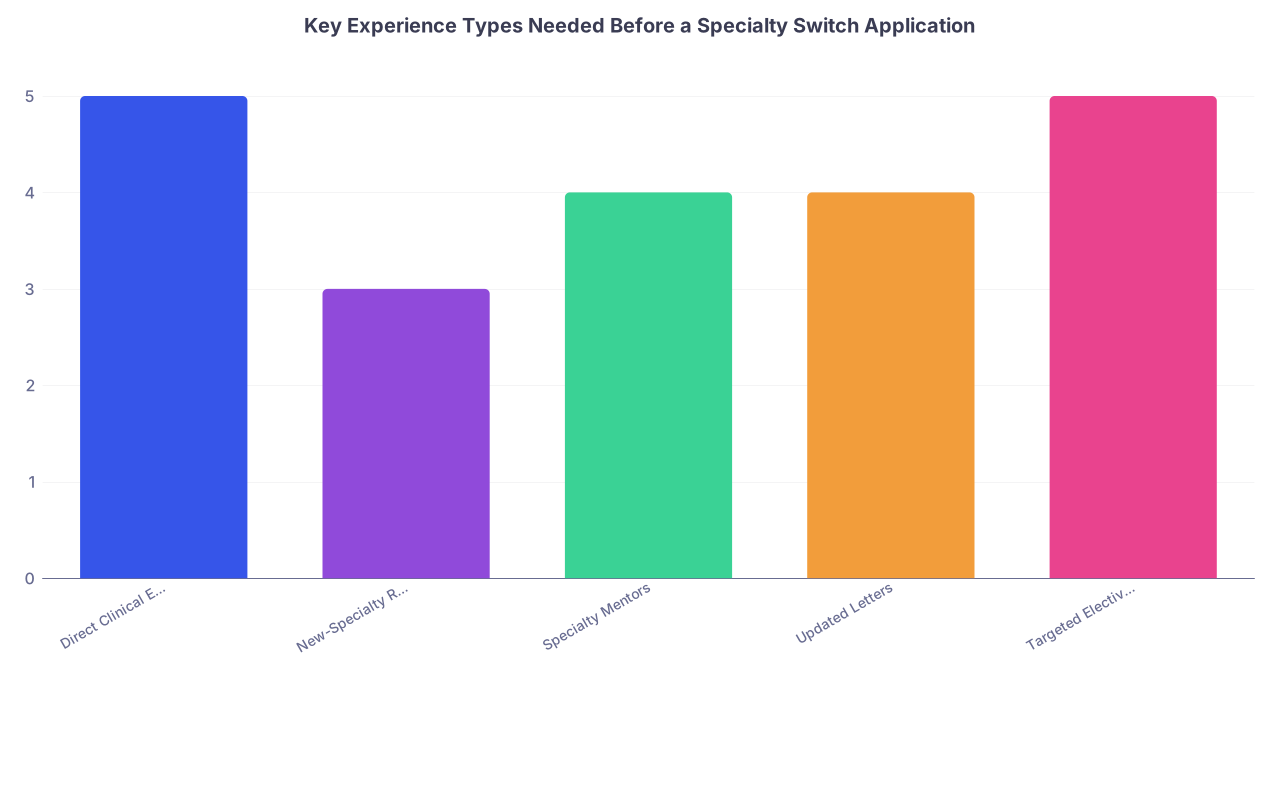
| Category | Value |
|---|---|
| Direct Clinical Exposure | 5 |
| New-Specialty Research/QI | 3 |
| Specialty Mentors | 4 |
| Updated Letters | 4 |
| Targeted Elective/Sub-I | 5 |
Think of 5 as “strongly recommended.” Your goal is to get as close to 5’s across these as you realistically can before ERAS opens.
Putting It All Together: A Quick Workflow
Here’s how I’d tell someone to attack this in real life, over 2–4 weeks of focused work:

| Step | Description |
|---|---|
| Step 1 | Clarify Reason for Switch |
| Step 2 | List All Experiences |
| Step 3 | Mark Items Relevant to New Field |
| Step 4 | Reorder CV Sections |
| Step 5 | Rewrite Clinical Descriptions |
| Step 6 | Reframe Research and Projects |
| Step 7 | Add New-Field Exposure Entries |
| Step 8 | Update Skills and Procedures |
| Step 9 | Confirm Timeline No Gaps |
| Step 10 | Align With Letter Writers |
Do this in order. Not randomly. The logic of the CV improves when you build from the story outward, not from some old template inward.
A Few Real-World Pitfalls I See All the Time
I’ve reviewed a lot of “pivot” CVs. These mistakes repeat:
- Leaving an old “Objective: To match into Orthopedic Surgery” line on a CV now submitted to PM&R. Instant trash pile.
- Putting “Unmatched” as an entry. That’s not a job. It’s a status. Do not do this.
- Over-bragging about procedures that don’t matter in the new specialty while ignoring communication, teamwork, or diagnostic thinking that does matter.
- Letting a 2-year-old shadowing experience in the new field sit as the only evidence of interest. That screams “backup plan,” not “career choice.”
If any of those sound like your current CV, fix them now.
One More Thing: Your Pivot Is Not a Sin
You may feel defensive about changing direction. Many applicants do. They write CVs that overcompensate—either pretending the old dream never existed, or clinging to it so hard that the new one looks fake.
You don’t have to do that.
Your job with this CV is simple:
- Show you’ve grown
- Show you’ve thought hard
- Show you’ve taken concrete steps toward this new specialty
- Show that your past isn’t a mistake, it’s an asset you’re bringing with you
If you can make that case on paper, interviews will follow. And in interviews, you’ll have a coherent story to tell that your CV already set up.
From there, you’re not “the one who switched.” You’re just another serious applicant with a clear trajectory.
You’ve now got the tools to rebuild your CV around the field you actually want. Next up is making sure your personal statement, program list, and interview answers all match that same story—but that’s a fight for another day.