
The way most applicants handle a leave of absence on their CV is wrong—and it hurts them more than the leave itself.
Programs do not tank your application because you took time off. They tank it because your story is confusing, your dates do not line up, and your documentation looks sketchy. You cannot fix the past, but you can absolutely fix how it appears on paper.
This is about that.
Step 1: Get Clear On What You’re Dealing With
Before you touch your CV or ERAS, you need to define your situation in the same blunt language a PD will use in their head.
Ask yourself:
- How long was the leave? (weeks, months, years)
- When did it happen? (preclinical, clerkships, after Step exams, during residency)
- What was the stated reason? (medical, mental health, family, academic, professionalism, “personal reasons”)
- Was it voluntary or mandated?
- Is there official documentation from your school or program?
Different patterns signal different things to programs. Here’s how they tend to look at it:
| Scenario | PD's First Instinctive Read |
|---|---|
| 4–8 week medical LOA, clean record otherwise | Probably fine, routine life event |
| 6–12 month personal/medical LOA, otherwise solid | Needs brief, coherent explanation |
| LOA tied to Step failure or remediation | Academic risk flag, context required |
| LOA for professionalism or conduct | Serious concern, needs strong evidence of change |
| Multiple LOAs | Stability/ reliability concerns, heavy scrutiny |
You do not need to write all this out for them, but you do need to understand what box they’ll mentally put you in. Your CV wording and documentation should be aimed at:
- Making the timeline perfectly clear.
- Showing stability after the leave.
- Reassuring them that the underlying issue is addressed or controlled.
If you ignore those three, the LOA becomes bigger than it actually is.
Step 2: Fix Your Timeline Before You Fix Your Wording
If your dates do not line up, nobody cares how artfully you phrase “leave of absence.”
The most common problem: gaps. A PD sees:
- M1: 08/2020 – 05/2021
- M2: 08/2021 – 05/2022
- Clinical rotations: 07/2022 – 06/2024
And there’s a random 2–3 month hole that’s not explained anywhere. That gap is more suspicious than an explicit “Leave of Absence – 03/2021 to 08/2021.”
Your goal is: no unexplained blank space in your education/training timeline.
Here’s the sequence:
- Lay out your full education/training on scratch paper.
- Mark every period where you were not actively enrolled, not in good standing, or not progressing normally.
- Label those clearly as LOA or extended training on your master timeline.
- Decide where each one will be documented:
- ERAS Education history
- ERAS “Education Interrupted” question
- CV Education section
- Personal statement (if needed)
- MSPE / Dean’s letter (usually written by school, but you should know what’s in there)
Once your personal master timeline is clean and continuous, you translate that into CV and ERAS format.
Step 3: How to Label a Leave of Absence on Your CV (By Scenario)
Here’s where people screw up. They try to hide the LOA in vague wording, or they over-explain and turn one line into a confession.
You want short, specific, neutral.
Basic Formatting Rules
- Use the same date format for everything (e.g., “Aug 2020 – May 2024”).
- Put the LOA line directly under the main program entry if it was during medical school or residency.
- Use the term “Leave of Absence” explicitly. Programs are used to it.
Scenario 1: Short Medical or Family LOA (No Disciplinary Component)
You had surgery, a major illness, pregnancy/parental leave, or cared for a sick relative. You are now fine and back on track.
CV example (medical school):
Doctor of Medicine (M.D.), University of X School of Medicine
Aug 2020 – May 2025Leave of Absence, University of X School of Medicine – Medical/Family
Jan 2022 – Jul 2022
That’s it. You don’t need the diagnosis, the hospital, or a mini-memoir in your CV.
If you want to be even more neutral:
Leave of Absence, University of X School of Medicine – Approved
Jan 2022 – Jul 2022
You can explain once in ERAS or in an interview. Not on the CV.
Scenario 2: Mental Health Leave
Same structure. Don’t put “Major depressive disorder,” “burnout,” or anything overly detailed on your CV. That belongs, if anywhere, in a controlled explanation elsewhere.
CV example:
Leave of Absence, University of Y School of Medicine – Personal/Medical
Mar 2021 – Dec 2021
If programs push in an interview, you can say something like:
“I had a significant health issue that is now well treated and stable. My school supported an approved leave, I returned in good standing, and I’ve had consistent performance since.”
You’re not obligated to list DSM codes to strangers across a Zoom call.
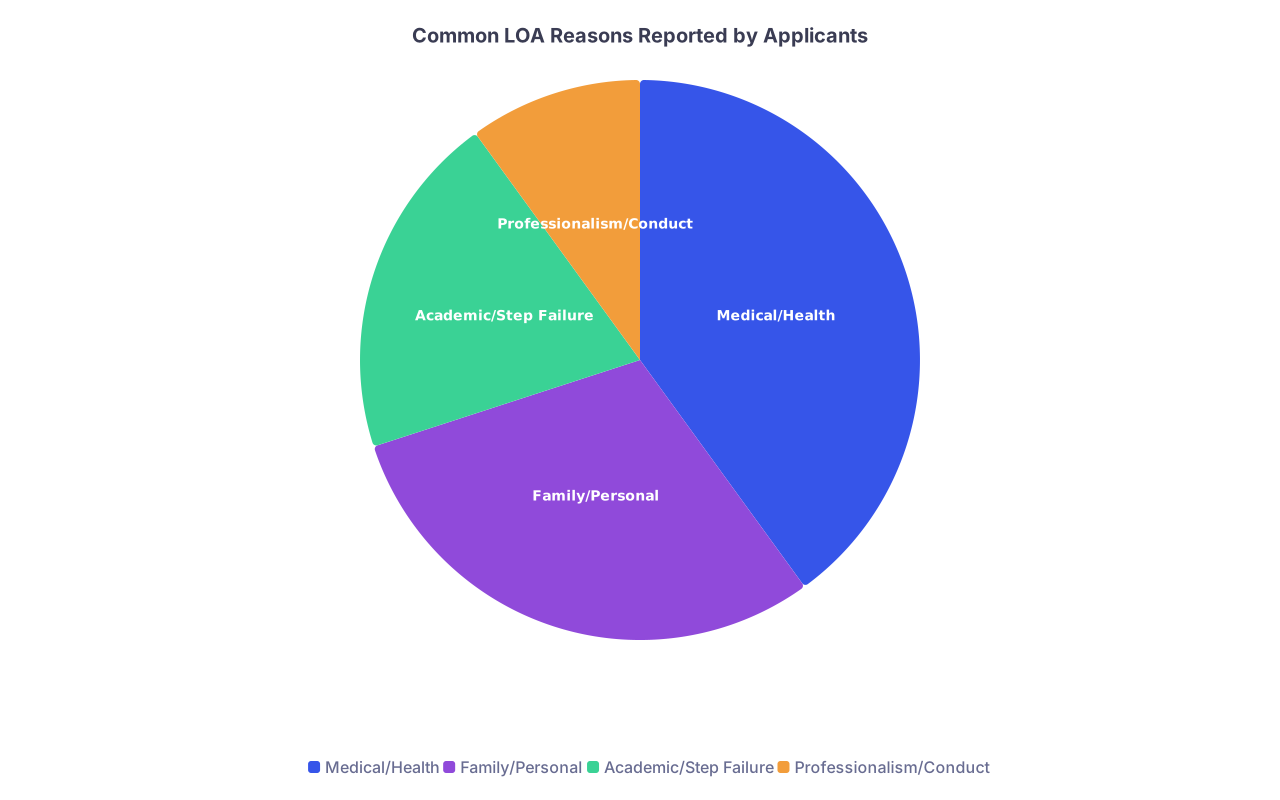
| Category | Value |
|---|---|
| Medical/Health | 40 |
| Family/Personal | 30 |
| Academic/Step Failure | 20 |
| Professionalism/Conduct | 10 |
Scenario 3: LOA for Step Failure / Academic Remediation
This one needs tighter handling. Programs care about risk. They want to know:
- Was this a one-time hit or a pattern?
- Did you come back and do well?
- Are you likely to need extra remediation in residency?
CV example:
Doctor of Medicine (M.D.), University of Z School of Medicine
Aug 2019 – May 2025Leave of Absence, University of Z School of Medicine – Academic Remediation
Feb 2022 – Nov 2022
Do not write “Failed Step 1, Board failure, on probation” in your CV line. “Academic Remediation” is enough. ERAS and your MSPE will carry the details.
What matters more than the label is what comes after that line. If the next bullets are strong:
- Step 2 CK: 245
- Honors in Medicine, Surgery, Pediatrics
That tells the story you want: hit a wall, fixed it, now stronger.
Scenario 4: LOA for Professionalism or Conduct
This is the hardest one. I’ve seen people try to bury it under “Personal Leave” or “Time away” language. That usually backfires when the MSPE describes it bluntly.
You want alignment between the official record and your CV. If your school labels it as “professionalism-related leave,” mimic the wording closely but cleanly.
CV example:
Leave of Absence, University of Q School of Medicine – Professionalism
Oct 2021 – Jun 2022
Don’t add your defense or your narrative here. Your task on the CV is clarity and honesty—not self-exoneration. The rebuilding happens through:
- Clean performance after return
- Strong letters that explicitly mention your growth
- A concise, owning-the-problem explanation in interviews
Step 4: ERAS vs CV – Make Them Match Without Duplicating the Mess
A lot of anxiety comes from not knowing where to put what. You end up either:
- Writing four slightly different versions of the same leave.
- Or saying almost nothing and hoping no one notices.
Both look bad.
Here’s the division of labor:
| Place | What Goes There |
|---|---|
| CV | Clean dates + brief label (1 line) |
| ERAS Education section | Standard timeline, same dates as CV |
| ERAS 'Education Interrupted' | 2–5 line factual explanation |
| MSPE | Official school narrative (you don't control this, but must know it) |
| Personal statement | Only if the leave is central to your motivation/story |
ERAS “Education Interrupted” Wording
This is where you get 2–5 sentences to explain. Not 2–5 paragraphs.
Template for medical/family leave:
During my second year of medical school, I took an approved leave of absence from January 2022 to July 2022 due to a significant health/family issue. I remained in good academic standing and returned to full-time coursework without restrictions. Since my return, I have completed my preclinical and clinical requirements on schedule with strong performance.
Template for academic remediation:
My medical education was interrupted from February 2022 to November 2022 for academic remediation following a Step 1 failure. During this period I worked closely with faculty to develop new study strategies and completed a formal remediation program. I subsequently passed Step 1 on my second attempt and have since demonstrated consistent clinical performance and improvement, including [brief accomplishment, if true].
Template for professionalism-related leave:
I took a leave of absence from October 2021 to June 2022 related to a professionalism concern. This experience prompted significant reflection and work with mentors on communication, boundaries, and professional behavior. I returned in good standing and have since completed my remaining training without further incidents, with strong evaluations from faculty and peers.
You are not writing a legal brief. This is: what happened, what changed, where you are now.
Step 5: Documentation You Should Quietly Collect (But Not Always Submit)
Programs rarely ask you to upload doctor’s notes, discharge summaries, or remediation plans. And you should not volunteer those unless explicitly requested.
Still, you should have a private folder with:
- Official letter from the school/program granting the LOA (if it exists)
- Any reinstatement letter or email confirming return in good standing
- Summary statement from student health or counseling (if they provide one) that states “fit to return,” not your full chart
- Any formal remediation completion letter
You’ll use these in three ways:
- To align your wording with the official language.
- To respond quickly if a program says, “Can you provide documentation of…”
- To help letter writers describe your improvement accurately and truthfully.
What you should not do: attach PDFs full of personal medical details or therapy notes to applications. Over-disclosure is not a virtue here.

Step 6: Align Your CV With Your Letters and MSPE
If your CV calls something a “Personal Leave” and your MSPE says “academic leave due to Step 1 failure,” that mismatch gets noticed fast.
You don’t control the MSPE, but you can usually:
- Request to read it (or at least the sections relevant to you).
- Ask your Dean’s office what wording they use.
- Ask specifically: “How is my leave of absence described?”
Then do this:
- Mirror the tone but keep it clipped.
- Make sure dates are identical across CV, ERAS, and MSPE.
- Coach your letter writers (gently) on how they might reference your return.
For example, if your MSPE says:
“The student took an academic leave for remediation following a failure of Step 1, and subsequently demonstrated improved academic performance and professionalism.”
Your CV + ERAS language should use:
- “Academic Remediation”
- “Improved performance”
- “Returned in good standing”
You want them telling a single, coherent story from three angles—not three different stories that force programs to guess which is real.
Step 7: Optional – Using the Personal Statement Without Letting It Hijack Your Application
You only bring your LOA into the personal statement if:
- The leave genuinely changed your trajectory, values, or specialty choice
- Or the default interpretation without context would be severe (e.g., professionalism leave) and you want to show growth
If your LOA was a pregnancy, appendectomy, or brief family care situation and you’re now fine—skip it. Put your word count into why you’ll be a great intern.
If you do use it, keep the ratio tight: no more than 20–25% of the personal statement. You are not “the LOA applicant.” You are an applicant who once had a leave.
Wrong approach:
- 80% of PS is a detailed play-by-play of your illness, mental health journey, or conflict with the Dean.
- 20% on why you actually want to train in internal medicine.
Better structure:
- 2–3 sentences briefly defining the leave and context.
- 4–6 sentences on what changed—skills, insight, maturity.
- Rest of the statement focused on your strengths, experiences, and fit for the specialty.
Example (academic remediation flavor, concise):
Early in my training, I underestimated the depth and discipline required for board preparation and failed Step 1. The subsequent academic leave was an abrupt stop and a necessary reckoning. Through structured remediation and close mentorship, I rebuilt how I study, how I manage stress, and how I ask for help. Returning to the wards with a different level of preparation and humility changed how I show up for patients and teams. Since then, my clinical evaluations, Step 2 CK performance, and subinternship experiences have reflected that growth…
Then you move on. You’ve owned it; now you prove it.
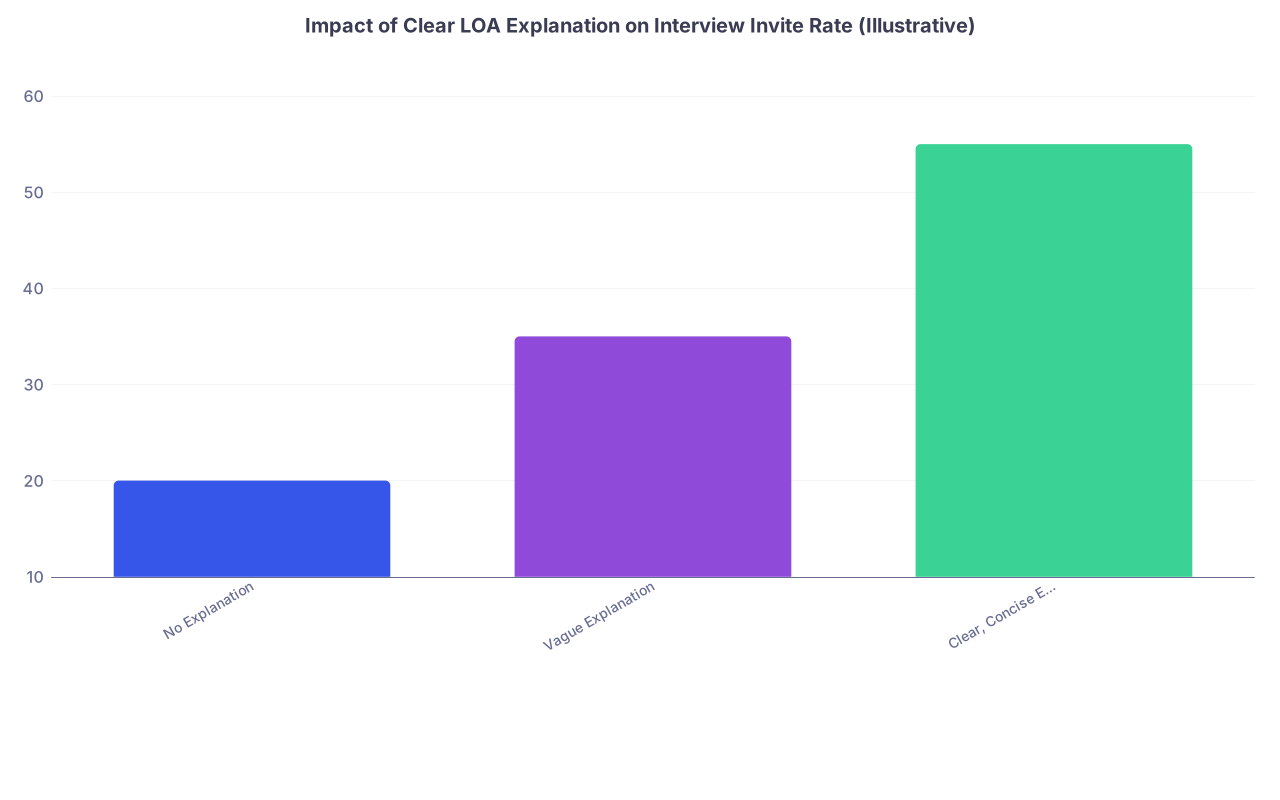
| Category | Value |
|---|---|
| No Explanation | 20 |
| Vague Explanation | 35 |
| Clear, Concise Explanation | 55 |
Step 8: What To Say When They Ask You About It in Interviews
If you’ve done the CV and documentation work right, the LOA will come up in a minority of interviews—but it will come up.
Your answer needs three parts, delivered calmly, in under 90 seconds:
- What happened – high-level, factual, no drama.
- What you did – remediation, treatment, changes.
- Where you are now – evidence of stability and performance.
Example – medical leave:
“During my second year I developed a medical issue that required surgery and recovery time, so my school and I agreed on an approved leave of absence from January to July. I used that period to fully recover and clear it with my physicians before returning. Since then, I’ve completed all of my rotations without interruption and have had no ongoing limitations.”
Example – academic leave:
“I took an academic leave after failing Step 1. At that point, my study approach was passive and inconsistent. During the leave, I worked with the learning specialist, adopted a structured daily schedule, and did thousands of practice questions with active review. I passed Step 1 on my second attempt and went on to score 247 on Step 2 CK and perform well on my clerkships. The strategies I learned then are the same ones I use now to stay on top of clinical reading.”
If they keep pressing for sensitive details (especially about mental health), you can set a boundary without sounding evasive:
“The short version is that it was a significant health issue that is now well treated and stable. I’m comfortable saying that, but I prefer to keep the specific diagnosis private. What matters for residency is that I’ve been fully functional and reliable since returning, which my recent performance and letters reflect.”
That’s a perfectly acceptable answer.

| Step | Description |
|---|---|
| Step 1 | Did you have a Leave of Absence |
| Step 2 | Brief CV line only |
| Step 3 | CV line + ERAS Education Interrupted |
| Step 4 | CV line + ERAS + Prepare interview script |
| Step 5 | Consider brief mention in PS |
| Step 6 | Skip PS mention |
| Step 7 | Is it visible on your transcript or MSPE |
| Step 8 | Academic or professionalism related |
| Step 9 | Central to your story |
Step 9: Common Mistakes That Make Your LOA Look Worse
I’ve watched strong candidates sabotage themselves in six predictable ways:
Trying to hide the leave entirely.
Gaps with no explanation scream “problem” louder than an honest LOA line.Over-disclosing in writing.
Your CV is not your therapist. No multi-sentence justifications or medical details.Inconsistent wording across documents.
“Personal reasons” on the CV, “academic remediation” in MSPE, “burnout” in the PS = red flag.Centering the entire application around the leave.
You are not your worst semester. Stop auditioning for “Comeback Story of the Year.”Sounding defensive or bitter in explanations.
Blaming the exam, the Dean, the system—programs hear that and imagine how you’ll handle feedback on the wards.Not highlighting the “after.”
The leave matters less than what your last 12–24 months look like. If they’re solid, put those front and center.
Step 10: If You’re Still In the Middle of a Leave
Different situation, same principles, but with one twist: you must be honest about your readiness.
Your CV should show:
Doctor of Medicine (M.D.), University of X School of Medicine
Anticipated Graduation: May 2026Leave of Absence, University of X School of Medicine – Medical/Personal
Jun 2024 – Present
And you need a clear statement in ERAS or from your Dean that:
- You are expected to return by [X date].
- You are anticipated to graduate by [Y date].
- You will meet requirements before residency start.
If your return date is uncertain, applying now might not be wise. A shaky “I think I’ll be back by March” is how you end up in disaster territory with contracts you can’t fulfill.
The Bottom Line
There are three things programs really want to know about your leave of absence, and your CV + documentation should answer them cleanly:
- What happened and when – with honest, neutral labels and zero timeline confusion.
- What changed – remediation, treatment, reflection, concrete steps, not vague “I grew a lot.”
- Who you are now – stable, reliable, performing well, with recent evidence to back that up.
Write your CV and ERAS like a responsible colleague telling the truth, not like a defendant trying to beat a charge. That alone puts you ahead of most applicants with a leave.