
It’s 11:30 p.m. You’ve just finished a call shift, you still have lunches to prep for your kids tomorrow, and ERAS is glaring at you from your laptop. There’s that section: “Significant Experiences” or the optional text box some programs mention. Your CV is open too. Research, leadership, publications. Then the thing that’s actually shaped the last four years of your life: taking care of a sick parent. Or being the primary caregiver to your child. Or working 20–30 hours a week to support your family.
You’re wondering: Is this “application material” or just “life”? Do you put it on your CV? How? Will it help you, or will it silently hurt you?
Let me be blunt: handled correctly, significant personal or family responsibilities can strengthen your residency application. Handled sloppily, they can either confuse people or raise questions you don’t want raised.
Here’s exactly how to handle it.
1. First question: Is this responsibility actually “significant”?
You are not putting “called grandma every Sunday” on your CV. That’s life, not experience.
You do consider including it if it meets at least one of these:
- It required ongoing, structured time (weekly, monthly) over months to years
- It forced you to make real trade-offs (fewer activities, delayed Step, gap year, reduced research)
- It explains a spike or dip in your timeline (leave of absence, part-time enrollment, fewer extracurriculars)
- It demonstrates skills residency programs care about: resilience, time management, advocacy, systems navigation, maturity
Concrete examples that usually qualify:
- You’ve been primary caregiver for a parent with advanced cancer, dementia, severe disability.
- You’re raising children with minimal support while in med school (especially as a single parent).
- You financially support your family with regular work hours while in school.
- You managed siblings’ lives (school, health, logistics) because your parents were absent, ill, or working multiple jobs.
- You served as interpreter/advocate for non-English speaking relatives across multiple health systems.
If what you did significantly shaped your availability, schedule, or opportunities, that counts. Do not downplay something that ate 10–20 hours of your week for years.
If you’re not sure, do this:
Ask:
“If a PD looked at my CV without knowing this, would they be missing a key piece that explains why my record looks the way it does?”
If yes, it probably belongs.
2. Where to put it: CV vs ERAS vs personal statement
You’ve got three main tools:
- The CV itself
- The ERAS “Experiences” section
- Personal statement / secondary essays / “adversity” prompts
You do not need to use all three. You should, however, be intentional.
A simple placement strategy
Use this as a starting rule:
- If it affected your time, options, or trajectory → Put it on the CV and in ERAS Experiences.
- If it’s deeply tied to your motivation for the specialty or your view of medicine → Also address it briefly in your personal statement.
- If it’s highly sensitive or stigmatized (substance use, incarceration, severe mental illness in family) → Prefer ERAS “Experience” / essays and a short, neutral CV entry.
| Situation | CV | ERAS Experiences | Personal Statement |
|---|---|---|---|
| Explain limited extracurriculars | Yes | Yes | Maybe |
| Central to specialty choice | Yes | Yes | Yes |
| Very sensitive details | Yes (brief) | Yes | Maybe (careful) |
| Minor but meaningful | Maybe | Maybe | No |
Rule of thumb: The CV holds the fact of the responsibility. ERAS lets you add a bit of context. The personal statement explains the meaning if it is central to your story.
3. How to label it on your CV without sounding dramatic or vague
You’re not writing a diary. You’re documenting a role.
Two goals:
- Neutral, professional wording
- Brief but clear indication of scope
You’re looking for something that would not look out of place next to “Research Assistant” or “Volunteer Coordinator.”
Here are some clean, usable titles:
- “Family Caregiver – Parent with Chronic Illness”
- “Primary Caregiver – Child with Special Needs”
- “Family Support and Care Coordination”
- “Household Manager and Family Caregiver”
- “Financial Provider – Part-time Employment to Support Family”
- “Medical Advocate and Interpreter – Family Members”
- “Primary Support for Disabled Sibling”
Notice what I’m not suggesting:
- “Burdened Child of Alcoholic Parent”
- “Survivor of Childhood Trauma”
- “Victim of Family Illness”
You can tell the emotional story later, verbally or in essays. The CV is for structure and function.
Basic CV structure
On the CV, structure it like any other role:
- Title
- Organization/Context (Family, City, State)
- Dates
- 1–3 bullet points max
Example:
Primary Caregiver – Parent with Advanced Cancer
Family, Chicago, IL
2019 – 2023
- Coordinated medical appointments, medication schedules, and home health services during parent’s treatment for metastatic cancer (10–15 hours/week).
- Served as primary contact for oncology and palliative care teams; managed communication between family members and health providers.
Notice this:
- Specific, not melodramatic
- Time commitment hinted (hours/week)
- Shows skills (coordination, communication, reliability)
You can absolutely omit the weekly hours if that feels too granular, but hinting at scope helps.
4. Matching the entry to your actual situation
Let’s walk through specific common scenarios and how to write them.
Scenario A: Caring for a sick parent during pre-clinicals and clerkships
You were the person taking them to chemo, managing meds, staying with them post-op.
CV entry:
Family Caregiver – Parent with Chronic Kidney Disease
Family, Houston, TX
2020 – 2024
- Organized and attended thrice-weekly dialysis sessions; coordinated transportation and post-treatment monitoring.
- Managed medication refills, insurance forms, and communication with nephrology and primary care teams.
Then, in ERAS Experiences, you can add:
- Approximate hours/week
- One or two lines on what you learned / skills gained
Do not turn it into a mini-personal statement. Keep it tight.
Scenario B: You’re raising kids during med school
Especially if you’re a single parent or your partner has a demanding schedule.
CV entry:
Primary Caregiver – Two Children (Ages 3 and 6)
Family, Boston, MA
2021 – Present
- Balanced full-time medical education with primary caregiving responsibilities, including daily school routines, appointments, and extracurricular activities.
- Developed advanced time management and prioritization skills to maintain academic performance while managing family responsibilities.
You’re not asking for pity; you’re quietly showing capability.
If this explains fewer extracurriculars, then in interviews you can say:
“I had fewer formal activities than some of my classmates because I prioritized being present for my kids. That meant I had to be extremely efficient with academics and clinical work.”
That’s a strength, not an excuse.
Scenario C: You worked substantial hours to support your family
This one can easily be misread as “just a job” unless you frame it.
CV entry (work will often already be there, but you can make the context clear):
Medical Assistant – Community Clinic
Sunrise Community Health, Phoenix, AZ
2019 – 2022
- Worked 25–30 hours/week during medical school to provide financial support for family household expenses.
- Performed clinical intake, vital signs, and EHR documentation for underserved patient population.
Now the PD seeing “MA – 25 hours/week” understands why your research section is thinner. The trade-off is obvious.
Scenario D: You basically ran the household for siblings
Very common among first-gen and low-SES students. And too often completely hidden.
CV entry:
Household and Sibling Care Coordinator
Family, Newark, NJ
2018 – 2023
- Managed daily schedules, school communication, and transportation for two younger siblings while parents worked extended hours.
- Oversaw homework support, medical appointments, and college application processes.
Again, no drama. Just clarity.
5. How much detail is too much?
You’re not writing a social work assessment. You’re not giving a trauma narrative.
Keep these hard boundaries:
- No graphic medical or psychiatric details
- No long descriptions of abuse, neglect, or violence on the CV
- Do not name family members by name or give overly identifying details
- Avoid diagnostic labels that might bias readers (e.g., “alcohol use disorder,” “incarceration for X”) unless it’s central and you’re prepared to discuss it
For sensitive situations, do something like:
Family Support – Relative with Severe Mental Illness
Family, Los Angeles, CA
2017 – 2022
- Assisted with appointment scheduling, medication monitoring, and coordination with mental health services for an adult family member.
- Helped navigate community resources and social services to support independent living.
That’s enough. If they want more context, they’ll ask at the interview. You can control how much you share.
6. Avoiding the “excuse” vibe
Program directors have very sensitive “is this an excuse?” radar. You want your responsibilities to read as context and strength, not a plea for special treatment.
Do this:
- State what you did. Concrete tasks.
- Hint at time and duration. Shows it was real, not occasional.
- Connect to skills, not suffering.
Bad:
“Cared for sick parent, which made medical school more difficult and limited my ability to participate in research.”
Better:
“Cared for sick parent, coordinating appointments and home care (10–15 hours/week) while maintaining full-time medical studies. This limited my availability for longitudinal research projects but strengthened my time management and resilience.”
Even better if you can show you still achieved something, even if smaller scale:
- Shorter research project
- Local volunteering
- Strong clinical performance
The message you want in their head: “This person had real responsibilities and still showed up. They can handle residency.”
7. How to tie this into red flags (LOA, score dips, thin CV)
If you had:
- A leave of absence
- Semester off
- USMLE/COMLEX delay or failure
- Sparse extracurricular section
Family responsibilities might be part of why. You can (and in many cases should) connect those dots, but carefully.
Do not do this on the CV in long prose. Use:
- ERAS “Experiences” text
- The “Additional Information” section
- A program-specific note if invited
- Advisor/Dean’s letter if possible
Example wording (ERAS description):
“In 2021–2022, I served as the primary caregiver for my father during his treatment for advanced lung cancer. This role, averaging 20 hours/week, coincided with a dip in my academic performance and contributed to my decision to delay Step 1. Following his transition to hospice and stabilization of my family responsibilities, my academic performance and clinical evaluations returned to prior levels.”
That’s honest, direct, and resolution-focused.
Key moves:
- Time-box the issue (it was then, not forever)
- Show progression back to baseline or improvement
- Do not sound like you’re blaming your family member
8. How this plays in interviews
If you put it on your CV, assume it can come up.
Common PD/faculty thoughts:
- “Will this responsibility still exist during residency?”
- “Does this limit their ability to take call/relocate?”
- “Is this a strength or just an explanation?”
So you need a ready, honest script for three things:
Current status
“My father passed away in 2023; that intense caregiving period has ended, though it significantly shaped me.”or
“My child is now in school full-time, and we have stable childcare arrangements in place.”
What you learned (in residency-relevant language)
“I got very good at prioritizing tasks under time pressure and functioning despite emotional stress—which is basically residency.”Reassurance about reliability
“During medical school, even at the peak of my caregiving responsibilities, I met my clinical obligations and received strong evaluations. I’m confident about my ability to fully commit to residency.”
Never promise something that’s not true. But you can be clear about realistic support structures.
9. Common mistakes to avoid
I’ve seen people shoot themselves in the foot with this stuff. Do not:
- Bury major responsibilities completely and then sound angry in interviews that programs “don’t understand your journey”
- Turn your CV into a trauma memoir
- List every family event as an “experience”
- Use vague or self-pitying language like “overcame many hardships” with zero specifics
- Over-explain on the CV; save nuance for ERAS or essays
- Omit dates (looks suspicious)
- Contradict yourself (e.g., say caregiving was 30 hours/week but have 6 other major leadership roles during the exact same time)
You’re aiming for “clear, contained, credible.”
10. Quick templates you can adapt today
Here are some plug-and-play CV entries you can tweak.
Family Caregiver – Parent with Advanced Illness
Family, [City, State]
[Year] – [Year]
- Coordinated medical appointments, medication schedules, and communication with multiple specialists for a parent with advanced illness.
- Assisted with activities of daily living and home care support while enrolled in full-time medical studies.
Primary Caregiver – Child with Special Needs
Family, [City, State]
[Year] – Present
- Managed daily care, therapies, and educational coordination for a child with developmental needs alongside medical school responsibilities.
- Collaborated with medical, educational, and social service teams to optimize support and accommodations.
Household and Sibling Care Coordinator
Family, [City, State]
[Year] – [Year]
- Oversaw schedules, homework, and transportation for [number] younger siblings while parents worked extended or variable shifts.
- Coordinated medical and school appointments and served as primary liaison with teachers and counselors.
Family Support – Chronic Mental Health Condition
Family, [City, State]
[Year] – [Year]
- Supported an adult family member with a chronic mental health condition by coordinating outpatient follow-up, medication adherence, and community resources.
- Gained firsthand exposure to challenges in outpatient mental health access and continuity of care.
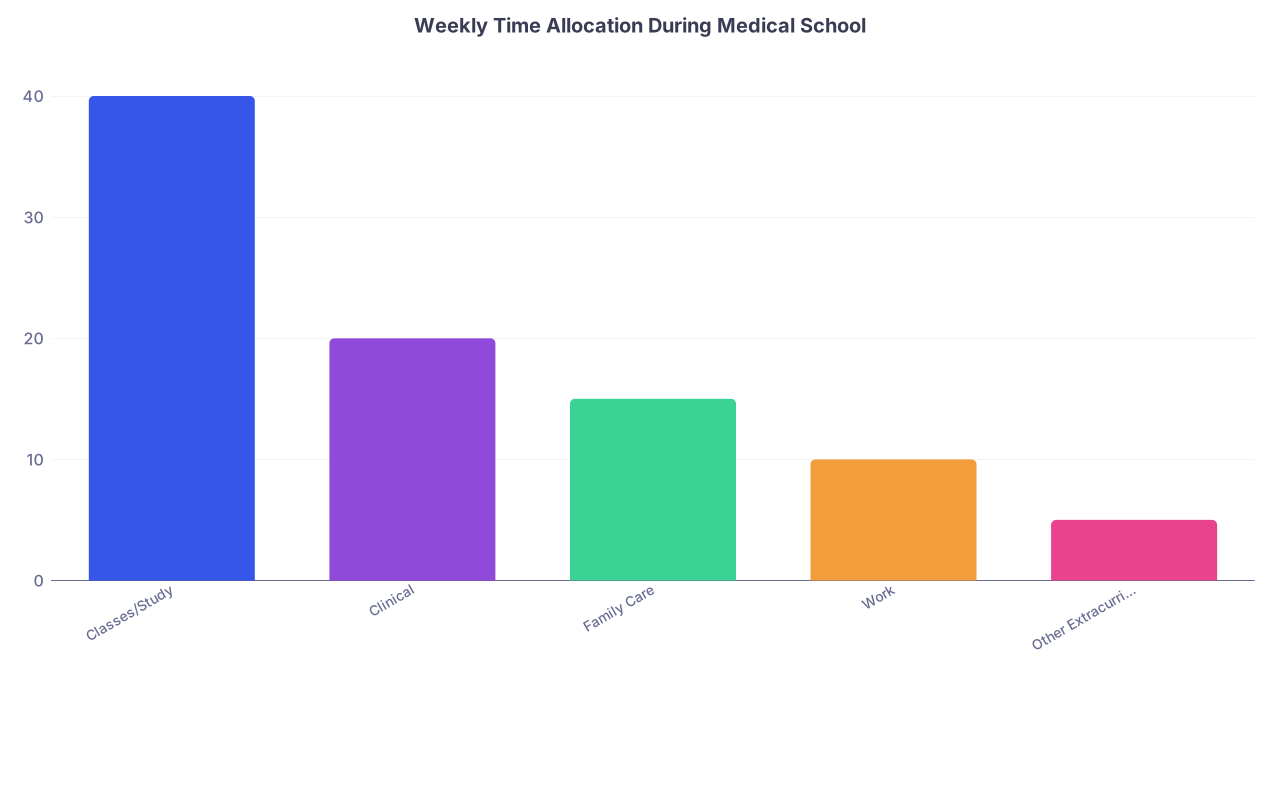
| Category | Value |
|---|---|
| Classes/Study | 40 |
| Clinical | 20 |
| Family Care | 15 |
| Work | 10 |
| Other Extracurriculars | 5 |
11. How this fits into the bigger residency application picture
Your responsibility entry is one piece. It has to coexist with:
- Your specialty choice
- Your academic record
- Your narrative about why this field, now
So if you’re applying to, say, heme/onc eventually or palliative-heavy IM, and you were a caregiver for a parent with cancer, that connection is obvious. Spell it out briefly in your personal statement:
“One of the most formative experiences of my life was serving as my mother’s caregiver during her treatment for metastatic breast cancer. That experience exposed me to the power and limits of oncology, and it is a major reason I am drawn to internal medicine with a focus on complex, longitudinal care.”
Then stop. Don’t write three paragraphs about your mother. The star of the application is you, not your family member.
If the responsibility doesn’t directly tie to the specialty (e.g., caring for siblings and applying to radiology), you don’t need to manufacture a connection. Focus on the skills and perspective you gained that are broadly applicable: discipline, efficiency, understanding of patient families, etc.

| Step | Description |
|---|---|
| Step 1 | Significant Family Responsibility |
| Step 2 | Do not list or keep minimal |
| Step 3 | Create CV Entry |
| Step 4 | Add brief context in ERAS or PS |
| Step 5 | Keep as stand alone experience |
| Step 6 | Affected time or trajectory |
| Step 7 | Explains red flags or gaps |
FAQ (3 questions)
1. Will programs judge me negatively for having big family responsibilities?
Some will, quietly. Most will not if you present it professionally. Many PDs actually respect applicants who handled real obligations and still performed well. Your job is to show that the intense phase is either over or stably managed, and that you’re fully able to meet residency demands. The way you talk about it—calm, concrete, no self-pity—matters more than the fact that it happened.
2. What if my responsibility is ongoing and will continue during residency? Should I still mention it?
Yes, but be strategic. If it will affect call, relocation, or schedule, you have to be honest. Frame it with the support structures you already have in place (other family members, childcare, community resources) and examples from med school showing that you’ve already managed both. Programs worry about reliability, not about you having a life. Show them you’ve stress-tested your system already.
3. I’m afraid this will open me up to intrusive questions. How do I protect my privacy?
You control the level of detail. On the CV, keep it neutral: “family member with chronic illness,” “significant mental health condition,” etc. In interviews, if someone pushes into areas you don’t want to go, you can redirect: “The specifics are private to my family, but in practical terms it meant I was coordinating appointments and providing day-to-day support while in school. What I took from that was…” and then move to skills or insight. Most faculty will take the hint and back off.
Open your CV document right now and add one clean, neutral entry that reflects your biggest ongoing family or personal responsibility over the last few years. One title, dates, and two bullets. Then step back and see if your overall application story suddenly makes more sense.