
The worst way to handle an academic warning on your CV is to pretend it never happened.
If you’re in this situation, you’re not ruined. But you are under a microscope. Programs will ask: “Did this person learn anything, or are we inheriting the same problem?” Your CV can either answer that question decisively—or raise more doubts.
Let’s walk through exactly what to do, step-by-step, so that your academic warning becomes a managed risk rather than a quiet red flag.
Step 1: Understand how programs actually view academic warnings
Most applicants wildly misjudge this. They either panic (“I’m done”) or minimize it (“Everyone struggles sometimes”). Both are wrong.
Here’s how PDs and selection committees tend to think when they see any of these phrases in your file:
- “Academic warning”
- “Remediation”
- “Leaves of absence – academic”
- “Probation”
- “Course/clerkship failure”
They immediately want answers to four things:
- What exactly happened?
- Is it still an issue now?
- What has the applicant changed since then?
- Can I trust this person with my patients and my call schedule?
They do not care about long excuses. They care about:
- Pattern vs one-off
- Timeline (early vs late in training)
- Current performance
- Insight and accountability
Your CV is not the primary place for the full story (that’s for your personal statement, ERAS “Additional Information,” or a dean’s letter). But your CV needs to be internally consistent with those other documents and show a clear “before and after” arc.
Step 2: Decide if your CV should mention the warning directly
This depends on your context. Let’s sort which bucket you’re in.
| Situation | CV Strategy |
|---|---|
| Formal academic probation or repeated failures | Address indirectly + highlight remediation and improvement |
| Single early-course warning, no repeats, strong later record | Usually keep warning out of CV; let MSPE/ERAS handle it |
| Leave of absence for academic reasons | Must be clear on timeline; clarify status and return |
| Rotation/clerkship failure later remediated | Emphasize remediation and eventual strong performance |
| US MD/DO vs IMG with multiple flags | IMGs often need more proactive explanation via experiences |
You usually do not write “Academic Warning” as a bullet point on your CV. That’s not strategic; that’s self-sabotage.
But you do need to handle:
- Dates: Any gaps or leaves must be clear.
- Status: If you took time off or repeated a year, your CV dates will expose that even if you don’t explain why.
- Remediation: If you completed a formal remediation or extra coursework, it’s often smart to frame it as structured improvement, not as a secret.
The rule of thumb:
- If the academic issue is already formally documented elsewhere (MSPE, transcript, ERAS questions), use your CV to demonstrate growth and stability, not re-litigate the past.
- If your CV would look weird without context (odd dates, missing year, repeated year with no explanation), give a brief, professional explanation in the appropriate place.
Step 3: Fix your CV timeline so it doesn’t make the warning look worse
Most people screw this up with dates.
If you had:
- A repeated year
- A leave of absence
- A gap semester
- A delayed graduation
…then your dates will not be “traditional.” Programs notice.
Your job is to make the timeline clean and honest. No weird half-gaps. No switched month formats. No unexplained dead space.
Here’s how to structure it.
A. Education section: be honest and precise with dates
Instead of trying to hide the delay, you normalize it with straightforward formatting.
Example 1 – Standard, no delay:
- MD, University of X School of Medicine, City, State
Aug 2020 – May 2024
Example 2 – Repeated preclinical year:
- MD, University of X School of Medicine, City, State
Aug 2019 – May 2025
You don’t need to write “(extended curriculum due to academic remediation)” on the CV line. The dates speak for themselves and the MSPE will provide the context.
Example 3 – Leave of absence:
- MD, University of X School of Medicine, City, State
Aug 2019 – May 2025
Extended curriculum with approved leave of absence
Short, neutral, factual. Not dramatic. Not defensive.
B. Fill real gaps with real activities
If you were out for a semester or year, but did meaningful work (research, tutoring, job), that goes on the CV.
Do not leave a blank 10–12 month hole. That screams “something went wrong and I hope you don’t ask.”
You’d list:
- Research Assistant, Department of Internal Medicine, University of X
Jan 2022 – Dec 2022
– Participated in outcomes research on [topic] under Dr. Y
– Co-authored [poster/paper/etc.]
Or:
- Medical Education Tutor, Office of Academic Support, University of X
Jan 2022 – Dec 2022
– Provided small-group tutoring in physiology and pharmacology
– Developed study guides used by >40 first-year students
If the gap was purely recovery without formal work (not uncommon), you do not fabricate activities. You simply let the dates reflect reality and deal with the explanation elsewhere in the application.
Step 4: Use your CV to prove the problem is solved
This is the key: your CV can’t erase the academic warning, but it can convince people it belongs in your past.
You do that by stacking evidence of competence after the warning.
Ask yourself: “Since that warning, what shows I can now do the job of an intern safely and reliably?”
You’re looking for:
- Strong clinical performance, especially in core clerkships and your chosen specialty
- Consistent engagement (no new gaps, no new flags)
- Extra responsibility: teaching, leadership, QI, research
- Anything that shows reliability, organization, and follow-through
A. Build a clear “after” section
If your warning was early (M1/M2), your later CV should read like this:
- Third- and fourth-year honors or high passes (even if you don’t list grades, your MSPE will echo this)
- Specialty-related electives completed successfully
- Sub-I or acting internship listed prominently
- Leadership roles (class rep, interest group officer, chief of something, etc.)
You do not need to label it “After Academic Warning.” You just make the chronology obvious.
Mix in verbs that scream reliability: “coordinated,” “managed,” “organized,” “completed,” “led,” “followed through.”
Programs mentally run this script: “Okay, something went wrong early. Do I see years of stability after that?” Your CV should let them answer “yes” in 15 seconds.
B. If you did formal remediation, frame it as structured improvement
Did you complete:
- Remediation course?
- Learning skills program?
- Academic support program?
- Extra clinical time?
You can list it once in a neutral, professional way, especially if it came with additional responsibilities or reflection.
Example:
- Participant, Academic Success Program, University of X
Jan 2021 – May 2021
– Completed structured curriculum in advanced learning strategies and test-taking
– Applied techniques to subsequent courses resulting in sustained passing performance
You’re not bragging about remediation. You’re signaling: “I took this seriously. I did something about it. It worked.”
Step 5: Align your CV with ERAS, MSPE, and letters
The fastest way to make a program nervous is inconsistency.
If your MSPE mentions:
- “Required to repeat second-year coursework due to academic performance” and your CV looks like a perfectly smooth 4-year MD with no hint of an extended curriculum—people notice.
You don’t have to echo every phrase. But the story must match.
Here’s how to sanity-check your file:
- Education dates on CV = education dates in ERAS and MSPE
- Any leave/remediation described in MSPE is not contradicted by your CV (no fake role during that time)
- If you list an “extended curriculum” on the CV, your personal statement / ERAS “Additional Information” gives the fuller explanation
- Your LOR writers are aware of the issue and (ideally) reinforce your growth and current reliability
This alignment matters more than whatever clever line you’re trying to use to soften the problem.
Step 6: Different scenarios and how to handle them
Let’s get specific. Here’s what to do in some very common real-world situations.
Scenario 1: Early academic warning, no repeats, now strong
You:
- Struggled M1 with a basic science course
- Got an academic warning
- No failures or repeats after that
- Good clinical evals and Step 2 score
CV strategy:
- Do not write “Academic Warning” anywhere on the CV
- Make education dates standard
- Emphasize clinical clerkships, sub-I, research, and any leadership
- Make sure later roles show responsibility and consistency
Where you address it:
- Briefly in personal statement or ERAS “Other Impactful Experiences” box
- Let the MSPE cover the formal language
- Use letters to emphasize your current performance
Your CV’s job here is: prove the issue is ancient history.
Scenario 2: Failed a clerkship, needed remediation, now applying to that specialty
You:
- Failed Medicine or Surgery or OB
- Remediated successfully
- Still want that specialty (or a nearby one)
CV strategy:
- Education dates will look standard
- In clinical experience, you can list both the clerkship and, if needed, an advanced elective that shows improvement
Example:
Internal Medicine Core Clerkship, University Hospital
Jan 2023 – Mar 2023Internal Medicine Subinternship, University Hospital
Aug 2023 – Sep 2023
– Managed inpatient teams of 4–6 patients under resident and attending supervision
– Consistently recognized for thoroughness in pre-rounding and follow-through
You don’t need “failed” written on the CV. That lives in the MSPE. Your CV instead shoves evidence of growth into the spotlight.
Where you address it:
- Personal statement: a short, direct paragraph about what changed
- ERAS: any “academic concern” box if available
- Ask at least one IM letter writer to speak directly to your reliability and growth
Scenario 3: Year-long academic LOA with weak explanation
You:
- Took 1 year off listed as “academic” or “personal/academic”
- Little structured activity during that year
CV strategy:
- Education line: “Extended curriculum with approved leave of absence”
- If you did any structured activity (part-time work, volunteering), list it truthfully
- Do not invent content; a thin CV is better than a dishonest CV
Where you address it:
- This needs a clear, concise narrative in your personal statement or ERAS “Additional Information”
- Focus on: what was going wrong, what changed, and why it is stable now
Your CV alone can’t rescue this scenario. But it can avoid making it worse with gaps and half-truths.
Scenario 4: Multiple academic warnings / borderline pattern
You:
- More than one course/rotation problem
- Maybe repeated a year
- Maybe Step failures too
This is high-risk from a program’s point of view. You cannot cosmetically fix this with word choice. You need to overwhelm them with a clear “late surge.”
CV strategy:
- Be brutally honest with dates and statuses
- Focus heavily on:
- Clinical rotations that went well
- Sub-I with strong responsibility
- Any job-like experiences (research coordinator, scribe, etc.)
- Show recent sustained performance: anything in the last 12–18 months that screams stability
This is where your CV should look like a work portfolio, not just a school transcript.
Step 7: Tighten your language so you sound like a resident, not a victim
Programs are allergic to victim narrative in this context. They don’t want to hear “unfair professor,” “messed up grading,” or “I just had bad luck.” Even if that’s true.
On your CV, your bullets should be:
- Active
- Concrete
- Un-dramatic
Bad bullet after academic trouble:
- “Struggled in preclinical coursework but worked hard to improve understanding of material.”
This screams insecurity and pulls attention straight back to the problem.
Better:
- “Completed extended basic science curriculum with improved performance in systems-based courses.”
- “Co-taught physiology review sessions for preclinical students during M3 year.”
Notice: calm, professional, specific. It acknowledges reality without wallowing.
Step 8: Know where the real explanation belongs (not your CV)
Your CV is not your confessional. It’s your portfolio.
If you’re tempted to write a multi-line explanation under your MD degree, you’re misusing the document.
Here’s where to actually explain:
- Personal statement: 1–2 short paragraphs max, woven into your story. Focus on insight + change, not excuses.
- ERAS “Additional Information” / “Impactful Experiences” boxes: Perfect for a clearer, factual explanation.
- MSPE / Dean’s Letter: Your school will already state the formal status and timing.
- Interviews: You’ll get asked. Rehearse a 45–60 second, direct explanation that matches your written materials.
Your CV’s job is to make sure the explanation is believable by backing it with evidence of current competence.
Step 9: Use a quick audit to see if your CV is helping or hurting
Before you send anything, do this 10-minute check.
- Print your CV and a clean piece of paper.
- Draw a vertical line where your academic warning happened in time.
- Look at everything after that line:
- Do you see solid, continuous activity?
- Do your roles and bullets reflect responsibility and stability?
- Would a stranger guess that your performance improved over time?
Then do this: hand it to someone who doesn’t know your story (a resident, advisor, even a smart non-med friend) and say:
“Assume there was an academic warning somewhere in here. What do you think happened, and do you think it’s still a problem?”
If their answer is, “I honestly can’t tell where it was, and your recent stuff looks fine,” then your CV is doing its job.
If their answer is, “It looks like something bad happened around [year] and I’m not sure it’s fixed,” you have more work to do.
Step 10: Common mistakes that quietly sink applicants with academic warnings
I’ve seen these enough times to know they kill trust fast:
- Inconsistent dates between CV and ERAS
- Over-explaining on the CV (paragraphs under “Education” that sound like an appeal letter)
- Tone mismatch: CV sounds polished, personal statement is full of defensiveness
- Hiding: random “Research internship” listed during a leave that never actually happened
- No clear “redemption arc”: your last year looks just as messy as the year you got warned
- Letting others tell the story badly: LORs that vaguely mention “struggles” without emphasizing recovery
Avoid these, and you’re already ahead of a lot of applicants in your position.
Quick visual: how much your “post-warning” period should carry the weight
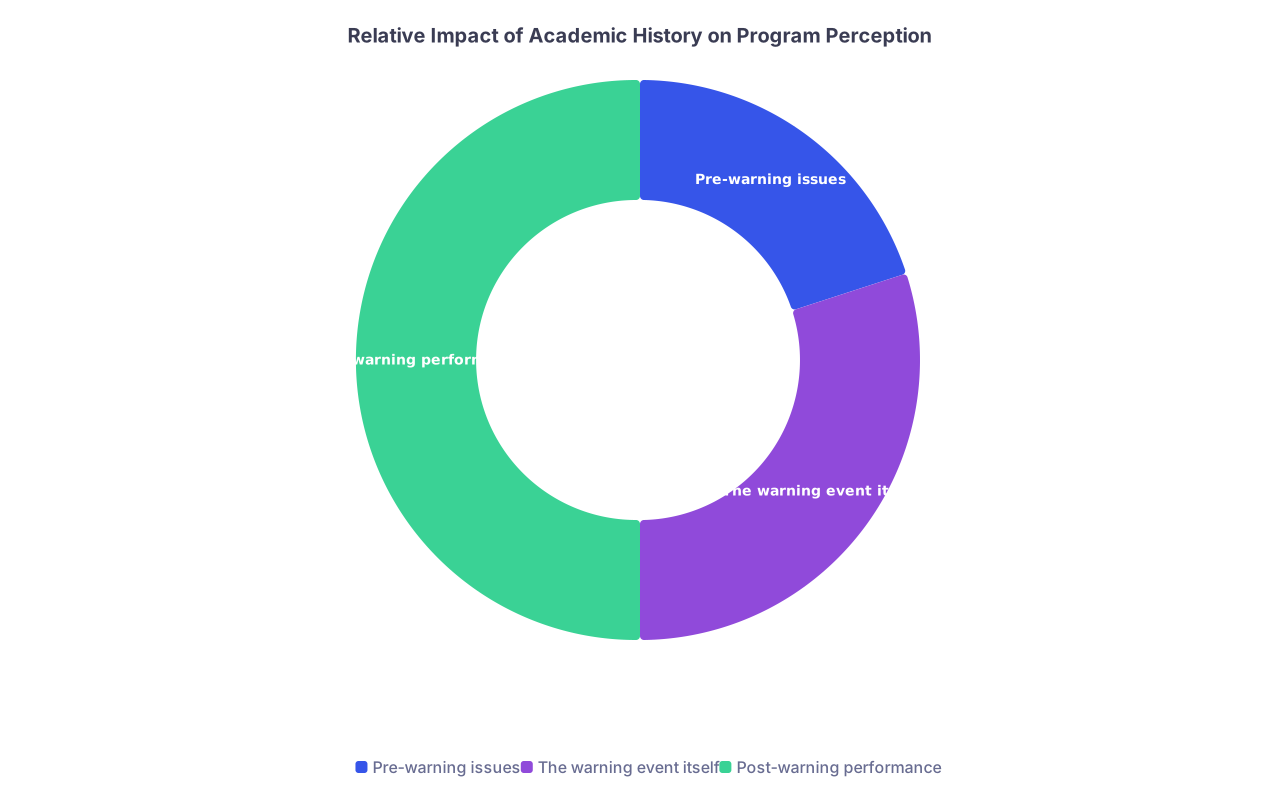
| Category | Value |
|---|---|
| Pre-warning issues | 20 |
| The warning event itself | 30 |
| Post-warning performance | 50 |
Programs do care about the warning itself. But they care more about the pattern after.
A concrete template you can adapt right now
Here’s a compact before/after style you can steal and tweak.
Education
MD, University of X School of Medicine, City, State
Aug 2018 – May 2025
Extended curriculum with approved leave of absence
Clinical Experience
Internal Medicine Core Clerkship, University Hospital
Jan 2023 – Mar 2023
Internal Medicine Subinternship, University Hospital
Aug 2024 – Sep 2024
– Managed a panel of 4–6 inpatients under supervision
– Led daily presentations on new admissions and overnight events
– Recognized for thorough documentation and reliable follow-up on tasks
Academic / Professional Development
Participant, Academic Success Program, University of X
Jan 2021 – May 2021
– Completed structured curriculum in advanced learning strategies and test-taking
– Applied techniques to subsequent courses with sustained passing performance
Teaching
Peer Tutor, Office of Academic Support, University of X
Sep 2022 – May 2024
– Led weekly small-group sessions in pathophysiology for preclinical students
– Co-created exam review materials used by >30 students each block
That CV doesn’t hide the delay. But it shows you’re functioning at a resident-like level now.
Your next move, today
Open your current CV and a blank page side by side.
On the blank page, write three headings:
- “What actually happened”
- “What is different now”
- “What on my CV proves that”
Then go line by line through your existing CV and ask:
“Does this line help prove that the problem is fixed, or is it just filling space?”
If it does not help your “after” story, either strengthen it or cut it.
Do that ruthless edit today—before you touch your personal statement or ERAS text—so your CV becomes the backbone of a coherent narrative, not a landmine waiting to blow up in an interview.