
Last week I stared at my CV for almost an hour because of one stupid line: “Interests: running, baking, mental health advocacy, journaling.” I hovered over the delete key thinking, “If I put ‘mental health advocacy,’ are they going to assume I have depression? If I put ‘journaling,’ do I sound unstable? If I delete everything, do I sound like a robot?”
That’s what this feels like, right? Every bullet point on your residency CV turns into a landmine. Too personal and you’re “unprofessional.” Too bland and you’re forgettable. And somehow your entire future hangs on whether you admit you like Dungeons & Dragons.
Let’s talk about what’s actually safe to share… and what’s not.
The Core Fear: “If They Really Knew Me, They’d Reject Me”
Underneath all the “Is this okay to put?” questions, there’s usually something darker: the fear that if programs see too much of the real you, they’ll throw your app in the trash.
So you start second-guessing everything:
- “If I say I took a leave, they’ll think I’m weak.”
- “If I mention being a parent, they’ll think I won’t work hard.”
- “If I include mental health volunteering, they’ll assume I’m the patient, not the doctor.”
- “If I mention being queer/first-gen/low-income, it’ll quietly hurt me.”
I’ve watched applicants twist themselves into knots trying to “sanitize” their lives into something residency-safe. The problem is, that usually creates one of two bad outcomes:
- A CV that’s so generic it’s basically the same as everyone else’s.
- A CV that hints at something but doesn’t explain it, which makes reviewers more suspicious, not less.
The trick isn’t “share everything” or “share nothing.” It’s: share the right things, in the right way, for the right reason.
What A Residency CV Is Actually For (And What It’s Not)
Here’s the blunt reality: program directors are skimming. Hard.
Your CV is not your diary. It’s not your therapy session. It’s not your confessional. It’s a filtered highlight reel that answers three questions:
- Can you do the work here without falling apart?
- Are you reasonably mature and professional?
- Are you someone we’d tolerate at 3 am on call?
That’s it.
So every time you’re wondering “Is this too personal?” ask instead:
- Does this help answer one of those three questions in a positive way?
- Or does it just open the door to speculation and bias without a clear upside?
If it’s the second one, it doesn’t belong on your CV. Not because you should be ashamed. Just because this is not the place.
The Big Gray Zones: Common Things We Over-Share (Or Under-Share)
Let’s go through the stuff that usually triggers maximum anxiety.
1. Health Issues, Mental or Physical
You’re probably terrified of this one.
You had depression in M2. Or an eating disorder. Or a surgery with a long recovery. Or you burned out so badly you took time away.
Your brain is screaming:
“If I tell them, they’ll never rank me.”
“If I don’t tell them, I’m lying by omission.”
Here’s the ugly-but-true middle ground:
- You are not obligated to disclose diagnoses. At all.
- You are expected to explain concrete things that show up on your application: leaves of absence, failed courses, big gaps.
But “explain” does not mean “confess your entire medical chart.”
Bad version (too personal):
“During M2, I experienced severe depression with suicidal ideation and required hospitalization…”
Better version (professional, enough but not too much):
“Took a medically necessary leave of absence during M2, received appropriate care, and have since successfully completed the curriculum without further interruption.”
Programs want to know: is whatever happened addressed, stable, and unlikely to derail residency?
You don’t need to specify:
- Exact diagnosis
- Medications
- Therapy details
- Family drama behind it
That’s not being dishonest. That’s called boundaries.
If your health history doesn’t show up anywhere on your record (no LOA, no repeat year, no failed courses)? Then it doesn’t belong on your CV. Full stop.
2. Family, Caregiving, and Kids
Another panic trigger: “If I say I have a child, they’ll think I can’t handle call.”
Let me be very clear: you do not need to declare your family status on your CV.
That said, sometimes your family responsibilities are a real accomplishment:
- You were the primary caregiver for a sick parent while in med school.
- You supported siblings financially.
- You raised kids while in a demanding program.
Those things show grit. Time management. Priorities. They can be framed as strengths. But not on the “Personal Details” line with ages and names like a Facebook bio.
Better places to put this kind of thing:
- As a brief context sentence in an adversity experience.
- As one line in a description of a gap or nontraditional path.
Example:
Instead of:
“2018–2020: Stayed home to care for ill mother with advanced cancer.”
Try:
“2018–2020: Primary caregiver for a terminally ill family member while working part-time as a medical assistant; returned to complete premed coursework with a 3.8 GPA.”
Same truth. Much less “please judge my personal life.”
Your CV is not a parenting blog. Don’t list your kids as activities. Don’t list “mom of two” in your header. If you want to talk about being a parent, interviews and personal statements are usually safer, more nuanced spaces.
3. Religious, Political, or Activist Involvement
This one makes people sweat because it feels like a trap. And yeah, sometimes it is.
Here’s the reality:
- Clinical training environments are full of diverse beliefs.
- Some PDs can separate professional work from personal ideology.
- Some absolutely cannot.
So you have to protect yourself.
Generally SAFE to include:
- Faith-based volunteering that’s neutral/non-controversial (“Free clinic, church-based health outreach”).
- General community advocacy (food banks, voter registration, health equity initiatives).
- Roles that are clearly leadership/organizational with obvious transferrable skills.
Higher risk:
- Highly polarized political orgs.
- Single-issue activist groups that trigger strong feelings (on either side).
- Social media-based activism identities that are Google-able and angry.
Ask yourself: if someone disagreed with the core views of this group, would they still respect the professionalism of the role I held?
If yes → probably okay.
If no → either omit, or describe at a higher level of abstraction.
For example, instead of:
“Organizer, Pro-Choice Campus Coalition”
Something like:
“Organizer, student reproductive health advocacy group: coordinated campus events on access, counseling, and education.”
Same work. Less target on your back.
4. LGBTQ+ Identity and Related Activities
This one hurts because the fear of bias is very real.
You don’t have to out yourself on your CV. Ever. That includes:
- Pronouns in the header (if you’re afraid they’ll be used against you).
- Orientation or gender identity in personal info.
- Directly labeling yourself in an activity.
You can still list LGBTQ+-related work safely by focusing on the role and mission:
“Leader, LGBTQ+ Student Alliance – organized educational events on inclusive care, coordinated mentorship for students interested in gender-affirming medicine.”
Does that still implicitly out you sometimes? Yeah. But it focuses reviewers on something programs publicly say they want: people who care about inclusive patient care.
Red flag for oversharing: using your CV to process your own identity journey in emotional language. That belongs in a reflective essay at most, and even then, you need to be careful. CV = roles and outcomes, not inner turmoil.
5. Hobbies and Personal Interests
The “Interests” section is where people either undershare (“reading, travel, cooking”) or brutally overshare (“trauma journaling, true crime podcasts, discussing my childhood”).
Interests should do one of three things:
- Make you sound like a human.
- Offer an easy interview icebreaker.
- Subtly reinforce traits that help in residency (discipline, teamwork, resilience, creativity).
Examples that are safe, even if slightly personal:
- “Long-distance running (completed 3 half marathons).”
- “Baking sourdough and experimenting with new recipes.”
- “Meditation and mindfulness practice.”
- “Science fiction novels and narrative medicine.”
Things I’d think twice about listing:
- Anything that screams unresolved trauma (“true crime obsession,” “writing about childhood abuse”).
- Hyper-provocative humor (“dark memes,” “roasting on Twitter”).
- Things that sound like they’ll interfere with work (“professional-level gaming 40 hours/week”).
You don’t have to be fake. But you also don’t need to display your deepest coping mechanisms as branding.
What Definitely Does Not Belong on a Residency CV
Just to be crystal clear, here are the hard no’s:
- Exact medical or psychiatric diagnoses.
- Substance use history.
- Details of personal trauma (assault, abuse, etc.).
- Romantic relationships or breakups.
- Family conflict specifics.
- Financial crises in emotional detail.
- Political rants or ideological manifestos.
Can those things be a huge part of why you’re here? Yes. Can they shape your empathy and your goals? Yes.
Do they belong as bullet points on a CV? No.
Your worth as a physician is not measured by how much pain you perform on paper.
How Much Detail Is “Just Enough”?
Use this rule of thumb:
Say what you did and what you learned or produced.
Skip the graphic detail of why your life was on fire at the time.
Here’s a little comparison to make it concrete:
| Situation | Oversharing Version | Better Version |
|---|---|---|
| Medical leave | “Took a year off for severe depression and anxiety after failing two courses” | “Medical leave after academic difficulty in M2, returned with improved performance and completed remaining coursework successfully” |
| Caregiving | “Left school to care for my alcoholic father during his final relapse” | “Took one year away from full-time coursework to serve as primary caregiver for a terminally ill parent while maintaining part-time employment” |
| Activism | “Organizer, radical climate action protests blocking hospital entrances” | “Organizer, health-focused climate advocacy group: coordinated educational events on environmental health impacts” |
See the pattern? You’re not lying. You’re filtering.
The One Question To Ask Before Including Anything Personal
Before adding any personal detail, ask yourself:
“If a tired, overworked program director read this in 5 seconds, what snap judgment might they make?”
Not the ideal, perfect, unbiased academic. The real human with biases, stress, and limited time.
If the realistic snap judgment is:
- “Wow, resilient.”
- “Clearly committed.”
- “Interesting, I’d like to ask about this.”
Then it’s probably safe.
If the realistic snap judgment could be:
- “Is this going to be a problem at 3 am?”
- “Is this person going to need a lot of support?”
- “Is this going to cause drama in the team?”
Then either reframe it, move it somewhere else (like a personal statement with more context), or leave it out.
A Quick Visual: Where To Put Different Levels of Personal Detail
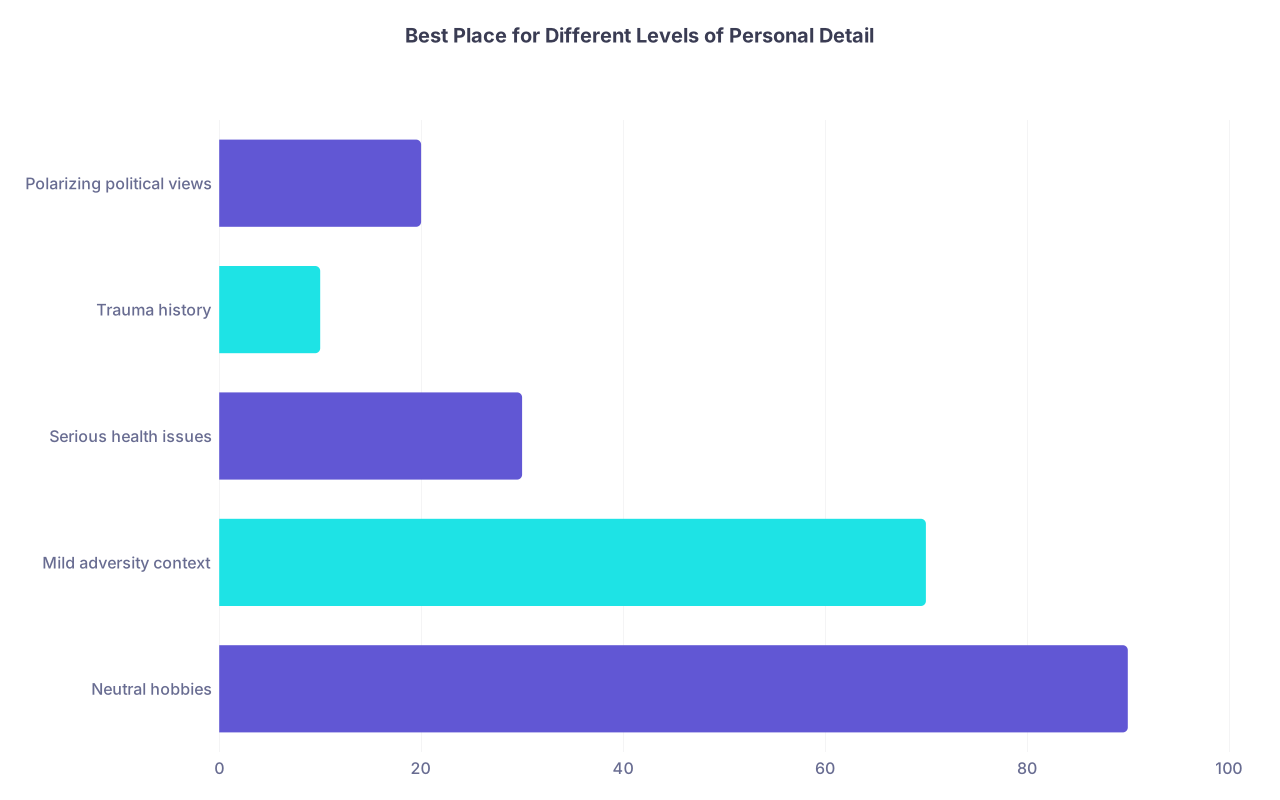
| Category | Value |
|---|---|
| Neutral hobbies | 90 |
| Mild adversity context | 70 |
| Serious health issues | 30 |
| Trauma history | 10 |
| Polarizing political views | 20 |
Interpretation (roughly):
- Neutral hobbies: CV is great.
- Mild adversity: CV or personal statement, carefully framed.
- Serious health issues: usually not on CV; maybe brief context in PS if needed.
- Trauma: rarely on CV; if mentioned at all, needs extreme care.
- Polarizing politics: usually avoid on CV.
Numbers aren’t scientific. Just a gut-level guide.
How To Gut-Check Your CV When You’re Anxious And Biased (Because You Are)
By the time you’re editing your CV at 1 am, you’re the worst possible judge of “too much or too little.” You’re too close to the story and too scared of everything.
Do this instead:
- Print your CV or convert it to PDF.
- With a pen (or annotator), circle anything that:
- Mentions health, family, politics, religion, identity, or trauma.
- Makes your stomach drop when you read it.
- For each circled item, write in the margin:
- “What is this trying to show about me as an applicant?”
- “Could I show that same quality in a less personal way?”
If the personal detail isn’t necessary to prove something important, cut it or neutralize it.
Then — and this is key — show it to two types of people:
- Someone who knows your full story (to keep you honest).
- Someone who doesn’t know your story at all (to tell you what impression they’d get just from the words).
If the second person raises their eyebrows, you’ve probably overshared.
A Simple Framework To Keep You Out of Trouble
Here’s a stripped-down mental checklist:

| Step | Description |
|---|---|
| Step 1 | Personal detail |
| Step 2 | Phrase briefly and neutrally |
| Step 3 | Omit from CV |
| Step 4 | Include in professional terms |
| Step 5 | Visible on transcript or MSPE? |
| Step 6 | Need brief explanation? |
| Step 7 | Does it clearly help selection? |
Translation:
- If it doesn’t show up anywhere officially and doesn’t clearly help your case → it probably doesn’t belong on the CV.
- If it does show up (LOA, gap, etc.), explain it in calm, boring language. Boring is your friend.
You’re Not Lying By Having Boundaries
This is what I wish someone had told me when I first started agonizing over this:
You are allowed to protect your story.
You’re allowed to say, “Here’s what I’ve done and what I’ve learned,” without handing over every painful detail that got you there. You’re not being dishonest by choosing which parts of your life are relevant to this decision and which are not.
Residency programs are not your confessional. They’re not your therapist. They’re not your best friend on a 2 am call. You don’t owe them your entire past in exchange for a possible interview slot.
You owe them clarity about your capabilities, your reliability, and your professionalism. That’s it.
Do This Today
Open your CV right now and highlight every line that includes something personal: health, family, politics, identity, trauma, religion, or anything that feels “vulnerable.”
For each highlighted line, rewrite it in one sentence that:
- Focuses on your role or achievement.
- Uses neutral, professional language.
- Leaves out diagnoses, graphic details, and emotional backstory.
Then decide: keep the neutral version, move the deeper story to your personal statement (if it truly helps you), or cut it altogether.
One line at a time, you’ll pull your CV back from “emotional landmine” territory into “professional, strong, and still human.”