
It’s late. You’ve got ERAS open on one tab, your CV on another, and a half‑finished email to your mentor that you’ve deleted and rewritten three times. You scroll through your ‘Volunteer’ section and your stomach just sinks.
Free clinic. Then a random health fair. Then that one‑off 5K race you helped with. A semester of tutoring. The hospital gift shop from M1 that you bailed on when anatomy hit. Nothing connects. Nothing screams “future internist” or “dedicated psychiatrist.” It just looks… chaotic.
And now your brain goes straight to the worst‑case scenario:
“They’re going to think I’m flaky. Or that I just chased hours. Or that I don’t actually care about anything.”
Let’s walk through this like someone who’s been on both sides: the panicking applicant side and the side quietly reviewing ERAS PDFs at 11 pm asking, “Okay, what is this person actually about?”
First: Is “Random” Volunteer Work Actually a Dealbreaker?
Short answer: no. Longer, more honest answer: it can hurt you if you leave it unexplained and incoherent.
Programs aren’t sitting there with a rubric saying “volunteer work must be in one perfectly aligned niche or automatic rejection.” That’s fantasy-level catastrophizing. What they’re doing is much more basic: they’re scanning for patterns and maturity.
They want to see:
- Do you show up consistently anywhere?
- Do you stick with things long enough to matter?
- Do you seem like a person who gives a damn about something beyond your own CV?
They’re not expecting you to have a 5‑year longitudinal project in homeless outreach that perfectly aligns with your dream specialty. They are expecting you not to look like you signed up for 12 random events to hit 100 hours and bounced.
So the problem usually isn’t that your activities are all over the place. It’s that they read as all over the place because you haven’t given anyone a storyline to follow.
And honestly, that’s fixable. Even a month before ERAS submission.
Step 1: Diagnose the Actual Problem (Not the Imagined One)
Before you spiral, you need to be brutally honest about what’s on your CV. Not what you wish were there. What’s actually there.
Pull up your list and ask:
- Do I have anything that lasted longer than a few months?
- Are there repeat activities or roles, even if the settings differ?
- Are there common threads (teaching, language skills, underserved, mental health, kids, chronic disease, etc.)?
You might think, “No, none, it’s all random,” but that’s usually not true. It’s just that you’ve never forced yourself to see patterns.
Let me give you an example of what “random” often looks like on paper:
- M1 fall: Hospital gift shop volunteer (3 months)
- M1 spring: Free clinic intake (intermittent)
- M2: Health fair blood pressure screenings (3 events)
- M2: Tutoring undergrad premeds (one semester)
- M3: Made calls for a vaccine outreach campaign (2 months)
At 2 a.m., that looks like chaos. At 2 p.m., with a calmer brain, it’s actually not that bad. There are threads: patient contact, health access, some teaching.
The issue isn’t the content; it’s the framing.
Step 2: Build a Coherent Narrative Out of “Random”
Programs love narratives because they make your file easier to remember. But “narrative” doesn’t mean lying or pretending you had a master plan since high school. It just means connecting dots you already have.
There are a few common “through‑lines” you can legitimately lean on without faking anything:

Possible storylines to connect scattered volunteering
Service to underserved / access to care
Free clinic? Health fair? Vaccine outreach? That’s all access and public health.Communication and education
Tutoring, patient education at fairs, vaccine calls, teaching roles. That’s an education/communication theme.Long‑term interest in patient-facing roles
Anything with direct patient or public contact can get tied into your interest in clinical work and bedside manner.Exploring where you fit
If you truly jumped around, you can own that honestly: you were figuring out where and how you can meaningfully contribute.
Pick 1–2 themes that are true for you. Then, when you describe your roles in ERAS or on your CV, lean into those threads.
For example, instead of:
“Volunteered at various community events including health fairs and vaccination campaigns.”
You write:
“Consistently sought patient‑facing roles in community settings, from blood pressure screenings at local health fairs to phone outreach for COVID vaccination, with a focus on improving access for under‑served neighborhoods.”
Same underlying events. Completely different impression.
Step 3: Rewrite Your Activity Descriptions So They Stop Sounding Random
This is where most anxious applicants quietly sabotage themselves. The activities are fine, but the descriptions are robotic and disconnected.
Instead of listing tasks like a grocery list, tie each role to a skill, a value, or a pattern.
Compare these two:
Version that screams ‘checkbox’:
“Worked in hospital gift shop. Helped customers find items, stocked shelves.”
Version that actually helps you:
“Regular weekly volunteer in the hospital gift shop, serving as one of the first points of contact for patients and families. Learned to communicate with anxious visitors, coordinate with nursing staff, and support families during long hospital stays.”
Same job. But now it sounds like part of your growth as a future physician, not “I sold candy once.”
Do that for every volunteer line:
- Add continuity (“over two semesters,” “across multiple events,” “over three years”)
- Add purpose (“with a focus on…,” “to support…,” “aimed at…”)
- Add what you learned that matters for residency
You’re not inflating. You’re explaining.
Step 4: Consider Grouping Certain Activities (Smartly)
If you’ve got 7 micro‑volunteering gigs, each 5–10 hours, listed separately, it looks messy and desperate. You can sometimes group them under a broader umbrella in your CV or summarize them in one ERAS entry if appropriate.
Something like:
“Community health outreach events – 25 hours
Participated in multiple one‑day and weekend events including BP screenings at city health fairs, flu shot clinics, and COVID vaccination drives. Focused on patient education, counseling on lifestyle changes, and connecting participants to primary care resources.”
Now instead of three or four scattered 5‑hour entries, you have one coherent “community outreach” experience that looks intentional.
Programs don’t care that it was exactly three events versus one ongoing thing; they care what it says about you.
Step 5: Address It Directly (Without Apologizing)
If your volunteer work really does look scattered and you’re worried about how it’ll land, you can subtly address it in your personal statement or in an interview answer.
Not with a groveling apology. With context.
Personal statement example:
“Throughout medical school, I tried different ways of serving outside the classroom—from working in the hospital gift shop to helping with health fairs and tutoring. At the time it felt scattered, but looking back, I see a consistent desire to be face‑to‑face with people: listening, explaining, and trying to make the system a little less confusing. That is the part of medicine that keeps pulling me back, and it’s what draws me to internal medicine.”
You’ve just reframed “random” as “exploratory but values‑driven.”
In interviews, if they ask about volunteering, you can say something similar:
“Honestly, early on I tried a lot of different things to figure out where I felt I could be most useful. Over time I realized the common thread for me is direct interaction—either with patients in clinic or with students I’m tutoring. That’s a pattern I’d like to keep in residency, through clinic work and hopefully some teaching roles.”
Owning it calmly > acting ashamed or defensive.
Step 6: If You Still Have Time, Add One Anchor Activity
If you’re early enough in the cycle (or a year out), the best way to stabilize a “random” volunteer history is to add one more sustained, relevant experience and stick with it.
Not five. One.
Something like:
- Regular free clinic shift (even 2x/month)
- Longitudinal mentorship or tutoring
- Ongoing role in a community organization
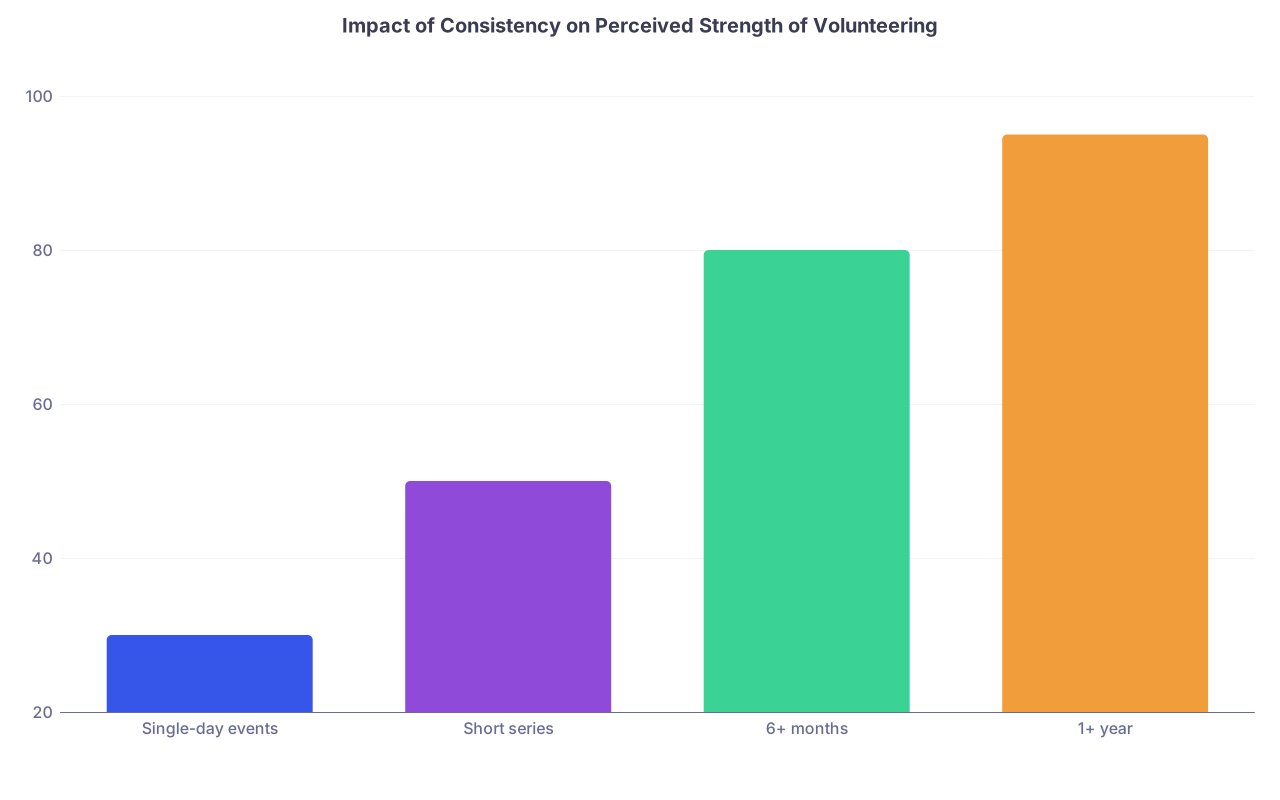
| Category | Value |
|---|---|
| Single-day events | 30 |
| Short series | 50 |
| 6+ months | 80 |
| 1+ year | 95 |
If a reviewer sees:
- 3–4 scattered earlier activities, plus
- 1 solid, 8–12+ month thing you stuck with
They’ll usually anchor on the long‑term one and mentally file the rest under “early exploration.”
I’ve literally heard attendings say: “Yeah, their preclinical stuff was all over, but they’ve been at that clinic a year now. That’s what matters.”
So if you’ve got any time left at all, invest it in consistency, not variety.
Step 7: Reality Check – How Much Do Programs Actually Care About This?
Harsh reality: for many competitive specialties, the order of importance really is something like:
- Exams / class rank
- Clinical performance / letters
- Research (depending on field)
- Everything else
Volunteer work sits in that “everything else” box. It can differentiate you positively, but it’s rarely the thing that kills an otherwise solid app.
The people who get hurt by their volunteer section fall into two groups:
- Those who have literally nothing and look like they never did a single thing not required
- Those whose entire app screams “checkbox”: 27 tiny things started, completed none
If you’re in the middle—some genuine service, some randomness, some attempt at continuity—you’re not in disaster territory. You’re in “this could look better with some editing and framing” territory.
Step 8: How to Talk About “Random” Volunteering in Different Contexts
On your CV / ERAS
- Use strong, intentional language, not vague filler
- Emphasize continuity wherever you can
- Group micro‑activities when justified
- Tie every description to skills or values that matter in residency (communication, reliability, teamwork, caring about access, etc.)
In your personal statement
You don’t need a paragraph on every volunteer gig. You can:
- Mention 1–2 that actually meant something to you
- Pull out the theme (“being at the front line,” “explaining complex information,” “working with underserved communities”)
- Briefly acknowledge any “exploratory” period if it helps your story, then move on
In interviews
If asked, don’t panic and word-vomit your entire volunteer history chronologically. Hit:
- The why behind your volunteering in general
- 1–2 experiences that were meaningful and what you learned
- How that carries into the kind of resident you want to be
If they say “You’ve done a lot of different things,” you can respond with something like:
“I did. Early on I was figuring out where I could show up consistently. What stuck for me was [X], and I’ve tried to build on that since.”
That’s mature, not flaky.
| Raw Activity | Weak Description | Strong, Focused Description |
|---|---|---|
| Health fair BP checks | Took blood pressure at events | Conducted BP screenings and counseled on lifestyle risk |
| Tutored undergrads | Helped students with classes | Provided weekly mentorship and study coaching |
| Hospital gift shop | Sold items and stocked shelves | Supported patients and families as first contact point |
| Vaccine phone outreach | Called people about vaccines | Educated patients and addressed vaccine hesitancy |

| Step | Description |
|---|---|
| Step 1 | Scattered Activities |
| Step 2 | Identify Common Themes |
| Step 3 | Rewrite Descriptions |
| Step 4 | Group Short Events |
| Step 5 | Highlight 1-2 Key Experiences |
| Step 6 | Anchor With Ongoing Role |
What If It Still Feels Hopeless?
I know the voice in your head: “Yeah but mine is worse. Mine is really random. And I quit stuff. And I have gaps.”
Let me be blunt: I’ve read apps from people who clearly panicked M4 fall, signed up for three new things in September, and dumped them all into ERAS with 6–8 hours each. That looks bad.
If your volunteering:
- Spans multiple years—even with gaps
- Includes at least one thing you stayed with for a bit
- And isn’t obviously fabricated or “I did this yesterday”
Then you’re not that applicant.
Stop grading yourself against some imaginary person who ran a nonprofit, did global health in three countries, and wrote an NEJM piece about it. Most people are not that person.
You just need to:
- Clean up how things are presented
- Decide what story you’re telling
- Stop underselling what you actually did learn from these experiences

FAQs
1. Should I delete short, one‑time volunteer activities from my CV?
If you have a bunch of 2–5 hour events, you don’t need to list each one separately. That screams “padding.” Either:
- Group them under one “Community Health Events” type entry, or
- Cut the lowest‑yield ones if you already have stronger, longer-term activities
If you only have a few things total, you can keep a couple of short ones, but rewrite them so they connect to your themes and don’t dominate your section.
2. Will programs think I’m unfocused if my volunteer work doesn’t match my specialty?
Almost never. People match into IM with peds volunteering, into EM with teaching gigs, into psych with general free clinic work. They’re looking at whether you show up for other humans, not whether every activity screams “future cardiologist.” If your whole app is a mismatch (research, statements, letters, volunteering), then it raises questions. But volunteer–specialty mismatch alone is not what sinks you.
3. Is it too late to start a new volunteer role right before ERAS?
If you’re a month out? You’re not going to impress anyone with “Started last month” unless you can explain why it’s meaningful. It can help your future narrative, but it won’t magically transform this cycle. If you have 6–12 months before applying, then yes, start something and commit. Programs care more about duration and depth than the exact start date.
4. What if I quit a volunteer position—do I still list it?
If you did a reasonable amount of work (say, a semester, or >20 hours) and you left for a normal reason (schedule conflict, clinicals, leadership change), you can keep it. Just don’t lie about the end date. No one is cross‑checking your exact months unless something looks blatantly fake. If you bailed after two shifts, I’d probably leave it off unless your app is empty and you can group it with others under a general entry.
Key points:
- “Random” volunteer work usually isn’t fatal; unframed volunteer work is.
- Your job is to pull out real themes, rewrite descriptions, and, if possible, anchor everything with one consistent role.
- Programs are looking for evidence that you show up for people and stick with things—not that you architected a perfect, specialty‑branded service portfolio starting M1 day one.