
The biggest mistake applicants make with residency CVs is thinking longer automatically means stronger. It doesn’t. Past a certain point, more pages just prove you don’t know how to edit.
Here’s the answer you’re actually looking for.
Ideal Residency CV Length (And When To Break The Rule)
For 90% of residency applicants:
Your residency CV should be 2–3 pages.
Not one page. Not six. Two to three.
Here’s the breakdown:
- MS3 / early MS4 with average experience: 2 pages
- Strongly involved student (research, leadership, publications): 2–3 pages
- MD/PhD or heavy research track: 3–4 pages is acceptable
- International medical graduates with long prior careers: 3 pages is typical; up to 4 if there’s substantial, relevant experience
If you’re under 2 pages as a typical US MS4, you probably haven’t included enough detail.
If you’re over 4 pages, you almost definitely haven’t cut enough.
Programs don’t read CVs like a novel. They scan:
- Top third of page 1
- Section headers
- First 1–2 items in each section
- Anything that clearly stands out (R01-level work, first-author pubs, major awards)
So your goal is not “fit everything I’ve ever done.”
Your goal is “make it brutally easy to see I’m a serious, focused applicant in 60 seconds.”
Ideal Entry Counts By Section
You asked about length, but the tactical question under that is: how many entries is too many in each section?
Here’s what I recommend as a starting target.
| Section | Typical Range | Red Flag Range |
|---|---|---|
| Education | 2–4 | >4 |
| Clinical Experience | 4–10 | >12 |
| Research | 2–8 | >10 |
| Publications | 0–15 | >25 |
| Presentations | 0–15 | >25 |
| Leadership | 3–10 | >15 |
Let’s go section by section and talk what’s normal and what’s too much.
Education
Normal: 2–4 entries
Examples:
- Undergraduate degree
- Medical school
- Prior graduate degree (MS, MPH, PhD)
- Possibly a major formal post-bacc or SMP
No one needs:
- Your high school
- One-off certificate courses as separate “education” entries
- Every 2-week online course framed as a degree-level item
If you’re listing more than 4 education entries, you’re probably padding.
Clinical Experience (Non-Rotation)
For residency CVs, your core clerkships usually don’t go here; they’re implied by your medical school training unless the CV format specifically asks.
What belongs:
- Sub-internships / acting internships
- Away rotations (if you choose to include them)
- Longitudinal clinics
- Significant preclinical clinical work (scribe, MA, EMT)
- Meaningful volunteer clinical roles
Reasonable target: 4–10 entries.
Red flag: 15+ micro-experiences like “Half-day shadowing” or “Observed 4 colonoscopies.” Those make you look like you’re trying too hard to impress with fluff.
Research Experience
This varies a lot by specialty.
- Non-research-heavy specialties (FM, psych, peds): 2–5 research experiences is totally fine
- Competitive & academic specialties (DERM, ENT, ortho, rad onc, neurosurg): often 4–8 meaningful experiences
Key point: “Research experiences” means projects or roles. Not every small subtask as its own line.
A strong research CV might look like:
- 3 lab roles (e.g., undergrad, gap year, med school)
- 2–5 specific projects nested under those roles
- Then a separate section listing publications/presentations
What looks bad:
- 12 separate “research projects” that are essentially the same lab, same PI, different cells studied
- Listing “data collection for X” as its own entry with no context
- Giant laundry lists with no measurable outcomes
Publications
This is the one that really stresses people out.
Here’s the honest version:
- Many solid applicants have 0–2 publications
- For most specialties, 3–10 is very good
- For super competitive fields, 10–20 is common at top programs (including abstracts and posters)
Don’t panic if your number is low. Programs care about:
- Consistency of effort
- Evidence you can finish what you start
- Level of your contribution (first-author vs 17th name in the list)
Once you’re above ~20 total citations (papers + abstracts + posters), start curating.
Do you really need every tiny conference poster from 4 years ago? Maybe. Maybe not.
If you’re at 30+ entries and still a med student, I’ve almost always found the section to be:
- Full of very low-impact abstracts, or
- A mess of duplicates, in-press, submitted, etc. mixed together
You want it readable, not padded.
Presentations
Same idea as publications, but a bit looser.
Reasonable:
- 0–15 is normal
- Over 20, I start trimming older, lower-yield local talks
Be ruthless with things like:
- 10-minute presentations at small student clubs
- Required med school course presentations
- “Informal” teaching sessions you’re trying to rebrand as talks
Presentations that deserve space:
- National or major regional conferences
- Institutional research days if the work was strong
- Invited talks, grand rounds, or formal lectures
Leadership & Service
You want depth here, not raw count.
Ideal:
- 3–10 entries that show progression, responsibility, and impact
Less helpful:
- 20+ ultra-short commitments (“Attended one-day free clinic fair,” “Helped organize single event”)
For every entry, ask: If the PD asked, “Tell me about this,” do I have a 30–60 second story with real content? If not, consider cutting it.
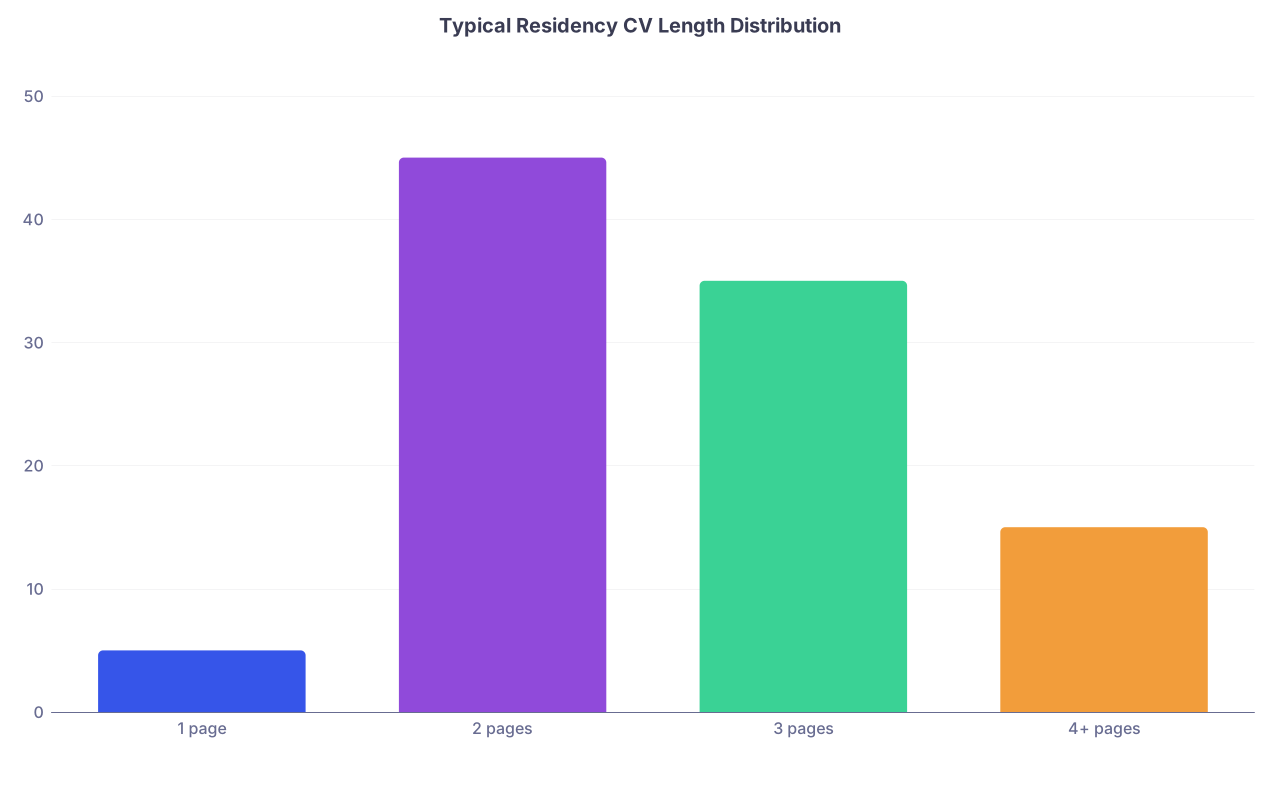
| Category | Value |
|---|---|
| 1 page | 5 |
| 2 pages | 45 |
| 3 pages | 35 |
| 4+ pages | 15 |
How To Keep Your CV The Right Length
Let’s talk editing, because that’s what actually controls length.
Rule 1: Ruthlessly Remove Redundancy
If you repeat the same role three different ways, compress it.
Bad pattern:
- Research assistant – Dr. Smith Lab
- Data collector – Dr. Smith Lab
- Manuscript assistant – Dr. Smith Lab
Better:
- Research Assistant, Dr. Smith Lab (Month Year – Month Year)
- Led data collection and analysis for three projects on [topic]
- Contributed to manuscript preparation resulting in X publications (Y first-author)
One job, two bullets, done.
Rule 2: Drop Anything Before College (Almost Always)
High school awards, clubs, volunteer work — gone.
Exception: Truly elite, relevant things (e.g., you were on a national Olympic team, or you did something so significant it still matters now). And even then, you keep it to one line.
Rule 3: Use 2–4 Bullets For Major Roles, 1–2 For Minor Ones
If every role has 6–8 bullets, your CV will explode to 5+ pages and no one will read them.
General guide:
- Big, identity-defining roles (e.g., 2-year lab, major leadership position): 3–4 bullets
- Solid but not central roles: 2–3 bullets
- Short-term, lower-impact roles: 1–2 bullets
If you can’t explain the impact in 1–2 bullets, the impact probably wasn’t that big.
Rule 4: Combine Repetitive Volunteer Work
Instead of listing:
- Free Clinic Volunteer – Site A
- Free Clinic Volunteer – Site B
- Free Clinic Volunteer – Site C
Consider:
- Student Free Clinic Volunteer (3 sites)
- X total hours across primary care and specialty clinics
- Responsibilities: [condensed meaningful tasks]
Cleaner. More impressive. Less bloat.
Rule 5: Stop Listing “Nothing” As Experience
People pad CVs with:
- “Journal club participant”
- “Anatomy small group member”
- “Attended weekly case conference”
If it’s required curriculum or passive attendance, it’s not a CV entry. That belongs in “Interests” at best, or nowhere.

| Step | Description |
|---|---|
| Step 1 | Draft CV |
| Step 2 | Likely OK |
| Step 3 | Cut low impact items |
| Step 4 | Combine and condense |
| Step 5 | Get mentor review |
| Step 6 | Over 3 pages? |
| Step 7 | Still over 4 pages? |
| Step 8 | Still long or cluttered? |
When 1–Page Or 4–Page CVs Actually Make Sense
Let’s talk edge cases.
When a 1-Page CV Is Appropriate
Honestly? Almost never in residency recruitment.
One-pagers are for:
- Industry jobs
- Some away rotations that explicitly ask for a 1-page resume
- Non-clinical roles
For residency applications, a 1-page CV usually screams: very light activity or lack of understanding of what belongs.
If a program specifically tells you “upload a 1-page CV,” then sure, follow the instruction. That’s not common, though.
When 4+ Pages Is Actually Fine
You’re not wrong to go past 3 pages if:
- You’re MD/PhD with multiple years of full-time research
- You have 20+ peer-reviewed publications
- You have genuine prior careers (engineer, RN, military officer, etc.) with substantial responsibility
But even then, format matters.
Once you spill past 3 pages:
- Organize publications with subsections (peer-reviewed, abstracts, posters, other)
- Consider abbreviating older, less relevant positions
- Keep clinical and leadership content easy to find near the front
If page 1 is 80% poster abstracts and page 3 is the only place leadership shows up, your priorities look off.
Practical Page-By-Page Structure
Here’s a structure that tends to land around 2–3 pages and reads cleanly.
Page 1 (non-negotiable sections):
- Name + contact info (simple, no 3-line mission statements)
- Education
- Major honors & awards
- Clinical experience (highest-yield stuff)
Page 2:
- Research experience
- Publications & presentations (if you have them)
- Leadership & service
Page 3 (if you need it):
- Additional publications/presentations
- Teaching experience
- Select professional memberships
- Skills & certifications (only if truly meaningful to clinical training)
What you skip or shove toward the end:
- Generic “skills” (Microsoft Word, basic conversational Spanish, etc.)
- Long lists of memberships where you never did anything
- Overly detailed hobby sections
Quick Self-Audit: Is My CV The Right Length?
Run your CV through this checklist:
Am I between 2–3 pages?
- If no, do I have a truly compelling reason to be outside that range?
Is page 1 mostly high-value content (education, major roles, real impact)?
- Or did I burn it on fluff (tiny awards, minor memberships)?
In each section, do I have:
- 3–10 entries for leadership/service?
- 2–8 research experiences (not counting publications separately)?
- A publications/presentations section that’s readable, not just “see 40 items”?
Could I defend each entry in a 60-second conversation with a PD?
- If I’d be embarrassed to talk about it, it probably doesn’t belong.
Do similar experiences clearly group together, or are they scattered and repetitive?
If you clean that up, you’ll almost always land in the right length range without obsessing over the exact page count.
FAQ (Exactly 5 Questions)
1. Is a 4-page CV automatically a red flag for residency?
No, but it raises questions. For a typical US MS4 without major prior careers or an MD/PhD, 4+ pages usually means you haven’t edited enough. If it’s 4 pages because you have real research productivity or a prior substantive career, that’s fine. Just make sure the first 2 pages highlight the most important stuff clearly.
2. Should I list every shadowing experience on my residency CV?
No. By residency, heavy shadowing is background noise. One or two truly formative or long-term shadowing experiences can be included under clinical experience, but 8 separate half-day shadows just make you look unfocused. Emphasize active clinical roles instead (scribe, MA, EMT, longitudinal clinic).
3. How many publications do I need for a competitive specialty?
There isn’t a magic number. For things like derm, ortho, neurosurg, rad onc, ENT, it’s common to see 5–15 total items (including abstracts and posters) at top programs, but programs care more about quality, consistency, and clear involvement. One strong first-author paper plus clear ongoing work looks better than 12 meaningless abstracts where your name is buried.
4. Should I include my hobbies and interests on the CV?
Yes, but briefly. One short “Interests” section at the bottom (2–4 lines) is enough. It’s there to humanize you and provide interview talking points, not to take up half a page. Don’t list 15 hobbies; list the 3–5 you actually engage in regularly and could talk about comfortably.
5. Do I need separate CV versions for different specialties?
Sometimes. If you’re dual-applying (e.g., IM and neurology, or FM and psych), you can usually use one well-edited CV and be fine. If you’re applying to wildly different fields (like neurosurgery and pathology), it can be worth subtly reordering or emphasizing different sections, but the total length and core content should stay honest and similar. Don’t invent or delete major experiences for one version.
Bottom line:
- Aim for 2–3 pages; step outside that range only when you can justify it.
- Curate your entries — depth and clarity beat raw count every time.
- If you’re not sure whether something belongs, ask yourself: would I be happy if they asked me about this on interview day? If not, cut it.