
The advice that “only medical stuff belongs on a residency CV” is wrong.
Non-medical jobs can absolutely help you—if you choose the right ones and put them in the right place.
Here’s the direct answer you’re looking for:
Yes, you usually should include non-medical jobs on your residency CV. But you need to be selective, frame them correctly, and put them in the right section so they help you instead of cluttering your application.
Let’s break down exactly how to do that.
1. When Non-Medical Jobs Help You (And When They Hurt)
Non-medical work can be a real asset. Program directors are trying to answer three questions:
- Can you handle the workload?
- Are you reliable?
- Are you someone they want on their team at 3 a.m.?
Good non-medical jobs help you say “yes” to all three.
You should include non-medical jobs if they show:
- Long-term work commitment (especially during school)
- Leadership, supervision, or management
- High responsibility (money, safety, people, operations)
- Customer service / communication under pressure
- Grit or overcoming hardship (worked to support yourself or family)
You should skip or minimize non-medical jobs if they’re:
- Very short-term and clearly just filler (one-month seasonal jobs, random one-off gigs)
- Distant in time and overshadowed by stronger, more recent experiences
- Redundant with better experiences you already list (e.g., listing 4 different very similar part-time retail jobs)
General rule:
If you can’t tie the job to skills that matter for residency—teamwork, reliability, communication, leadership, resilience—it probably doesn’t belong, or it needs to be condensed.
2. Exactly Where Non-Medical Jobs Belong on a Residency CV
Stop overthinking the “where” question. It’s simple when you follow this structure.
Your main options:
- Employment / Work Experience
- Leadership & Management
- Volunteer & Community Service (if unpaid)
- “Prior Career” or “Other Professional Experience” (for career changers)
Let’s walk through when to use each.
A. Standard Applicant: Use “Employment” or “Work Experience”
If you’re a typical med student (no previous full-time career), this section title works well:
- “Employment”
- or “Work Experience”
Put it after your Education section and before Research, Leadership, or Volunteer sections.
This is where to list:
- Restaurant work
- Retail jobs
- Tutoring (if paid)
- Administrative jobs
- Campus jobs (library, IT, residence assistant if it’s primarily paid work)
- Anything that looks like a real job with real responsibility
Format it like any other professional role:
- Job Title
- Organization / Company, City, State
- Dates (Month Year – Month Year)
- 1–3 bullet points max
Example:
Employment
Server, Olive Garden, City, State
06/2018 – 08/2021
- Worked 20–25 hours per week while completing pre-med and early medical coursework
- Managed high-volume sections and resolved customer concerns in a fast-paced environment
- Trained 4 new hires on workflow, customer communication, and POS system
That tells a program: this person can work hard, deal with people, and hold responsibility over time. That’s useful.
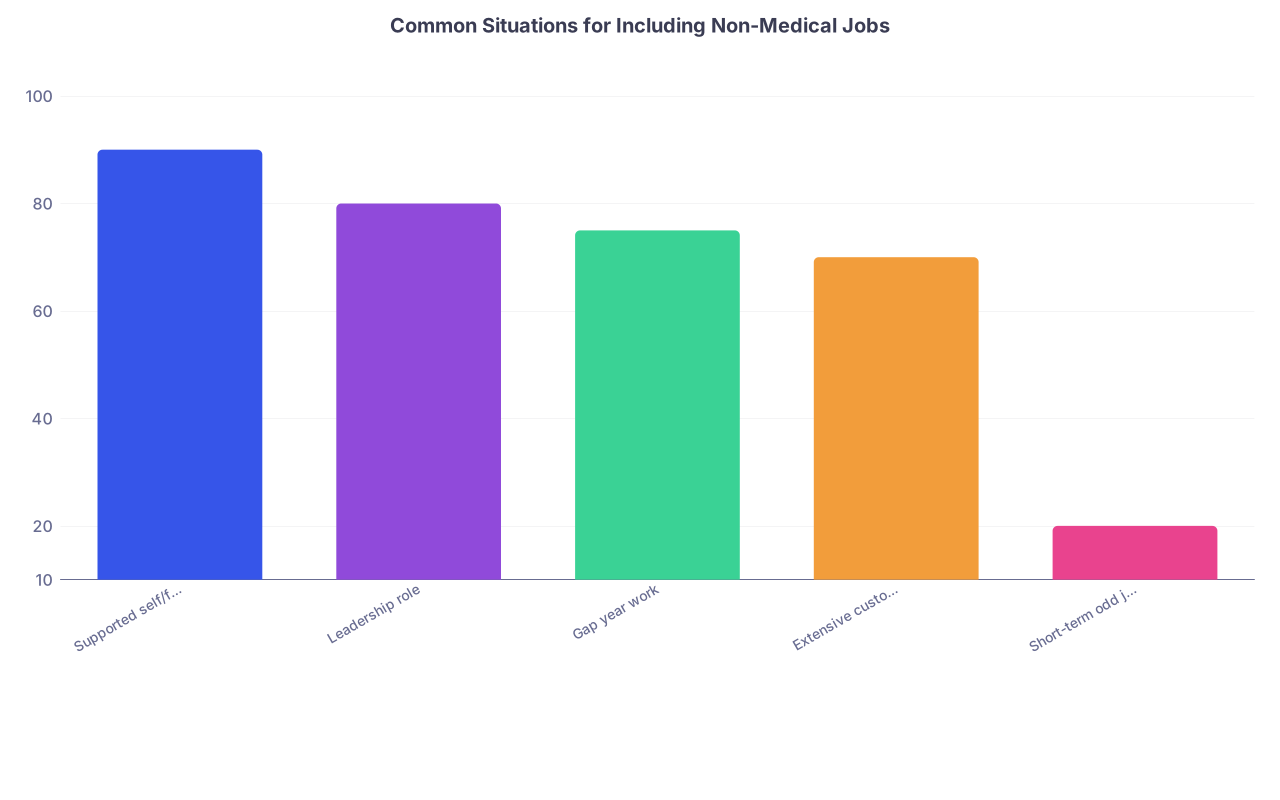
| Category | Value |
|---|---|
| Supported self/family | 90 |
| Leadership role | 80 |
| Gap year work | 75 |
| Extensive customer service | 70 |
| Short-term odd jobs | 20 |
B. If You Had Supervisory Responsibility: Consider “Leadership” Too
If the non-medical job involved real leadership (not just “senior cashier” by title), you have two choices:
- Keep it under Employment but emphasize leadership in the bullets, or
- List the job under Employment and also list a leadership role from that job under Leadership & Management
Example:
Employment
Store Associate, Target, City, State
08/2017 – 05/2020
- Worked 15–20 hours per week while enrolled full-time
- Consistently ranked in top 10% for customer feedback scores
Leadership & Management
Shift Supervisor, Target, City, State
06/2019 – 05/2020
- Supervised 6–8 staff per shift and coordinated nightly closing operations
- Led weekly huddles to assign roles, review performance goals, and resolve workflow issues
That second entry shows you weren’t just clocking in. You were trusted to run things. Programs like that.
C. Volunteer vs Employment: Don’t Mix Them Up
If the role was unpaid, it usually belongs in Volunteer Experience or Community Service, not Employment.
Example:
- Unpaid hotline volunteer → Volunteer / Community Service
- Paid call center agent → Employment
Don’t play games here; programs can smell it. If it’s paid, it’s employment. If it’s unpaid, it’s volunteer. Label it honestly.
D. Career Changers: Use “Prior Career” or “Previous Professional Experience”
If you had a real career before medicine (engineer, teacher, accountant, software developer, etc.), don’t bury it under generic “Employment.” It deserves its own section.
Section titles that work well:
- Prior Career
- Previous Professional Experience
- Non-Clinical Professional Experience
Place this right after Education, before Research and other sections. It tells a story immediately: “I didn’t stumble into this. I changed direction.”
Example:
Prior Career – Software Engineering
Software Engineer, Google, Mountain View, CA
08/2014 – 07/2019
- Led development of internal tools adopted by a 20-person team
- Collaborated with cross-functional stakeholders to define requirements and timelines
- Mentored two junior engineers on code quality and project ownership
Then, in your personal statement, you tie that mindset, teamwork, and problem-solving into why you’ll be a strong resident.
3. How Far Back To Go: High School, College, Random Gigs
Here’s the blunt version:
- High school jobs → Usually leave them off, unless:
- You worked significant hours to support your family
- It was unusually relevant or impressive (founded a real business, major responsibility)
- Early college jobs → Include if:
- They’re sustained (1+ year)
- Show work ethic, responsibility, or leadership
- You don’t have many later experiences to fill the page
- Random short gigs → Group them or skip them:
- Don’t list “DoorDash Driver – 4 months” and “Campus Flyering – 2 weeks” separately
- If you must, group as “Various part-time service roles during college” with one bullet
Your residency CV is not your autobiography. It’s a curated argument. Every line either helps that argument or gets cut.

4. How To Write Non-Medical Job Entries So They Actually Help
This is where most people mess it up. They copy a generic job description instead of showing what matters to residency.
Don’t write:
- “Operated cash register”
- “Answered phone calls”
- “Stocked shelves”
That’s useless. It tells a PD nothing about you that helps them.
Instead, write bullets that show:
- Volume / intensity
- Reliability
- Leadership or initiative
- Conflict resolution / communication
- Time management (especially alongside school)
Examples:
Bad:
“Cashier at grocery store”
Better:
“Cashier, Kroger, City, State
08/2019 – 05/2022
- Worked 20 hours per week while enrolled full-time in pre-med courses
- Recognized twice as employee of the month for reliability and customer service
- Trained 5 new employees on register procedures and conflict resolution”
Another example:
Bad:
“Tutor for high school students”
Better:
“Private Math and Science Tutor, Self-employed, City, State
09/2018 – 06/2021
- Tutored 6–8 students per semester in algebra, chemistry, and biology
- Developed individualized study plans and tracked progress toward measurable goals
- Coordinated with parents and teachers to address academic and behavioral challenges”
See the difference? You’re not proving you can press buttons or explain equations. You’re proving you can communicate, manage time, manage people, and be accountable. Those are residency skills.
5. Matching Non-Medical Jobs to Specialty: What To Emphasize
You don’t need to force some ridiculous “serving food made me a future neurosurgeon” angle. But you can highlight different aspects depending on your target specialty.
Here’s how to think about it:
| Target Specialty | What To Emphasize | Example Job Angle |
|---|---|---|
| Emergency Med | Working under pressure | Night shift manager at 24/7 store |
| Internal Med | Communication, reliability | Long-term tutoring or customer service |
| Surgery | Responsibility, precision, endurance | Supervising operations, long shifts |
| Pediatrics | Working with youth/families | Teaching, coaching, childcare |
| Psychiatry | Conflict resolution, listening | Customer complaints, call center |
You don’t rewrite history. You just adjust which skills you highlight in your bullets and personal statement.
Example for EM:
“Managed closing shift at high-volume restaurant, resolving conflicts among staff and customers during peak hours.”
Example for Psych:
“Handled escalated customer concerns by de-escalating conflict and collaboratively identifying solutions.”
Same job. Different angle.
6. Red Flags and Common Mistakes With Non-Medical Jobs
Program directors don’t hate non-medical jobs. They hate sloppy non-medical job sections. Avoid these:
Overloading your CV with every job you’ve ever had
If your CV looks like a tax return, you’ve lost the plot. Pick what supports your story.Job-hopping with no explanation
Six jobs in two years with shallow descriptions looks unreliable. Either:- Group very short-term roles
- Or emphasize that they were seasonal/temporary if that’s true
Inflated titles
“Chief Operations Manager” for a campus coffee shop when you were a shift lead? Don’t do that. PDs will roll their eyes.No dates
Missing dates makes people suspicious. Always include month/year ranges. Gaps are fine. Dishonesty is not.No connection to your timeline
If you took a research year or had a score delay, non-medical employment can explain what you were doing. If you leave it off, it can look like you weren’t doing much.
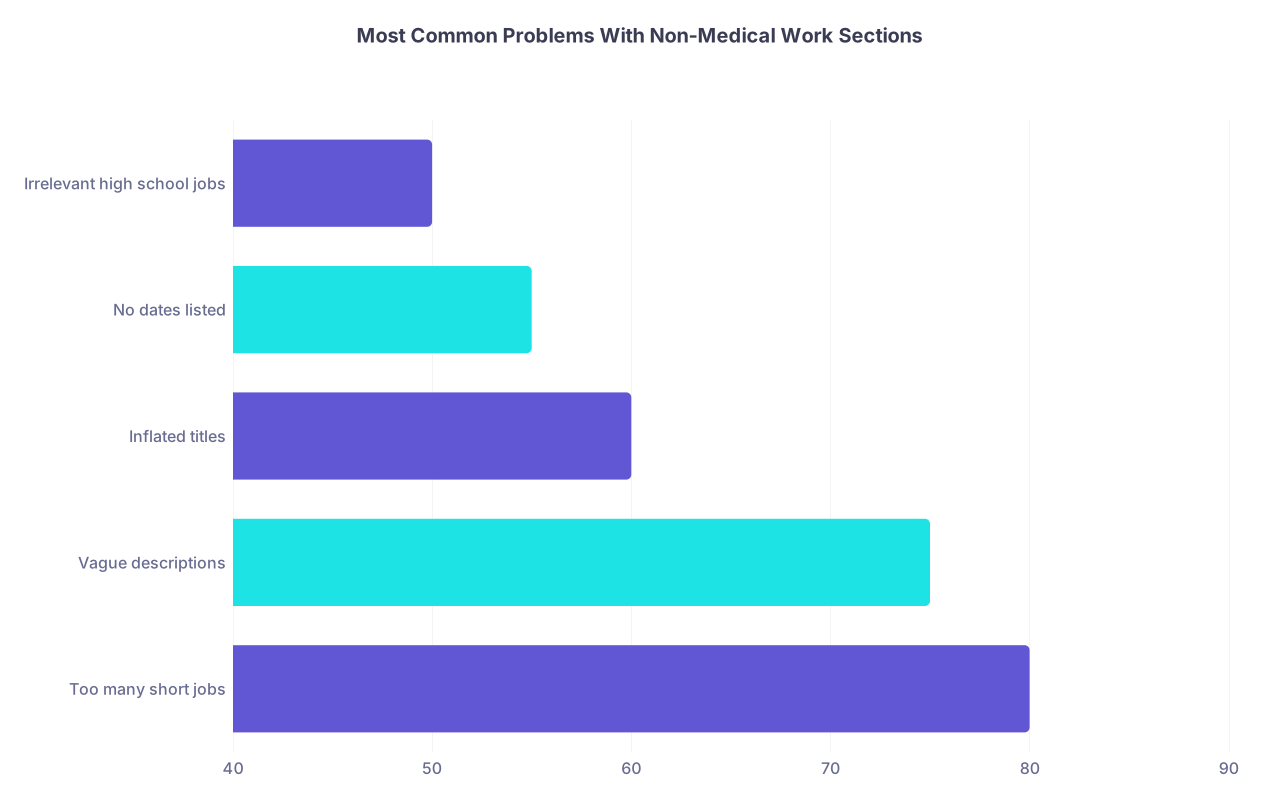
| Category | Value |
|---|---|
| Too many short jobs | 80 |
| Vague descriptions | 75 |
| Inflated titles | 60 |
| No dates listed | 55 |
| Irrelevant high school jobs | 50 |
7. How This Plays With ERAS vs. A Traditional CV
You’re juggling two similar but not identical beasts: ERAS “Experiences” and a traditional PDF CV some programs still ask for.
Here’s how to handle both.
ERAS
In ERAS, everything (research, work, volunteer) goes under “Experiences” with a type label.
For non-medical jobs:
- Type: “Work” (not “Volunteer”)
- Setting: Choose the closest option (usually “Other” or appropriate non-clinical setting)
- Description: Same rules—focus on responsibility, consistency, and skills
You don’t need a separate “Employment” section here; ERAS does the grouping for you.
Traditional CV (PDF)
For a PDF CV you upload or email, structure it like this:
- Education
- Prior Career / Professional Experience (if you had a career)
- Employment / Work Experience (for non-medical and medical paid work)
- Research Experience
- Volunteer / Community Service
- Leadership & Awards
- Publications / Presentations
- Skills / Languages (optional)
Non-medical jobs live in Employment / Work Experience or Prior Career, depending on your background.
8. Quick Gut-Check: Should I Include This Job?
If you’re still unsure about a particular job, ask yourself three questions:
- Did it require real responsibility or sustained effort?
- Does it fill a meaningful gap or strengthen my story as an applicant?
- Can I write 1–3 meaningful bullets that show residency-relevant skills?
If you can’t answer “yes” to at least two of those, it’s probably fine to cut it—or group it with other minor roles.
FAQ (Exactly 5 Questions)
1. Should I list my high school job on my residency CV?
Usually no. Exception: you had major, sustained responsibility (e.g., working 25–30 hours/week to support your family) and you don’t have many later experiences. In that case, include it but keep it brief and don’t let it dominate the page.
2. Is it bad if my non-medical job has nothing to do with medicine?
Not at all. Most don’t. Programs care more about what the job shows about you: reliability, work ethic, communication, teamwork, and how you managed it alongside school. A restaurant, warehouse, or retail job can be very positive if described well.
3. What if I was fired or left a job on bad terms—do I have to list it?
You’re not obligated to list every job you’ve ever had. If it was short, not central to your timeline, and not required for explaining a gap, you can leave it off. If it fills a big gap, you can list it without going into the circumstances of leaving—your bullets should focus on responsibilities and accomplishments while you were there.
4. How many non-medical jobs is “too many” on a residency CV?
If non-medical work takes more than about one page or clearly crowds out research, clinical, and leadership experiences, it’s too much. For most people, 1–3 well-chosen, well-described jobs is plenty. Group minor or short-term roles rather than listing them all.
5. Should I mention non-medical jobs in my personal statement too?
Yes, if they’re central to your story—especially if you worked to support yourself, had a prior career, or learned something that genuinely shaped how you see patients or teams. Just don’t force a fake connection. Use one or two strong examples rather than a full work history.
Key takeaways:
Non-medical jobs absolutely belong on a residency CV when they show responsibility, resilience, and real-world skills. Put them under Employment/Work Experience (or Prior Career), write focused, grown-up bullets, and skip the clutter. Your goal isn’t to show every job you’ve had—it’s to prove you’re the kind of person a program can trust on the wards.