
Your ERAS CV and your academic CV are not the same document—and treating them like they are is how strong applicants look average.
You are playing two different games:
- ERAS: structured, filtered data for residency selection.
- Academic CV: full, narrative record of your professional life.
If you try to use one style for both, you usually end up with:
- A bloated, unreadable ERAS application, or
- A thin, unimpressive academic CV that undersells you.
Let’s sort this out clearly so you know exactly what to do for residency season—and how not to sabotage your future academic career in the process.
Big-Picture Difference: Form vs. Document
First distinction that matters:
- ERAS “CV” is not really a CV at all. It’s a structured online form (Experience, Education, Publications, etc.) with strict categories, word limits, and formats.
- Academic CV is a free-form document (usually Word or PDF) that you design and control. You decide sections, formatting, length, and level of detail.
Put differently:
- ERAS = what programs see in your residency application.
- Academic CV = what people see when they’re asking, “Who is this person professionally?” outside ERAS.
That means:
- For Match: ERAS rules; programs never see your “real” CV unless they specifically ask.
- For research positions, fellowships, awards, visiting rotations, and later jobs: your academic CV matters a lot.
If you’re only polishing ERAS and ignoring your CV, you’re making future-you’s life harder than it needs to be.
Structural Differences: How They’re Built
Here’s how they differ structurally.
| Feature | ERAS CV (Application) | Academic CV |
|---|---|---|
| Format | Online form | Document (Word/PDF) |
| Length | Functionally limited by fields | Unlimited, often 4–15+ pages |
| Control over layout | Very low | Very high |
| Section order | Fixed by ERAS | Chosen by you |
| Character limits | Strict | None (just use judgment) |
| Primary use | Residency selection | Academic/professional career |
ERAS CV: What You’re Dealing With
ERAS forces you into:
- Predefined buckets: Work, Research, Volunteer, Leadership, Teaching, Honors/Awards, Publications, Presentations, etc.
- Short descriptions: “Most meaningful” entries get a bit more space; the rest are tight.
- Fixed ordering: Chronological sections the program director scrolls through quickly.
- Uniform styling: Everyone’s application basically looks the same.
You can’t bold your name, change font sizes, or reorganize sections to emphasize your strengths. Your “design” is in which experiences you choose and how you write about them, not in visual layout.
Academic CV: Fully Under Your Control
Academic CVs are built more like this:
- Sections you decide: Education, Training, Licensure, Employment, Research, Publications, Grants, Teaching, Leadership, Service, Presentations, Skills, etc.
- Subsections by type and sometimes by peer-reviewed vs non–peer-reviewed or first-author vs co-author.
- You can bold your name in author lists, use consistent citation styles, and group content to highlight your strengths.
An academic CV is meant to:
- Tell the full story of your academic and professional development.
- Grow with you over time (you should keep it updated yearly at minimum).
- Be adaptable: shortened for a one-page bio, expanded for promotion packets.
Content Differences: What Goes Where and How It’s Written
Same experiences. Different emphasis.
1. Length and Level of Detail
- ERAS: Brevity wins. Each entry is a tight snapshot.
- Academic CV: Detail is fine and expected, especially for academic roles.
Example: A research project
ERAS entry (Research Experience):
- Title: “Clinical Research Assistant – Heart Failure Outcomes Study”
- Role: Clinical Research Assistant
- Description (2–4 sentences):
- Designed REDCap data forms, enrolled 85+ patients, coordinated with cardiology team, and performed preliminary data analysis for a multi-center heart failure outcomes study.
Academic CV entry (Research Experience section):
- 2023–Present – Clinical Research Assistant, Heart Failure Outcomes Study, Division of Cardiology, XYZ Medical Center. PI: John Smith, MD.
- Responsibilities: Patient recruitment, informed consent, REDCap database design, chart abstraction, statistical analysis (Stata), manuscript preparation.
- Output: Pending first-author manuscript; abstract accepted to ACC 2025.
- 2023–Present – Clinical Research Assistant, Heart Failure Outcomes Study, Division of Cardiology, XYZ Medical Center. PI: John Smith, MD.
Notice: ERAS is fast and impact-focused. CV spells out responsibilities, tools, and products.
2. Scope: What You Include
ERAS is focused on what matters for residency selection:
- Demonstrated responsibilities
- Commitment, reliability, teamwork
- Evidence of interest in the specialty
- Academic potential (through research, leadership, teaching)
Some minor or unrelated things get cut or condensed in ERAS:
- Old accomplishments from early undergrad
- Non-medical jobs with little transferable skill
- Tiny one-off activities
Academic CV is more inclusive:
- You can list more jobs, more minor awards, smaller presentations, committee work, etc.
- You may include professional memberships, reviewer roles, institutional committees, and more academic “service” that might not fit ERAS cleanly.
If something is real, traceable, and professionally relevant, it usually has a home on the academic CV—even if you skip it in ERAS.
Presentation Differences: How You Describe Things
Here’s where people mess up ERAS most.
You cannot copy-paste your academic CV entries into ERAS text boxes. The tone and structure are wrong for that.
ERAS Descriptions: Concise, Outcome-Oriented, Filter-Friendly
Think like a PD skimming 80 applications on their third cup of coffee.
Good ERAS entries:
- Lead with action and impact.
- Use clear language a non-specialist can understand.
- Highlight your role and results, not generic project background.
Bad:
“Worked on cardiology research focusing on heart failure with multiple duties including chart review, entering data, and helping with manuscripts.”
Better:
“Enrolled and consented 85+ heart failure patients, built REDCap database, and performed chart review that supported a multi-center analysis presented at ACC 2024.”
ERAS is where you sell:
- Reliability: long-term commitment, consistent involvement.
- Initiative: things you started, improved, or took ownership of.
- Fit for specialty: things clearly aligned with that field.
Academic CV Descriptions: Precise, Formal, Complete
Your academic CV can:
- Use formal titles and institutional language.
- Include co-investigator names, grant numbers, full journal names, DOIs.
- Document the process, not just the outcomes.
For example, in an academic CV, instead of “Poster at ASCO,” you’d list the full citation and venue.
Publications and Presentations: Handled Very Differently
This piece is critical and often sloppy in ERAS.
ERAS
Publications and presentations are jammed into:
- “Publications” or “Scholarly Work”
- “Presentations/Posters” (depending on year’s setup and specialty expectations)
Key ERAS rules:
- Use a consistent citation style (Vancouver is fine).
- Don’t fake “in press” or “submitted.” Programs notice.
- Clarify status: published, accepted, in press, submitted (if allowed).
Your name should be:
- Clearly visible (typically bold in academic CV; ERAS fields often separate it by default).
- Correctly positioned in author order.
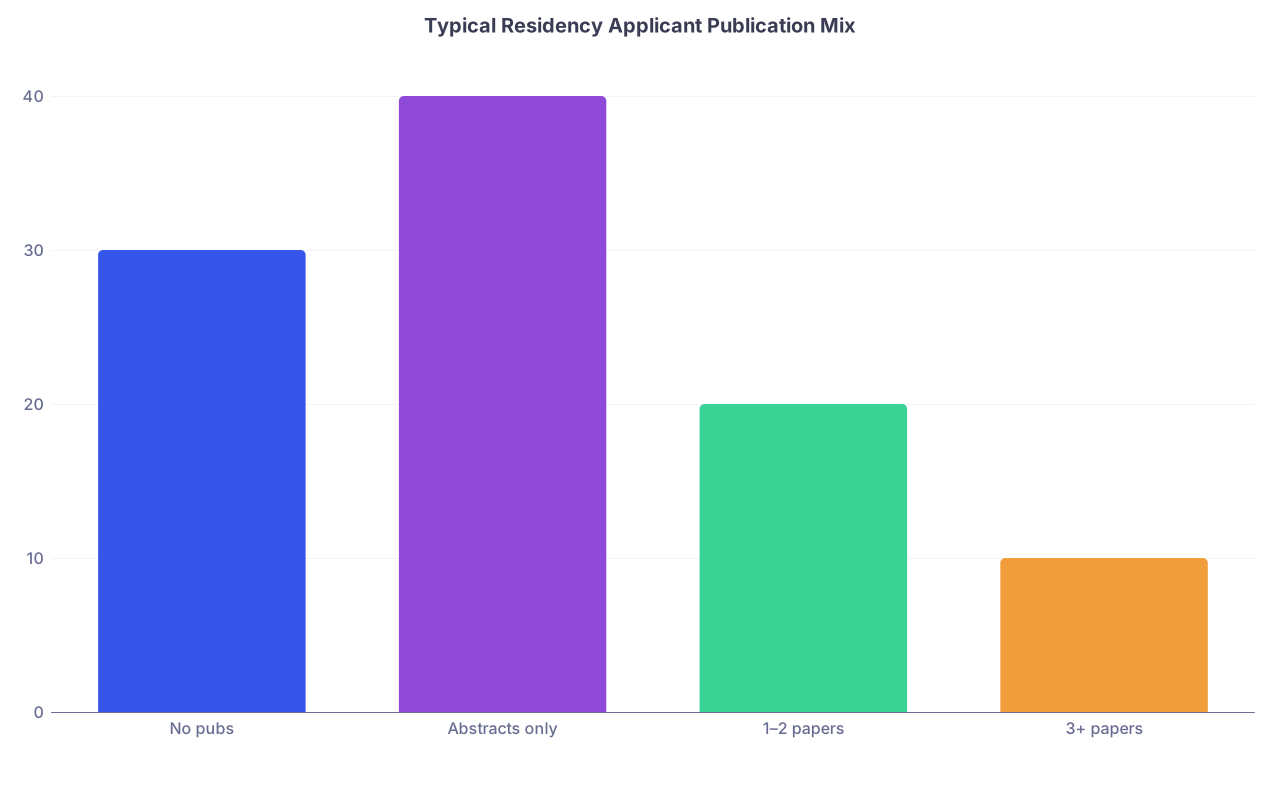
| Category | Value |
|---|---|
| No pubs | 30 |
| Abstracts only | 40 |
| 1–2 papers | 20 |
| 3+ papers | 10 |
This is roughly what I see: many applicants have abstracts/posters only; a smaller group has full manuscripts.
Academic CV
Publications and presentations often get multiple subsections:
- Peer-reviewed journal articles
- Review articles
- Book chapters
- Abstracts
- Oral presentations
- Poster presentations
- Online publications / invited blogs
You can:
- Separate first-author vs co-author.
- Add DOIs and PubMed IDs.
- Maintain strict formatting and reverse-chronological order.
ERAS compresses scholarly work. Your academic CV preserves the full record.
Strategic Use: When Each One Actually Matters
Think timing and audience.
During Residency Match
Programs will:
- Read your ERAS application.
- Sometimes ask for a CV upload, but many don’t.
- Skim, not study, your experiences.
Your ERAS entries are far more important than your academic CV for the Match itself.
Where your academic CV still shows up:
- Away/visiting sub-I applications that use VSLO or direct emails.
- Scholarship or award applications during MS4.
- Letters of recommendation where a faculty member asks, “Send me your CV.”
And keep in mind: if your CV looks disorganized or sparse, that attending silently downgrades their mental picture of you. I’ve seen it happen.
After You Match (and Beyond)
Your academic CV becomes more important over time:
- For fellowship applications that still use ERAS, your raw data comes from what you’ve kept track of in your CV.
- For academic jobs, promotions, research funding, and speaking invites, people will ask for a CV, not your ERAS printout.
So the smart move:
- Treat ERAS as your short-term sales pitch.
- Treat your academic CV as your long-term professional ledger.
They feed each other if you maintain them both.
How to Build and Maintain Both Without Losing Your Mind
Here’s the workflow I push students and residents to use.
Step 1: Build a Master Academic CV Now
Do not wait until fellowship apps.
Core sections for a senior med student / early resident:
- Name and contact info
- Education and training
- Licensure and certifications (USMLE/COMLEX status can be brief)
- Research experience
- Publications (full citations)
- Abstracts and presentations
- Teaching experience
- Leadership and service roles
- Honors and awards
- Professional memberships
Keep one master file:
- Update it after every new publication, talk, or position.
- Use a single citation style and formatting rules.
Step 2: Use Your CV as Your ERAS Source
When you’re filling ERAS:
- Pull titles, dates, and roles from your CV to avoid inconsistency.
- Convert detailed CV entries into short, punchy ERAS descriptions.
- Prioritize the most impactful and recent experiences—especially those that support your chosen specialty.
This avoids:
- Typos between applications.
- Misremembered dates and titles.
- Leaving out things you actually did that matter.
Step 3: Maintain a Simple Activity Tracker Going Forward
Even a basic spreadsheet with:
- Date started / ended
- Role
- Institution
- Mentor/PI
- Output (poster, paper, nothing yet)
- Brief description
Then you update:
- Your academic CV every few months.
- Your ERAS (or similar system) when application season comes around.
This makes later seasons—fellowship, jobs—much easier.
FAQ: ERAS CV vs Academic CV
1. Do residency programs ever actually look at an uploaded academic CV?
Sometimes, but far less than your ERAS entries. Many programs never open attached PDFs unless something about you stands out (heavy research, unusual path, international graduate). Still, send a clean, professional CV when asked; it backs up your ERAS and helps for letters and internal discussions.
2. Should my ERAS entries match my academic CV exactly?
Dates, titles, and roles must be consistent. Descriptions do not need to be identical. ERAS should be shorter, more results-focused, and tailored to residency selection. Your CV can be more detailed and formal. If a PD cross-checks them, they should clearly describe the same underlying experience.
3. How long is too long for an academic CV as a med student or resident?
For most graduating med students: 3–6 pages is normal if you’ve been active. For residents: 4–10 pages depending on research and teaching. Twenty-page CVs from a PGY-2 are usually bloated with unnecessary fluff. Detail is good; noise is not.
4. Where do I put non-medical jobs or random side gigs?
On ERAS, include non-medical jobs if they show responsibility, long-term commitment, or skills relevant to residency (management, teaching, language, tech). Skip short, irrelevant one-offs. On your academic CV, they can go under “Other Employment” or “Professional Experience,” but keep them concise and professional.
5. I’m not “academic.” Do I really need an academic CV?
Yes. Even if you end up in pure community practice, you’ll need a CV format for credentialing, hospital privileges, locums work, and job applications. You can keep it simpler and less research-heavy, but a clean, updated CV is basic professional hygiene.
Key points to remember:
- ERAS is a structured application, not a true CV. You write for speed, clarity, and impact—under character limits.
- Your academic CV is your long-term professional record. You control its structure, and it should be thorough, consistent, and kept updated.
- Use your academic CV as the master source, and tailor that content into ERAS-friendly, high-impact entries when you apply for residency and later for fellowship.