
Should I Mention Unfinished Research Projects or Only Completed Work?
What do you do with that half-finished manuscript and the IRB-approved project that stalled when your PI ghosted you—put them on your CV or quietly bury them?
Here’s the direct answer:
You can list unfinished research on your residency CV, but only if you do it honestly, label the status clearly, and you’re ready to talk about it without sounding flaky or evasive. Listing every abandoned idea? Bad move. Highlighting serious, ongoing work? Smart.
Let’s break down exactly how to decide what to include, how to label it, and how to avoid looking like you never finish anything.
1. The Core Rule: Honesty + Signal, Not Noise
Residency programs are not dumb. They know most medical students have some research that never makes it to publication. That’s normal.
What they care about is:
- Do you follow through on big commitments?
- Can you explain your work clearly?
- Does your research history match your story and your stated interests?
- Are your CV and ERAS entries honest and not padded?
So your rule of thumb:
- Include substantial, real research efforts – even if unfinished
- Exclude minor, short, or dead projects that add no value or signal you can’t finish things
If a project:
- Took months of your time,
- Taught you real skills (data analysis, chart review, study design),
- Is ongoing or reasonably likely to produce something,
…it probably belongs on your CV, with accurate status.
If it:
- Barely got off the ground,
- Was just a brainstorming session or a two-week “maybe we’ll do this” idea,
- Has been totally abandoned with no output and no future,
…leave it off.
2. What Counts as “Worth Listing” if It’s Not Finished?
You should seriously consider listing incomplete research if it fits one of these:
Ongoing project with defined role
Example: multi-center retrospective study; you’re responsible for data extraction for 200 patients and you’re actively working on it.Manuscript in progress or under review
Example:- “Manuscript in preparation” with a real draft in progress, not just a title
- “Submitted” or “Under review” at a real journal
Presented locally but not yet published
Example:- Accepted for a poster at a medical school research day or regional conference
- Abstract accepted but full paper still being written
Legitimate project interrupted for a real reason
Example:- PI left the institution
- COVID shut down recruitment
- IRB delays killed the timeline
As long as you can explain what you did and what you learned, these can help you.
What’s not worth listing most of the time:
- “Brainstormed idea for case series” with no IRB, no data
- “Helped with someone’s project” where you did 2 hours of work and never followed up
- A project that died two years ago and has no ongoing activity, no product, and no clear future
If you’re padding your CV with a dozen dead projects, it shows. Programs see that and think: lack of follow-through.
3. How to Label Unfinished Research on ERAS and Your CV
The status label is where people mess this up. If you’re vague or misleading, faculty notice.
Use clear, honest status terms like:
- “In progress”
- “Manuscript in preparation”
- “Submitted”
- “Under review”
- “Data collection ongoing”
- “Study design phase”
Avoid:
- Implying it’s published when it’s not
- Listing a journal name if nothing has been submitted
- Using “manuscript in preparation” for nothing but a title and an idea
Here’s how to structure it.
Example Formatting for ERAS / CV
Published/Accepted:
Smith J, YourName, Lee K. Outcomes after X in Y population. Journal of Example Medicine. 2024;13(2):123–130. (Accepted, in press)
Submitted / Under Review:
YourName, Patel R, Kim L. Predictors of readmission after heart failure hospitalization. Manuscript submitted to Journal of Hospital Medicine, under review.
Manuscript in Preparation (serious project):
YourName, Chen A, Gonzalez M. Burnout rates among internal medicine residents at a large academic center. Manuscript in preparation.
Ongoing Project (no manuscript yet but real work):
Retrospective chart review on complications after laparoscopic cholecystectomy. Role: co-investigator; responsible for data extraction and preliminary analysis. Data collection ongoing.
Where to put it:
- Publications/Presentations: things that are accepted, submitted, in preparation as actual manuscripts
- Research Experiences: broader descriptions of projects, roles, and skills—even if they are ongoing

4. The Big Risk: Looking Like You Never Finish Anything
Programs don’t punish you for not having 10 papers. They do raise an eyebrow at:
- 1 publication
- 7 “manuscripts in preparation”
- 4 “projects in progress”
- None of which sound close to completion
That looks like chronic non-completion.
You want a balanced profile. A mix like:
- A couple of concrete outputs (publication, poster, abstract, quality improvement project that led to protocol change)
- A few ongoing things that show trajectory (especially relevant to your chosen specialty)
Not a graveyard of half-baked projects.
Here’s a simple sanity check:
If more than half of your research entries are “in progress / in preparation” and have been sitting that way for over a year, you need to:
- Cut weaker ones, or
- Actually push 1–2 across the finish line (poster, local presentation, short communication)
| Situation | Should You List It? |
|---|---|
| Serious project, active work, clear role | Yes |
| Manuscript drafted and being edited | Yes |
| Abstract submitted or accepted | Yes |
| Idea only, no data or IRB | No |
| Stalled 2+ years ago with no future | Usually no |
5. How Programs Really Judge Your Unfinished Work
They look at four things.
Consistency with your narrative
Applying to neurology with multiple neuro research projects (some ongoing) makes sense.
Applying to ortho with five random endocrine projects and no ortho exposure? Confusing.Depth vs. scatter
One or two long-term, in-depth projects (even unfinished) look better than eight tiny, random ones. It shows commitment.Your ability to explain it
On interview day, a faculty member asks:“Tell me about this manuscript in preparation on sepsis outcomes—what’s your role and what have you found so far?”
If you answer with specifics—methods, your responsibilities, rough results—you’re fine.
If you stumble and it’s clear you barely touched it, that’s a red flag.Honesty and credibility
Inflated authorship, fake submission claims, vague status—this is where careers get quietly written off. Faculty talk. If you’re caught bending the truth, that sticks.
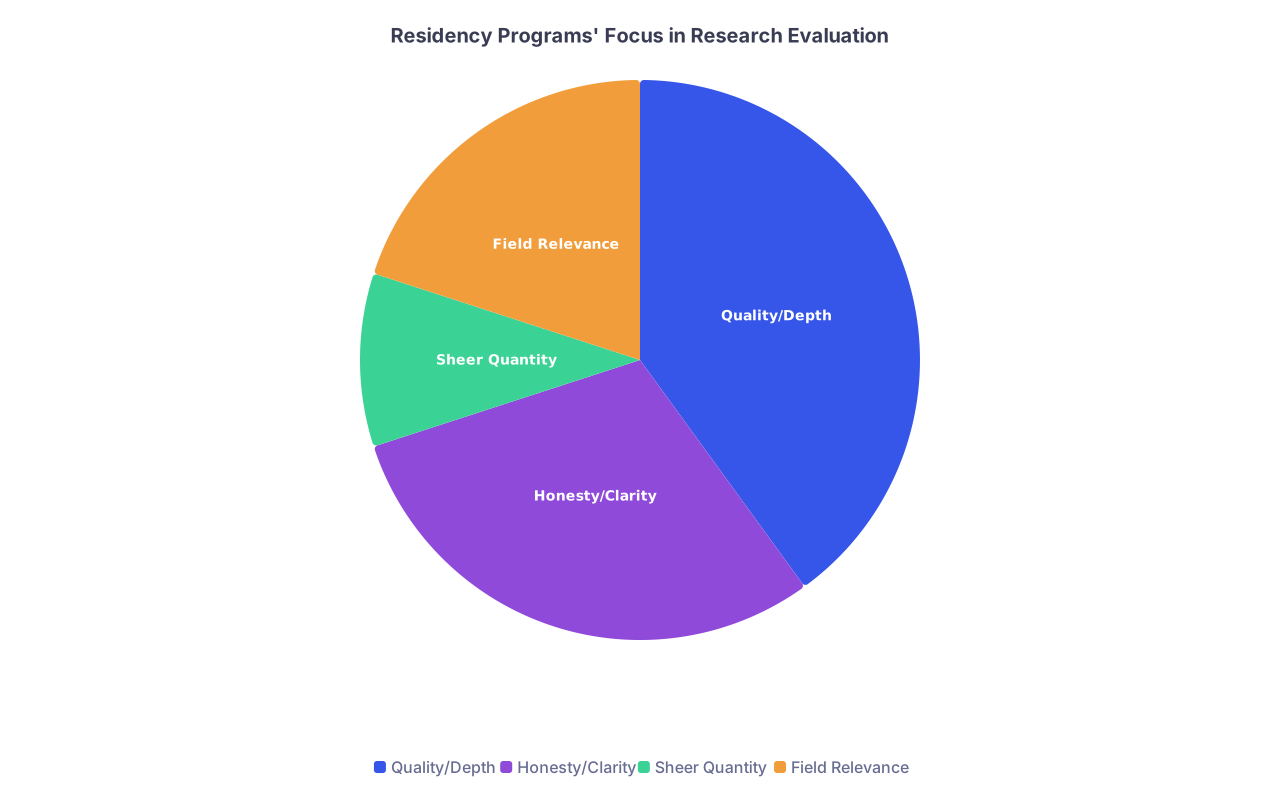
| Category | Value |
|---|---|
| Quality/Depth | 40 |
| Honesty/Clarity | 30 |
| Sheer Quantity | 10 |
| Field Relevance | 20 |
6. How to Talk About Unfinished Projects in Interviews
You will get asked. Programs love picking something from the “in preparation / in progress” category to see how you handle it.
Use a simple structure when answering:
Context (1–2 sentences)
“This is a retrospective study on X in Y population at our institution over the last 5 years.”Your specific role
“I designed the data collection sheet, pulled 150 charts, and performed the initial statistical analysis with supervision.”Current status
“We’ve completed data collection and I’m working with the PI on revising the manuscript draft. We’re targeting submission this winter.”What you learned
One concrete skill or lesson. “I learned how small decisions in data definitions can completely change an analysis.”
If the project stalled:
- Acknowledge it directly
- Give the real (non-dramatic) reason
- Emphasize what you gained
Example:
“That project ultimately stalled when our PI left for another institution and we couldn’t secure a new mentor. We weren’t able to finish the analysis as planned, but I did learn how to structure a chart review protocol and got comfortable with REDCap and basic stats, which I’ve used in a later project that did get completed.”
That sounds mature. Not like excuse-making.

| Step | Description |
|---|---|
| Step 1 | Research Project |
| Step 2 | Do not list |
| Step 3 | List as experience |
| Step 4 | List with accurate status |
| Step 5 | Did you invest significant time? |
| Step 6 | Is work ongoing or recently active? |
| Step 7 | Any concrete product? |
| Step 8 | Clear role and tasks? |
7. How to Clean Up a Messy Research Section Before ERAS
If your research history is a cluttered drawer, here’s how to fix it.
Make a raw list of everything
Every project you touched. Institution, mentor, approximate dates, your role, current status.Categorize by outcome:
- Published / accepted
- Submitted / under review
- Abstract / poster / talk
- Ongoing with real progress
- Dead or dormant with no product
Be ruthless with cuts
For the dead/dormant group:- Keep it only if you gained substantial skills and you can explain it clearly
- Otherwise, remove it
Consolidate similar experiences
If you did multiple tiny tasks for the same lab, it’s often better to list one “Research Assistant – Dr. X’s Cardiology Lab” entry rather than 4 micro-projects.Update all statuses
Change “in preparation” that has sat for 18 months with no work to something honest:- Either cut it, or
- Reframe as a past research experience rather than an active manuscript

8. Specialty-Specific Nuances
Some fields care more about research quantity; others focus on whether your activities match your story.
Highly academic specialties (Derm, Rad Onc, Neurosurgery)
Listing strong, ongoing projects is expected. But in these fields, over-selling fake productivity is suicidal. Faculty will know your mentors and may know your projects.Moderately academic (IM, EM, Anesthesia, Gen Surg)
A couple of serious ongoing or incomplete projects are normal. Focus on depth and clarity of your role more than raw count.Community-focused or less research-heavy fields (FM, Psych at many places, some Peds)
They care more that you can see something through than that you tried eight things and finished none. A single quality QI project with real implementation can beat multiple “manuscripts in preparation.”
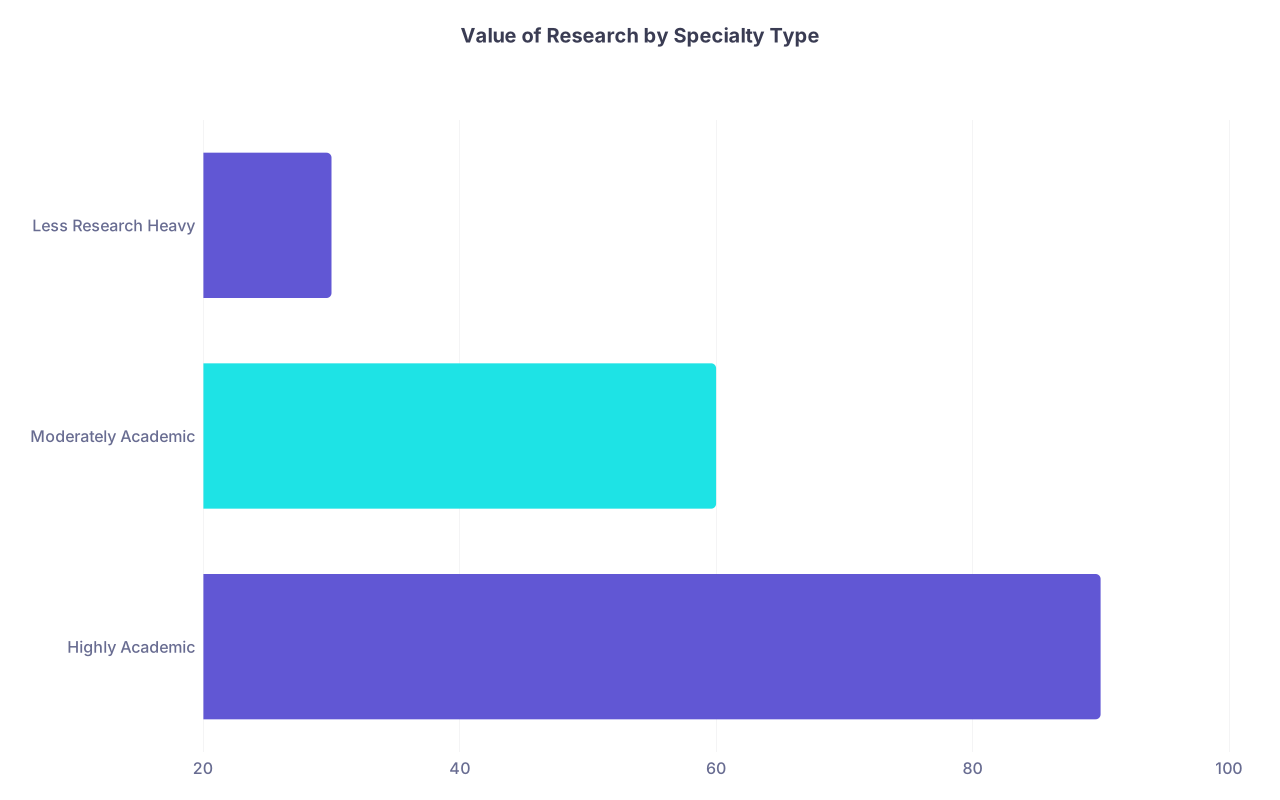
| Category | Value |
|---|---|
| Highly Academic | 90 |
| Moderately Academic | 60 |
| Less Research Heavy | 30 |
9. Final Position: So What Should You Actually Do?
Here’s the bottom line.
- Yes, you should mention unfinished research on your residency CV if it represents substantial, real work and you label it accurately.
- No, you should not list every abandoned idea or vanity “manuscript in preparation” with no actual draft.
- Your goal is to show seriousness, honesty, and trajectory—not to impress with fake volume.
If you’re on the fence about a project, ask yourself:
“If an attending drilled me on this for 5 minutes, would I look engaged and credible—or exposed?”
If the answer is “exposed,” cut it.

FAQ: Unfinished Research on Your Residency CV
1. Is it lying to list “manuscript in preparation” if the draft isn’t done yet?
If there’s no real writing started and only an idea and maybe some data, yes, that’s misleading. “Manuscript in preparation” should mean an actual working draft exists or is actively being written. If you’re still collecting data and haven’t started the paper, use “data collection ongoing,” not “manuscript in preparation.”
2. What if my PI is sitting on the draft and nothing is happening?
You can still list the project, but frame it as a research experience with honest status. For example: “Retrospective study on X; data collection and primary analysis completed; manuscript drafting delayed pending mentor feedback.” Do not pretend it’s submitted or actively moving if it isn’t.
3. Should I remove old stalled projects that will never be published?
Usually yes, unless they represent a major learning experience where you had a substantial role. If a project is >2 years old, has no output, no chance of revival, and you only did minor work, it’s just clutter. Cut it and keep your CV focused and credible.
4. Can I list a project that got rejected from a journal?
Yes, but don’t frame it as accepted or under review if it’s not. You can either:
- Re-submit and then list it as “submitted to [journal]” when that’s true, or
- List the project under research experience without naming a journal or implying current submission.
5. What if I have zero completed publications but several ongoing projects?
That’s not fatal. Programs care more about your trajectory and your ability to clearly explain what you’ve done. Focus on making your descriptions specific (your role, skills, methods) and try to get at least one tangible product—poster, abstract, or local presentation—before applications if possible.
6. Can I list a project twice—once as a research experience and once as a manuscript in preparation?
Yes, if they’re in different sections and you’re not double-counting or exaggerating. For example, in “Research Experience” you describe your role and what you did; in “Publications/Presentations” you list the manuscript status honestly (“manuscript in preparation” or “submitted”). Make sure the details are consistent across entries.
Key points:
- Include unfinished research only if it reflects real, substantial work and is labeled with accurate status.
- Avoid clutter and fakery—too many dead or vague projects make you look unreliable.
- Be ready to discuss every project you list with concrete details, or cut it.