Is It Better to Show Breadth or Depth on a Residency CV?
What happens when you’ve got 18 half‑done activities on your CV and then you meet someone with 3 things they’ve clearly owned and led—who looks better to a residency program?
Let me be direct: depth beats breadth for residency. But you cannot ignore breadth entirely. You need focused depth, supported by coherent breadth, not maximalist chaos.
Here’s how to think about it like a program director actually reading your CV, not like a pre‑med checklist addict.
How Programs Actually Read Your CV
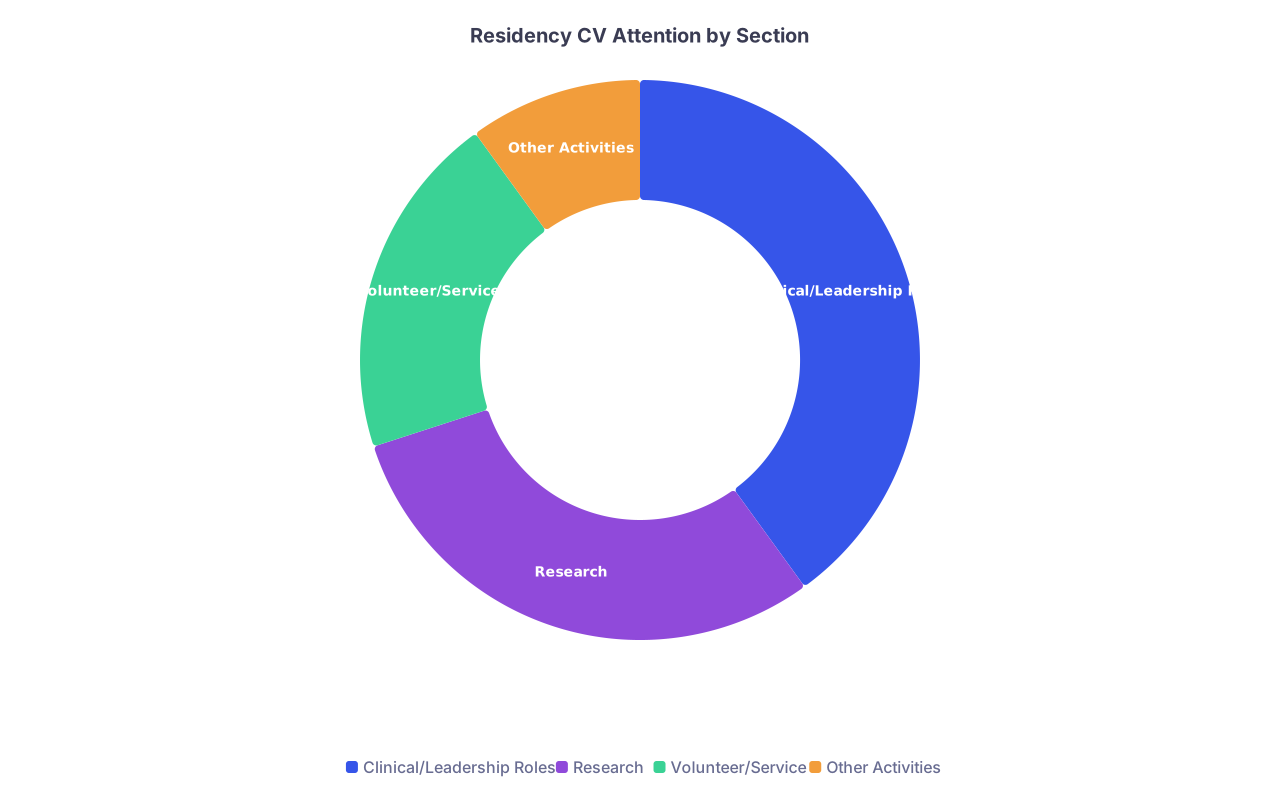
| Category | Value |
|---|---|
| Clinical/Leadership Roles | 40 |
| Research | 30 |
| Volunteer/Service | 20 |
| Other Activities | 10 |
They’re not counting lines. They’re scanning for:
- Evidence you finish what you start
- Signals of maturity and reliability
- Fit with their specialty and program culture
- Anything that makes you memorable at rank meeting
That means:
- A single, high‑impact longitudinal role often carries more weight than five throwaway memberships.
- A coherent story (e.g., “interest in medical education” or “commitment to underserved care”) is more powerful than a random assortment of stuff.
- Sloppy breadth—lots of 3‑month, low‑commitment, no‑outcome activities—actually hurts you. It screams “box‑checking.”
When I look at a CV, I ask myself: If I call this student’s mentor, will they tell me this person was central to the project, or barely there? Your job is to leave no doubt.
When Depth Wins (Most of the Time)
Depth means you:
- Stayed with something for a long time
- Took on increasing responsibility
- Produced outcomes: posters, protocols, curricula, leadership changes, etc.
Examples of good depth:
- 3 years in a free clinic → started as interpreter → became clinic coordinator → led QI project → poster at regional conference.
- 2 years in neurology research → second author on one paper, one poster, maybe a review.
- 2 years leading your school’s EM interest group → redesigned workshop series, organized simulation nights, formal mentorship program.
Programs like this because it shows:
- You can commit.
- You can grow within a role.
- You don’t bail when it gets boring or hard.
For competitive specialties (derm, ortho, plastics, ENT, ophtho, rad onc), depth in research is almost non‑negotiable. Not “I helped collect data for three months.” I mean sustained involvement with tangible products.

Depth Checklist: Are You Actually Deep or Just Busy?
You’re showing real depth if most of these are true for at least 2–3 activities:
- 1+ years in the role (or full project lifecycle)
- Clear progression (member → coordinator → director / RA → abstract author / volunteer → founder)
- Concrete outputs: posters, manuscripts, QI results, new protocols, new curricula, measurable changes
- Someone could write you a detailed letter about that specific activity alone
If your CV has zero activities that meet this standard, you have a depth problem. Fix that before you add anything new.
When Breadth Helps (And When It Hurts You)
Breadth is not evil. It just has to be disciplined.
Breadth helps when it:
- Reinforces a theme. Example: global health elective, free clinic for refugees, Spanish interpreter, global health research. That’s breadth with a backbone.
- Shows you’re a real human. A couple of non‑medical things (coaching, music, athletics) can make you easier to remember and more likeable.
- Fills obvious gaps. No teaching? Run a workshop or TA. No service? One consistent volunteer role.
Breadth hurts when:
- You have 15+ activities, each 2–3 months long, no impact.
- Your list looks like you joined every interest group and led none.
- You clearly chased titles (3 “vice president” roles, zero outcomes).
- Your activities don’t connect to any plausible story.
Here’s the line you’re walking: more experiences is not always more value.
How to Decide: Breadth vs Depth For You
Use this simple decision rule: Protect depth first; then add strategic breadth.
Step 1: Identify Your 2–3 “Pillars”
Your pillars are the core identity pieces you want a PD to remember:
- “Serious researcher in X”
- “Committed to underserved and primary care”
- “Leader in med ed”
- “Strong teacher and mentor”
- “QI and systems-focused”
Pick 2–3 max. If you try to be six things, you will be none.
Now look at your CV and ask:
- Do I have at least one deep activity supporting each pillar?
- Would an outside reader recognize this pillar from my activities alone?
If not, you do not need more breadth. You need to deepen the right things.
| Pillar | Strong Depth Example |
|---|---|
| Research-focused | 2+ years, multiple abstracts, 1+ manuscript |
| Underserved care | Long-term free clinic leadership |
| Medical education | Multi-year curriculum or OSCE involvement |
| Quality improvement | QI project with measured outcome, poster |
| Leadership & advocacy | National org role with initiatives completed |
Step 2: Decide Where One More Thing Would Actually Matter
Ask yourself for each possible new activity:
- Does this strengthen an existing pillar?
- Does this plug a real hole (e.g., zero teaching or zero service)?
- Can I stay long enough to show impact, not just presence?
If the answer is no to all three, skip it.
Specialty‑Specific: How Much Breadth vs Depth?
Different specialties care about different combinations. Here’s a rough signal:
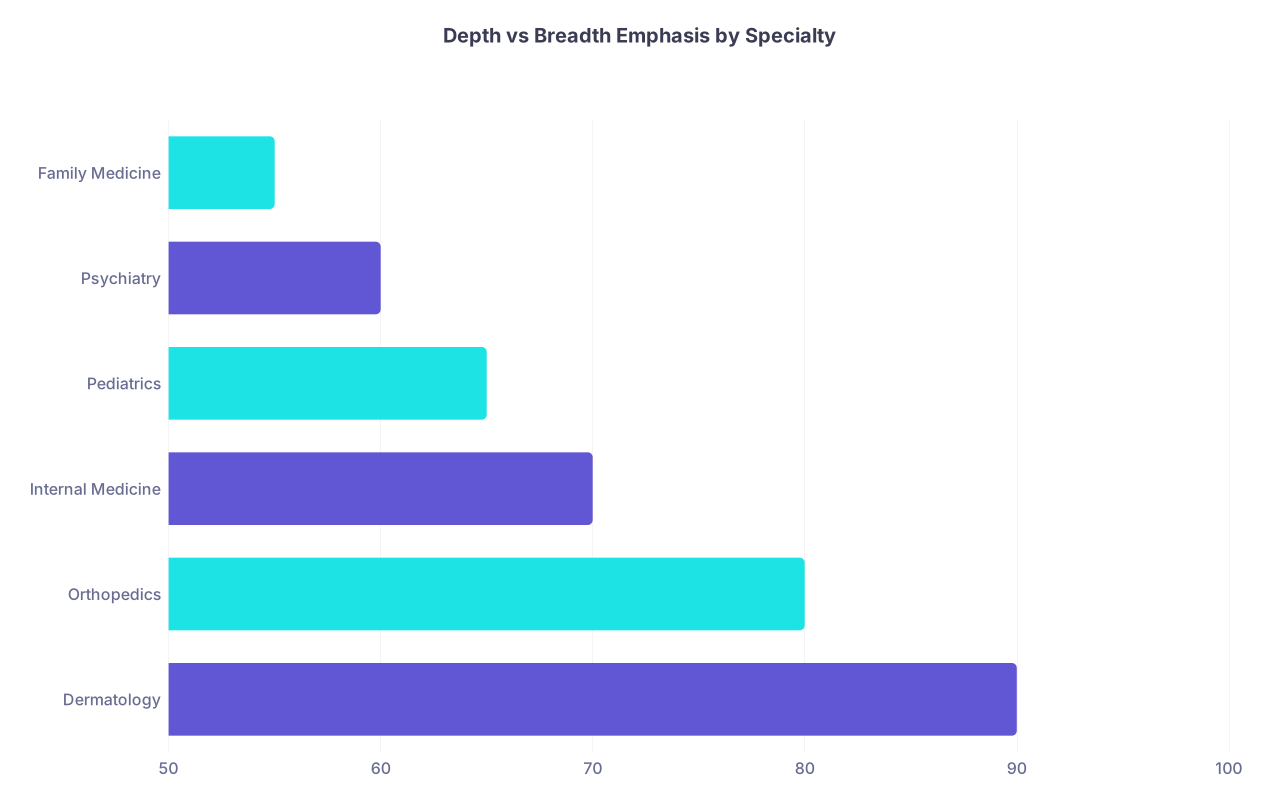
| Category | Value |
|---|---|
| Dermatology | 90 |
| Orthopedics | 80 |
| Internal Medicine | 70 |
| Pediatrics | 65 |
| Psychiatry | 60 |
| Family Medicine | 55 |
(Values reflect how much programs lean toward depth over breadth.)
Highly competitive (derm, ortho, ENT, urology, plastic surgery, neurosurgery):
- Depth in research and specialty-specific involvement is huge.
- One derm research group for 2.5 years with 3 pubs beats “I did 6 different short derm projects with 6 different faculty.”
- Breadth is fine but must not dilute your specialist identity.
Moderately competitive (EM, anesthesia, radiology, OB/GYN, general surgery):
- Prefer one or two deep things in the specialty + solid general CV.
- Breadth across teaching, service, leadership is good if at least one of those shows depth.
Less competitive (FM, psych, peds, some IM programs):
- Still care about depth, but are often more impressed by:
- Consistent service
- Longitudinal patient-facing roles
- Evidence of being a team player and finisher
- Breadth here can show you’re collaborative and well-rounded, but again: not 20 meaningless lines.
Concrete Moves to Shift Toward Depth
If your CV is currently “mile wide, inch deep,” here’s how to fix it.
1. Ruthlessly prune low‑value activities
You’re not obligated to keep everything forever. You can:
- Quietly drop passive memberships and groups where you never took on responsibility.
- Stop starting new short‑term things “for the CV.”
Use this litmus test: If an interviewer asked, “Tell me about this,” and you’d stumble or say, “I was just a member,” it’s probably not helping you.
2. Double‑down on 2–3 roles you already have
Ask: “What’s the next level of impact here?”
Examples:
- Research: move from data helper to abstract or manuscript author. Ask your PI how you can own a subproject.
- Interest group: move from officer to someone who builds a new recurring program (skills workshop, mentorship series, mini‑conference).
- Free clinic: take on operations, scheduling, QI, or training of new volunteers.
Residency committees notice clear, upward progression in the same domain. That’s textbook depth.
3. Turn participation into product
Depth has deliverables. If you’ve been doing something for months or years, ask yourself:
- Can this be a poster or talk?
- Is there a QI angle we could measure and present?
- Could this be shaped into a curriculum, guide, or toolkit?

| Step | Description |
|---|---|
| Step 1 | Ongoing Activity |
| Step 2 | Identify Problem or Outcome |
| Step 3 | Collect Data or Feedback |
| Step 4 | Create Poster or Presentation |
| Step 5 | Submit to Local or National Meeting |
| Step 6 | Continue Activity and Seek Larger Role |
| Step 7 | 1+ year involved |
This is how you convert “just volunteering” into “led a QI initiative and presented findings.”
How Many Activities Is Enough?
There’s no magic number, but here’s what typically looks strong vs suspicious:
| Total Activities | How It Usually Looks |
|---|---|
| 5–7 | Few but often deep; fine if strong |
| 8–12 | Common sweet spot; manageable to discuss |
| 13–18 | OK only if clear depth and no fluff |
| 19+ | Often signals padding or box‑checking |
If you’re above ~15, you’d better have:
- Obvious longitudinal commitments
- No ridiculous one‑month activities
- A clear narrative tying things together
Otherwise, trim.
Presenting Depth on Your CV So It’s Obvious
You might actually have decent depth but hide it by formatting everything identically. Stop doing that.
Make depth jump off the page:
- Use sub‑bullets wisely. Give your 2–3 main activities 2–4 concise bullets with outcomes, not tasks.
- Show progression explicitly.
“Volunteer → Shift leader → Operations coordinator (2021–2024)” - Quantify impact.
“Organized 6 simulation nights with 80+ student participants” beats “organized events.”

On the flip side, for superficial roles, keep it minimal or leave them out. You don’t want shallow bullets taking space away from deep ones.
What If You’re Late and Don’t Have Depth Yet?
If you’re in MS3 or early MS4 scrambling, you cannot retroactively create 2‑year commitments. But you can still salvage a depth‑like story:
- Pick one area to go all‑in on now: research project, sustained clinic, or a leadership/education role.
- Increase intensity and responsibility, not just hours. Take ownership of a discrete piece and see it through.
- Focus on at least one tangible product before applications: poster, local presentation, protocol, curriculum session, etc.
You will not magically become a “4‑pubs in derm” applicant if you start in January. But you can show a sharp upward trajectory, which many programs respect.
Quick Summary: So Which Is Better?
If you force me to choose: Depth wins. Almost every time.
Breadth is a support act. It:
- Makes you human.
- Shows adaptability.
- Rounds out your story.
But what actually moves the needle:
- 2–3 activities where you clearly mattered.
- Long‑term involvement with visible results.
- Coherent pillars that match your specialty and values.
If your CV looks scattered, do less and go deeper. Programs are not impressed by how many lines you can cram into ERAS. They’re impressed by who you are underneath those lines.