
What happens when you’ve actually done good academic work—presentations, posters, invited talks—but your CV makes it look like you did… none of it?
Let’s fix that.
If you’re applying for residency, where and how you list presentations/posters/talks matters more than most people realize. Done well, it makes you look like a serious, academically engaged applicant. Done badly, it looks like noise or, worse, like you’re inflating stuff.
Here’s how to do it like someone who knows what they’re doing.
The Short Answer: Where Do They Go?
On a residency CV (or ERAS application), presentations, posters, and talks belong in their own clearly labeled section.
Use one of these headings:
- “Presentations and Posters”
- “Conference Presentations”
- “Scientific Presentations”
- “Oral and Poster Presentations”
If you have a lot of all of these, you can split them:
- “Oral Presentations”
- “Poster Presentations”
- “Invited Talks / Grand Rounds”
If you have only a few total, keep one combined section so it doesn’t look sparse.
Bottom line: they should not be buried under “Volunteer,” “Leadership,” or “Work Experience.” They’re academic output. Treat them that way.
How To Structure the Section (Format That Programs Expect)
Here’s the format I recommend—and what academic programs are used to seeing.
Order of items within the section:
- Most recent first (reverse chronological)
- Oral > poster only when at the same meeting and you’re grouping, but usually just go by date
- Peer-reviewed conference presentations usually before local abstracts if the dates are similar
Each entry should have, in this order:
- Authors (you in bold or underlined if formatting allows)
- Title of presentation
- Type of presentation (oral, poster, invited talk, workshop, grand rounds, etc.)
- Meeting or event name
- Location (city, state, country, or “Virtual”)
- Date (at least month and year)
Example (how you should actually write it on a CV):
Smith J, Lee A, Patel R. Improving discharge communication in internal medicine. Oral presentation, American College of Physicians National Meeting, Boston, MA, April 2024.
For a poster:
Lee A, Chen M, Davis P. Trends in CT utilization for pediatric abdominal pain. Poster presentation, Society for Pediatric Emergency Medicine Annual Meeting, Virtual, May 2023.
And for a local event:
Lee A. High-value care in the inpatient setting. Invited grand rounds, Department of Medicine, University Hospital, Chicago, IL, February 2023.
Don’t overcomplicate this. Consistency is more important than perfection.
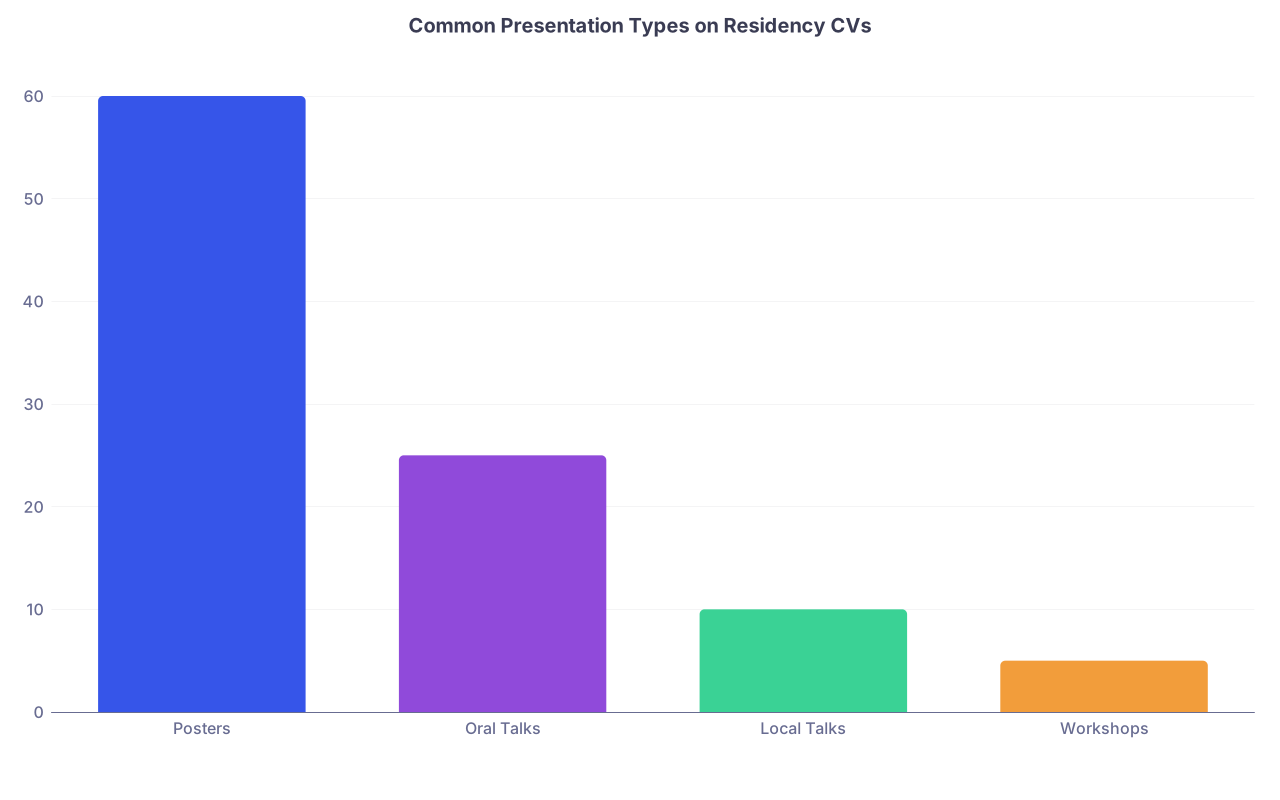
| Category | Value |
|---|---|
| Posters | 60 |
| Oral Talks | 25 |
| Local Talks | 10 |
| Workshops | 5 |
Where They Go On Different CV Types
1. For ERAS (Residency Application)
ERAS separates things out. Here’s how it usually works:
- Research / Scholarly Activity: Project descriptions
- Publications: Journal articles, book chapters, online publications
- Presentations / Posters: Abstracts, conference talks, posters
ERAS often has specific fields for:
- Title
- Authors
- Event/meeting name
- Type (poster/oral)
- Date
If you’re also submitting a separate CV (for email to PDs, away rotations, or networking), mirror the ERAS categories. You want them to recognize the same content quickly.
2. For a Standalone Academic CV
Standard order for residency-bound med students usually looks like:
- Education
- Exams (USMLE/COMLEX) – optional on CV if already in ERAS
- Honors and Awards
- Research Experience
- Publications
- Presentations and Posters
- Teaching Experience
- Leadership and Service
- Work Experience (if relevant)
Notice: Presentations and Posters get their own section around the middle. Not shoved under Research Experience. Not lumped under “Misc.”
If you only have one or two small presentations, you can combine:
But if you’ve got more than ~3, give them their own heading. Looks stronger, reads easier.
3. For a Short, One-Page CV or Resume (For Physicians Applying Outside Academia)
If you’re using a compressed version—for non-academic fellowships, industry roles, or side gigs—create a brief section:
“Selected Presentations”
Then list 3–5 of the most impressive and recent ones only.
Exactly How to Format Authors, Titles, and Conferences
This is where people screw it up and look less serious than they are.
Rules I’d use:
Be consistent with author style.
Either: “Last FM” (Smith JA) or “First Last” (John A. Smith). Don’t mix.Put your name in bold if the format allows.
It’s not “cheating.” It’s clarity.Include type of presentation.
Programs care if it was oral vs poster vs invited talk.Spell out the conference the first time, then acronym in parentheses if it’s big.
Example: “American Heart Association (AHA) Scientific Sessions”Don’t list submitted-but-not-accepted abstracts here.
That’s padding. If absolutely needed, they go under “Research Experience” as ongoing work, not “Presentations.”
Here’s a clean, correct entry for a national poster:
Lee A, Gomez R, Tran T. Rates of CT overuse in low-risk PE workups. Poster presentation, American College of Emergency Physicians Scientific Assembly, Philadelphia, PA, October 2023.
And a local student research day entry (yes, these count):
Lee A. Barriers to primary care follow up in uninsured populations. Oral presentation, Medical Student Research Day, State University School of Medicine, City, State, March 2022.

How To Handle Messy Real-Life Situations
You’re not living in a textbook. So let’s hit the gray areas people ask me about all the time.
1. What if the abstract is accepted but the conference hasn’t happened yet?
You can list it. Just be precise.
Lee A, Khan S. Outcomes in telehealth follow up for CHF. Poster presentation (accepted), American College of Cardiology Scientific Session, Atlanta, GA, scheduled March 2025.
The word “accepted” is non-negotiable if it hasn’t actually occurred.
2. Virtual conferences
Yes, they count. Just mark them clearly.
Poster presentation, Society of Hospital Medicine Annual Meeting, Virtual, May 2022.
If the conference normally has a location, and it was moved online, just use “Virtual” instead of city/state.
3. Repeated presentations of the same project
If you presented the same project at multiple meetings, you can list each separately. That shows dissemination, which is a good thing.
But don’t pretend they’re different projects.
Example:
Lee A, Brown K. Impact of standardized discharge summaries on 30-day readmissions. Oral presentation, Internal Medicine Resident Research Symposium, University Hospital, City, State, May 2023.
Lee A, Brown K. Impact of standardized discharge summaries on 30-day readmissions. Poster presentation, Society of General Internal Medicine Annual Meeting, Denver, CO, April 2023.
Same title, different venue and format. That’s fine.
4. You’re not first author
Don’t hide. If you presented it, you list it.
Johnson M, Lee A, Carter S. Title… Poster presentation…
If you’re not first, you still keep authors in the real order. Programs can smell author-order editing from a mile away. It’s a bad look.
| Activity Type | Best Section Heading |
|---|---|
| National conference poster | Presentations and Posters |
| Local student research day | Presentations and Posters |
| Grand rounds talk | Presentations / Invited Talks |
| Journal article | Publications |
| Ongoing research project | Research Experience |
| Quality improvement talk | Presentations and Posters |
How Programs Actually Read This Section
Let me be blunt: few people read every title in detail. They skim. Quickly.
- Pattern: Do you consistently engage in scholarly work, or is there one random poster from M1?
- Level: Are your presentations mostly local, regional, national? All are valuable, but 4 national meetings is different from 1 local research day.
- Role: Are you leading projects, or always somewhere in the middle of a 12-author line?
- Relevance: Anything connected to their specialty? A peds applicant with peds posters stands out.
Your job is to make those answers obvious at a glance:
- Clear headings
- Clean format
- Dates aligned
- Conference names recognizable
The content you already did is the hard part. The formatting is just making it legible.
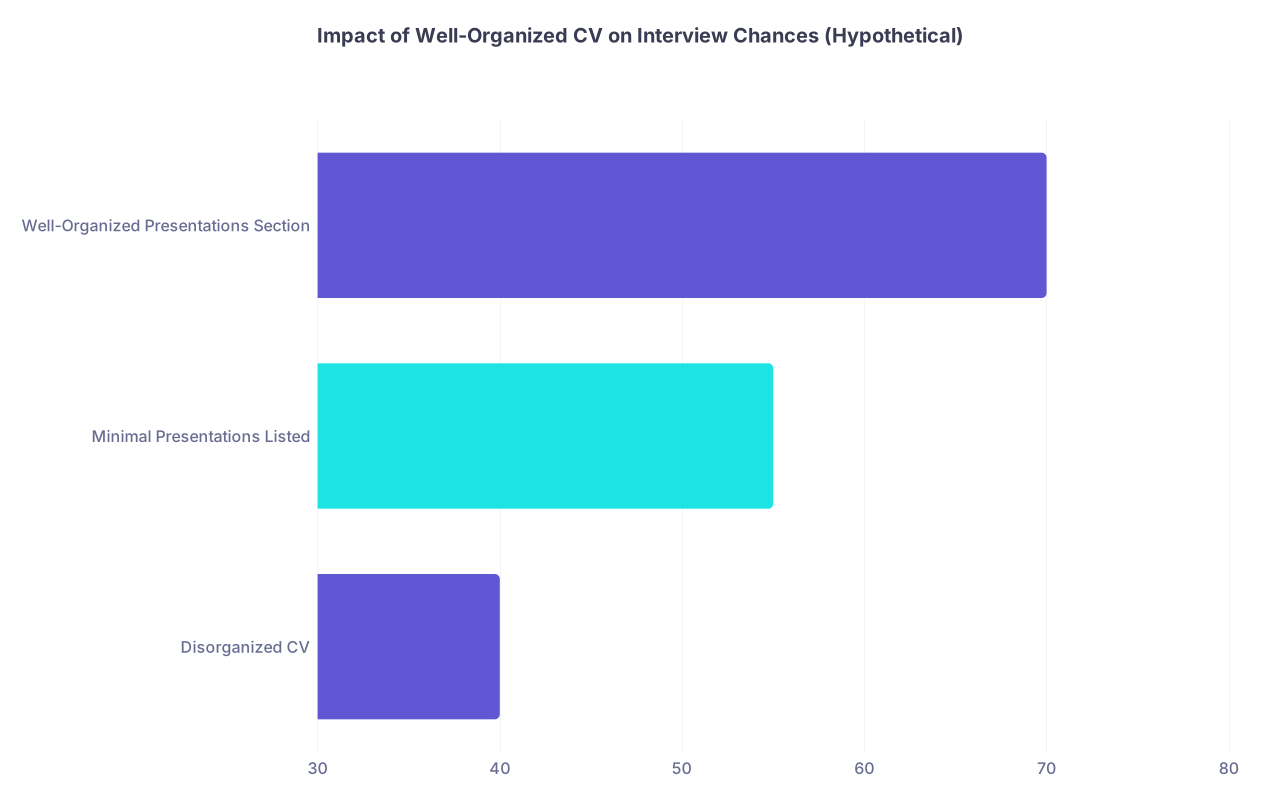
| Category | Value |
|---|---|
| Disorganized CV | 40 |
| Minimal Presentations Listed | 55 |
| Well-Organized Presentations Section | 70 |
Common Mistakes That Make You Look Less Serious
I’ve seen these on actual residency CVs from strong students:
Burying presentations under “Research Experience” only.
Then the program never realizes you actually presented at a national meeting.Inventing a “Publications” section for posters.
Posters are not publications unless the abstract actually appeared in a journal supplement and you’re very clear about that.Listing “planned” or “in-preparation” posters.
If it hasn’t been accepted, it’s not a presentation. Talk about the project under Research, not here.No dates.
Looks shady and kills the timeline. Always include at least month + year.Random formatting changes mid-section.
Example: one entry has first initials, next one has full names and no location. That screams “copy-paste chaos.”
You want your CV to look like someone you’d trust with a note to a consultant: clean, clear, accurate.

Step-by-Step: Fix Your Presentations Section Tonight
If you want a quick action plan, here you go:
- Open a blank “Presentations and Posters” section on your CV.
- Make a reverse-chronological list of every:
- Poster
- Oral presentation
- Grand rounds
- Workshop or invited talk
- For each, add:
- Authors (with your name in bold if possible)
- Title
- Type (poster, oral, invited talk, etc.)
- Event name
- Location or “Virtual”
- Month + year
- Clean up formatting so every line follows the same structure.
- Remove anything that:
- Was never accepted
- Was just a project but never presented
- If you only have 1–2 items, consider combining with “Publications” into “Publications and Presentations.”
That’s it. One dedicated, clean, properly formatted section.

| Step | Description |
|---|---|
| Step 1 | Academic activity |
| Step 2 | Presentations and Posters |
| Step 3 | Publications |
| Step 4 | Research Experience |
| Step 5 | Was it presented? |
| Step 6 | Published in journal? |
FAQ: Presentations, Posters, and Talks on a Residency CV
1. Do posters actually matter for residency applications?
Yes. Posters show you followed a project through to dissemination. Programs don’t treat them like first-author NEJM papers, but a handful of well-placed posters signals you engage with scholarly work and can finish things. That’s what they care about.
2. Should I separate oral presentations from poster presentations?
If you have more than ~6 total, yes. You can split into “Oral Presentations” and “Poster Presentations.” If you only have 2–4, keep a single “Presentations and Posters” section and specify “oral” vs “poster” within each entry.
3. Can I list a presentation that was accepted but the conference is after the Match?
Yes, as long as you label it honestly: “Poster presentation (accepted), [Conference], scheduled [Month Year].” Don’t pretend it already happened. Programs are fine with that; they just don’t want spin.
4. Do local student research days and hospital QI days count?
They absolutely count. They’re not as weighty as national conferences, but they’re still scholarly presentations. Just be accurate with the event name and don’t oversell it as a national meeting.
5. Where do I list grand rounds or invited talks?
Same section. Either keep them in “Presentations and Posters” and specify “Invited grand rounds” or create a small “Invited Talks and Grand Rounds” subsection if you have several. Either way, presentations stay together as academic output.
6. What if my only “presentation” is a short talk as part of a course or clerkship?
Graded course presentations (like a 5-minute M3 case presentation) generally don’t belong on the CV. If it was a formal conference, research day, or departmental event, list it. If it was just daily rounds, leave it off.
7. Should I repeat the same project under Research Experience and Presentations?
Yes, but with different angles. Under Research Experience, describe your role and what you did. Under Presentations, list the actual output: where you presented it. It’s the same project, but the CV sections emphasize different things.
Key takeaways:
- Presentations, posters, and talks deserve their own clear section—“Presentations and Posters”—in the middle of your residency CV.
- Use a consistent, simple format: authors (with you bolded), title, type, meeting, location, date.
- Only list accepted or completed presentations; be honest about “accepted” vs “scheduled,” and keep the section clean and easy to skim.