
You’re staring at your CV on ERAS. Again.
It’s late. You’ve scrolled past the same “Volunteer – Food Bank 2015,” “High School Valedictorian,” and “Treasurer, Pre‑Med Club” entries three times. Part of you knows they look childish. Another part of you is terrified to delete anything because “what if my CV looks empty?”
This is where applicants quietly sabotage themselves.
Residency PDs aren’t just looking for what you have. They’re filtering out what screams: “I don’t understand what matters at this level.” Outdated, irrelevant, or flat‑out cringe entries do exactly that.
Let me be blunt: a cluttered, immature CV can hurt you more than a lean, focused one. I’ve watched strong applicants get side‑eyed in selection meetings because their CV read like a high school brag sheet.
You’re not applying to college. Stop building a scrapbook. Build a professional document.
Here’s what to cut. Now. Before a PD or APD rolls their eyes and moves on.
1. High School and Early College: The Dead Weight You’re Afraid to Delete
If you’re in medical school or applying to residency and your CV still talks about high school… you’re signaling you don’t have enough recent substance. Or worse, that you don’t understand what counts anymore.
Things that almost always need to go:
- High school honors (valedictorian, salutatorian, AP Scholar, National Honor Society)
- High school sports and leadership (team captain, student council, club officer)
- Pre‑med club roles from early undergrad (especially if generic: “member,” “secretary”)
- Shadowing from freshman/sophomore year
- Short‑term high school mission trips or “medical brigades”
The usual excuse: “But that was a big accomplishment for me.” I don’t doubt it. It just doesn’t belong on a residency CV in 2026.
As a rule of thumb: if it ended before you started medical school, it’s probably gone. The exceptions are very specific:
- National‑level elite achievement (Olympic athlete, nationally ranked musician, published author with real distribution)
- Truly formative, long‑term experiences that clearly connect to your specialty and continued in some form into med school
Even then, you frame them as background, not center stage.
Common mistake: Letting old stuff crowd out your growth
I’ve seen CVs where the “Honors and Awards” section is just: high school valedictorian, Dean’s List (sophomore year), and one random scholarship. Nothing med‑school‑level. That reads like: peaked at 18, then coasting.
You’re better off with:
- One carefully chosen pre‑med achievement (if really major)
- Then only medical school recognitions (AOA, Gold Humanism, clerkship honors, school scholarships)
Cut the rest. You’re not rated on longest CV. You’re rated on relevance and maturity.
2. Short, Fluffy Experiences That Scream “Box‑Checking”
Program directors are very good at spotting fluff.
You know those CV entries that look like this?
- “Volunteer – Health Fair, 1 day”
- “Member, XYZ Interest Group, 2022”
- “Participant, Blood Drive, 4 hours”
These read as “I needed to fill space.”
The worst offenders:
- One‑off events under “Longitudinal Service”
- “Memberships” where you did nothing besides put your name on a list
- Attending a single conference as a “leadership” experience
- One‑day medical missions labeled like global health work
Let me translate how these look from the PD side:
- 1‑day event: “Showed up, got the T‑shirt, wrote it on the CV.”
- Passive membership: “Needs to pad CV with buzzwords.”
- Over‑inflated title: “Not honest about actual role.”
If an experience is:
- Under 10 total hours
- No clear role or responsibility
- No outcome, skill, or impact you can describe
…it likely does not belong on your residency CV. Or at least does not deserve its own full entry.
You can batch some things. For example:
Instead of three separate entries:
- Volunteer – Flu Shot Clinic (4 hours)
- Volunteer – Health Fair (3 hours)
- Volunteer – BP Screening (3 hours)
Use one:
“Clinical outreach volunteer, community events (2022–2024): Assisted with BP screening, flu vaccination clinics, and basic health education at recurring community outreach events (approx. 10–15 hours total).”
That’s honest, not inflated, and not cluttering your document with micro‑experiences.
3. The Cringe Category: Overstated, Overly Personal, or Embarrassing
This is where people get themselves quietly blacklisted.
If a PD or faculty reads your CV out loud in a committee and everyone chuckles or cringes — that’s bad. You do not want to be “the applicant with that weird CV entry.”
Here’s what needs to die immediately:
Over‑dramatic “passions” and personal branding
Things like:
- “Passionate thought leader in medical innovation”
- “Aspiring world‑renowned neurosurgeon”
- “Future leader in global surgery and humanitarian work” (when you’ve done one abroad trip in undergrad)
You don’t brand yourself on a CV. You present facts. The pattern of your work should speak for itself. Self‑appointed titles make you look immature.
Questionable or unprofessional “hobbies”
Hobbies are fine. They humanize you. But there’s a line.
Red‑flag hobbies:
- Anything related to alcohol (“craft beer connoisseur,” “mixology,” “wine tasting club”)
- Anything hyper‑political or polarizing (unless it’s clearly framed as structured advocacy with professionalism)
- “Social media influencer” unless you can back it with professional content, metrics, and relevance
- “Partying,” “nightlife,” “clubbing” (yes, I’ve seen it)
- Explicit religious mission content framed like recruitment
If you’d be uncomfortable having a conservative senior faculty read it out loud in an interview, don’t put it on your CV.
TMI or trauma dumping
I’ve seen “Personal experiences” listed that read like therapy notes. Childhood trauma. Complex family details. Raw mental health disclosures. That belongs in carefully chosen personal statement moments, if anywhere — not as bullet points on a CV.
The CV is not your memoir. It’s not your confessional. Keep it professional, concrete, and relevant.
4. Research and “Publications” That Aren’t Really Publications
Research gets messy fast. Applicants try to boost their academic profile and end up shooting themselves in the foot with over‑labeled or fake‑sounding items.
Main mistakes:
- Listing “papers” that are just drafts or ideas
- Inflating “submitted” and “in preparation” to sound like accepted work
- Calling low‑quality, predatory, or vanity publications “peer‑reviewed research” without context
- Listing themselves as first author on projects where they barely participated
Here’s how programs think:
They do not expect everyone to be a research rockstar. They do expect honesty and clarity.
Use this simple structure:
| Status | How to Label It |
|---|---|
| Published | Full citation with PMID/DOI if possible |
| Accepted | “In press” with journal name |
| Submitted | “Manuscript under review” + journal name |
| Not submitted | Describe as “project” or “manuscript draft” |
If something is “in preparation” and realistically may never be submitted, strongly consider not listing it at all or moving it to “Research Experience” as part of what you worked on, not as its own “publication.”
Cringe move: 8 different “manuscripts in preparation” from 8 projects in the last 6 months. Everyone knows what that means.
Also: poster and abstract mills. If you presented at a tiny local poster day with 20 attendees, don’t package it like an international plenary session.
Be accurate:
- “Poster presentation, internal medical student research day, University of X, 2023.” Not:
- “International conference presentation” because there was one Zoom link.
If you’re not sure whether something sounds inflated, it probably does.
5. Outdated Roles You’ve Outgrown (But Keep Hanging Onto)
One quiet CV killer is “timeline mismatch.” You’re a fourth‑year med student applying to EM, but your leadership section is dominated by “Treasurer, Biology Club (2016–2017).” That’s a problem.
What often needs to get cut or compressed:
- Early undergrad clinical jobs (hospital transporter, CNA, scribe) that ended 6–8 years ago and aren’t uniquely impressive
- Old leadership in irrelevant student clubs (especially non‑medical)
- Certifications that expired years ago (BLS from 2015? Delete or update.)
- Roles that obviously have no connection to who you are now
If a role ended more than 4–5 years ago and you’ve had multiple more advanced roles since, it either:
- Gets cut, or
- Gets reduced to a single line under a “prior work” or “background experience” section
…not front and center.
The story you want your CV to tell: growth and progression. If the first half of your CV is undergrad activity and random jobs, you’re telling the wrong story.
Ask yourself:
“If a PD only skimmed the first 2–3 entries in each section, would they see medical school‑level engagement and responsibility?”
If the answer is no, you have too much old stuff still clogging the top.
6. Leadership That Isn’t Leadership (And Volunteering That Isn’t Service)
A lot of CVs are full of what I call “title inflation.”
Typical offenders:
- “Co‑founder, medical education startup” that is actually just a website you never launched
- “Director, clinical skills teaching program” where you showed up to 3 sessions someone else organized
- “Leader, social media outreach” where you made one Instagram post
If you didn’t:
- Recruit or manage people
- Own a process or project
- Make decisions with actual consequences
- Commit time over months, not days
…it’s probably not meaningful leadership.
On the service side, programs are sick of:
- One‑week overseas “mission trips” presented as long‑term global health commitment
- Single shifts in a soup kitchen framed as deep engagement with underserved populations
- CVs with 15 separate “volunteer” entries that collectively add up to maybe 30 hours
You don’t impress anyone by making small things sound big. You impress them by making big things sound precise and honest.
If your “leadership” roles vanish when you strip away the title, cut them or reframe them honestly as participation.
7. Old Skills and Certifications That Make You Look Behind
Skills sections on residency CVs are often garbage. Applicants think “more words = more impressive.” PDs think “why is this person listing Microsoft Word like it’s a unique skill?”
Skills to delete immediately:
- “Proficient in Microsoft Office”
- “Basic computer skills”
- Generic soft skills: “Team player,” “Strong communication,” “Leadership,” “Hard worker”
- High school‑level language skills: “Spanish – basic,” when you can’t hold a clinical conversation
- Obsolete tech: old software nobody uses anymore unless it’s niche in your specialty
Certifications to fix:
- Expired life support certs (BLS, ACLS, PALS) listed as current
- Random online certificates (Coursera, Udemy) highlighted as if they are official qualifications
If a skill won’t matter to your daily work as a resident in that specialty, or it’s so universal as to be meaningless, cut it.
You can keep:
- Real language proficiency (and be honest — you will be tested in clinic)
- Coding or data analysis skills if you’ve actually used them in research or projects
- Specialized software relevant to your field (e.g., imaging analysis tools, R, Python, REDCap)
But even then — concise, understated. No one needs a 12‑item stack of buzzwords.
8. The Overcrowded, Hard‑to‑Read CV That Gets Skipped
Here’s the part nobody tells you: PDs and selection committees do not read your entire CV word for word. They skim.
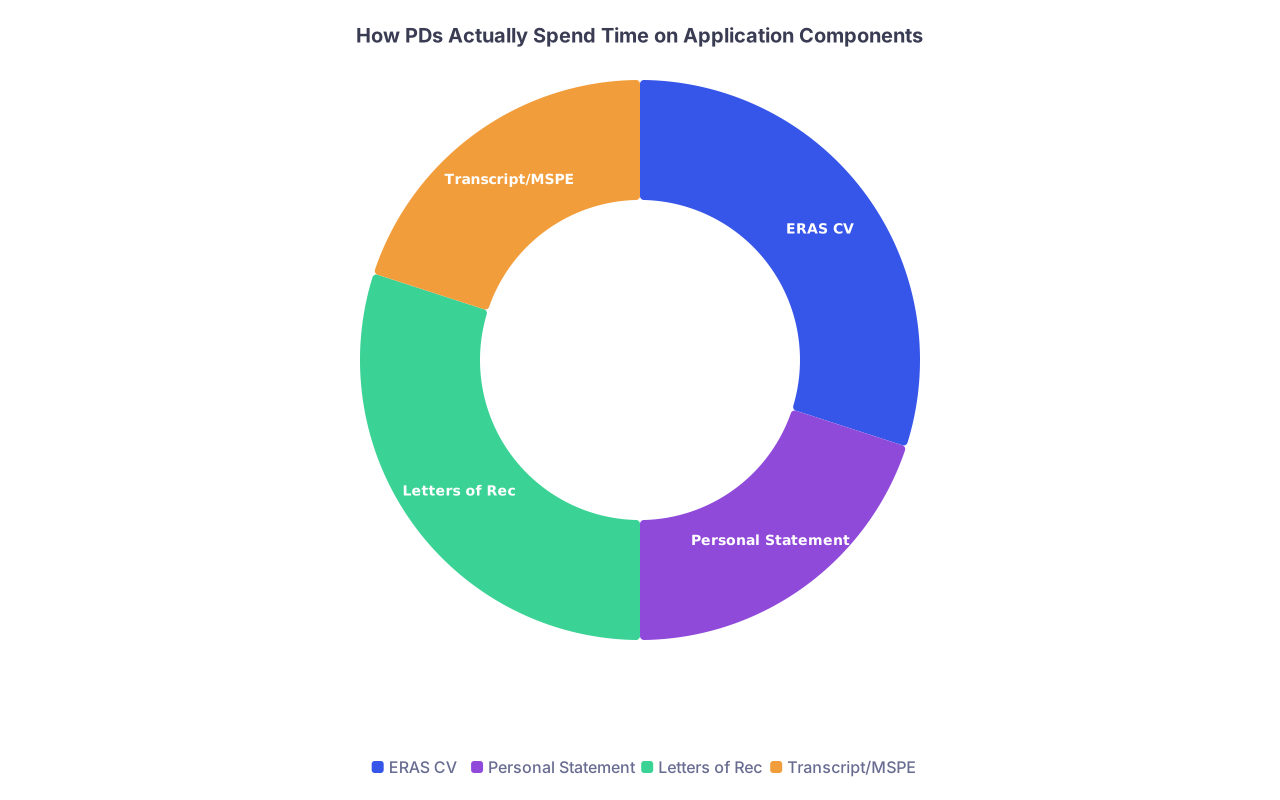
| Category | Value |
|---|---|
| ERAS CV | 30 |
| Personal Statement | 20 |
| Letters of Rec | 30 |
| Transcript/MSPE | 20 |
On a quick first pass, some faculty spend 30–60 seconds max before deciding “yes, maybe, or no.”
If your CV:
- Has tiny font and no spacing
- Uses huge paragraphs for each entry instead of tight bullets
- Dumps every possible detail under each role
- Mixes tense, style, and formatting
…you’re making their job harder. And when you make a busy PD’s job harder, you lose.
Common formatting mistakes that scream amateur:
- Switching between past and present tense randomly
- Inconsistent date formats (2018–19 vs 2020–2021 vs June 2022)
- Weird fonts or colors
- Overuse of bold/italics/underlining for random emphasis
You want clean, scannable, and calm. That means less content, not more.
A sharp CV entry looks like this:
“Student coordinator, free clinic (2022–2024)
Organized student schedules, supervised intake for ~20 patients per week, and implemented a triage checklist that reduced average waiting time by ~15 minutes.”
Not this:
“Volunteer at free clinic. Duties included helping patients, answering phones, organizing stuff. I gained teamwork, communication, and leadership skills.”
If your bullets all end in “skills gained,” they’re filler. Let the responsibilities and outcomes speak for themselves.
9. Red Flags You Don’t Realize You’re Waving
Some content is not just irrelevant. It’s actually dangerous.
Things that hint at professionalism problems
- Jobs you were fired from, framed vaguely with short dates and no explanation, but proudly highlighted as leadership
- “Activism” that sounds like constant conflict with administration and no growth
- A long list of experiences each lasting only 3–4 months — pattern of quitting
- Excessive focus on side businesses, startups, or non‑medical work with minimal clinical engagement
Programs want residents who will:
- Show up
- Do the work
- Not blow things up
If your CV reads like you’re always chasing the next shiny object or constantly in battles with systems, that’s a risk.
Things that hint at poor judgment
- Half‑baked startups with buzzwords and no substance (“AI‑driven blockchain platform for medical equity” that never left Google Docs)
- Social media projects you clearly can’t defend professionally
- Content creation that borders on mocking patients, nurses, or other specialties
Ask: “Would a risk‑averse 60‑year‑old faculty member be comfortable defending this applicant to the chair?” If not, either cut it or reframe aggressively.
10. What To Keep: A Simple Filter So You Stop Second‑Guessing
Before you delete (or keep) each entry, run it through three questions:
Is it recent?
- Medical school and beyond should dominate.
- Pre‑med only stays if it’s truly exceptional or foundational.
Is it relevant to who I am as a future resident?
- Clinical, research, leadership, teaching, and meaningful service win.
- Random jobs and one‑off events usually don’t.
Is it respectable and professional?
- Nothing that makes people cringe, laugh at you, or question your judgment.
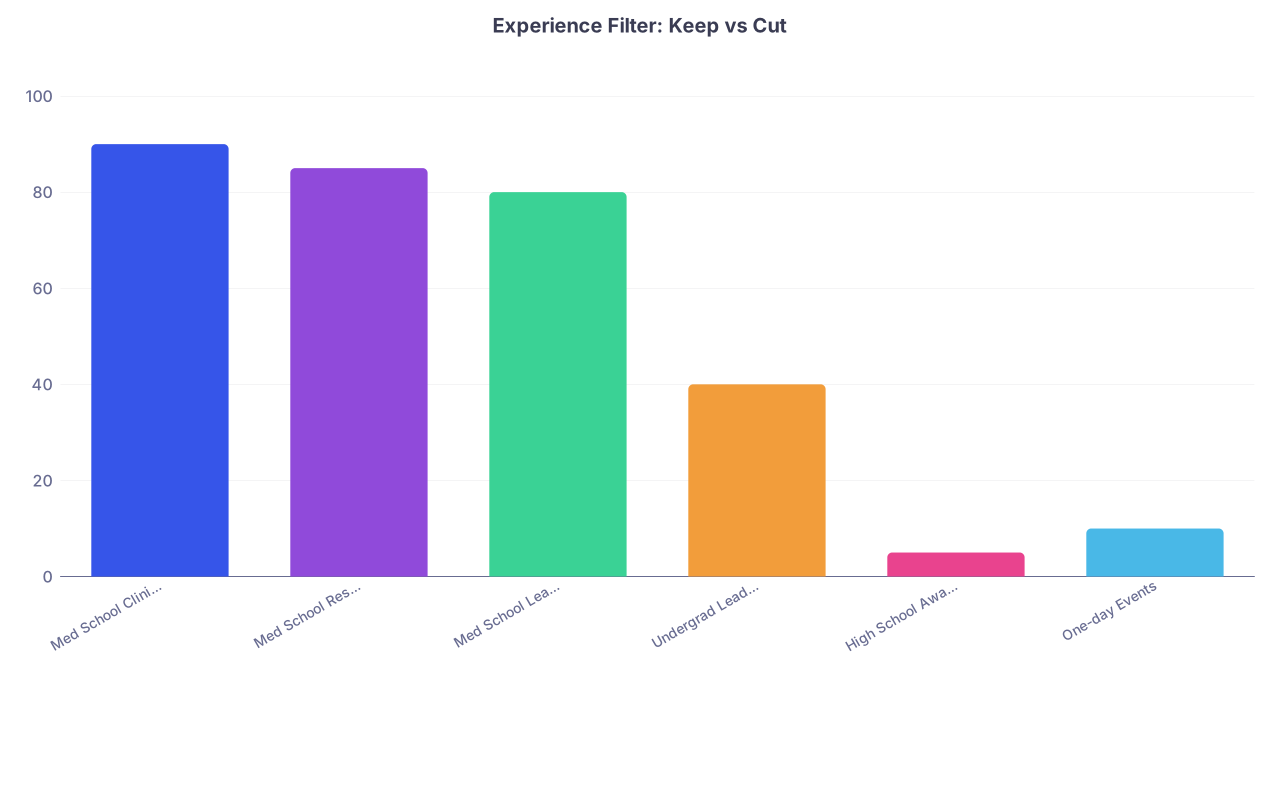
| Category | Value |
|---|---|
| Med School Clinical | 90 |
| Med School Research | 85 |
| Med School Leadership | 80 |
| Undergrad Leadership | 40 |
| High School Awards | 5 |
| One-day Events | 10 |
If an item fails 2 out of 3, cut it. If it barely passes, consider merging or shrinking it.
Don’t be afraid of white space. A clean, tight CV with 12 strong entries beats a bloated document with 30 mediocre ones.
11. Quick Triage: What To Cut This Week
You’re overloaded. So here’s a simple, ruthless pass you can do in under an hour.

| Step | Description |
|---|---|
| Step 1 | Open CV |
| Step 2 | Delete unless elite or foundational |
| Step 3 | Batch or delete |
| Step 4 | Delete or shrink |
| Step 5 | Reframe or delete |
| Step 6 | Keep and polish |
| Step 7 | Ended before med school? |
| Step 8 | Under 10 total hours? |
| Step 9 | Connected to clinical, research, leadership, teaching, service? |
| Step 10 | Make you cringe to explain? |
Then one more pass:
- Scan your hobbies. Delete anything alcohol‑centered, hyper‑political, or too personal.
- Scan your “skills.” Delete generic items and expired certifications.
- Scan research. Clean up anything that’s not actually published, accepted, or realistically submissible.
If you’re honest with yourself, you’ll probably remove 20–40% of your current content. That’s good. That’s the point.
12. A Quick Before‑and‑After Reality Check
To make this concrete, here’s the kind of transformation I’m talking about.
| Section | Before Cleanup Example | After Cleanup Example |
|---|---|---|
| Honors | HS valedictorian, Dean's List x4, AP Scholar | AOA (candidate), Gold Humanism nominee, clerkship honors |
| Activities | 12 separate one-day events listed individually | 1 combined community outreach entry, 3 major roles |
| Research | 6 “in preparation” manuscripts, no details | 2 published papers, 1 poster, 1 ongoing project |
| Hobbies | “Partying, clubbing, craft beer, travel, Netflix” | “Distance running, piano, home cooking, travel” |
I’ve watched applicants do this kind of cleanup and suddenly their file reads as focused, mature, and credible — even though their underlying experiences didn’t change at all. Only the framing did.
That’s the power of cutting the outdated, irrelevant, and cringe.
Your Next Step Today
Don’t just mentally agree with this and move on. Open your CV right now and do one ruthless thing:
Scroll to the oldest entry on your document and ask: “If I had to defend this to a PD in 30 seconds, would I feel confident or slightly embarrassed?”
If you’d feel even slightly embarrassed, delete it or move it to a less prominent spot.
Start there. One cut leads to another. Your future self on interview day will thank you for not being “the applicant with the high school valedictorian flex on page one.”