
The residency programs you want are rejecting you for things you think are “strengths” on your CV.
The Hidden Red Flags in an Otherwise “Strong” CV
Let me be blunt: a lot of applicants accidentally advertise duty-hour violations and professionalism problems right on their CVs and ERAS entries. Then they wonder why interviews dry up.
You’re probably not documenting “I violated ACGME duty hours and ignored professionalism.” But you’re signaling it. Loudly.
Program directors and selection committees read thousands of applications. They’re not impressed you “worked 80+ hours a week” or “volunteered 40 hours every weekend while on sub-I.” They’re looking for three things:
- Can this person follow rules (duty hours, supervision, documentation)?
- Will this person be safe for patients and the team?
- Will this person be a professionalism headache?
Your CV and ERAS can quietly answer “no” to all three if you’re not careful.
Let’s walk through the mistakes that make you look like a duty-hour risk or professionalism problem—and how to fix them before your application goes out.
1. “Hard-Worker” Language That Actually Screams “Duty-Hour Risk”
I’ve seen this line way too many times in ERAS:
- “Regularly worked 90–100 hours per week on surgery clerkship.”
- “Stayed late daily to follow patients even after duty hours ended.”
- “Always the last to leave; stayed overnight beyond scheduled shifts.”
You think you’re proving dedication. Program directors read it as:
- This person ignores rules.
- This person doesn’t understand duty hours.
- This person will put my program at risk in an ACGME site visit.
Phrases That Quietly Signal Duty-Hour Problems
Watch out for wording like:
- “Worked 90+ hours/week”
- “Stayed overnight after call”
- “Came in on off days to preround”
- “Covered extra shifts during away rotation”
- “Never left on time; always stayed until every task finished”
- “No days off during rotation”
These lines do not make you look heroic. They make you look like a liability.
How to Reframe Without Lying
You do not need to invent fake boundaries. You need to describe commitment in a way that respects systems and rules.
Instead of:
- “Worked 90–100 hours/week during sub-internship.”
Use:
- “Assumed near intern-level responsibility within duty hour expectations, including managing patient lists, writing notes, and following up on results.”
Instead of:
- “Always stayed late even when shift ended.”
Use:
- “Ensured safe and thorough patient handoffs at the end of shifts, often assisting with transition of care tasks.”
Focus on:
- Responsibility
- Reliability
- Ownership within structure
Not: ignoring rules, staying late “no matter what,” or turning yourself into a martyr.
2. The Time-Math Problem: When Your CV Schedule Makes No Sense
One of the easiest ways to flag yourself as unprofessional is simple: list an impossible number of hours and commitments.
Program leadership do this subconsciously: they run the math. If your listed activities imply a 120-hour workweek plus full-time school, you look dishonest or wildly unaware.
Classic “Impossible Schedule” Patterns
I’ve seen students list:
- Full-time research “40 hrs/wk”
- Clinical shifts “20 hrs/wk”
- Tutoring “15 hrs/wk”
- Leadership roles “15 hrs/wk”
- AND full-time medical school
On paper, you just invented a 90-hour week before studying, sleeping, commuting, or eating.
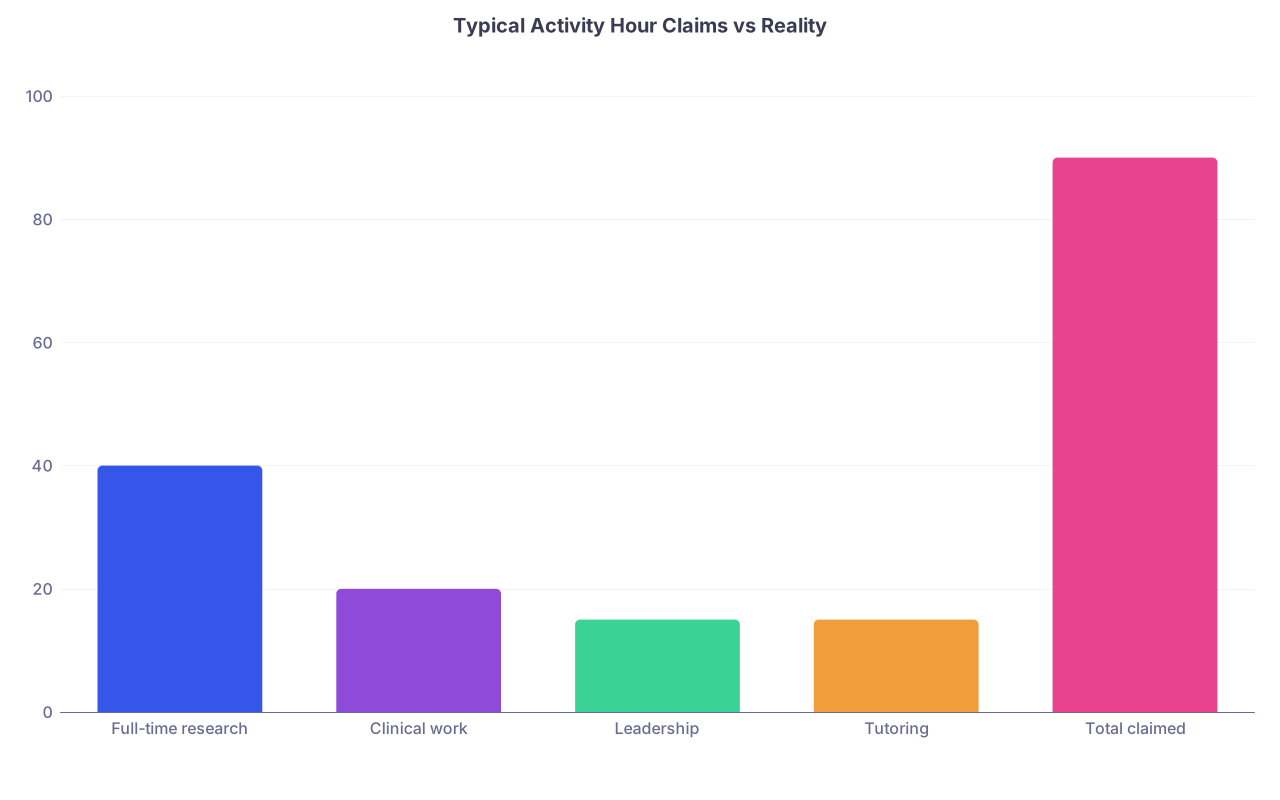
| Category | Value |
|---|---|
| Full-time research | 40 |
| Clinical work | 20 |
| Leadership | 15 |
| Tutoring | 15 |
| Total claimed | 90 |
That’s not grit. That’s a credibility problem.
How Programs Interpret Implausible Hours
When your hours don’t add up, evaluators ask themselves:
- Is this person exaggerating?
- Do they not understand reasonable workload?
- Will their documentation in the EMR be this sloppy?
- If the ACGME audits time-logs, will this person cause issues?
You don’t want those questions.
Fix the Time-Math Before You Submit
You must reconcile:
- Clinical duties
- Research hours
- Leadership
- Volunteering
- Personal life (at least minimally believable)
If you did research while on rotations, don’t claim 40 hours/week. That’s not believable.
Examples of safer phrasing:
- “Part-time research assistant (~5–10 hrs/week during preclinical years; variable during clinical clerkships).”
- “Weekend clinic volunteer (2–4 hrs/week during M2–M4, schedule dependent).”
- “Student interest group president (~3 hrs/week average, with increased time during major events).”
If you stacked commitments during lighter months, specify that:
- “Peak involvement 10–12 hrs/week during summer research block; 2–3 hrs/week during clinical rotations.”
You’re not being “less impressive.” You’re being credible. Programs value that more.
3. CV Entries That Smell Like Boundary and Professionalism Issues
Professionalism concerns don’t always come from obvious disasters like “leave of absence for misconduct.” They often leak from patterns in your CV.
Common Red-Flag Patterns
Too many jobs labeled “left due to conflict with supervisor” or similar
- On a residency application, that looks like: “This person will fight attendings and chiefs.”
Leadership positions that ended abruptly without explanation
- Example: “President, Student Surgical Society (2022–2023)” when everyone knows the term is usually one calendar year and you started mid-year.
Repeated short-term commitments
- Everything is “3 months,” “4 months,” “6 weeks,” and then you leave.
- That can signal poor follow-through, impulsivity, or interpersonal friction.
Oddly defensive descriptions
- “Despite lack of support from some faculty, continued to advocate for…”
- “Maintained professionalism despite difficult environment and negative feedback.”
You might think you’re showing resilience. What programs see is conflict.
How to Defuse These Without Hiding the Truth
You do not need to manufacture a perfect narrative. But you do need to avoid writing like you’re already arguing with the reader.
Instead of:
- “Left research position due to disagreement with PI.”
Use:
- “Completed defined project period; transitioned to a new mentor aligned with my evolving academic interests.”
Instead of:
- “Despite challenging co-residents, maintained professionalism.”
Don’t put that at all. That commentary doesn’t belong in ERAS activity descriptions. It belongs—if anywhere—in a carefully framed personal statement, and even there, usually not.
Focus entries on:
- What you did
- What you learned
- What you produced
Not: who wronged you.
4. Overclaiming Autonomy: When “Intern-Level” Sounds Unsafe
Another subtle professionalism trap: you oversell how independently you worked.
I see things like:
- “Functioned independently as primary provider in ED shifts.”
- “Managed ICU patients essentially as an intern.”
- “Worked without direct supervision overnight.”
To a program director, that triggers:
- Scope of practice violations
- Patient safety concerns
- Poor insight into your learner role
Dangerous Autonomy Phrases to Avoid
Be very careful with claims like:
- “Managed all aspects of patient care…”
- “Worked without attending oversight…”
- “Made final clinical decisions for…”
- “Ran codes without supervision…”
Even if your attending gave you leeway, you are still a student. You should frame your role that way.
Smarter Ways to Describe High-Responsibility Roles
You can show initiative and responsibility without implying unsafe independence.
Instead of:
- “Served as primary provider in rural ED with no supervision.”
Use:
- “Performed initial evaluations and proposed diagnostic and management plans for ED patients in a rural setting, reviewing all cases with supervising physicians.”
Instead of:
- “Ran all MICU rounds independently.”
Use:
- “Led portions of MICU rounds by presenting patients and proposing comprehensive assessment and plans, which were reviewed and modified by the attending.”
Key idea: you showed ownership within the supervision structure. That’s what programs want.
5. Sloppy Documentation: If Your CV Is Messy, Your Notes Will Be Worse
Duty hours and professionalism are not just about time and behavior. They’re also about documentation. How you present your CV is a proxy for how you’ll document patient care.
Sloppiness That Programs Notice (Even If They Don’t Tell You)
- Inconsistent dates (one activity is “08/2021–05/2023,” another is “Fall 2021–Spring 2023”)
- Misspelled institution names
- Job titles that change wording across sections (e.g., “Research Fellow” vs “Research Assistant” for the same role)
- Publications listed differently in CV vs ERAS vs personal statement
- Abstracts labeled as “peer-reviewed publications”
This doesn’t just look lazy. It looks dishonest or careless—both serious professionalism issues.
Create a Consistency Checklist
Before you submit, check:
- Are all dates plausible and consistent across ERAS, CV, and personal statement?
- Are titles uniform for the same role everywhere?
- Are all publications categorized correctly (manuscript, online ahead-of-print, abstract, poster, oral)?
- Are acronyms explained at least once?
Small mistakes add up. A program director once circled three conflicting dates on a printout and said: “If they cannot keep their own life straight, I do not trust them with med recs.”
You do not want to be that applicant.
6. The “Always Available” Trap: When Reliability Looks Unhealthy
Many students try to prove they’re team players by writing about:
- “Always available for extra call.”
- “Never said no to covering missing shifts.”
- “Frequently picked up additional responsibilities when others were absent.”
On the surface, that sounds positive. But in the duty-hour era, it can backfire.
Why?
Because residency programs do not want:
- People who cannot set boundaries
- People who normalize unsafe coverage
- People who enable systems to ignore staffing problems
An “I never say no” person becomes:
- Burned out
- Unreliable eventually
- A possible duty-hour violation magnet
Healthier Ways to Show You’re Reliable
Instead of:
- “Never declined extra shifts; always available when needed.”
Use:
- “Consistently dependable for scheduled commitments and willing to assist with coverage when feasible and appropriately approved.”
Instead of:
- “Always picked up more patients than assigned.”
Use:
- “Efficiently managed patient responsibilities within team expectations while supporting peers during high-volume periods.”
Message: you’re reliable within structure, not recklessly self-sacrificing.
7. How to Audit Your CV for Hidden Duty-Hour and Professionalism Red Flags
Do a structured pass through your entire application with one goal: remove or reframe anything that could be read as:
- Unsafe
- Dishonest
- Exaggerated
- Boundaryless
- Conflict-prone
Here’s a simple audit framework.
| Area | What to Check |
|---|---|
| Hours/Time | Do the weekly hours add up? |
| Autonomy | Any claims of unsupervised care? |
| Language | “Always/never/90+ hours” phrasing |
| Consistency | Dates/titles/publications match? |
| Tone | Defensive or conflict-heavy? |
Step 1: Run the “Duty-Hour” Lens
Ask of each clinical/volunteer role:
- Are claimed hours realistic for that phase of training?
- Do any descriptions brag about overwork or skipping days off?
- Could a reviewer imagine an ACGME citation based on what you wrote?
Anything questionable gets toned down, qualified, or clarified.
Step 2: Run the “Professionalism” Lens
For each entry:
- Do I sound defensive, bitter, or blaming?
- Am I hinting at conflict with supervisors or peers?
- Am I exaggerating my role or accomplishments?
If yes, rewrite to focus on actions, outcomes, and learning—not drama.
Step 3: Have a Skeptical Reader Review It
Ideally:
- A resident in the specialty you’re applying to
- Or a faculty mentor who reads a lot of ERAS applications
Tell them explicitly:
“I want you to circle anything that looks like exaggeration, conflict, or unsafe behavior.”
Then listen. If multiple people question the same lines, they’re a problem.
8. Examples: Bad vs Better CV Language
Let’s make this completely concrete.
Example 1: Sub-Internship
Bad:
- “Worked 90–100 hours/week and stayed overnight even when off call to ensure all patient needs were met.”
Better:
- “Took near intern-level responsibility for patient care on sub-internship, including daily notes, order proposals, and follow-up of results, while adhering to duty-hour expectations and team protocols.”
Example 2: ED Experience
Bad:
- “Acted as primary provider in busy ED, often making independent decisions without attending input.”
Better:
- “Performed initial assessments and proposed management plans in a busy ED setting, discussing all cases with supervising residents and attendings before implementation.”
Example 3: Research Commitment
Bad:
- “Full-time medical student and full-time research (40 hrs/week) throughout M3–M4.”
Better:
- “Longitudinal research involvement beginning in preclinical years, with variable weekly commitment (5–15 hrs/week) depending on clinical rotation intensity.”
Example 4: Leadership Conflict
Bad:
- “Resigned from leadership position due to disagreement with faculty advisor about direction of group.”
Better:
- “Served as vice president during 2022–2023, focusing on organizing educational events and peer mentorship. Transitioned role at the end of a defined term to a junior student leader.”
9. Professionalism Signals You Do Want on Your CV
Let’s flip this. What actually reassures programs about your professionalism and respect for duty hours?
Look for opportunities to include things like:
- “Worked with team to ensure appropriate handoffs at shift end to maintain continuity and safety.”
- “Participated in quality improvement project addressing resident workload and documentation efficiency.”
- “Helped develop coverage schedule that maintained duty-hour compliance while ensuring adequate clinical coverage.”
- “Consistently completed required modules and compliance training ahead of deadlines.”
Not fluffy. Very real professionalism markers.

| Step | Description |
|---|---|
| Step 1 | Draft CV and ERAS entries |
| Step 2 | Adjust hours and descriptions |
| Step 3 | Reframe within supervision |
| Step 4 | Neutral, outcome focused wording |
| Step 5 | Standardize across documents |
| Step 6 | Have resident or faculty review |
| Step 7 | Submit polished application |
| Step 8 | Hours realistic? |
| Step 9 | Any unsafe autonomy claims? |
| Step 10 | Conflict or defensive tone? |
| Step 11 | Consistent dates and titles? |
FAQs
1. Is it lying to lower the hours I list if I felt like I was working 90+ hours a week?
No, it’s correcting exaggeration. Feeling like something was “90 hours” during a brutal rotation doesn’t mean it literally was. List reasonable, defensible estimates that align with actual schedules and typical expectations. Programs want honest, realistic numbers—not hero stories.
2. Can I mention that I came in on days off to see specific patients I was attached to?
You can, but be smart. Don’t normalize a pattern of violating policies. A safer frame is: “Maintained continuity by following patient progress through chart review and communication with the team, even when not physically present on the ward.” Coming in occasionally is fine; bragging that you did it “all the time” is not.
3. What if I really did have a serious professionalism issue in the past? Should I hide it completely on my CV?
You should not fabricate or erase factual events that exist in your official record, but you also don’t need to spotlight them in every section. Usually, these are best addressed—in a controlled, mature way—in your personal statement or an institutional letter, focusing on insight, remediation, and growth. Your CV descriptions should stay neutral and factual.
4. How do I know if I’m overselling autonomy vs appropriately describing responsibility?
Use this test: if an attending or program director who supervised you read the line, would they say, “Yes, that’s accurate and safe”? Emphasize that you proposed plans, participated in management, and worked under supervision. Any phrasing that sounds like you were practicing independently as a physician is too far for a medical student or incoming resident.
Bottom line:
- Your CV can quietly broadcast duty-hour and professionalism problems if your hours, language, or tone are careless.
- Fix the red flags now—exaggerated hours, unsafe autonomy claims, conflict-heavy wording, and sloppy inconsistencies—before program directors see them and move on.