
No Leadership Titles on My CV: Will Programs Think I’m Passive?
It’s 11:47 pm. You’ve got your ERAS CV open in one tab, a couple of Reddit threads about “must-have leadership” in another, and your brain is quietly spiraling.
Everywhere you look: “Chief this.” “President that.” “Founder, Director, Chair, Co-chair.”
And you’re staring at your Activities section thinking:
“I…went to meetings.”
“I…helped with projects.”
“I…did stuff. But I never had the word ‘President’ next to my name.”
So now the loop starts:
Are programs going to look at my CV and just see someone…passive?
Like I just drifted through med school, followed instructions, never took initiative?
Is this the thing that’s secretly going to tank my application?
Let me be direct: lack of formal leadership titles does not automatically equal “passive” to programs. But if you present your experiences the wrong way, they absolutely can look that way on paper.
Your problem isn’t that you didn’t have titles.
Your problem is that nobody trains you how to show leadership when you don’t have them.
Let’s fix that.
What Programs Actually Mean When They Say “Leadership”
Here’s where people get messed up: they think “leadership” = “big official position.”
President of this. Chief of that. Founder of something that somehow already has a logo and a website.
Programs don’t actually care that much about the title. They care if you’ve shown:
- You can take responsibility for something that matters
- You can move things forward without being hand-held
- People trust you with tasks that affect others
- You don’t crumble or vanish when things get hard
They’re asking: “Is this someone I’d want on my team at 2 am when admissions explode and something needs to get done?”
Here’s the annoying truth: titles are a shortcut signal. They’re lazy but convenient. “President” suggests you did leadership things. But plenty of people had big titles and did absolutely nothing. And plenty did serious leadership work with no fancy label.
Programs care a lot more about evidence than titles. The problem is you’re probably sitting on actual leadership examples and listing them like you were background scenery.
You’re writing:
“Member, Dermatology Interest Group”
When what actually happened is more like:
“Ran a skin cancer screening event for 80+ patients and coordinated 10 volunteers.”
Same experience. Completely different impression.
Why Your CV Might Read as “Passive” (Even If You Aren’t)
I’ve watched people with insanely solid experiences look “meh” on paper because of this. Let’s walk through how it usually happens.
You’re thinking:
“I was never president, so I should list myself as ‘Member.’ I don’t want to oversell.”
So you put:
- Member, Pediatrics Interest Group
- Volunteer, Student-Run Free Clinic
- Research Assistant, Cardiology Lab
- Teaching Assistant, Physiology Course
All technically accurate.
But here’s what programs see on a first skim:
“Joined a club. Showed up somewhere. Helped in lab. TA.”
No verbs with weight. No initiative. No sense that you owned anything.
You’re not lying. But you’re also not telling the full story.
What they need to see is how you existed in those roles. Did you:
- Start something new?
- Fix something broken?
- Take over a duty that wasn’t technically required?
- Train people?
- Improve a system or process?
If you did any of that — that’s leadership. Even if your title was “member.”
How to Turn “I Just Helped Out” Into Real Leadership on Your CV
Let’s be blunt: if you have no titles, your bullets have to work harder. They have to prove you weren’t passive.
You can do that by shifting your bullets from “I existed” to “I owned this specific thing.”
Instead of:
- “Volunteer at student-run free clinic”
Try:
- “Coordinated intake flow for weekly free clinic sessions, streamlining triage and reducing average patient wait time from ~90 to ~55 minutes.”
See the difference? Same unpaid role. Completely different energy.
Or instead of:
- “Member, Internal Medicine Interest Group”
Try:
- “Organized a resident Q&A panel for 60+ students, collaborating with program leadership to answer questions on IM residency and lifestyle.”
Was your title still just “member”? Probably. But you did the work. That’s what matters.
Quick structure to rewrite bullets:
Ask yourself for each activity: “What did I actually drive?”
Then write bullets like this:
- Start with a strong verb: led, organized, initiated, coordinated, implemented, streamlined, created, developed, mentored, managed
- Add what you did: what project, what group, what change
- Add impact if you can: numbers, scale, improvement, outcomes
Example transformations:
Original: “TA for Physiology”
Better: “Led weekly review sessions for 20–30 first-year students, clarified high-yield physiology concepts, and created practice questions now used by future TAs.”
Original: “Research assistant in cardiology lab”
Better: “Took ownership of data collection and protocol refinement for a 120-patient heart failure study, improving data completion rate from 70% to 92%.”
You see what this does? It screams: “I don’t just sit around. I push things forward.”
That’s leadership. Without ever writing “President.”
| Category | Value |
|---|---|
| Letters | 90 |
| Clinical evals | 85 |
| Personal statement | 60 |
| Research | 50 |
| Leadership titles | 30 |
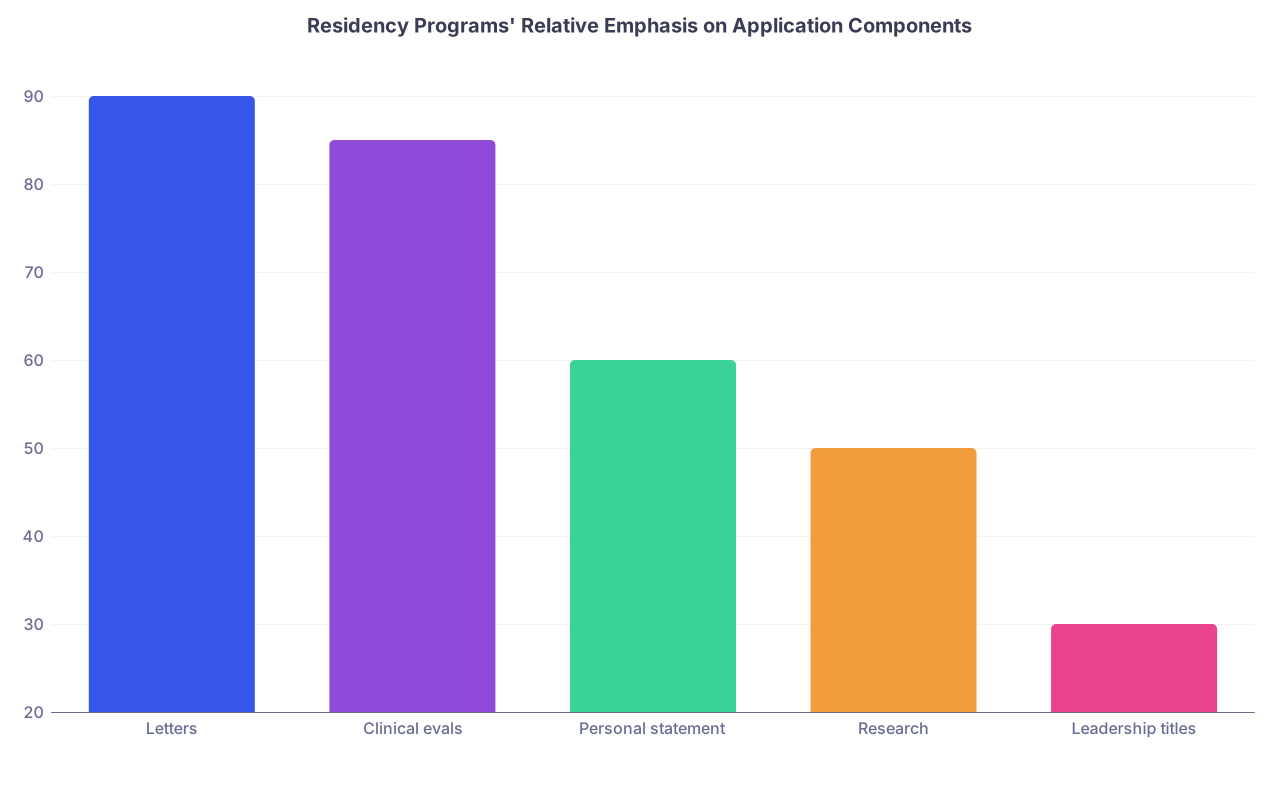
How Much Do Programs Actually Care About Titles Themselves?
Short answer: far less than Reddit makes you think.
Most program directors I’ve heard talk about this stuff care way more about:
- Letters that say “they step up when things get busy”
- Comments like “took initiative beyond expectations”
- Evidence on your CV that you actually did things
They’re not building a cabinet. They’re not like, “We need three presidents and two founders.” They’re trying to answer: “Is this person going to be dead weight, or can I trust them?”
- You’re applying to super competitive specialties
- You’re in a crowded pile with similar scores, grades, and research
- The content of what you did as president/chair/etc was actually substantial
Leadership titles hurt when:
- The title is big, but the bullets are empty and vague
- It looks like you collected positions for optics
- There’s a ton of “President / Founder / Director” and basically no depth
Your situation — no titles, but real contributions — is not disqualifying. It just means you have to be much more intentional about your descriptions and your letters of recommendation.
If attendings and mentors can say, “They weren’t the formal leader, but everyone went to them to get things done,” that speaks louder than some “Treasurer” title where you approved one budget.
What You Can Still Do Now If You’re Mid-Application
If you’re in the middle of an application cycle and spiraling about your “no leadership” CV, there are still levers you can pull.
1. Rewrite your activity descriptions. Aggressively.
Do not undersell. Do not default to “member.” Ask yourself, for each role:
- Did I ever organize anything?
- Did I ever create a resource?
- Did I ever fix a messed-up process?
- Did people depend on me for something specific?
- Did I teach, mentor, or onboard others?
If yes, your bullets need to say that. Not in a cringey, inflated way. Just accurately.
Bad: “Participated in journal club meetings.”
Better: “Selected and presented primary literature at monthly journal clubs, facilitating discussion among 15–20 peers and residents.”
Still true. Still you. Just not passive.
2. Use your personal statement to quietly show leadership traits
Not “I’m a great leader” — nobody believes that line.
But show moments where:
- You stepped up when things were chaotic
- You took responsibility without being told
- You advocated for a patient or system change
- You went beyond what was required, not for praise, but because it needed to be done
You’re not applying to an MBA program. They’re not asking for some heroic “I led a team of 50 engineers.” They want to see: “Can you be the intern who doesn’t fold when the floor explodes?”
3. Prime your letter writers
You can’t script their letters, but you can remind them:
“I know I didn’t have formal leadership titles, but I tried to take initiative on X, Y, Z things on the team. If any of that stood out to you, I’d be grateful if you could comment on it.”
That’s not manipulative. That’s just nudging them toward what programs care about: do you step up?
I’ve seen letters that say, “While they never held a formal leadership role, they consistently took on coordination tasks and functioned like a senior member of the team.” That’s gold.

If You Still Have Time Before Applying: Quiet Leadership Moves You Can Make
If you’re M2/M3 and reading this in a cold sweat, you actually have time to shift the story.
You don’t need to become President of Everything. You need one or two things you own.
Examples of low-drama, high-impact “leadership” moves:
- In your free clinic: take charge of one small aspect — scheduling volunteers, stocking supplies, designing a new intake sheet, starting basic follow-up tracking. Then actually do it reliably.
- In an interest group: organize one recurring event (case conference, resident panel, skills night). You don’t need to be on the “board” to be the person who made it happen.
- In research: volunteer to manage REDCap, coordinate meetings, or train new students. Take responsibility for a piece of the project’s workflow.
- In academics: run informal review sessions for classmates or underclassmen, then solidify that into something consistent.
The key is this: pick something small but real, and own it. Don’t wait for a title before behaving like someone who leads.
Years from now, nobody will care that your line item said “Coordinator” vs “Member.” They’ll care that there’s a clear pattern: when something needs doing, you raise your hand and then follow through.

| Step | Description |
|---|---|
| Step 1 | Existing Role |
| Step 2 | Rewrite bullets to show initiative |
| Step 3 | Find small piece to own now |
| Step 4 | Highlight impact and responsibility |
| Step 5 | Discuss in PS or interviews |
| Step 6 | Did you own anything? |
The Interview: When “No Titles” Will Mess With Your Head
You know what’s coming.
“Tell me about a time you demonstrated leadership.”
And your brain is going to whisper, “You didn’t. Remember? No titles.”
Prepare for that sabotage now.
You can pull stories from:
- Times you advocated for a patient when the team was too rushed
- Situations where you oriented new students or helped them not drown on their first day
- Projects you pushed across the finish line when they were drifting
- Times you saw something broken in workflow and quietly fixed it
And say them clearly. Not apologetically. Not, “Well, I wasn’t officially a leader, but…”
Drop that preface. It screams insecurity and makes the story sound smaller.
Just: “On my medicine rotation, I noticed X problem, so I did Y, and here’s what changed.”
That’s plenty.
| Scenario | Weak CV Line | Strong CV Line |
|---|---|---|
| Free clinic volunteer | Volunteer at free clinic | Managed triage flow for weekly free clinic, coordinating 8–10 students per shift |
| Interest group member | Member, Surgery Interest Group | Organized suturing workshop for 40+ students with resident instructors |
| Research assistant | Assisted with cardiology research | Led data management for 100-patient registry, improving data completeness to 95% |
| Teaching assistant | TA for physiology | Ran weekly review sessions and created a 40-question practice set used by class |
| Peer mentor | Peer mentor for M1s | Mentored 5 first-year students, holding monthly check-ins and sharing study resources |
The Part You Don’t Want to Hear but Need To
You’re not going to trick programs into believing you’re someone you’re not. And you shouldn’t try.
If you truly spent four years hiding in the back, never stepping up for anything, never taking responsibility when stuff got messy — then yeah, that’ll show. And it should.
But I doubt that’s you.
Most anxious people in your position actually care a lot. They do step up. They just:
- Don’t recognize it as leadership because it wasn’t formal
- Write their CV like a police report instead of a story of what they contributed
- Downplay the very things programs want to see because they’re terrified of “overselling”
Stop assuming that because you weren’t “President,” you were invisible. You weren’t. You just haven’t learned how to translate reality into ERAS-speak.
Do that, and your application will stop looking passive — without you manufacturing some fake persona.
FAQ (Exactly 6 Questions)
1. Is having zero formal leadership titles a red flag for residency programs?
No, not by itself. Programs don’t have a secret checkbox labeled “must be president of something.” What is a problem is an application that reads like you never took responsibility for anything. If your roles, bullets, and letters show that you step up, follow through, and contribute meaningfully, the lack of titles won’t tank you.
2. Should I suddenly try to grab a leadership title late in M3/M4 just to fill the gap?
Honestly? That usually looks hollow. Slapping “Vice President” on your CV for a group you barely affected won’t impress anyone. You’re much better off taking ownership of a real project or task — a clinic initiative, an educational session, a research workflow — and doing it well enough that you can describe concrete impact and have someone back it up in a letter.
3. Can I call myself a “leader” of something if it wasn’t an official position?
Don’t invent titles. That’s how you lose trust. But you can absolutely describe what you led in your bullets. For example: “Led a small group of 4 volunteers running XYZ event” is fair if that’s what happened. The bullet should describe the function you performed, not pretend you had a formal role you didn’t hold.
4. How many leadership experiences do I “need” to be competitive?
There’s no magic number. One or two substantial things you clearly owned are more convincing than eight flimsy titles. If you can point to a few experiences where you clearly took initiative, coordinated people or processes, and followed through reliably, that’s enough to demonstrate leadership potential for most specialties, especially paired with strong clinical evaluations.
5. Will competitive specialties (derm, ortho, plastics) judge me more harshly for no titles?
They’ll scrutinize everything more: scores, research, letters, leadership. But again, titles aren’t the core issue. In competitive fields, they’re looking for evidence of drive, resilience, and initiative. You can show that through high-level research responsibility, building a meaningful project, or leading within a lab or clinic — even without a formal “President” or “Chief” label.
6. Should I address my lack of leadership titles directly in my personal statement?
Don’t write a whole paragraph apologizing for not being president of something. That just highlights the insecurity. Instead, use your statement to tell stories that demonstrate leadership traits — initiative, responsibility, advocacy, reliability. Let readers infer from your behavior that you’re not passive. They care far more about how you’ve actually acted than what your titles were.
Years from now, you won’t remember whether you wrote “member” or “coordinator” on line 14 of your ERAS CV. You will remember this: when you started treating your own story like it mattered enough to tell it fully — and stopped assuming that a missing title meant you had nothing worth showing.