
Only 27–35% of program directors say international electives positively influence their ranking decisions. Most are neutral. A few are quietly annoyed.
Let’s kill the fantasy right away: going abroad for four weeks to “do global health” is not the golden ticket you’ve been told it is. It can help. It can hurt. Most of the time, it does almost nothing unless you build it correctly.
You’re not just up against your class. You’re up against the story PDs tell each other in hallways and Zoom meetings: “Yeah, we’ve had a few who did those ‘mission trips.’ Looked great on paper. Total liability on the wards.”
So let’s separate hype from data.
What Program Directors Actually Think (Not What Your Class Groupchat Thinks)
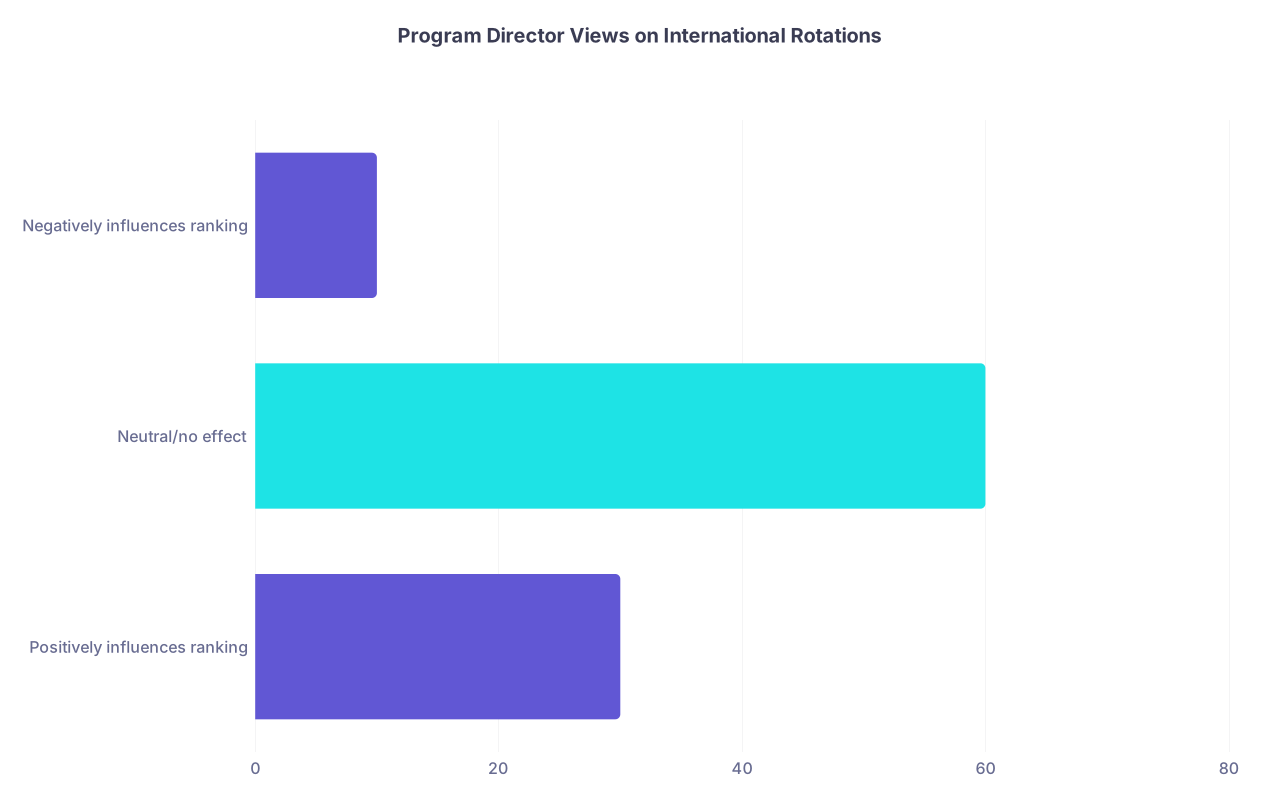
| Category | Value |
|---|---|
| Positively influences ranking | 30 |
| Neutral/no effect | 60 |
| Negatively influences ranking | 10 |
Those numbers roughly match what shows up in survey data from specialties like IM, EM, FM, and peds over the last decade: a minority see international electives as a plus, most don’t care, and a non-trivial chunk are skeptical.
Patterns you see over and over in PD comments:
- “Nice, but not decisive.”
- “Depends how it’s framed and what they did.”
- “Red flag if it replaces core clinical time or if letters are useless.”
- “I’m more impressed by a strong Sub-I here than a month in [insert exotic place].”
Here’s the blunt truth: if you’re hoping an international elective will compensate for weaker Step scores, mediocre clinical evaluations, or no home Sub-I, it will not. At all.
What PDs reliably care about more than your overseas adventure:
- Clinical performance at your home institution
- Sub-I/acting internship performance
- Step 2 CK (post–Step 1 pass/fail)
- Letters from people they know or institutions they trust
- Professionalism and reliability stories from faculty they can call
Your elective abroad is extra. Optional garnish. Sometimes tasty, often decorative, occasionally questionable.
Big Myths About International Electives
Myth 1: “Any international elective automatically boosts my application”
No. PDs don’t award points just because you got a passport stamp.
They ask:
- Was this a structured, supervised, accredited rotation?
- Did you have meaningful, appropriate patient care responsibilities?
- Did anyone credible evaluate you in a way that maps to US training standards?
- Did you learn anything you can actually talk about that’s relevant to residency?
If all you did was take selfies in an OR with no proper credentialing, sit in on clinics where you don’t speak the language, and come back with a generic “global health changed my perspective” statement, PDs see right through it.
Myth 2: “International electives are the best way to show commitment to global health”
Another overstatement.
Longitudinal commitment > one-month elective. Always.
Someone with:
- 2–3 years of continuous involvement in a student-run global health org
- A structured global health track at their med school
- A couple of posters or papers on health disparities, epidemiology, or implementation work
- Advocacy, QI, or curriculum work that continues after they land back at the airport
…looks far more serious than someone who disappears for a month in M4 and reappears with colorful photos and one line in the CV.
Myth 3: “It will give me a strong LOR that PDs love”
Maybe. Usually not.
Common problems with international LORs:
- Written by non-physicians or people unfamiliar with US training (“She will be a very good doctor in the future” = useless)
- No US-style grading, no comparison to US students
- Inflated praise with no concrete behavioral examples
- Unknown institution and unknown faculty → no trust anchor
PDs heavily discount letters they can’t calibrate. A bland letter from a mid-tier US IM attending usually beats an effusive letter from “Professor of Surgery, National Hospital of X” that doesn’t speak the PD’s language (evaluatively, not linguistically).
When International Electives Actually Help You
They can be valuable. But only if they intersect with what PDs already care about.
1. When they plug directly into a real global health or academic story
If your trajectory shows:
- Global health research
- Long-term involvement in health equity, refugee care, migrant health clinics
- A global health track or certificate
- Then an international elective with structured outcomes (project, QI, curriculum, research)
Now you’re not “tourism with a stethoscope.” You’re building depth.
This matters more in:
- Family Medicine
- Internal Medicine
- Pediatrics
- EM
- OB/GYN
Especially at programs with a defined global health pathway or affiliated centers (think UCSF, Harvard, UW, UNC, Brown, etc.).
2. When the site is well-known and integrated with US schools
PD translation: trusted environment + reliable assessment.
Examples that tend to carry more weight:
- Long-standing partner sites of major US med schools (e.g., GH/ID sites in Kenya, Uganda, Peru, India, Haiti attached to recognized US academic centers)
- Rotations that explicitly issue US-style evaluation forms
- Programs where US attendings or fellows rotate and can co-sign evaluations or letters
If your dean or global health office has a list of “approved partner sites,” those are usually vetted for:
- Supervision
- Scope of practice
- Legal/ethical safeguards
- Educational value
Those boxes matter far more than the romantic location.
3. When the elective yields concrete, CV-worthy outputs
A PD cares far more about outputs than your personal epiphany.
Things that actually move the needle:
- Co-authored paper, even if not in NEJM – especially on implementation, epidemiology, or outcomes
- Structured QI project: defined aims, data, and impact
- Curriculum design that you then present at a regional/national meeting
- Abstracts, posters, or talks about your work or data from the site
“Spent a month in rural clinic” is fluff.
“Implemented a triage protocol that reduced waiting time by 20% and presented this at [regional meeting]” is substance.
When International Electives Backfire Or Do Nothing

This is the part nobody selling you on “transformative global experiences” likes to talk about.
1. When they displace critical core US rotations or Sub-Is
If PDs have to choose between:
- Strong performance on a medicine Sub-I + local EM rotation
vs - That same time spent abroad
They’ll take the Sub-I every single time.
- You skipped a Sub-I in your target specialty to go abroad
- Your only strong clinical feedback is from an international site, while home evals are weak
- Your Step 2 CK is borderline and you spent your elective time out of the US instead of shoring up clinical gaps
PD mental model: you chose adventure over building core competence.
2. When your story screams “medical tourism”
They won’t use that phrase to your face. They use it to each other.
Red flags they notice:
- Short, unsupervised surgical “experience” in a low-resource setting wearing no proper PPE
- Photos in your personal statement or social media of you doing procedures you’re not credentialed for
- Over-dramatic savior narratives: “I saw poverty like never before; now I’m dedicated to serving the underserved” after 3 weeks doing basically nothing safely billable in the US
You do not get extra points for working beyond your level of training. You get ethics concerns.
3. When your LOR from abroad is your “best” letter
If your strongest letter is from a site abroad and your home institution letters are lukewarm, PDs notice the asymmetry.
They might read it as:
- Grade inflation or cultural difference in evaluation
- You perform better when not under US-level scrutiny
- You’re seeking letters from people who don’t really know the comparative bar
It doesn’t mean you’re doomed. But it doesn’t help you as much as you think.
How To Make An International Elective Actually Work For Your CV
Let’s talk tactics, not fantasy.
Step 1: Decide if you should even do one
Good reasons:
- You already have a global health track, longitudinal work, or real interest in health systems
- You’ve secured strong home Sub-I evaluations and Step 2 CK is solid
- The elective is at a vetted, structured site with clear supervision and evaluation
- There’s a realistic chance of a project/paper/QI outcome
Bad reasons:
- “Everyone says it looks great for residency.” (They’re wrong.)
- “I need to make my CV stand out because my scores are weak.” (It won’t fix that.)
- “I want to travel before life gets busy.” (Then just own it as travel. Don’t pretend it’s a strategic CV move.)
Step 2: Choose the right site
| Feature | Strong Elective Site | Weak Elective Site |
|---|---|---|
| Affiliation | Partner of US med school | Random individual contact |
| Supervision | Dedicated faculty, daily | Sporadic, unclear |
| Evaluation format | US-style, competency-based | Vague narrative or none |
| Scope of practice | Level-appropriate | Students doing procedures |
| Potential for output | QI/research built-in | None, pure observation |
If the site can’t guarantee proper supervision and evaluation, it’s a nice life experience, not a residency asset.
Step 3: Optimize the output, not just the experience
During the elective, aim for at least one of:
- QI project with measurable outcomes
- Data collection that feeds into a paper/poster
- Curriculum or teaching module you help build and later present
Ask explicitly at the start: “Is there an ongoing project I can plug into that might lead to a poster or abstract?”
If the answer is basically “Just observe clinics,” your CV payoff will be minimal.
Step 4: Be strategic about letters
If you’re going to ask for a letter:
- Confirm the writer understands US-style letters for residency
- Provide them with your CV, personal statement draft, and examples of US LOR expectations
- Ideally, co-sign with a US-affiliated faculty if possible
And then—crucially—do not let that be your main letter. Use it as a supplemental piece if it adds something unique.
Step 5: Frame it right in your CV and interviews
You win or lose a lot based on how you talk about it.
Bad framing:
- “It was life-changing, I realized how lucky we are.”
- “I did so many procedures there I’d never be allowed to do here.”
Better framing:
- Specific skills: resource triage, diagnostic reasoning without imaging, cross-cultural communication
- Systems insight: how you saw health systems function under constraint and what that taught you about efficiency, teamwork, or task-shifting
- Concrete outcomes: project results, process improvements, teaching activities
PDs respond to competence, reflection, and relevance to US training—not emotional travelogues.
Where International Electives Matter Most (And Least)
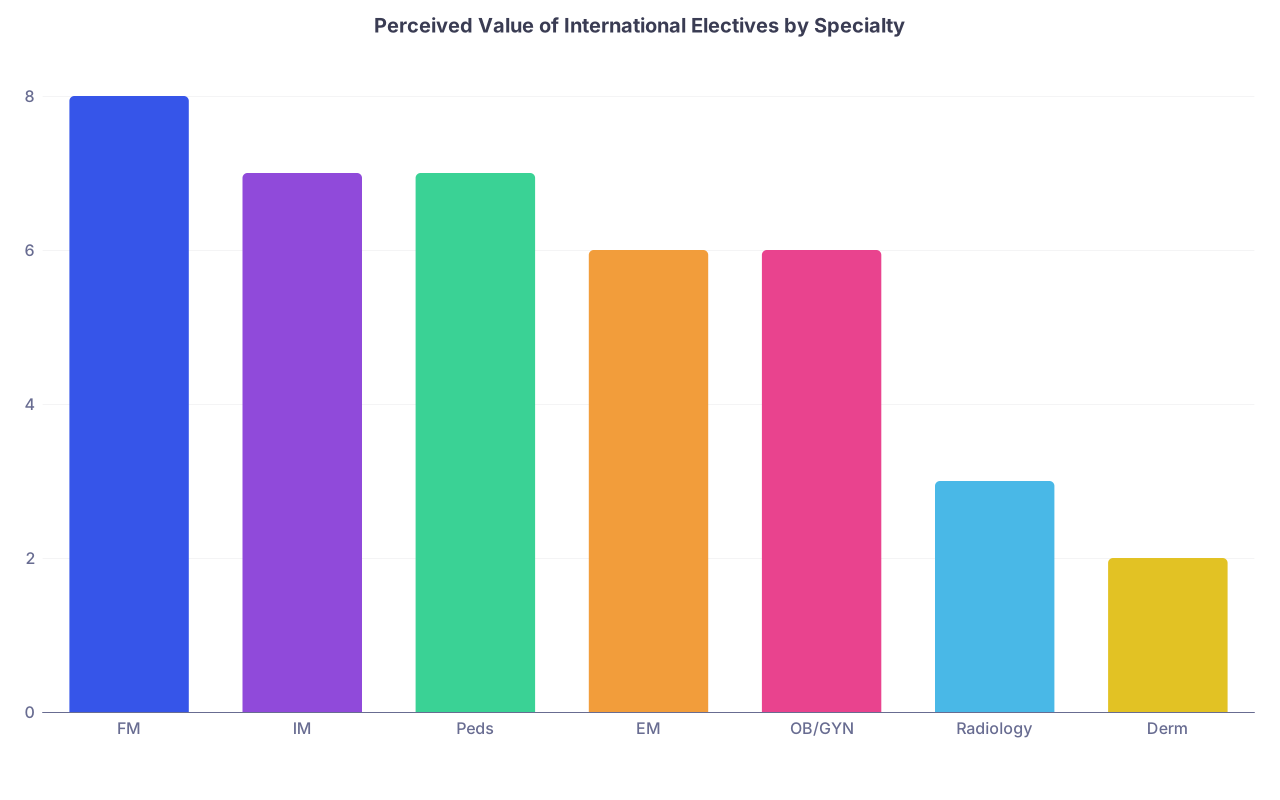
| Category | Value |
|---|---|
| FM | 8 |
| IM | 7 |
| Peds | 7 |
| EM | 6 |
| OB/GYN | 6 |
| Radiology | 3 |
| Derm | 2 |
(Scale here is rough: 1 = almost irrelevant, 10 = can be significantly additive.)
More receptive:
- Family Medicine
- Internal Medicine
- Pediatrics
- EM and OB/GYN with clear global health pathways
Less impressed:
- Radiology
- Pathology
- Derm
- Most surgical subs unless it’s a structured global surgery track at an academic powerhouse
Even in the “receptive” fields, it’s an enhancer, not a core metric.
FAQs
1. If I have average Step scores, can a strong international elective compensate?
No. It can complement, but it will not overwrite your scores or your core clinical evaluations. PDs won’t say, “Scores are borderline, but they went to Kenya, so let’s bump them up.” That’s not how this works.
2. Is it better to do an away rotation in the US or an international elective?
If you’re trying to match a competitive program or specialty, a US-based away (especially at a place you’d be happy to match) almost always has more direct impact: known evaluators, comparable expectations, and real networking. International is optional bonus on top of that, not a substitute.
3. Do PDs ever see international electives as a red flag?
Yes, in specific contexts: if it replaced a core Sub-I, if the LOR is your only strong letter and home letters are weak, or if the way you talk about it suggests poor boundaries or unethical practice (bragging about procedures you shouldn’t be doing is a big one).
4. How should I list an international elective on my CV?
Treat it like any other clinical elective: include site, supervising department, dates, and a one-line description. If there were specific outcomes (QI project, poster, curriculum), list those separately under research, QI, or presentations—don’t bury them in the elective description.
5. If I’m genuinely passionate about global health, should I still do one?
Yes—if you can afford it, it’s well-organized, and it fits into a coherent story: prior involvement, ongoing work, and future plans (e.g., applying to programs with global health tracks). Just stop pretending it’s a magic PD-impressing move. It’s one piece of a larger, long-term commitment.
Key points: International electives aren’t golden tickets; they’re optional enhancers that only help when tied to real supervision, outputs, and a coherent global health story. Never sacrifice core US clinical performance, Sub-Is, or Step 2 prep for a month abroad. Build substance, not just scenery.