
The obsession with stuffing your CV is killing your application.
I see the same pattern every cycle: students show up with a 9-page document full of “member, member, member,” 15 one-week “research experiences,” and five half-dead QI projects. Then they wonder why programs are not impressed.
You’ve been sold a bad story: that more lines on your CV = stronger candidate.
The data, the way program directors actually think, and what happens in real rank meetings say the opposite. Depth beats volume. Every time.
Let’s break this properly.
The Myth: “I Need a Long CV to Match”
Here’s the unspoken belief many students carry:
“If my CV looks packed, they’ll think I’m motivated and competitive.”
Reality: past a certain point, more items make you look unfocused, insecure, and possibly…inflated.
Program directors have been very clear about this for years. Go read the NRMP Program Director Survey (yes, the thing no one actually reads but everyone quotes). When they list what matters, they are not saying:
- “Number of distinct activities”
- “Page length of CV”
They care about:
- Demonstrated commitment to a specialty
- Meaningful research or scholarly output
- Longitudinal involvement
- Leadership roles with real responsibility
- Strong letters explaining those experiences
Notice the pattern? Depth. Continuity. Impact. Not clutter.
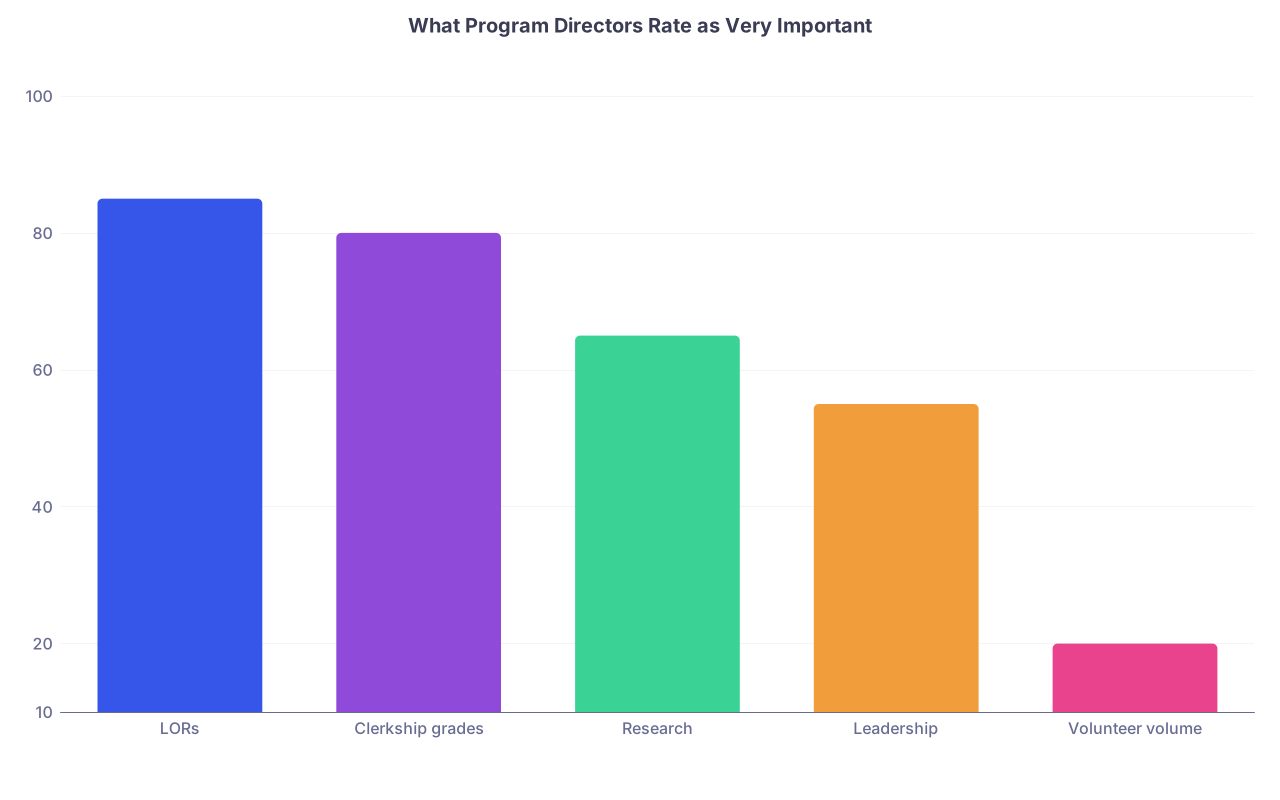
| Category | Value |
|---|---|
| LORs | 85 |
| Clerkship grades | 80 |
| Research | 65 |
| Leadership | 55 |
| Volunteer volume | 20 |
Those numbers are representative of what the surveys show cycle after cycle: quality of involvement, not raw quantity.
How Program Directors Actually Read Your CV
Let me be blunt: no one is reading your 300-hour soup kitchen entry line-by-line at 11:30 p.m. after their sixth application committee meeting of the week.
Here’s what really happens.
They skim in passes:
- Quick screen: where are you from, school, scores, obvious red flags.
- Pattern search:
- Do I see a coherent story pointing toward this specialty?
- Any sustained activities? 2+ years, clear progression?
- Any real output? Posters, papers, QI that actually finished?
- Highlight extraction: a few things to bring up in interview or justify ranking.
What they do not do:
Admire that you listed “pre-med club member” separately from “pre-med club event volunteer” and “pre-med club social chair substitute.”
When your CV is packed with shallow entries, it creates three problems:
- Signal dilution: The good stuff gets buried.
- Credibility erosion: 15 “projects in progress” with nothing completed reads as fluff.
- Cognitive fatigue: If it feels like work just to parse what you actually did, the reader mentally checks out.
In committee, no one says: “Applicant 1327 only has 7 extracurriculars instead of 18.”
They say: “This person did serious research over three years, led their free clinic, and has a strong letter describing both.”
That’s depth.
What the Data and Outcomes Actually Show
Let’s talk outcomes, not vibes.
When you look at matched vs unmatched applicants—especially in competitive specialties—two patterns stand out:
- Matched applicants do not necessarily have more items listed.
- They have more completed and impactful work.
I’ve watched this up close in competitive fields like dermatology, ortho, plastics, ENT.
Two real-world style profiles:
| Feature | Shallow CV Applicant | Deep CV Applicant |
|---|---|---|
| Research entries | 9 | 3 |
| Actual publications | 0 | 2 |
| Poster/oral presentations | 1 | 4 |
| Longitudinal activity | 1 | 4 |
| Leadership roles | 0 “in title only” | 2 with clear scope |
The second applicant almost always interviews better, matches better, and gets better letters. Why? Because:
- Their mentors actually know them (years together, not weeks).
- They saw projects through, which screams reliability.
- Their story is understandable and believable.
Everyone “does research” now. That’s table stakes. But seeing a project from idea → IRB → data → abstract → manuscript? That’s differentiating.
Why Fewer, Deeper Activities Win (Mechanistically, Not Just Philosophically)
Let’s make this concrete. Depth wins for several very practical reasons.
1. Deeper Activities Create Stronger Letters
The best letters are not “Applicant is hardworking and pleasant.” Those are useless.
The best letters sound like this:
“Over the last three years, I have worked with Alex on multiple projects, including a multi-center study where Alex independently coordinated data collection across three sites…”
You don’t get that from jumping between 10 labs for 2 months each.
You get that from:
- Staying in the same lab for multiple years
- Running a clinic role for your entire M3–M4
- Owning a project and dragging it across the finish line
Letters are weighted heavily in the NRMP surveys. Those letters require continuity, trust, and visibility. Which demands depth.
2. Depth Produces Visible Outputs
Residency applications love products:
- Posters
- Oral presentations
- PubMed-indexed papers
- Accepted QI projects with actual implementation
Those outcomes do not usually come from 6-week summer stints you abandon when the next shiny thing appears.
They come from exactly what the shallow-CV crowd avoids: long, often boring, unglamorous follow-through.
So two students:
- Student A: 7 research experiences, 0 outcomes, all “in progress”
- Student B: 2 research experiences, 1 paper, 3 posters
Every serious program director knows which is more compelling. And no, “submitted” and “in preparation” do not carry the same weight as accepted.
3. Depth Makes Your Narrative Coherent
Interviewers are pattern-recognition machines. They’re trying to decide: “Who is this person, and where are they going?”
If your CV looks like:
- One month in cardiology research
- Brief stint in global health
- Random health-tech start-up line
- Two unconnected volunteer things
- Occasional tutoring
- Some shadowing
- One half-finished QI project
…it says nothing except: “I panicked and grabbed anything that looked good on paper.”
If instead they see:
- 2.5 years in the same lab with stepped-up responsibility
- 3 years involved in the student-run clinic, eventually co-director
- Thread of activities all pointing toward underserved care / oncology / surgery / whatever your real angle is
They can build a narrative in their head. And that makes it easier to advocate for you in ranking.
4. Depth Is Easier to Talk About Under Pressure
You know what torpedoes interviews? Shallow engagement.
I’ve watched applicants freeze when asked basic follow-ups:
- “So what exactly was your role in this project?”
- “How did you handle conflicts in that leadership position?”
- “Walk me through the methods for this study.”
If you were in a project for three weeks and mostly updated an Excel sheet, you will feel that heat.
If you lived with that project for a year, you cannot run out of things to say.
Deep work gives you:
- Rich stories
- Specific examples of challenges and failures
- Authentic enthusiasm (because you actually know what you’re talking about)
How to Shift from “More Stuff” to “Better Stuff”
Let’s talk tactics. You’re not here just for theory.
Step 1: Ruthlessly Audit Your Current CV
Print it or open it and mark each activity with three letters:
- D – Deep: ≥1 year, clear increasing responsibility, tangible outcomes
- M – Medium: 6–12 months, some role but not central to your identity
- S – Shallow: brief, low responsibility, no real output
Your application should be built around the D’s and a few of the strongest M’s. The S items are filler. Many of them can simply be deleted or compressed.
If you have 20 activities and only 3 D’s, the problem is not that you need 10 more M’s. The problem is you need to go deeper on the things you already have and stop chasing more surface area.
Step 2: Consolidate and Compress Low-Impact Stuff
You do not need 6 separate entries for similar, low-impact roles.
Bad approach:
- “Student volunteer – free clinic (3 events)”
- “Community health fair volunteer”
- “Flu shot drive helper”
- “COVID PPE packing event”
- “Local outreach night volunteer”
Better approach:
- One consolidated entry: “Community health outreach volunteer, 2021–2024”
Then describe the most meaningful 1–2 roles or contributions.
This clears space so when someone scrolls, they actually see the big items that matter.
Step 3: Pick 2–4 Pillars and Double Down
Decide on your pillars. For most strong CVs, these are:
- Core clinical or specialty interest (e.g., EM, IM, surgery)
- Longitudinal patient-facing service (free clinic, mobile outreach, etc.)
- Scholarship (research, QI, educational projects)
- Leadership/teaching
You do not need all four maxed out, but you need 2–3 done well.
Then ask, for each pillar: “What would depth look like over the next 12 months?”
For example:
- Research depth: taking 1–2 projects from data collection all the way to presentation or publication, instead of starting 4 new ones.
- Clinic depth: moving from “volunteer” to “shift leader” to “clinic coordinator.”
- Teaching depth: building a recurring workshop series, not one random lecture.
Concrete Examples: Weak vs Strong Entries
Let’s compare how depth vs fluff looks in practice.
Weak (shallow, unimpressive):
“Research assistant, Cardiology lab (06/2023–08/2023). Helped with data collection for multiple projects. Attended lab meetings. In progress.”
Strong (deep, specific, credible):
“Clinical research fellow, Cardiology outcomes lab (07/2022–present). Led retrospective cohort study on readmission rates after PCI. Designed data abstraction protocol, trained 3 medical students, and coordinated with biostatistics. Presented findings as first author poster at ACC 2024; manuscript under revision for Circulation.”
Weak:
“Volunteer, Student-run clinic. Helped with intake and vitals.”
Strong:
“Clinic operations coordinator, Student-run clinic (08/2021–05/2024). Started as intake volunteer, then promoted to operations coordinator for Saturday clinics. Oversaw scheduling of 40+ volunteers monthly, implemented new triage workflow that reduced average patient wait time from 90 to 55 minutes, tracked with basic run charts as part of QI initiative.”
Same number of lines on the CV. Radically different impact.
When “More” Actually Hurts You
Here’s where the myth really backfires.
Inconsistency across documents
If your CV lists 18 major activities but your MSPE and letters barely mention any of them, that discrepancy breeds distrust.Red flag for poor priorities
Overloaded, scattered CVs scream: “I don’t know how to say no” and “I chase checkboxes rather than commit.” Not ideal for residency life.Obvious padding
Things like:- Listing one shadowing day as an “externship”
- Creating separate entries for “data collection,” “data cleaning,” and “data entry” for the same project
- Adding “self-study” of some textbook as an “independent project”
These tricks are transparent to anyone who has sat through more than one application cycle.
Interview self-sabotage
The more fluff you add, the higher the chance the interviewer latches onto something you barely did—and exposes it.
A Simple Rule for What Belongs on Your CV
Use this filter:
“If they asked me, ‘Tell me everything about this activity and what you actually did,’ could I talk confidently, with specific examples, for 3–5 minutes?”
If the honest answer is no, that activity should either:
- Be cut, or
- Be consolidated under a broader, more honest umbrella
This standard forces you toward depth automatically.
Visualizing the Tradeoff: Depth vs Breadth Over Time
Here’s how strong vs weak strategy often plays out across med school years:

| Step | Description |
|---|---|
| Step 1 | M1 Start |
| Step 2 | Shallow strategy - join many clubs |
| Step 3 | Deep strategy - pick a few pillars |
| Step 4 | M2 - scattered low impact roles |
| Step 5 | M2 - growing responsibility in few areas |
| Step 6 | M3 - scramble for outcomes |
| Step 7 | M3 - projects maturing to outputs |
| Step 8 | Application - long but weak CV |
| Step 9 | Application - concise but strong CV |
The “deep strategy” looks boring in the moment. Less novelty, more repetition. But when ERAS opens, it’s the one that actually works.
FAQ: The “More is Better” CV Myth, Answered
1. How many activities are “enough” for a residency CV?
There is no magic number, and anyone who gives you one is guessing. Most strong applicants end up with roughly 8–15 substantive activities. But the number matters far less than this question: “Can I clearly identify 3–5 deep, high-impact experiences that define my application?” If yes, you’re fine. If no, adding more shallow items won’t fix that.
2. Should I leave off short or minor experiences entirely?
Often, yes. If something was very brief (a weekend event, a 1–2 week stint) and doesn’t connect to your broader narrative or outcomes, it’s usually safe—and smart—to cut it or bury it in a consolidated entry. You’re curating, not confessing every move you’ve ever made.
3. What if I’m late and only have shallow activities now?
You cannot retroactively create depth, but you can be strategic right now. Pick 1–2 existing areas where you have at least some base involvement—research, clinic, teaching—and push hard for real outcomes over the next 6–12 months: a poster, a leadership role, a QI project that actually launches. Better to have a few “overachieving” M-level activities than 10 more S-level ones.
4. Does this advice still hold for very competitive specialties?
Even more so. In derm, ortho, plastics, ENT, what separates applicants with similar scores is completed scholarly work and clear, sustained specialty interest. People who scatter across 7 labs usually end up with less to show than the person who embedded deeply in one or two groups and actually published. Committees remember the applicant with three real outputs, not the one with fifteen “in progress” lines.
5. How do I explain a leaner, more focused CV if someone asks about quantity?
You say the quiet part out loud—in a professional way. For example: “I decided early on that I wanted to commit deeply to a few areas rather than spread myself too thin. That’s why I stayed with this clinic for three years and followed these two research projects all the way through to presentation and publication.” Most faculty will respect that. They live the consequences of residents who never learned to prioritize.
Two things to walk away with:
- A shorter CV with real depth, continuity, and outcomes will beat a bloated, padded CV almost every time.
- Your job now isn’t to do more. It’s to make what you already do actually matter.