You do not need a perfect CV to match a competitive residency. You need a coherent story and a few spikes that matter.
The obsession with the “perfect” CV is one of the most damaging myths in residency applications. I see students with solid profiles spiraling because they don’t have a first-author NEJM paper, a global health mission trip, and three leadership titles by MS2. Meanwhile, some of the residents actually sitting in ortho, derm, and plastics programs have crooked, messy, very human CVs.
Let’s pull this myth apart and look at what the data and real match outcomes actually show.
The “Perfect CV” Is a Fantasy Construct, Not a Real Selection Tool
The idea of a “perfect” CV usually sounds like this:
- 260+ Step 2
- AOA
- 8+ publications, with 1–2 first author
- Multiple leadership positions
- Global health or community service
- Teaching, tutoring, maybe an MPH or PhD for extra shine
I have seen applicants try to reverse-engineer this template like it’s a checklist for derm or neurosurgery. Here’s the problem: when you actually look at matched residents’ CVs across programs, they’re all over the place.
Let me ground this with some patterns that consistently show up in real applications I’ve seen evaluated:
- A matched ortho resident with a mid-230s Step 2, strong letters, and 3 focused ortho research projects—but no leadership and minimal community service.
- A matched derm resident with average research (2 posters, 1 low-impact paper) but a ridiculous letter from a well-known derm faculty who practically lit themselves on fire vouching for the student.
- A matched neurosurgery resident with zero publications but a year of full-time basic science research with a big-name PI and strong department advocacy.
Their CVs weren’t “perfect”. They were sharp. Focused. Defensible.
Program directors do not sit there with a Platonic ideal CV template and compare yours line by line. They ask a much simpler question: Does this applicant look like someone who will succeed in my program and in this specialty?
Perfection is irrelevant. Fit and signal density matter.
What Programs Actually Screen For (Not What Reddit Thinks)
Let’s look at what really drives interviews and ranking. Not myths—data and behavior.
We can roughly bucket programs’ behavior into three stages:
- Screening for red flags and minimums
- Looking for convincing specialty commitment and capability
- Using letters, reputation, and interviews to finalize rank
The CV mostly operates in stages 1 and 2. But it doesn’t work the way most students think.
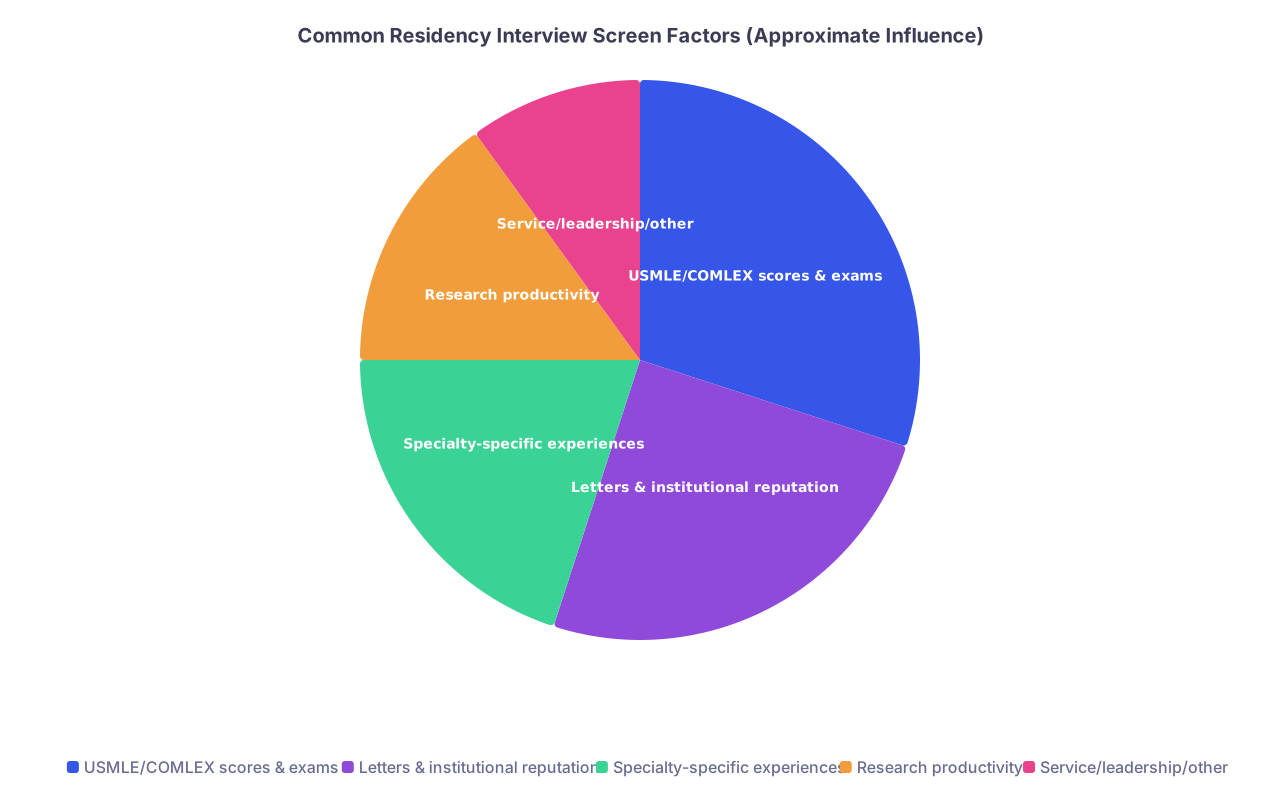
| Category | Value |
|---|---|
| USMLE/COMLEX scores & exams | 30 |
| Letters & institutional reputation | 25 |
| Specialty-specific experiences | 20 |
| Research productivity | 15 |
| Service/leadership/other | 10 |
Notice what’s not on there: “overall perfection” or “having everything.” Programs want enough evidence, not all evidence.
Here’s how this usually plays out.
1. Hard and Semi-hard Filters
Programs often start with crude filters:
- Step 2 above some threshold
- Passed all exams on first attempt
- No glaring professionalism issues
This is the brutal, boring part. Your CV won’t rescue you if you blow through red flags here. But if you clear this bar, the myth that “you need to be perfect to move on” is already broken. You just need to be good enough to avoid the trash pile.
2. Specialty Fit and Signal
Once you’re past crude filters, your CV’s job is simple: scream, “I am serious about this specialty and will function on day one.”
Programs look for:
- Specialty-aligned research or QI (not just any research)
- Relevant electives, sub-I’s, away rotations
- Evidence that faculty in that field trust you (which often shows up in letters, but your CV must make those letters believable)
They’re not looking for derivations of the same generic “leadership + research + volunteering” package. They’re checking whether your path leads logically to this field.
This is where a CV that’s narrow but deep beats a broad, perfectly balanced one.
3. Letters and Institutional Trust
Here’s a dirty little secret: your CV is often interpreted through the lens of where you trained and who you worked with.
If your CV says “3 projects in interventional cardiology,” and one of those attendings writes, “This is one of the top 5 students I’ve worked with in the last decade,” the projects suddenly matter more.
If your CV is objectively “perfect” but nobody goes to bat for you, it lands softer.
So no, you don’t need a perfect CV. You need one that sets up credible, strong letters and tells a coherent story that faculty can fight for.
Where the “Perfect CV” Myth Actually Hurts You
The perfection myth doesn’t just create anxiety. It pushes you into lousy strategic decisions.
I’ve watched students:
- Chase random research in 4 different specialties, ending up with 7 weak pubs/posters and no real identity.
- Accept meaningless leadership titles that eat time and add nothing to their narrative.
- Waste entire summers on box-checking volunteer work with no real impact or continuity.
Then they show me their CV and say, “Look, I covered everything.” And that’s exactly the problem. It looks like they were trying to cover everything.
Programs don’t reward that. They see it as scattered, desperate, or directionless.
Instead of chasing perfection, you should be chasing signal strength.
The CV That Actually Works: Spiky, Coherent, Defensible
Let me reframe this for you. Programs don’t want a perfect circle of excellence. They want spikes—areas where you’re clearly above average—in a story that makes sense.
Think of your CV in three pillars:
- Academic and clinical competence
- Specialty commitment and performance
- Professionalism and being pleasant to work with
You do not need to max all three. You need to avoid major weaknesses and show one or two compelling spikes.

Let’s make this concrete.
Example: The “Research-Heavy but Average Scores” Applicant (Competitive Specialty)
- Step 2: 238
- No AOA
- 1 year of dedicated research in the target field
- 2–3 first-author papers, 5+ posters, consistent work with one or two mentors
- 2 aways in the specialty with solid (not superstar) comments
Is this “perfect”? Absolutely not. Some programs won’t look twice because of the score. But quite a few competitive programs will interview this person because the signal in that field is undeniable. The CV screams: “Committed to this field, works hard, already part of the research ecosystem.”
Example: The “Strong Clinician, Light Research” Applicant (Still Competitive)
- Step 2: 252
- Honors in core rotations, especially in the target specialty and medicine/surgery
- Outstanding sub-I comments: “Functions at intern level,” “Top student this year”
- Minimal research: Maybe 1 poster, 1 low-impact paper
- Solid longitudinal volunteering (e.g., 3 years at a free clinic)
Research purists would call this “weak.” But a lot of clinical programs love this candidate. You walk in, you can carry patients, you’re not a professionalism risk, and you’re clearly serious about the specialty. That’s enough for many places, especially outside the absolute elite hyper-academic programs.
How to Actually Improve Your CV (Without Chasing Perfection)
Let’s get practical. You want to make your CV stronger for residency. The move is not “add more random stuff.” The move is tighten the narrative and deepen the meaningful parts.
Step 1: Decide What You Want Your CV to Say in One Sentence
Yes, one sentence. If a PD flipped through your CV for 20 seconds, what should come across?
Things like:
- “This person is clearly committed to ENT and already producing academic work in the field.”
- “This applicant is a strong clinician who will hit the ground running in internal medicine.”
- “This student is unusually mature, reliable, and great with patients.”
Pick your intended message. Then audit your CV. Does it support that sentence, or does it look like a grab bag?
If it looks scattered, you don’t need more content. You need to align existing and future experiences with that core message.
Step 2: Stop Padding. Start Consolidating.
Program directors are not impressed by:
- Six separate “short-term volunteer” entries with 5–10 hours each
- Leadership roles that are obviously title-only
- Ten similar poster presentations that all say basically the same thing
Clean it up.
Group short, related experiences into one entry with a narrative. Cut fluff that doesn’t add to your main story. If something doesn’t strengthen your central message, it’s just static.
Step 3: Deepen 2–3 Things Instead of Adding 10 More
You want your CV to have a few places where someone goes, “Huh, that’s actually substantial.”
That might be:
- A longitudinal clinic where you started as a volunteer and then became a coordinator.
- A research project you saw from conception to publication instead of hopping between 5 half-finished projects.
- Teaching that grew from tutoring one-on-one to organizing a formal review series for the class below you.
Programs aren’t tracking how many line items you have. They’re tracking: Can you commit? Can you see something through?

| Step | Description |
|---|---|
| Step 1 | Look at current CV |
| Step 2 | Deepen existing strengths |
| Step 3 | Choose target specialty now |
| Step 4 | Align new research and electives |
| Step 5 | Seek stronger letters in field |
| Step 6 | Refine and trim CV entries |
| Step 7 | Clear specialty story? |
The Competitive Specialty Trap: What the Data Actually Shows
Let’s talk about the fields that fuel this myth hardest: derm, ortho, neurosurgery, plastics, ENT, ophtho, rad onc.
You’ll hear people say: “For [insert specialty], you basically need a perfect CV.” False. You need to understand how that field weights its signals.
Here’s a rough reality check using representative patterns (not exact numbers, but this is how programs behave):
| Specialty | Scores Emphasis | Research Emphasis | Letters/Connections Emphasis |
|---|---|---|---|
| Dermatology | Very High | Very High | Very High |
| Ortho | High | Medium | Very High |
| Neurosurg | High | Very High | Very High |
| Plastics | High | High | Very High |
| ENT | High | Medium-High | Very High |
Notice something? “Very High” shows up in letters/connections across the board.
This is where the perfect CV myth collapses. You can’t “CV” your way out of weak institutional support. A 260 and 12 pubs from people who barely know you will lose to a 245 with 4 serious projects, an away rotation, and three phone calls from trusted faculty.
So how do you improve your odds without chasing perfection?
- Get plugged into one department early
- Become “their” student
- Produce a few meaningful outputs with them
- Get 1–2 senior people who will actually advocate for you
That matters more than checking every generic CV box.
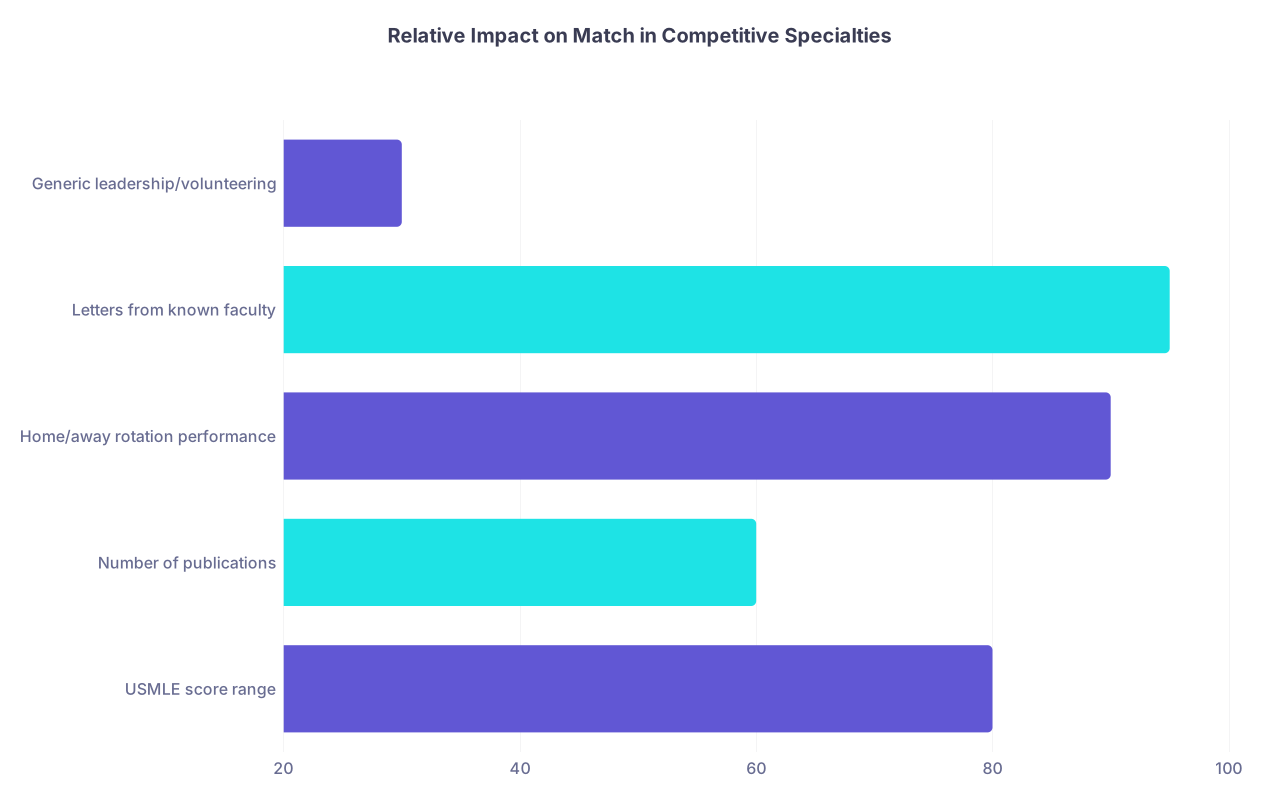
| Category | Value |
|---|---|
| USMLE score range | 80 |
| Number of publications | 60 |
| Home/away rotation performance | 90 |
| Letters from known faculty | 95 |
| Generic leadership/volunteering | 30 |
Those bottom numbers are where perfection-chasers waste time. They burn hours inflating “leadership” lines and collecting low-impact volunteer work while neglecting the things that actually move the needle.
How to Fix a “Flawed” CV Late in the Game
What if you’re an M4 or late M3 staring at a CV that feels off?
You can’t rewrite the past. But you can change the way it’s interpreted.
Here’s how you salvage:
Own your path in your personal statement and interviews.
If you switched specialties late, or your early research is scattered, explain the evolution clearly. Programs would rather see an honest, coherent arc than a fake airbrushed story.Concentrate the time you have left.
One strong sub-I with a glowing letter beats “joining 3 new research projects” that will never mature before ERAS.Get your current faculty to frame your CV for you.
A letter that says, “Yes, this student’s interest in [specialty] crystallized later, but in the last year they have…” can neutralize a ton of “imperfect” early choices.Don’t panic-add junk.
When I see a CV suddenly explode with “leadership” and “committee” roles 6 months before ERAS, it looks transparent and desperate. Better to show focused, rational improvement than chaotic box-checking.

The Real Test: Would a Reasonable PD Fight for You?
Strip away the noise and perfectionism. Ask yourself this instead:
If a program director liked you on interview day, and their committee was on the fence about ranking you high, does your CV give them ammunition to fight for you?
Things like:
- “They’ve been consistently involved in our field for two years.”
- “They worked hard in our sub-I and were universally praised by residents.”
- “Their research shows they can produce and finish work.”
- “Their volunteer work shows reliability and follow-through, not just a one-off trip.”
If the answer is yes to even one or two of those, your CV is already doing its job.
You don’t need perfect. You need enough—aligned with a clear story—to let someone vouch for you without feeling foolish.

The Bottom Line
Three things to walk away with:
- Programs don’t want perfect CVs. They want believable, coherent ones with a few strong spikes that match their specialty.
- Random, box-checking additions make your CV weaker, not stronger. Depth and continuity in 2–3 areas beat shallow breadth in 10.
- The real leverage isn’t perfection—it’s alignment: your CV, letters, and personal story all pointing to the same clear signal that you’re ready for this field and worth betting on.