
The romanticized idea that any study-abroad or “medical mission” trip makes your residency CV stronger is wrong.
Sometimes these experiences help you. Sometimes they’re neutral. And sometimes—especially the glossy, one-week “surgery in Guatemala” type trips—they actively hurt you in the eyes of serious programs.
Let’s separate feel-good marketing from how real program directors (PDs) and selection committees actually think.
The Harsh Truth: Most Study-Abroad and Mission Trips Are CV Filler
Here’s the part nobody selling you “global health opportunities” will say out loud: most U.S. residency program directors are drowning in applications. They do not have time—or patience—for vague, parachute-style global work that looks good on Instagram but thin on substance.
Talk to faculty who sit in rank meetings and you’ll hear versions of:
- “Another one-week mission trip where they list themselves as ‘assistant surgeon’… pass.”
- “They wrote three paragraphs about their time in Peru and not one line about what they actually did.”
- “I worry they’re drawn more to medical tourism than to real continuity of care.”
They’re not against global health. They’re against fluff. And they’ve seen enough of it to be skeptical by default.
So the real question isn’t: “Do study-abroad and mission trips help or hurt?”
The real question is: “Does this specific experience, the way you did it and the way you present it, help or hurt?”
Because the impact is not binary. It depends on:
- Duration
- Role and responsibility
- Supervision and ethics
- Output (skills, language, research, leadership)
- Relevance to your specialty and narrative
Let’s break that down.
What Actually Matters to Program Directors
You’re not being evaluated on how heartwarming your photos are. You’re being evaluated on value, maturity, and alignment with residency.
Here’s how global/study-abroad stuff usually gets filtered in PD brains:
| Type of Experience | Common PD Reaction |
|---|---|
| 1–2 week “mission trip” with vague role | Skeptical / often negative |
| 4–8 week structured elective with faculty | Neutral → mildly positive |
| 6–12 month funded/global health program | Strong positive |
| Preclinical summer “shadowing abroad” | Mostly neutral |
| Language-immersion with high fluency gain | Positive if clearly used |
If your experience lives in the top row—short, unstructured, vague role—you’re starting in the hole. You have to fight your way out with specifics and honesty, or not feature it prominently.
If you’re in the bottom rows—longer, structured, or skills-based—you’ve got something to work with.
Study-Abroad: When It Helps vs When It’s Just Vacation With Extra Steps
Let’s start with study-abroad, because it’s less likely to hurt you, but often wildly over-sold.
When Study-Abroad Helps Your Residency CV
Study-abroad helps when it clearly contributes to one or more of:
Language proficiency you actually use clinically
Example: A semester in Chile, living with a host family, coming back with near-fluent Spanish that you use daily on wards and can prove in an OSCE or interpreter-free patient interactions.Cultural competence you can link to patient care
Not the cliché “I learned that people are different,” but: “I learned to navigate health beliefs around chronic disease that helped me counsel Spanish-speaking patients with diabetes in clinic.”Academic or research output
Think: public health project, policy paper, co-authorship with local faculty, poster at CUGH or APHA.Long-term commitment to global or underserved work
You studied public health in Uganda → later volunteer at a free clinic → then matched into FM or IM with a strong underserved track. There’s a through-line.
What PDs like is coherence. The experience supports your story and your skills, not just your passport stamps.
When Study-Abroad Is CV Neutral
Most “I did a semester in Europe studying general biology” falls here. The committee sees:
- Different country
- Standard coursework
- Maybe some personal growth
They shrug and move on. It doesn’t hurt you, but it doesn’t explain why you should get the interview over someone else.
If it was not medically oriented, not language-intensive, and not connected to later behavior, don’t over-sell it. One line under “Additional” or “Interests” is plenty.
When Study-Abroad Can Quietly Backfire
Study-abroad can hurt when you:
Talk more about travel than about medicine or values
A PS paragraph that reads like a travel blog signals misaligned priorities.Over-claim relevance
“My semester in Florence transformed my understanding of global health” when you took art history and drank Aperol spritzes every weekend just screams performative.Use it to pad rather than to explain
If every answer in an interview somehow loops back to “when I was abroad,” it feels like you’re hiding a thin CV behind a single experience.
Use study-abroad like seasoning, not the main dish. Unless it truly is the main dish (long-term, intensive, skills-based), in which case give it the depth and detail to prove it.
Mission Trips: The Most Overrated and Dangerous CV Line
Now for the sacred cow: “medical mission trips.”
Residency selection committees are increasingly skeptical of these. In some fields—global health, ID, academic IM—there’s open disdain for short-term, unsupervised “service” trips that border on medical tourism.
Here’s why.
The Three Big Red Flags PDs See
Ethical and scope-of-practice concerns
If your CV or PS implies you were doing procedures or making independent clinical decisions you weren’t trained for, that’s a massive red flag.
Example of what makes PDs cringe: “Performed minor surgeries…” as an MS1 on a 10-day trip. You just told them you don’t understand ethics or scope.Saviorism vibe
If your narrative centers on how you came to “help” poor communities, but shows no understanding of local systems, continuity of care, or sustainability, many global health–savvy faculty will write you off.Zero longitudinal relationship
You show up, take photos with kids, do one week of “clinic,” then never interact with that community again. Programs committed to underserved care see that as the opposite of what they want.
Short, one-off mission trips are under heavy suspicion now. Not just ethically, but from a “does this predict being a good resident?” standpoint. The data suggests: not really.
What the Evidence and Surveys Actually Show
Let’s cut to the numbers where we have them.
NRMP Program Director Survey (various years) consistently ranks:
- USMLE/COMLEX scores
- Clerkship grades
- Class rank/AOA
- Letters of recommendation
- Specialty-specific experiences
…way above generic “volunteer/mission” work.
In many specialties, global health or mission experiences are explicitly listed as:
- “Considered” or “mildly important,” but almost never in the top 5 factors.
Studies in medical education journals on global electives show:
- Students report increased cultural awareness and sometimes self-efficacy.
- Objective performance gains are modest and very dependent on structure, duration, and supervision.
- Long-term career impact (actually practicing global health, primary care, underserved medicine) correlates most strongly with longer, structured, usually 6–12 month experiences, not 1–2 week trips.
So no, your spring break mission trip to Honduras is not a golden ticket. At best, it’s neutral. At worst, it raises questions.
To visualize this, here’s how different experiences realistically move the needle:
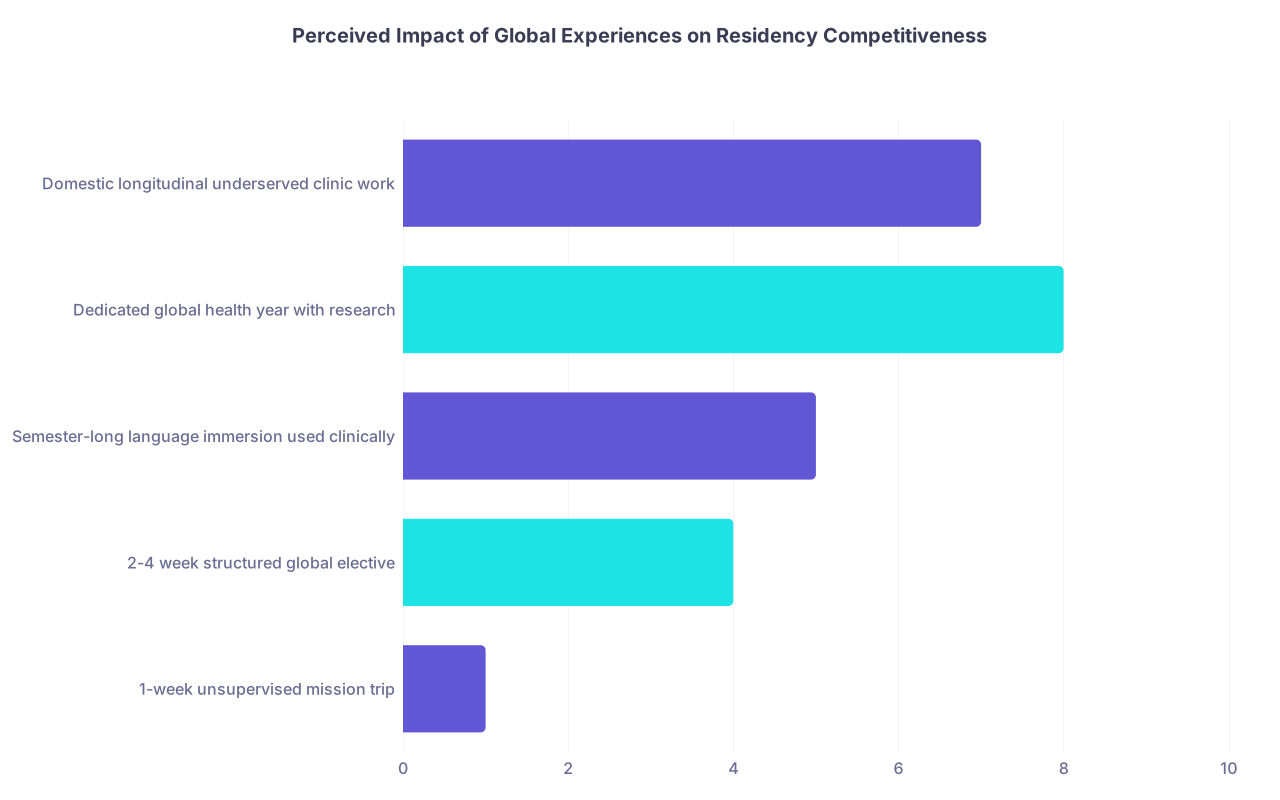
| Category | Value |
|---|---|
| 1-week unsupervised mission trip | 1 |
| 2-4 week structured global elective | 4 |
| Semester-long language immersion used clinically | 5 |
| Dedicated global health year with research | 8 |
| Domestic longitudinal underserved clinic work | 7 |
(Scale: 1 = almost no impact, 10 = strong positive impact on applications to relevant programs. This is approximate, but it tracks with how PDs talk behind closed doors.)
How to Tell If Your Experience Is Helping or Hurting
Use a simple stress test. If an honest version of your activity description makes you wince, you have a problem.
Ask yourself:
Duration and continuity
- Less than 2 weeks? You’re in “probably fluff” territory unless it’s part of a multi-year relationship or program.
- Repeated visits to the same site with growing responsibility and mentoring? Now we’re talking.
Role clarity Can you describe your role without exaggeration and still feel like it was worthwhile?
Compare:
- Bad: “Provided medical care to rural villagers.”
- Better: “Assisted with triage and history-taking under supervision in a rural primary care clinic; focused on blood pressure screening and medication adherence.”
Supervision
- Was there real attending-level oversight? Or were you and your classmates winging it with a local translator and zero formal evaluation?
Skills and outcomes Ask: What can I do now—concretely—that I couldn’t do before, that matters in residency?
Examples:
- Conduct a full H&P in Spanish without an interpreter.
- Design and implement a QI project in a limited-resource setting.
- Work effectively in a low-resource environment without cutting safety corners.
Alignment with your specialty
- Applying FM or IM with global/underserved focus? A structured global elective or longitudinal commitment helps.
- Applying Derm or Ortho with a single mission trip and nothing else clinically relevant? Looks more like a photo-op than a pattern.
If you can’t get through those questions without feeling the need to “dress it up,” that’s your warning sign.
How to Present These Experiences Without Shooting Yourself in the Foot
You don’t have to hide your global or study-abroad experiences. You just have to stop treating them like glitter and start treating them like any other clinical or academic entry.
Do This Instead of Grandstanding
Be precise and un-dramatic in your CV entries
Bad:
“Saved lives in resource-limited setting as part of mission to Nicaragua.”Better:
“Volunteered for 10 days in a rural clinic in Nicaragua; recorded vitals, assisted in triage, and provided patient education under supervision of local physicians.”Anchor to skills and insights, not to feel-good narratives
In your personal statement or interviews, skip the “I realized how privileged I am” monologue. They’ve heard it a hundred times.
Say something like:
“Working in X setting forced me to learn how to prioritize problems quickly, communicate across language and cultural barriers, and accept constraints without cutting corners. I’ve used those same skills on night float when… [specific example].”Show continuity and humility
If you went abroad, then came home and kept working with similar populations locally (free clinics, FQHC, refugee health), highlight that. It proves this wasn’t a one-off ego trip.
Don’t let it dominate your story
Unless you did a dedicated global health year or a formal degree, your one or two short trips should not be the spine of your personal narrative. They’re supporting characters at best.
When a Global or Mission Experience Can Be a Real Asset
There are scenarios where this stuff legitimately sets you apart.
You completed a funded global health fellowship year with research, teaching, and ongoing collaboration with an academic partner abroad. You’re applying in IM, Peds, EM, or FM and want an academic/global track. That’s gold—if backed by outputs (posters, QI projects, presentations, mentoring).
You became functionally fluent in a high-need language (Spanish, Mandarin, Arabic, etc.) through immersion abroad and can now conduct independent patient encounters that your peers cannot. And you have faculty who can attest to that.
You helped design or evaluate a sustainable program (e.g., hypertension registry, vaccination campaign, EMR implementation) and can speak to process improvement and outcomes like an adult, not a tourist.
These are not typical “mission trip” outcomes. They require time, structure, and actual work.

If You Have a Weak or Cringe-Worthy Mission Trip on Your CV
Plenty of people do. You went as an MS1, you didn’t know any better, now you realize it was sketchy. What do you do?
- Keep it small and factual on the CV. No hero language, no inflated role.
- Don’t use it as a centerpiece in your personal statement.
- If asked, be honest and reflective:
“Looking back, I have mixed feelings about that trip. It exposed me to resource limitations, but I’ve since learned a lot about the ethics of short-term work. That’s why I shifted toward working in our local free clinic where I could build continuity with patients.”
That answer shows growth. Many faculty will actually respect that more than uncritical enthusiasm.
How to Actually Improve Your CV (If You Care About Underserved or Global Health)
Let’s be blunt. If your real goal is to help your residency chances and do meaningful work, you’re usually better off with:
- A longitudinal role in a domestic underserved clinic (2+ years, progressive responsibility)
- A well-mentored research or QI project on health disparities or global health systems
- Strong letters from people who saw you work in tough clinical environments—abroad or at home
- A formal track, certificate, or MPH with real output, if you’re genuinely invested
Study-abroad and mission trips can be part of that ecosystem. They just can’t replace the hard, unglamorous, long-term work.
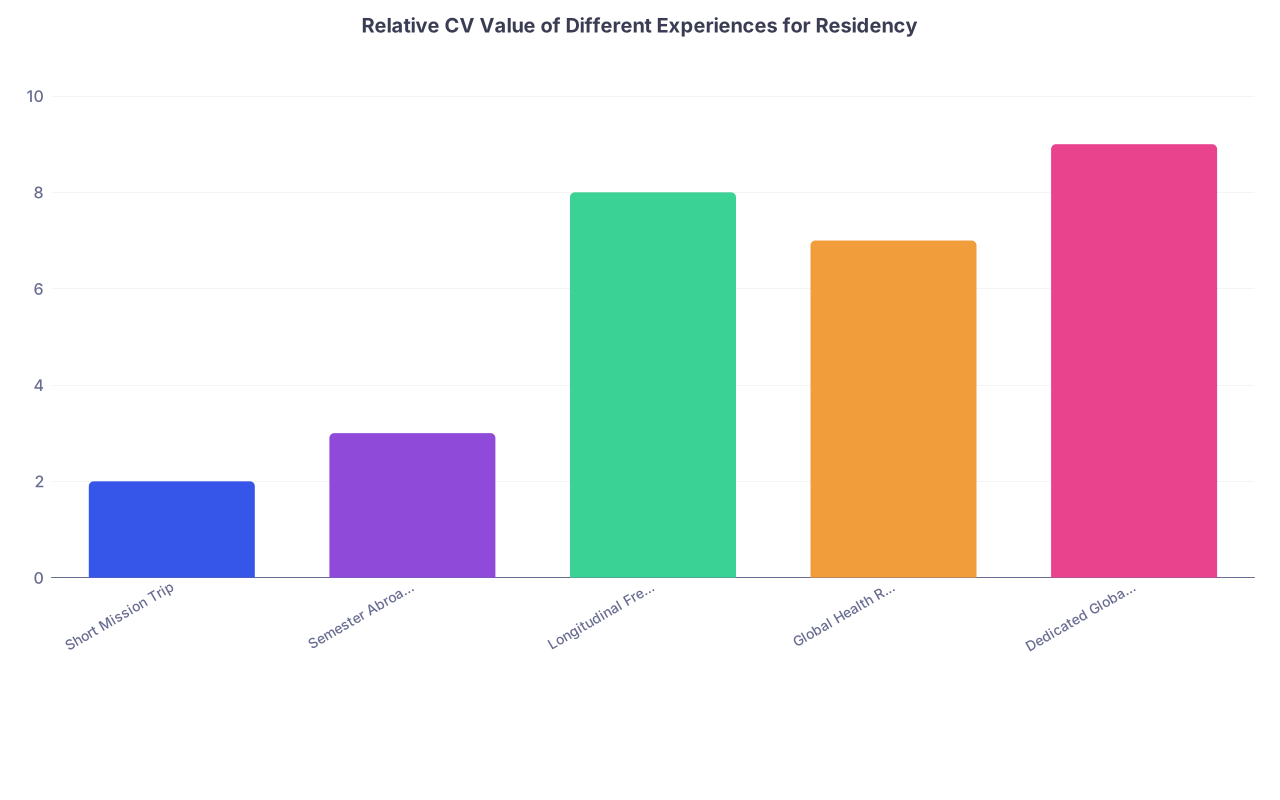
| Category | Value |
|---|---|
| Short Mission Trip | 2 |
| Semester Abroad (non-clinical) | 3 |
| Longitudinal Free Clinic | 8 |
| Global Health Research | 7 |
| Dedicated Global Health Year | 9 |
If you’re deciding where to put your energy, put it where the 7s, 8s, and 9s live—not where the marketing brochures live.
The Bottom Line
Most short, one-off mission trips and generic study-abroad experiences are CV-neutral at best and can be negative if they scream “scope creep” or saviorism. Stop pretending they’re magic.
The global and abroad experiences that actually help your residency application are long, structured, supervised, and clearly tied to skills, outputs, and a coherent narrative that matches your specialty.
If you already did a weak or ethically questionable trip, do not double down with grandiose language. Be precise, humble, and show growth—and spend your remaining time in medical school building real, longitudinal, locally grounded experiences that carry actual weight.