
The obsession with “President,” “Founder,” and “Chair” on residency CVs is wildly overblown.
Program directors do not care about your title nearly as much as you think. They care what you did, what you learned, and whether any of it predicts that you will be a reliable, teachable resident who will not implode at 2 a.m. on call.
Let me be blunt: a CV full of hollow titles and shallow impact is worse than a modest CV with clear, sustained contribution.
You’ve been fed a bad narrative: that without “big leadership” you are dead in the water. The data and the people actually reading your application disagree.
What Programs Actually Look For (Not What Reddit Says)
Most applicants build their CV around what other applicants flex about, not what programs value.
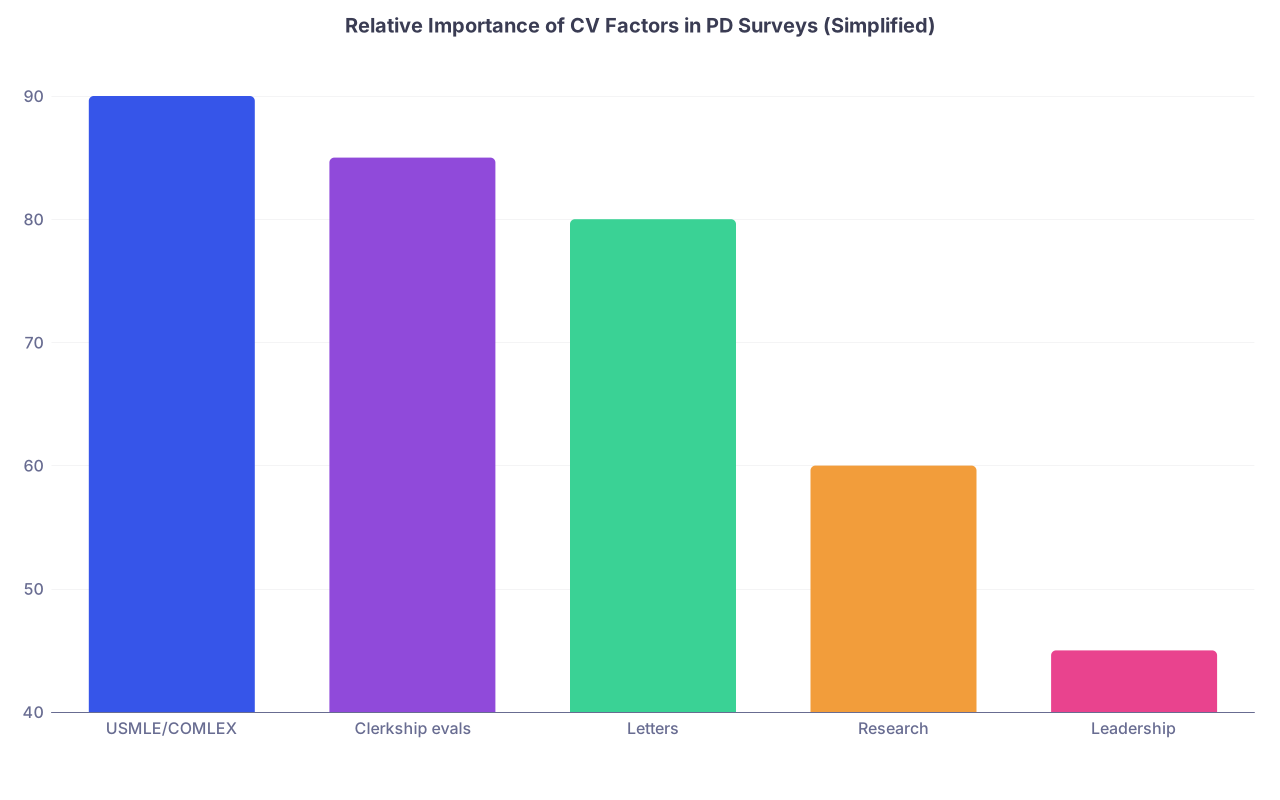
Here’s what the NRMP Program Director Survey actually shows when they rank selection factors for interviews and ranking: Step scores (or pass), clerkship grades, letters of recommendation, MSPE, and interview performance sit at the top. “Leadership” is there, but not as a primary driver. It is a plus, not a gatekeeper.
Leadership is often lumped into broader categories like “commitment to specialty,” “professionalism,” and “personal characteristics.” Translating: they do not care that you were “Vice President of Social Affairs.” They care if you can:
- Take responsibility without drama
- Work in a team without being a liability
- Follow through on tasks over time
- Show initiative when things are ambiguous
You can demonstrate all of that without a single fancy title.
| Category | Value |
|---|---|
| USMLE/COMLEX | 90 |
| Clerkship evals | 85 |
| Letters | 80 |
| Research | 60 |
| Leadership | 45 |
That chart isn’t exact NRMP numbers, but it reflects the reality: leadership is in the middle of the pack. Helpful, not decisive. Anyone telling you “you must have X leadership title or you won’t match” is either misinformed or trying to sell you something.
The Big-Title Trap: Why Chasing Positions Backfires
I have watched this play out in real time:
- M2 applies for five orgs, grabs Treasurer, VP, and “Co-Founder” of a tutoring group that already existed under a different name.
- Shows up to half the meetings, delegates everything, does almost no actual work.
- Then spends 4 lines on the CV making it sound like they ran a nonprofit.
Here’s the problem. Program directors are not stupid. They’ve seen hundreds of nearly identical “President of X,” “Founder of Y,” “Director of Z” entries that all read like the same template. After a while, most of it turns into noise.
You know what cuts through the noise? Specific, believable impact. That’s where the myth collapses.
The “Big Leadership” trap causes three predictable issues:
Overinflated titles, underwhelming substance
“Founder & CEO” of a tutoring program that tutored 3 classmates for 2 weeks before Step 1. That screams insecurity more than leadership.Shallow involvement across too many things
Twelve organizations, four leadership positions, all for 3–6 months, no clear outcomes. That raises questions about reliability and honesty.Time drain with no strategic value
Students sinking hours into elections and titles they do not care about. Then scrambling later to fabricate “impact” because they never did the real work.
Program directors don’t reward this. If anything, it undermines your credibility when your interview answers don’t match the grandiose titles.
The Real Currency: Role × Impact × Consistency
Leadership on a residency CV isn’t about hierarchy. It is about function.
Ask any attending what leadership looks like in residency. It is not “Chief Resident” for most people. It is: the intern who quietly organizes sign-out so nobody gets blindsided, the resident who takes ownership of the QI project, the person who keeps the team from melting down when census spikes.
You can signal that you’re that person even if your official title was “member” or “volunteer.”
Think of every entry on your CV through three lenses:
- Role – What were you actually responsible for?
- Impact – What tangible change or output came from your involvement?
- Consistency – How long, how reliably, how often?
A plain-sounding role with strong substance beats an impressive title with vague fluff.

Let’s compare.
“President, Internal Medicine Interest Group”
– Led meetings. Organized events. Coordinated with faculty.vs.
“Member, Student-Run Free Clinic”
– Managed medication refills for a panel of 120 patients by building a simple tracking spreadsheet; cut refill errors by 30% over 6 months.
Who looks more like someone I want handling my service list? The second one. Every time.
Put differently: leadership is behavior, not title. Residency selection committees know this because they see residents lead from non-titled positions constantly.
How to Turn “Normal” Experiences into Leadership Signals
You probably already have more “leadership” on your CV than you think — you just labeled it as “volunteer” or “member” and then wrote one useless bullet: “Participated in X.”
That’s on you, not on your experiences.
Here’s how you fix it.
1. Extract the leadership behaviors
Go back through your experiences and ask:
- Did I initiate anything new?
- Did I improve a process?
- Did people rely on me for something consistently?
- Did I teach, mentor, coordinate, or organize others?
If yes, that’s leadership. You don’t need to change the title. You need to change the description.
Bad:
“Volunteer, Community Health Fair – Helped with blood pressure screenings.”
Better:
“Volunteer, Community Health Fair – Standardized blood pressure documentation by creating a shared recording sheet; reduced missing data from prior 25% to under 5% across three events.”
One tells me you showed up. The other tells me you led from wherever you stood.
2. Use numbers and outcomes, not adjectives
Everyone writes “organized,” “coordinated,” “led,” “collaborated.” Those words are wallpaper now. Replace them with specifics:
- How many people?
- How often?
- What changed?
- Who benefited?
If you do not have numbers, estimate conservatively and be ready to defend them. “Approximately 20 volunteers per event,” “Panel of ~80 patients,” “Monthly workshops for 10–15 students.”
3. Connect your work to residency-relevant skills
Program directors are screening for: follow-through, communication, systems thinking, teaching potential, QI mindset.
That tutoring job you shrugged at? That is literally “resident teaching intern,” just lower-stakes.
Instead of:
“Peer Tutor – Tutored preclinical students in physiology.”
Write:
“Peer Tutor – Provided 1:1 and small-group physiology tutoring for six M1 students; developed custom review sheets and tracked performance across quizzes, with all tutees improving at least one letter grade.”
Now you look like a future senior resident who can coach interns through overnight cross-cover.
Examples: Weak vs Strong CV Entries (With and Without Titles)
Let’s put this side by side.
| CV Entry Type | Weak Version | Strong Version |
|---|---|---|
| Big title | President, Surgery Club – Led meetings | President, Surgery Club – Secured 5 new faculty speakers and launched 3-skill suture series, increasing average meeting attendance from 12 to 35 students over one year |
| No title | Volunteer, Free Clinic – Took vitals | Volunteer, Free Clinic – Managed pre-visit intake workflow for 10–15 patients per shift, cutting average wait time from ~45 to ~25 minutes by redesigning patient flow with attending oversight |
| Teaching | Peer tutor – Helped with exams | Peer Tutor – Met weekly with 4 struggling students in pharmacology for 8 weeks; all passed the course after prior failures on midterm assessments |
| Research | Research Assistant – Worked on data | Research Assistant – Independently maintained REDCap database for 180-patient chart review; identified data inconsistencies that improved final dataset quality before analysis |
| Committee | Member, Curriculum Committee – Attended meetings | Student Representative, Curriculum Committee – Proposed adjustment to exam scheduling adopted for M2 cohort, reducing overlapping high-stakes exams during OSCE week |
Notice the pattern. The strong versions could work even if you deleted the titles entirely. The story stands on its own.
That is what you should be aiming for.
How Much “Leadership” Do You Actually Need?
Not as much as people tell you. You do not need five positions. You don’t even need one “big” one in many fields, especially if the rest of your application is solid.
What you need is:
- A few experiences (2–4) that clearly show responsibility, initiative, and follow-through.
- Descriptions that show impact and consistency rather than just participation.
- At least one example relevant to your specialty or to teaching/mentoring.
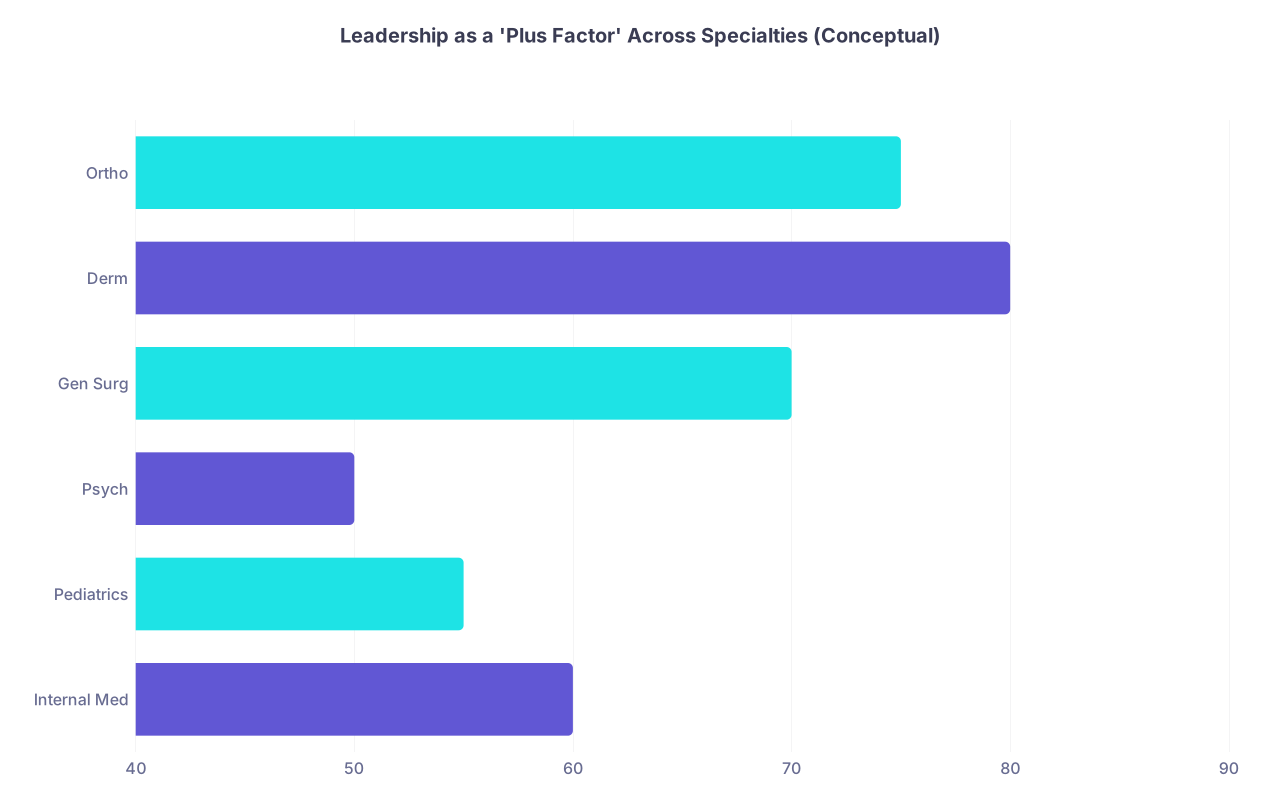
For competitive specialties, yes, things are tighter. But those programs still prefer real impact over inflated titles. A neurosurgery program will be more impressed by a 2-year QI project with clear metrics and a poster than by three meaningless “co-director” roles where nothing concrete happened.
| Category | Value |
|---|---|
| Internal Med | 60 |
| Pediatrics | 55 |
| Psych | 50 |
| Gen Surg | 70 |
| Derm | 80 |
| Ortho | 75 |
Again, that’s conceptual, not literal survey data. But the picture is right: as competitiveness rises, leadership can help more — but only if it’s credible. Fake or inflated leadership does not rescue a shaky application.
If You Still Want a Title, Do It Right
I’m not saying never hold a formal leadership role. I’m saying stop chasing them like they’re lottery tickets.
If you are going to take a title:
- Commit for at least a year if possible.
- Pick something aligned with your real interests or your target specialty.
- Decide on 2–3 concrete outcomes you want by the end of your term (attendance, new program, measurable change).
- Document those outcomes as you go so your CV description writes itself later.
Then your title is just the header. The bullet points are the evidence.
If your “leadership” is just showing up to a meeting once a month and forwarding emails? That is not leadership. It is admin. Do not expect it to move the needle.
Common Misconceptions to Stop Believing
Let’s kill a few persistent myths directly.
“If I don’t have a President/Founder role, I’m doomed.”
No. I have seen very strong matches into competitive specialties with zero major titles but stellar research, strong letters, and clear evidence of responsibility in clinical and volunteer roles.
“I should start my own club so I can put Founder on my CV.”
Usually a waste of time, unless you are solving a real, sustained problem and building something that survives after you leave. Programs can smell “CV project that died immediately” a mile away.
“More leadership is always better.”
No. Past a certain point, additional titles add nothing and raise concerns about depth and time management. Two real things > six fake things.
“Any leadership is better than none, even if it’s minor.”
Only if you can show something meaningful you did. A padded CV with fluff roles looks worse than a clean CV with a few well-developed activities.
“Program directors love buzzwords like ‘CEO,’ ‘co-founder,’ and ‘director.’”
They mostly roll their eyes at those unless the work backing them up is very, very clear.
How to Audit and Upgrade Your CV Tonight
You can improve your residency CV’s “leadership signal” dramatically in a single evening, without adding a single new position.
Go through every experience and:
- Delete or shorten anything that’s pure fluff (“attended meetings,” “helped with events”).
- Rewrite bullets to highlight responsibility, decisions you made, problems you solved, or systems you improved.
- Add rough numbers where you can: volumes, durations, frequencies, outcomes.
- Make sure at least a couple of entries clearly show: teaching/mentoring, QI/system change, or sustained patient-facing responsibility.
You’ll come out looking like a much stronger leader. No new titles required.