How much does that consulting job, coding bootcamp, or “gap year doing startups” actually matter to residency program directors—or is it just you trying to make a narrative out of needing to pay rent?
Let’s tear this apart properly. Because there’s a lot of nonsense floating around.
You’ve probably heard both extremes:
- “PDs don’t care about anything non-clinical. It’s all scores and clerkship grades.”
- “Your unique non-medical background is what will set you apart. It’s your edge.”
Both are wrong. And dangerously so if you’re planning your CV around them.
Here’s what the data and real-world behavior actually say.
What PDs Actually Say vs What They Actually Do
There are two sources of truth in residency selection:
- What program directors claim in surveys.
- What they actually do when staring at 800 ERAS applications at 11 p.m.
Those are not always the same thing.
The NRMP’s “Program Director Survey” (the one everyone quotes without reading) consistently ranks these near the top for interview offers:
- USMLE/COMLEX scores
- Clerkship grades
- MSPE/Dean’s letter
- Class rank/medical school performance
- Letters of recommendation
“Volunteer/extracurricular experiences” and “other life experience” come in below all of those but still show up in the “things we look at” list. Which tells you something critical:
Non-medical work is rarely a gate-opener. It’s a tie-breaker and a narrative builder—once you’re already in the ballpark.
So no, your year as a data analyst is not going to magically rescue a 205 Step 1 and mediocre clerkship comments. But yes, it absolutely can move you from “generic applicant #127” to “the candidate with real leadership and system experience” when your scores are already acceptable.
PDs are human. They remember interesting, coherent stories that fit what their program needs. They do not remember “multiple non-clinical experiences spanning diverse domains” no matter how nicely ERAS formats it.
The Biggest Myth: “Non-Medical Work Either Helps Immensely or Hurts You”
I’ve heard all variations of this in advising meetings:
- “Won’t a gap year in industry make me look less committed?”
- “If I don’t have cool startups or tech jobs, I’m screwed.”
- “PDs only care about research or clinical stuff.”
All nonsense.
Non-medical work tends to fall into three buckets in PD minds:
Signal of maturity and real-world functioning
You held a job, showed up, got paid, didn’t get fired, maybe managed other people, maybe handled real responsibility. Residency is a job. Programs like applicants who’ve…had a job.Evidence of a specific skill set
Coding, analytics, finance, teaching, project management, operations, leadership. The more obviously this translates to residency or medicine, the more they care.Potential red flag
This is the part people ignore. Some non-medical experiences do hurt you—usually not because they’re non-medical, but because of how they’re framed or what they suggest about your judgment.
Let me translate this into how PDs often think—even if they won’t say it out loud.
| Type of Experience | Typical PD Reaction |
|---|---|
| Full-time pre-med job | Mature, understands work, reliable |
| Tech / coding / IT | Useful skills, data, QI, EMR projects |
| Teaching / tutoring | Good for academic, education-heavy programs |
| Leadership / management | Possible chief resident material |
| Serial short-term gigs | Instability? Commitment issues? |
| MLM / vague entrepreneurship | Questionable judgment / fluff |
None of this is about “is it medical or not.” It’s about: does this help me trust you as a resident and potentially as a long-term colleague?
Where Non-Medical Work Matters a Lot (And Where It Barely Registers)
Non-medical work is massively over-sold for some specialties and under-valued for others. Here’s where it actually moves the needle.
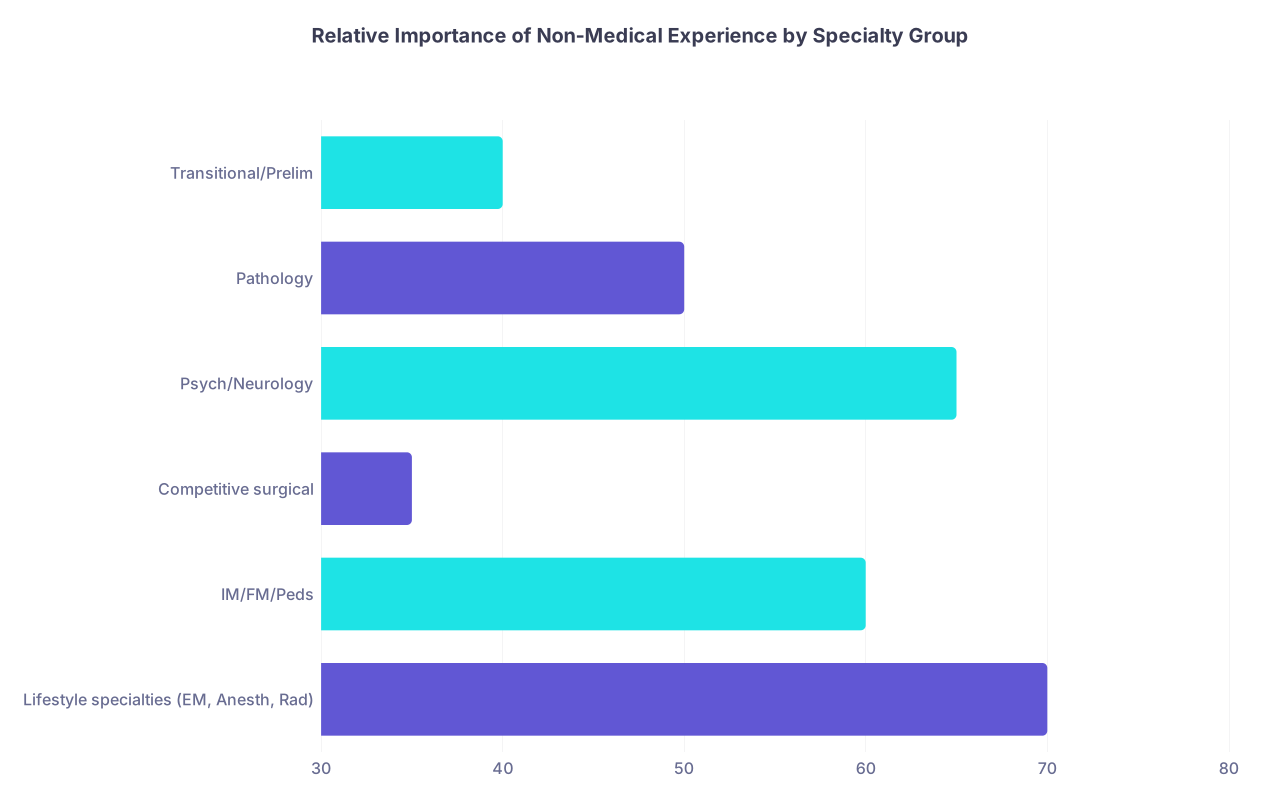
| Category | Value |
|---|---|
| Lifestyle specialties (EM, Anesth, Rad) | 70 |
| IM/FM/Peds | 60 |
| Competitive surgical | 35 |
| Psych/Neurology | 65 |
| Pathology | 50 |
| Transitional/Prelim | 40 |
(Scale: 0 = almost irrelevant, 100 = huge tie-breaker role once metrics are acceptable.)
Primary care and broad specialties (IM, FM, Peds)
These programs deal with communication, systems, messy social situations, burnout, and real-world practical problems.
- Former teachers? They see “education, patient communication, possibly good with students.”
- Management/operations background? “Maybe this person will help us fix our clinic flow or QI.”
- Military, EMS, significant customer-facing jobs? “This person has actually been yelled at by angry humans before. Good.”
Non-medical work doesn’t override bad performance, but it often pushes you higher on the rank list once you’re in the mix.
Psych, neurology, PM&R
Psych PDs in particular care a lot about maturity, insight, and life experience. Non-medical work that suggests you’ve actually lived among non-medical humans and survived real stressors does help.
Neurology and PM&R PDs frequently perk up at engineering, rehab, sports, or human-performance-related backgrounds. You look like someone who gets systems, not just pathophysiology.
Competitive surgical fields (ortho, ENT, plastics, neurosurg)
Let me be blunt: here, non-medical work is mostly background texture. They won’t care much unless:
- It is seriously impressive (e.g., you were a mechanical engineer at SpaceX designing hardware, not “intern at a startup”).
- Or it ties directly into what they do (e.g., biomechanics, device design, serious military special ops background).
Even then, if you do not have:
- Top scores
- Strong rotations
- Big-name letters
- Often, research
…your fascinating non-medical past will not rescue you. It makes a “yes” more satisfying, but it rarely turns a “no” into “yes.”
EM, anesthesiology, radiology
More middle ground.
EM: EMS, military, firefighting, high-intensity roles—these get real attention. A PD will absolutely remember “the former paramedic” or “the Army medic with deployments” if you’re competitive on paper.
Anesthesia: Engineering, physics, device-heavy work, or serious systems/OR management experience can be a real plus. They like people who think technically and handle high-stakes detail work.
Radiology: Coding, image analysis, data science, AI/ML, informatics—these are not fluff here. They fit.
The Hard Truth: PDs Don’t Care About the Experience—They Care About What You Did With It
This is where most applicants screw it up.
They treat non-medical work like a label. “Tutor.” “Research assistant.” “Consultant.” “Data analyst.” They dump it into ERAS like a census category and hope the title carries the day.
That’s not how this works.
If you want PDs to actually care, you have to make three things unmissably clear:
- Scope – Did you show up and passively exist, or did you own something?
- Responsibility – Were there consequences attached to your decisions?
- Outcome – Did anything improve because you were there?
“Barista for 3 years while in school” can sound trivial—or it can say: I consistently worked 25+ hours weekly, managed money and time, dealt with difficult customers, trained new staff, and was promoted to shift lead. Which version do you think a PD respects more?
Same job. Different framing. Different read on your maturity.
When Non-Medical Work Actually Hurts You
Here’s the part people conveniently ignore because it’s uncomfortable.
Non-medical experiences can look bad. Not because they’re non-medical, but because they reveal patterns PDs dread.
I’ve seen PDs react badly to:
- A chain of short-term “cool” roles all under 6–9 months with no clear reason. It reads as flaky, restless, and non-committal. Residency is the opposite of that.
- Vague “entrepreneurship” or MLM stuff with grandiose language and no substance. “Founded a lifestyle brand focused on wellness and empowerment” = what did you actually do? Often the answer is “not much besides Instagram.”
- Huge, badly explained gaps that you awkwardly try to plaster over with generic fluff. They don’t care that you left medicine for a year. They care that you cannot clearly explain why and what changed.
The red flag is almost never “worked outside of medicine.” It’s “this person either cannot hold a steady role, or cannot describe reality without inflating it.”
PDs are pretty good at smelling insecurity and spin. They see hundreds of applications a year. They can tell the difference between someone who actually ran projects and someone who copy-pasted corporate buzzwords.
How to Present Non-Medical Work So PDs Actually Respect It
Three principles. If you ignore these, don’t blame “PD bias” when your experience falls flat.
1. Translate it into residency language
Residency runs on some very boring, very real skills:
- Reliability
- Time management under high load
- Communication under stress
- Team functioning
- Owning tasks from start to finish
Any non-medical job that shows those off is relevant.
You don’t write:
“Collaborated cross-functionally to drive synergies and optimize workflows.”
You write:
“Led a team of 4 tutors, created a standardized curriculum, and cut student no-show rates by 30% over one semester.”
One sounds like an MBA case study. The other sounds like someone who can run a QI project or teaching session without dropping the ball.
2. Give numbers or concrete outcomes
Vague = ignored. Specific = respected.
- “Managed inventory for the store” vs “Managed weekly inventory for a store doing ~$40k/week in sales; reduced expired stock by ~20% over 6 months.”
- “Helped improve clinic flow” vs “Mapped our patient intake process and helped redesign check-in, decreasing average wait time from ~50 minutes to ~30 minutes over 3 months.”
You’re not writing a grant. Just show that something measurable changed.
3. Align it with why you’ll be a better resident, not why you’re “unique”
PDs are not admission committees for a liberal arts college. They care less about your “unique background” and more about: will this person handle nights, admit 10 patients safely, follow up tasks, not melt down under pressure, and get along with the team?
Your framing should constantly point there.
You’re not saying:
“My time in consulting makes me a uniquely diverse applicant with broad perspectives.”
You’re saying:
“Consulting forced me to own deadlines, give clear presentations to skeptical clients, and deal with direct criticism. That’s directly shaped how I accept feedback on rotations and how I’ll function as an intern.”
One is brochure-speak. The other is reality.
The Interview: Where Non-Medical Work Really Pays Off
The biggest impact of solid non-medical work is not in ERAS sorting. It’s once you’re in the room.
Here’s the flow PDs and faculty follow more often than not:

| Step | Description |
|---|---|
| Step 1 | Screen Applications |
| Step 2 | Reject |
| Step 3 | Look at Experiences |
| Step 4 | Generic but Acceptable |
| Step 5 | Memorable Narrative |
| Step 6 | Maybe Interview |
| Step 7 | More Likely to Interview |
| Step 8 | Interview Discussion |
| Step 9 | Rank List Boost if Consistent |
| Step 10 | Scores and Performance OK |
| Step 11 | Any Standout Experiences |
On interview day, non-medical work gives them:
- Easy hooks for questions.
- A reason to remember you among 40 similar Step score ranges.
- A way to judge your self-awareness and honesty when you talk about failure, growth, and stress.
You want them walking away saying:
“Yeah, that’s the former teacher who ran a whole classroom for 3 years, no wonder she seemed so comfortable with patients and students.”
Not: “Wait, what exactly did he do for three years before med school? I still don’t get it.”
Quick Reality Check: How Much Time You Should Invest in Non-Medical Work Now
If you’re already in med school or approaching application season and you’re asking, “Should I start a company / pick up a consulting internship / do a coding bootcamp to help my CV?”
No. Stop chasing brand-new “non-medical” things as a gimmick.
Your priorities, in brutally honest order:
- Do not tank your grades or Step/COMLEX scores. Nothing non-medical compensates for that.
- Do not sacrifice quality of core clinical evaluations and relationships with faculty.
- If you already have non-medical background, mine it properly. Frame it well.
- If you want to add something, make it:
- Sustainable with your schedule
- Genuinely interesting to you
- Something you can grow in for at least a year, not 3 months of resume theater
New non-medical activities can absolutely help—but only if they’re real, consistent, and you can talk about them without sounding like you’re auditioning for LinkedIn’s “Most Inspirational Post” contest.
The Bottom Line: Myth vs Reality
Let me strip this down.
Non-medical work is neither magic nor poison. It will not rescue bad metrics, and it will not destroy you unless it reveals instability or poor judgment. It’s a secondary but real factor once you’ve cleared the academic bar.
PDs care more about how you worked than where you worked. Scope, responsibility, outcomes, and the way you talk about it matter far more than the brand name of the company or the buzziness of the role.
Used well, non-medical experience is a tie-breaker and a narrative anchor. It helps them remember you, trust you as a future colleague, and justify putting you a few spots higher on the rank list when you are already competitive on paper.
You don’t need to manufacture a quirky “unique background.” You need to show that whatever you’ve done—medicine or not—you did it like someone they’d actually want on call with them at 3 a.m.