
Is your residency application dead on arrival if you do not have research on your CV?
Let me be blunt: if you listen to Reddit, your school’s “gunner” group chat, or that one classmate who did a summer at Mass General and now speaks like a program director, you’d think “no research = no match.”
That’s not what the data shows.
And it’s not how most programs actually read CVs.
Let’s dismantle this.
What Programs Actually Care About (According to Data, Not Lore)
First, stop guessing what matters. NRMP literally publishes rank-order data from program directors.
Look at the 2022 NRMP Program Director Survey. Here’s a stripped-down snapshot of what percentage of PDs in categorical Internal Medicine rated each factor as “Very Important” when deciding to invite interviews:
| Factor | % Very Important |
|---|---|
| Step 2 CK score | 76% |
| Clerkship grades | 69% |
| MSPE/Dean’s Letter | 63% |
| Letters of recommendation | 61% |
| Personal statement | 46% |
| Class ranking/quartile | 40% |
| Research experience | 21% |
Twenty-one percent. Not 90%. Not “everyone.”
For IM, research is a factor for a minority of programs, not the primary gatekeeper.
Surgery, derm, rad onc, neurosurgery? Different story. Some highly academic programs do treat research like oxygen. But even there, the nuance matters: what kind of research, where, and how it fits with the rest of your file.
Here’s the headline:
Research is not “mandatory” for every residency CV. Its importance is wildly specialty- and program-dependent.
So if someone tells you “you must have research to match,” what they really mean is, “I have not read the PD Survey.”
Myth 1: “No Research = No Match Anywhere”
This one is easy to kill because the match data already did the job.
NRMP’s Charting Outcomes in the Match shows average numbers of research experiences and publications by matched vs unmatched applicants, by specialty. People misread this as a requirement list.
It’s descriptive, not prescriptive.
Example: U.S. MD seniors, 2022 cycle (numbers rounded):
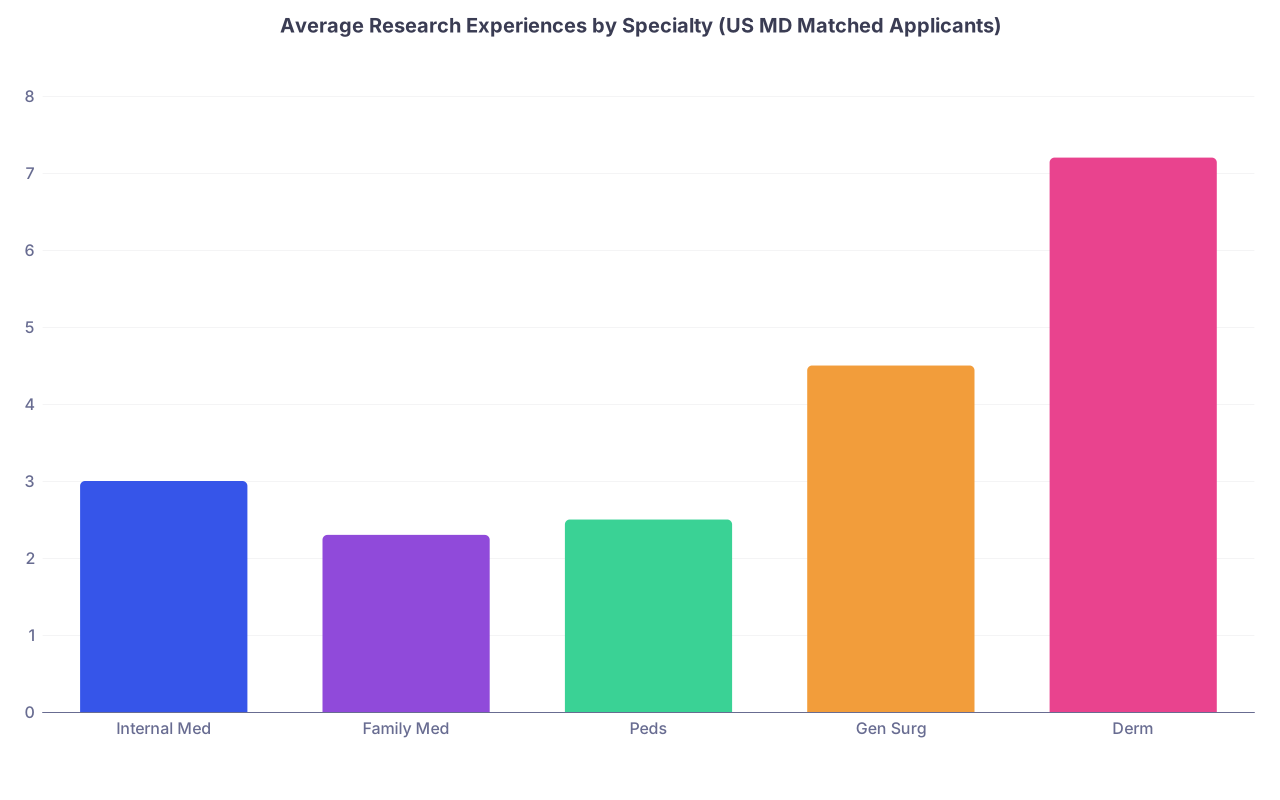
| Category | Value |
|---|---|
| Internal Med | 3 |
| Family Med | 2.3 |
| Peds | 2.5 |
| Gen Surg | 4.5 |
| Derm | 7.2 |
Here’s how people screw this up:
They see “Derm matched applicants have 7.2 research experiences” and translate it to “Derm requires 7+ research projects.”
That’s wrong for three reasons:
Experiences ≠ Publications
“Research experiences” includes: summer projects, chart reviews, QI projects, poster abstracts, ongoing work that never got published. The bar is lower than you think.Averages hide ranges
There are matched derm applicants with 2–3 solid projects at strong institutions and unmatched applicants with 15 garbage posters from predatory conferences. Numbers alone are junk.Specialty context matters
In family medicine or community internal medicine, you will absolutely see matched applicants with zero research experiences and strong clinical/leadership profiles.
I’ve watched solid US MD applicants match EM, psych, family medicine, and pediatrics with literally no research on their CV. They had strong Step 2, good letters, and clear commitment to the specialty.
Would research have helped? Maybe. Was it mandatory? Not remotely.
If you are aiming for:
- Community programs in IM, FM, psych, peds, EM → research is nice-to-have, not a hard filter.
- Mid-range academic programs in those same specialties → research bumps you, especially if related to the field, but you can compensate with strong clinical metrics.
- Top academic programs or hyper-competitive subspecialties (derm, plastics, neurosurg, rad onc, ENT) → lack of research is a real liability, sometimes a deal-breaker.
So the rule isn’t “no research = no match.”
The real rule is: “No research severely limits access to certain types of programs and specialties.”
Different statement. Very different implications.
Myth 2: “Any Research Is Better Than None”
This is where people waste time.
Students panic and sign up for:
- A barely supervised retrospective chart review that never finishes.
- A “online journal” that’s basically pay-to-publish spam.
- A poster at a vanity conference with 15 attendees and no peer review.
Then they slap “First Author Publication” on the CV and think programs will be impressed.
Program directors are not idiots. They know the difference between:
- A multicenter project at a known institution that led to a PubMed-indexed paper in a reasonable journal.
- A tenth-author case report in a journal nobody respects.
- A QI project that actually changed a clinic workflow and shows ownership and follow-through.
Content and signal matter more than sheer count.
If you’re going to do research, prioritize:
Mentor quality and track record
Does this attending publish? Do prior students from this lab get posters/pubs? If not, you’re likely signing up for “eternal draft” hell.Project feasibility within your timeline
A two-year basic science bench project when you’re starting MS3? That’s wishful thinking. A retrospective chart review or QI project you can push to completion? Much smarter.Relevance to your target specialty
For IM, a well-done QI project improving hypertension management is more useful than unrelated basic science in zebrafish development. For derm, actual derm-related work matters.
I’d rather see:
- 1–2 meaningful projects you can talk about in detail, where you understand the question, methods, and limitations,
than:
- 9 low-quality posters from random “international congresses” that look padded and hollow.
Programs look for seriousness, not just noise.
Myth 3: “Research Is Just to Check a Box”
No. That’s how students think about research. Programs look at it differently.
Research on your CV signals several things they care about:
- Can you ask structured questions and follow them through?
- Can you handle data, statistics, or methodology at a basic level?
- Are you intellectually curious or just memorizing buzzwords?
- For academic-leaning programs: are you likely to contribute to their scholarly output?
The more competitive and academic the program, the more this matters. But even in community programs, a well-executed QI project says something: you don’t just complain about systems; you try to fix them.
Where students mess up is doing research they never truly understood. Then on interview day:
“Tell me about your project.”
And you hear:
“So… uh… we looked at outcomes in, um, something about heart failure readmissions, and I helped with data collection and… yeah.”
Translation: I helped copy stuff into Excel and have no idea what the study was actually about.
That’s worse than having no research.
If it’s on your CV, you need to be able to:
- Clearly state the research question in 1–2 sentences.
- Explain the study design at a basic level (retrospective cohort, RCT, cross-sectional, etc.).
- Describe your specific role: data collection, analysis, writing, IRB submission, etc.
- Discuss one limitation and what you’d do differently next time.
If you can’t do that, it screams box-checking. And PDs know it.
Myth 4: “USMLE Pass/Fail Made Research Mandatory”
This one’s become fashionable lately:
“Now that Step 1 is pass/fail, programs care so much more about research.”
Not really. What happened is more subtle.
Step 1 going pass/fail removed a convenient numerical filter. Programs responded by leaning harder on:
- Step 2 CK score
- Clerkship grades
- School reputation
- Letters of recommendation
- Sub-I/away performance
Research did climb a bit in relative importance in competitive specialties and top-tier academic programs. But it didn’t suddenly become a universal requirement.
Think about it: community FM programs are not suddenly saying, “We used to just care if you passed Step 1, but now you need two first-author NEJM papers.” That’s absurd.
Where research gained more leverage:
- You’re at a lower-ranked or unknown school and want to prove you can perform at an academic level.
- You’re gunning for the top 10–20 programs in a decently competitive specialty.
- You’re trying to differentiate yourself in a sea of similar Step 2 scores.
It’s a tie-breaker and a differentiator, not the new Step 1 score.
If Not “Mandatory,” Then When Is Research Strategic?
Let’s make this practical.
Here’s when I’d push you to prioritize getting some research on your CV:
You’re targeting highly academic programs in IM, peds, EM, OB-GYN, etc.
Think: big-name university hospitals, strong fellowship pipelines, lots of NIH funding.You want competitive subspecialties eventually (cards, GI, heme/onc, critical care) and are already thinking fellowship.
Programs in these pipelines like to see an early trajectory of scholarly work.You’re coming from a lesser-known or lower-ranked school (Caribbean, newer DO or MD programs) and need to show you can hang academically.
Your USMLE or clinical grades are borderline for your target tier, and you need other strengths to compensate.
Now flip it.
Research is optional (and sometimes lower yield) if:
- You’re aiming mostly at community-based programs or lower- to mid-tier university affiliates.
- You’ve got excellent Step 2, strong narratives, and serious leadership or work experience.
- You’re late in the game (mid-MS4) with no research; at that point, “starting a project” may not materially change your outcome.
If you’re six months from ERAS and trying to “add research” from scratch, focus on:
- A small but real QI project you can complete and present locally.
- Helping an attending with a case report with a high chance of submission.
- Joining an existing project that’s near-submission, where you can do something substantive (not just run charts).
How to Strengthen Your CV Without Research (Yes, This Is Possible)
Some of you simply don’t have the time, access, or interest to suddenly produce scholarly output. Fair.
You’re not automatically doomed.
Here’s where you can move the needle without touching SPSS or IRB:
Sub-I and away rotations
This is the “research” of the clinical world. Crush your sub-internship in your target specialty. Work like an intern for four weeks in front of the exact people who write your letters and rank you.Letters of recommendation
One detailed, on-point letter saying “I would rank this student in the top 5 of my last 10 years of trainees” beats three generic “pleasant and professional” letters plus two fluff posters.Consistent specialty engagement
Longitudinal clinic, student interest group leadership, free clinic work, or relevant job experience. Show you’ve lived in the specialty, not just selected it in ERAS.Quality personal statement and narrative
Not “I like helping people” garbage. A clear, concrete story of why this specialty, what you’ve done to test that choice, and what kind of resident you’ll be.Clean, coherent CV
No fluff like “attended grand rounds” as an “activity.” Emphasize roles with responsibility, continuity, and impact.
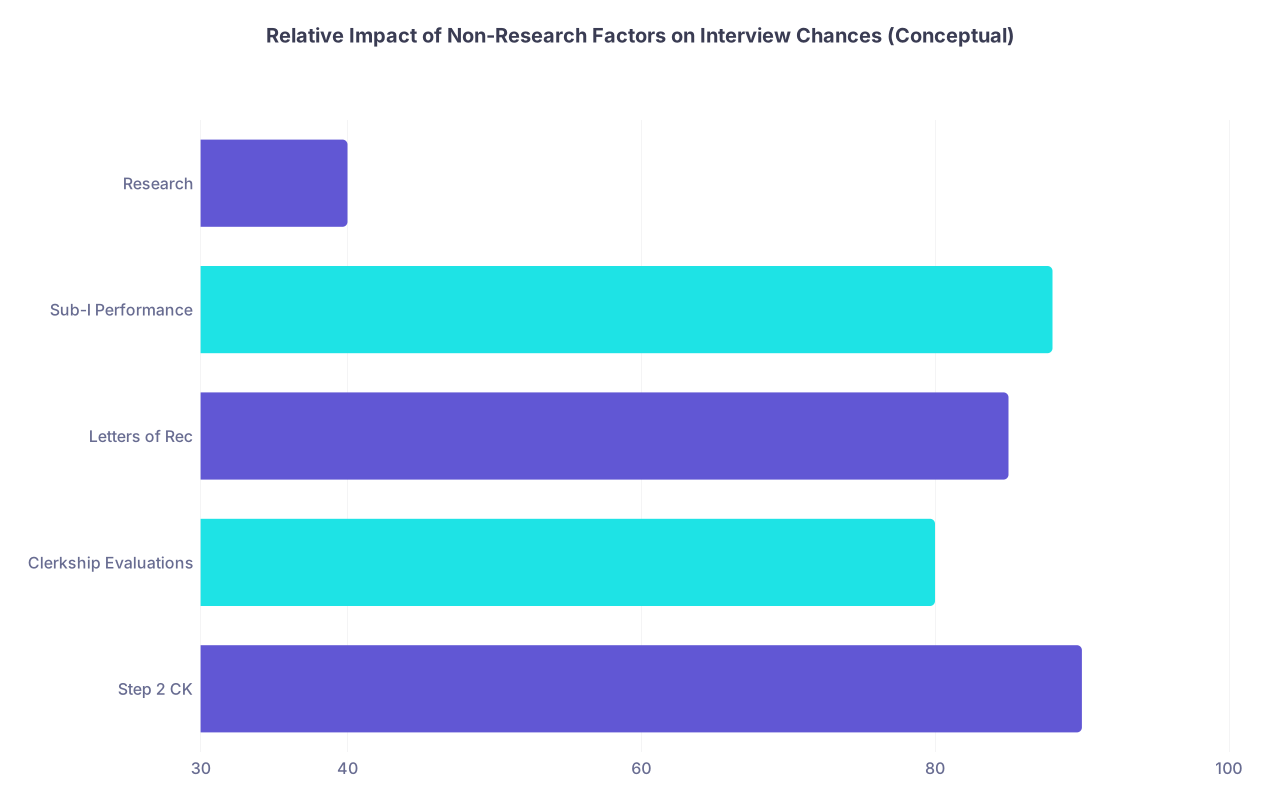
| Category | Value |
|---|---|
| Step 2 CK | 90 |
| Clerkship Evaluations | 80 |
| Letters of Rec | 85 |
| Sub-I Performance | 88 |
| Research | 40 |
That chart isn’t a direct NRMP copy; it’s the rough weighting I’ve seen play out in real decisions at mid-tier academic and community programs. Notice where research sits.
If You Decide to Do Research, Do It Like an Adult
If you’re going to invest the time, do it intentionally:
- Pick a mentor, not just a project. Good mentors pull you into multiple opportunities and help make sure something actually gets finished.
- Aim to finish at least one thing: a local presentation, a poster, a submitted manuscript. “Ongoing project” is fine, but “completed project” carries more weight.
- Keep a one-page running doc with your project’s question, methods, sample size, your specific contributions, key results. This becomes interview ammo later.
- Don’t inflate your role. PDs can smell it when a “primary author” cannot explain basic methods.
If you show up to interviews able to talk about your work clearly and thoughtfully, even a modest project can punch above its weight.
The Bottom Line
Let’s strip the emotion and folklore out of this.
2–3 key points:
- Research is not mandatory on every residency CV. It matters a lot for some specialties and top-tier academic programs, and far less for many community and mid-tier programs.
- When you do research, quality, relevance, and your understanding of the work matter far more than raw counts of “experiences” or low-impact posters.
- You can build a competitive residency CV through strong clinical performance, letters, sub-I work, and genuine specialty engagement—with or without research—if you’re honest about where you’re applying and what you’re aiming for.