
Prestige titles look impressive. They do not, by themselves, get you a match.
Let me be blunt: “Founder”, “CEO of Nonprofit”, “Lead Researcher”, “Chief This”, “Director That” — these labels are wildly overrated in residency applications. Programs are not fooled. They’ve seen a decade of inflated CVs and LinkedIn-style nonsense sewn into ERAS.
What actually moves the needle is surprisingly boring: sustained work, clear impact, and things that can be verified or independently judged. The label on the line matters far less than the substance underneath it.
If you’re spending more time wordsmithing titles than doing real work, you’re optimizing the wrong variable.
The Myth of the Magic Title
The dominant myth goes like this:
“If I can get ‘President’ or ‘Founder’ somewhere on my CV, programs will think I’m a leader and my application will pop.”
Here’s what really happens when an experienced PD or faculty reviewer reads those lines. I’ve watched this in real time in multiple selection committee rooms:
They see:
- “Founder, Global Health Initiative”
- “CEO, MedTech Startup”
- “Director of Research, Student Interest Group”
They immediately ask:
- What is this, concretely?
- Is this just a rebranded club officer role?
- Did it last more than one semester?
- Did anything measurable happen?
If the bullet points under that fancy title read like:
- “Organized several meetings”
- “Collaborated with peers”
- “Participated in research projects”
You’ve basically announced: “I gave myself a big title for regular student activity.” That does not signal leadership. It signals inflation.
Programs have seen too many “founders” of Instagram accounts with 74 followers, “CEOs” of LLCs that never made a dollar, and “research directors” whose only task was scheduling journal club. They’re numb to it.
The title is a hook. The content is the test. And the content is what predicts match outcomes.
What the Data Actually Says: What Predicts Matching
We do not have a giant RCT of “President vs Member” titles on ERAS. But we have a mountain of indirect evidence from NRMP data, program director surveys, and match outcomes tied to types of experiences.
When program directors are surveyed by the NRMP about what matters, “leadership roles” and “extracurricular activities” do appear — but far below:
- USMLE/COMLEX scores
- Clerkship grades
- Class ranking / AOA
- Letters of recommendation
- Residency interview performance
- Demonstrated interest in the specialty
- Research productivity for competitive fields
Notice what’s missing: “having a fancy title.”
What does correlate better?
- Number and type of peer-reviewed outputs (especially in competitive specialties)
- Consistency and duration of activities
- Leadership with documented outcomes (programs started, events scaled, policies changed)
- Activities that clearly align with that specialty’s culture and priorities
Let’s ground this. For surgery, ortho, derm, rad onc, plastics, ENT — PDs repeatedly say in NRMP surveys that research productivity and strong letters from known people carry heavy weight. Nowhere do they say, “I rank ‘Founder’ dramatically higher than ‘Member’ if the activity is otherwise the same.”
Because they do not.
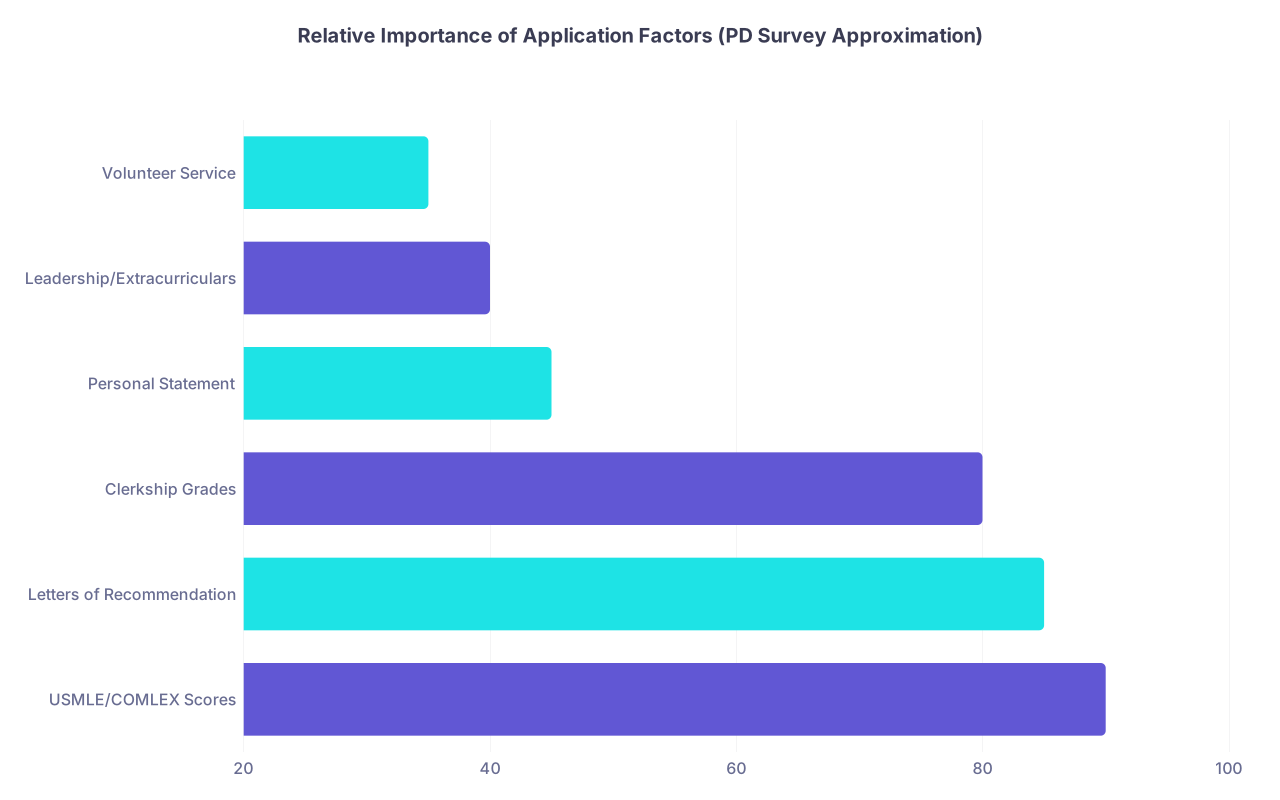
| Category | Value |
|---|---|
| USMLE/COMLEX Scores | 90 |
| Letters of Recommendation | 85 |
| Clerkship Grades | 80 |
| Personal Statement | 45 |
| Leadership/Extracurriculars | 40 |
| Volunteer Service | 35 |
Those numbers aren’t exact from one specific survey, but they capture the pattern: titles and leadership sit in the middle of the pack, not at the top.
Titles vs Substance: A Side‑by‑Side Reality Check
Imagine two nearly identical applicants on paper. Similar scores, similar schools, similar clerkship performance.
Applicant A:
- “Founder & CEO, MedEd Innovations”
- “Director of Research, Neurology Interest Group”
Underneath those titles:
- Ran 3 lunch talks, attendance ~15 each
- Helped with data collection on one faculty project, no publication yet
- Created an LLC that never produced a product or publication
Applicant B:
- “Coordinator, Student Neurology Clinic”
- “Co-investigator, Stroke Outcomes Study”
Underneath:
- Managed weekly free neurology clinic for 18 months, tracked >200 visits, implemented new triage protocol
- 1 first-author abstract at national meeting, 1 middle-author paper submitted, data analysis role clearly described
Applicant B is objectively stronger, despite the modest titles. Every serious reviewer knows this.
Programs have moved from title-chasing to impact-hunting because they’ve had to. Inflation forced it.
To make the contrast painfully clear:
| Aspect | Fancy Title, Low Substance | Modest Title, High Substance |
|---|---|---|
| Role label | Founder, Director, CEO | Coordinator, Member, Assistant |
| Duration | 3–6 months | 12–24+ months |
| Output | Meetings, vague initiatives | Papers, abstracts, protocols, measurable outcomes |
| Verifiability | Hard to confirm | Letters, publications, institutional record |
| PD reaction | Skeptical, probe deeper | Credible, often a plus |
When push comes to shove on rank lists, committees do not sit there saying, “But Applicant A was a Founder.” They say, “Applicant B actually did something.”
What Committees Actually Look For When They Read Titles
Let me walk you through how titles are actually parsed, because this is where most students fool themselves.
An experienced reader goes through experiences asking a few simple questions:
Is this real or inflated?
“National Director, Med Outreach” at a no-name volunteer group you joined last year? That’s going in the mental “inflated” bucket.
“President, Internal Medicine Interest Group” with clear evidence of multi-year activity? Credible.Is there time depth and progression?
Starting as “Member” MS1, then “VP” MS2, “President” MS3 — that progression looks authentic. Dropping in as “Founder” MS4 on something with no history looks suspicious unless the outcomes are big.What changed because you were there?
Did the clinic see more patients?
Did the group add new programming?
Did your research produce something tangible?
Your bullets should answer that without fluff.Does this match the letters and narrative?
If you call yourself “Lead Investigator” but your letter writer calls you “a dependable student assisting my ongoing project,” the committee trusts the letter, not your title.Is the title actually standardized?
Some titles mean something nationally (Gold Humanism, AOA, chief resident). Others are entirely local and flexible. Programs give much more weight to standardized honors and externally adjudicated roles than self-awarded titles.
The pattern here is obvious: the fancier and more self-important your labels look, the more scrutiny they get. If they’re not backed by substance, they actively hurt your credibility.
What Does Predict Match from Your CV Entries
Let’s separate signal from noise. These are the aspects of your CV entries that actually carry predictive weight for matching, especially in competitive programs.
1. Duration and Consistency
A 2-year commitment to one clinic is more impressive than four six-month “Director” roles scattered everywhere. PDs like people who finish what they start.
- 18–24 months in an ICU QI project
- Multiple semesters running the same outreach program
- Longitudinal involvement in one research area
These create a picture of reliability. That’s match currency.
2. Objective, External Validation
Anything that can be independently checked or judged beats your self-description.
- Peer‑reviewed publications
- Conference posters or podium presentations
- National or regional awards with a selection process
- Named scholarships, honor societies
You can call yourself “Lead Researcher” all day. One first-author paper in a solid journal says more in one line than five inflated titles.
3. Clear, Measurable Outcomes
The bullets under your activities matter more than the bolded titles. For example:
Bad:
- “President, Student Wellness Group – Organized events and advocated for wellness.”
Better:
- “President, Student Wellness Group – Led expansion from 2 to 7 annual events; attendance increased from ~40 to ~150 students; secured $2,000 additional funding; launched peer support initiative adopted by two other programs.”
Same title. Completely different level of impact.
Programs are hunting for applicants who can produce results in the messy, resource-limited reality of residency. Numbers and specific outcomes show that; fluff does not.
4. Specialty-Relevant Alignment
An “Immunology Journal Club Founder” means very little to an ortho program if nothing else about you points to ortho. For match prediction, relevance matters.
Derm:
- Dermatology research
- Skin cancer screenings, derm clinic work
- National derm conference presentations
Emergency medicine:
- ED volunteering, EMS work
- EM research, QI on throughput
- Simulation, resuscitation training
Internal medicine:
- Longitudinal clinic work
- IM-focused research
- Leadership in IM or subspecialty interest groups
A modest-sounding “Volunteer, Student-Run Free Clinic” can be far more powerful for family medicine than “Founder, Global Health Entrepreneurship Society” with no actual patient contact.
5. Credibility and Coherence Across the Application
Your CV doesn’t live alone. It’s interpreted alongside:
- LORs
- Personal statement
- MSPE
- Interview
If you present yourself as an all-caps LEADER on paper but your letters emphasize “quiet, diligent, dependable,” that disconnect undercuts you. The best-matching applicants have CVs whose tone and content match what others say about them.
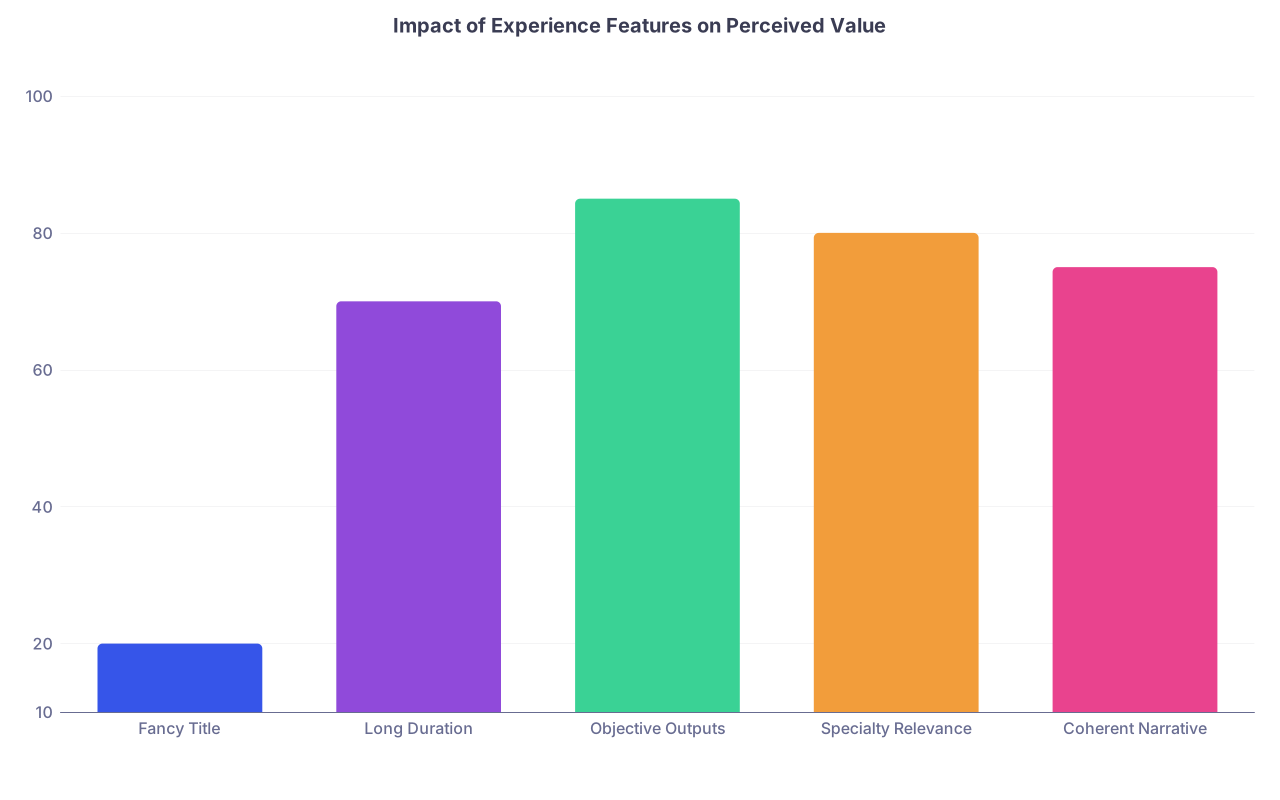
| Category | Value |
|---|---|
| Fancy Title | 20 |
| Long Duration | 70 |
| Objective Outputs | 85 |
| Specialty Relevance | 80 |
| Coherent Narrative | 75 |
Again, approximated, but directionally right: titles alone are weak; substance features are strong.
How to Fix Your CV Without Playing Title Games
If you’re still in the middle of med school or early in the match process, you can stop obsessing about labels and start optimizing for what actually helps.
Here’s the practical approach:
Keep titles accurate and modest.
If your role was “coordinator”, call it that. If you co-founded something with three other people, “Co-founder” is more honest than “Founder & CEO”. Accuracy builds trust.Aggressively strengthen the bullets under each role.
Replace vague verbs with concrete ones. Replace “helped with” and “participated in” with what you actually did: “collected data on 120 patients,” “designed survey instrument,” “wrote IRB amendment,” “implemented triage protocol that cut wait times by 20%.”Lean into time and impact, not flair.
Emphasize how long you did the work and what changed. Committees care more that you ran the same clinic for 3 years than that you invented a grandiose title for yourself.Pursue real, external signals now.
If you have limited time before applying, you’ll get better ROI from:- Pushing one near-finished project to submission
- Turning a poster into a manuscript
- Taking on a defined, impactful role in an existing project or clinic
than frantically “founding” something nominal just to print a fancy title.
Align efforts with your target specialty.
If you’re applying EM, join or take a real role in EM-related work. Ortho? Get in a lab that actually publishes ortho work. Your CV should read like a coherent story, not a random collection of shiny objects.
Fancy Titles That Do Matter (Because They’re Not Fancy, They’re Standardized)
Let me not overcorrect. Some titles are “fancy” but actually carry weight because they represent standardized, externally selected roles.
Things like:
- AOA (where still used)
- Gold Humanism Honor Society
- Chief resident (for those applying after PGY-1+)
- Elected class officer with real responsibilities over years
- National committee roles in major specialty organizations (with competitive selection)
These aren’t labels you made up. They’re roles you had to earn against competition. Completely different category from “Founder, Health Blog”.
Those do predict something: peer recognition, performance, reliability.
But even here, programs don’t stop at the title. They’re still going to ask: what did you do with that platform?
The Bottom Line: Stop Chasing Labels, Start Building Evidence
If you remember nothing else, remember this:
Residency programs are selecting colleagues, not LinkedIn influencers.
They want to know:
- Can you work hard consistently?
- Can you finish what you start?
- Can you contribute meaningfully to research, QI, education, or service?
- Are you genuinely interested in this specialty, or just decorating your CV?
- Do other people, whose judgement they trust, vouch for you?
Fancy titles with weak substance answer none of those questions. Modest titles with strong, measurable outcomes answer all of them.
Years from now, you will not care whether your CV once said “President” or “Coordinator.” You will care that you built real skills, real relationships, and real work you are not embarrassed to explain in a room full of attendings who have seen it all.