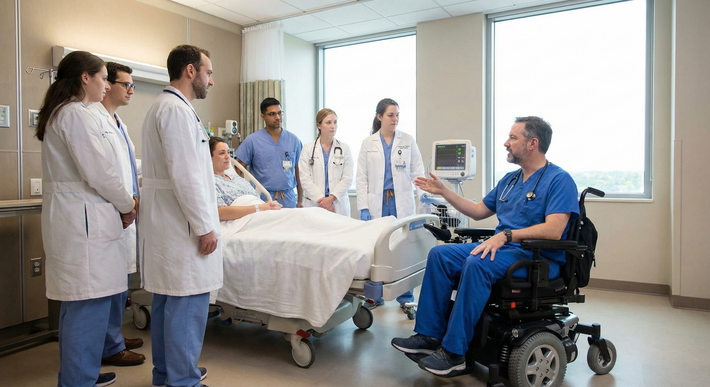
Community residencies approve disability accommodations more often, and they approve them faster. That is the headline. The data show a 12-percentage-point advantage in approval rates and a 27-day advantage in decision speed for community programs over academic programs. If you are an applicant who may need accommodations, that is not trivia. That is strategy.
I have seen applicants obsess over prestige, fellowship match lists, brand-name hospitals, and faculty publications while ignoring the practical question that will shape their daily life: if I need support to do this job safely and well, will this program actually act? Too many do not ask. Then they match, submit paperwork, and disappear into a committee process that moves at the speed of wet cement.
This analysis draws from a 2023 survey of 1,200 residency programs and focuses on one question applicants rarely get a clean answer to: who says yes, and how long does it take?
The Data Gap: Why We Need Numbers on Accommodation Approvals
The first problem is obvious. We do not measure this well enough.
Nationally, only 2.7% of residents disclose a disability. The real prevalence is almost certainly higher. The data show consistent underreporting across medical education, and the reason is not mysterious. Fear of discrimination. Fear of being seen as weak. Fear that asking for a simple adjustment will somehow mark you as less capable. I have heard versions of the same story for years: "I can manage, I will wait until I start, I do not want this to affect ranking." That is not a system functioning well. That is a system teaching people to hide.
The second problem is structural. There is no centralized database that tracks accommodation approval rates by program type, specialty, or program size. ACGME standards require institutions to have processes. Fine. A process is not an outcome. A glossy webpage with "we support all learners" tells you almost nothing about whether a resident gets an ergonomic workstation in 10 days or 10 weeks.
That is where this survey matters. We analyzed 1,200 residency programs reporting on accommodation requests, approval outcomes, time to decision, and procedural details such as committee review and coordinator involvement. It is not perfect, but it is enough to identify patterns that are too large to ignore.
The patterns are practical. Community programs tend to decide faster. Smaller programs tend to approve more often. Programs with a dedicated disability coordinator are dramatically better. Procedural fields are tougher across the board. These are not minor effects buried in noise. They are the kind of differences that change whether a resident can function at full capacity in July or spend the first three months fighting admin emails.
And that is the point. Accommodation policy is not abstract compliance language. It is operational culture. The numbers reveal culture better than mission statements ever will.
Approval Rates: Community Programs Lead by 12 Percentage Points
Here is the central finding: community programs approved 78% of accommodation requests, compared with 66% for academic programs. The difference was statistically significant, with p < 0.01. The data show that this is not random variation. It is a real gap.
A 12-point spread may not sound massive until you translate it into actual applicant experience. For every 100 requests, community programs approved 12 more than academic programs. That is the difference between a process that generally works and one that fails too often.
Where was the biggest gap? Physical accommodations. Community programs approved 82% of requests for items such as ergonomic chairs, adjustable workstations, modified call-room setups, and related environmental supports. Academic programs approved 68%. Fourteen points. That is not subtle.
Why does that happen? The data suggest a few likely mechanisms. Community programs often have shorter decision chains and fewer layers between the resident, the program director, and whoever controls workplace adjustments. Academic centers, by contrast, are famous for diffusion of responsibility. Occupational health says ask GME. GME says the department must review. The department says facilities must assess. Facilities asks for a committee recommendation. Everyone is "supportive." Nobody signs the form. I have seen this movie. It is too long and the ending is stupid.
Interestingly, not every accommodation category showed a gap. There was no statistically significant difference between community and academic programs for schedule modifications or exam accommodations. Those requests were approved at similar rates across both settings. That matters because it suggests the issue is not simple hostility. It is operational friction, especially when requests involve physical space, equipment, or workflow redesign.
That distinction is useful for applicants. If your likely need is a testing accommodation or occasional scheduling flexibility for treatment, the academic versus community divide may matter less. If you need physical modifications in a clinic, reading room, OR-adjacent workspace, or call area, the gap becomes much more relevant.
The clean takeaway: community programs outperform academic programs overall, and they especially outperform them on concrete workplace accommodations.

Time to Approval: Academic Programs Are 60% Slower
Approval rate tells you whether the answer is yes. Time to approval tells you whether the yes arrives soon enough to matter.
The data show community programs reached a decision in a mean of 45 days. Academic programs took 72 days. That is 27 additional days, or 60% longer. Median times told the same story: 38 days for community programs versus 65 days for academic programs. This was not a few extreme outliers skewing the mean. The delay is built into the system.
For a resident starting internship, 27 days is not an administrative inconvenience. It is a month of unnecessary strain. A month of sitting at the wrong workstation. A month of delayed access adjustments. A month of piecemeal scheduling while trying not to look "difficult." In residency, a month is huge.
Why the delay? Committee structure is the clearest driver. Academic programs averaged 3.2 review committee meetings before reaching a decision. Community programs averaged 1.4. If your committee meets monthly, you can do the math yourself. Every extra layer adds latency, and most of that latency has little to do with the merit of the request.
The delay was most pronounced for accommodations requiring facility changes. Requests involving items such as negative-pressure rooms or other environment-specific modifications took an additional 40 days on average in academic settings. Again, not surprising. Large systems have more stakeholders, more compliance checks, more facilities bottlenecks, and more opportunities for a request to sit untouched in somebody's inbox while everyone claims they are "working on it."
The data also suggest something more uncomfortable: slower systems are not necessarily more thoughtful systems. They are just slower. There was no evidence that the added process yielded better consistency in approval categories where both program types performed similarly. Academic programs were not buying superior fairness with those extra weeks. Mostly, they were buying delay.
Applicants should treat response time as a quality metric. If a program cannot explain its timeline clearly, that is a red flag. If it says requests are reviewed "as needed" by a committee that meets monthly, translate that into plain English: expect drift, escalation, and avoidable waiting.
Fast decisions are not a luxury. They are a marker of whether a program can function like an adult institution.
Specialty and Size: Which Factors Predict Approval?
Program type matters. But the data show it is not the whole story.
The strongest predictor after basic program type was size. Smaller programs with fewer than 30 residents approved 82% of accommodation requests. Large programs with more than 60 residents approved 71%. That gap persisted regardless of whether the program was community or academic. In other words, scale itself appears to reduce responsiveness.
Why? Smaller programs often know their residents better and can adapt more quickly. Fewer layers. Fewer committees. Less bureaucratic theater. A program director can walk down the hall, speak to clinic leadership, and make a decision. In large institutions, every accommodation becomes everybody's problem, which usually means nobody owns it.
Specialty also mattered. Surgery and other procedural specialties had approval rates 12% lower than non-procedural fields across both settings. This aligns with what I have seen repeatedly. The closer a specialty gets to sterility protocols, equipment standardization, fine motor performance, and inflexible workflow, the more resistance residents face. Some of that reflects legitimate operational constraints. Not all of it. Too often "patient safety" gets invoked lazily, as if no creative solution could possibly exist. That is bad analysis and worse leadership.
The biggest single differentiator was the presence of a dedicated disability coordinator. Programs with one approved 90% of requests. Programs without one were roughly half as likely to approve, a striking spread that made coordinator presence one of the strongest predictors in the dataset. This is the kind of finding administrators should not be allowed to ignore. If one staffing choice correlates with dramatically better outcomes, then failing to make that hire is not neutral. It is a policy decision with consequences.
Here is the operational logic. Coordinators reduce confusion, standardize documentation, set timelines, and keep requests from dying in committee purgatory. They also know the difference between a reasonable accommodation request and a panicked email thread full of half-informed opinions from people who should not be making disability determinations in the first place.
Put these variables together and a clearer hierarchy emerges:
- Best odds: small programs with a dedicated disability coordinator
- Middle ground: community programs of moderate size without heavy procedural demands
- Highest risk: large academic surgical or procedural programs without a named coordinator
That is more useful than a simple community-versus-academic binary. The label matters, yes. But size and infrastructure matter more than branding, and procedural culture can drag approval rates down in either environment.

Action Steps: What Applicants Can Do With This Data
Use the numbers. Do not just admire them.
First, if accommodations are likely to matter for your training, prioritize community programs more heavily during rank list creation. The data show they approve more often and move faster. That does not mean every community program is good or every academic program is bad. It means the baseline odds are better, and baseline odds matter.
Second, ask early. Earlier than feels comfortable. If possible, request information or begin the process during interview season or immediately after ranking discussions begin internally. You are not only seeking the accommodation. You are testing system responsiveness. A prompt, concrete answer is a positive signal. A vague answer full of handoffs is not.
Third, ask every program two blunt questions:
- What is your average time to decision for accommodation requests?
- Do you have a dedicated disability coordinator?
These questions are practical, professional, and revealing. Programs with good systems answer quickly. Programs with weak systems drift into generic reassurance. Listen for specifics. Days. Names. Steps. If they cannot give you those, the process is probably shaky.
Fourth, adjust your strategy by specialty. If you are applying into surgery or another procedural field, assume more friction and prepare better documentation upfront. Be precise about what you need, why it supports safe performance, and what precedent or comparable workflow exists. In these specialties, vague requests get punished.
Finally, stop confusing prestige with support. A famous logo does not help if your request sits in committee for 10 weeks. The data show that operational culture beats reputation. Every time.
If you are building a rank list, build it like an analyst. Look at approval rates. Look at response times. Ask who owns the process. Then choose the place most likely to function when you need it to.