
The idea that needing accommodations makes you “less competent” is not just wrong. It is the opposite of what the evidence and real-world performance actually show.
The myth survives because medicine still quietly worships a 1950s ideal: the tireless, able-bodied, 28‑hour-call, never-gets-sick superhuman. Anything that deviates from that image—wheelchair, ADHD meds, extra Step time, screen reader—gets coded as weakness. Or worse, as cheating.
Let me be blunt: using accommodations is not a proxy for lack of ability. It’s a proxy for whether a system is willing to stop penalizing you for a disability and let you actually show what you can do.
Let’s dismantle this properly.
The Core Myth: “If You Need Help, You’re Not As Good”
You’ve heard versions of this, maybe whispered in a hallway after an exam, or in a resident workroom:
- “If they need extra time, how can they handle being on call?”
- “If they can’t take the test like everyone else, maybe this isn’t the right field.”
- “Accommodations just lower the bar.”
Here’s the problem: most of those comments come from people who have never read a single study on disability, test accommodations, or clinical performance. They’re reacting to a story in their head, not to data.
And the story is lazy. It conflates three totally different things:
- Raw ability – your knowledge, reasoning, clinical judgment.
- Performance under a specific, often arbitrary condition – 1x time, tiny font, noisy test center, 8-hour sit.
- The presence of a disability – which can affect #2 without saying anything meaningful about #1.
If you design an exam that is unnecessarily hard for reasons that have nothing to do with the construct you claim to measure (like reading speed instead of knowledge), then accommodations don’t “give an edge.” They just remove the irrelevant handicap so you can be measured on what actually matters.
That’s not lowering the bar. That’s moving the test off the stairs and onto level ground.
What The Evidence On Accommodations Actually Shows
You want data, not feel-good slogans. Good. Let’s talk data.
1. Extra time does not magically create ability
Multiple psychometric studies in education (K–12, college, grad-level) show a consistent pattern: for people without a disability, extra time yields minimal or no meaningful score boost when the test is already well-timed.
When extra time does change scores substantially, it’s usually because the original time limit was artificially punitive—measuring speed more than mastery.
For people with documented disabilities (ADHD, learning disorders, visual impairments, etc.), extra time often normalizes performance. Not supercharges it. Normalizes it. The goal is that your score reflects what you know, not how fast you can push through text despite dyslexia or maintain focus with untreated ADHD.
Standardized testing organizations (including the AAMC and NBME) actually hire psychometricians to evaluate this. They’re not doing it out of charity; they do it because if accommodations corrupted the validity of the test, they’d be sued into oblivion and lose the ability to call these “standardized” exams.
So no, 1.5x time does not turn a 205‑level Step 2 candidate into a 260 monster. It mostly stops penalizing people for disability-related barriers that have nothing to do with diagnostic reasoning.
2. People with disabilities who get through training perform comparably
When you look at actual clinical performance, the “less competent” story falls apart fast.
- Studies of physicians with disabilities (physical, sensory, learning differences) show similar patient outcomes once they’re in practice, when workplaces accommodate them appropriately.
- In medical school, data from disability offices show that students who receive accommodations and persist through training average similar graduation and board pass rates compared with peers, when you control for entry metrics.
- Where you see higher attrition is before accommodations are in place or when they’re denied. That’s not about incompetence; that’s about systems making it functionally impossible for people to stay.
Here’s the unsexy truth: by the time someone with a disability has fought through undergrad, MCAT, medical school admissions, board exams, bureaucratic documentation, and stigma to get accommodations, you’re usually looking at someone who’s already more resilient and self-directed than average. They’ve had to be.
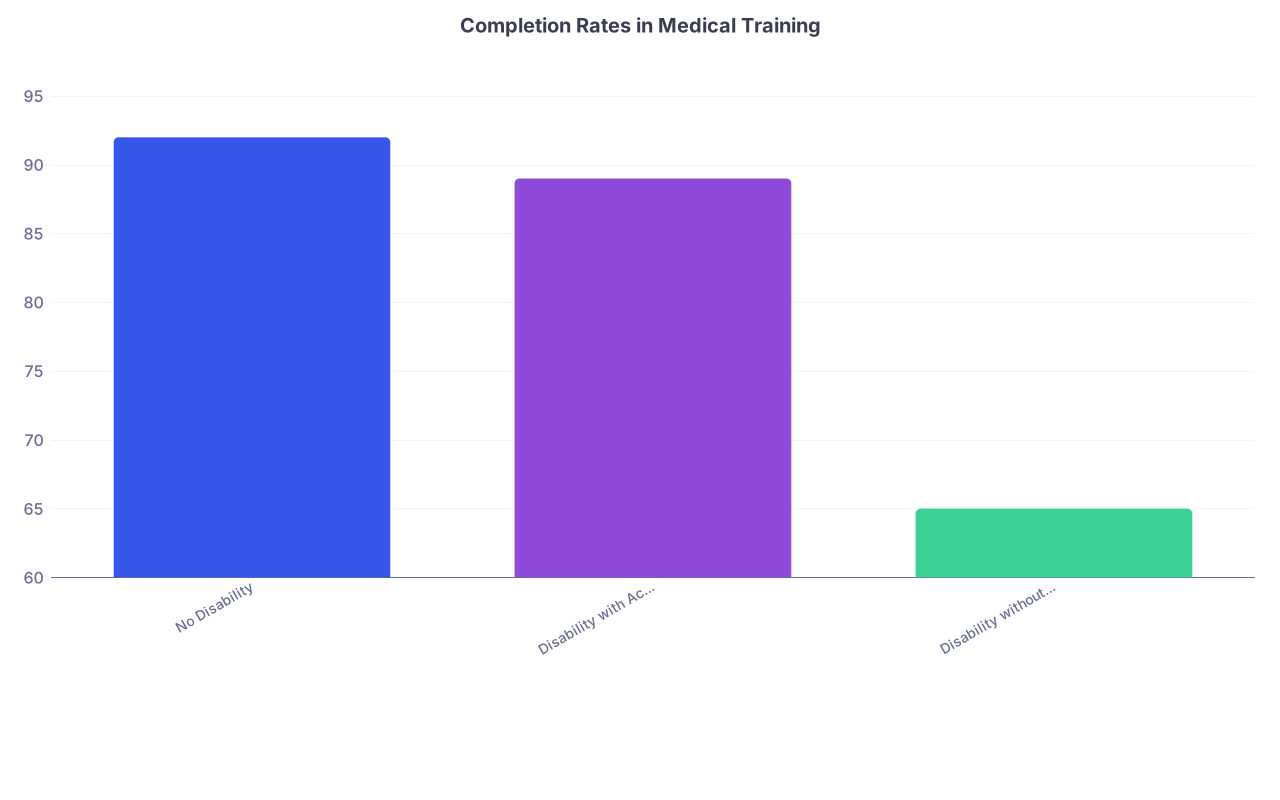
| Category | Value |
|---|---|
| No Disability | 92 |
| Disability with Accommodations | 89 |
| Disability without Accommodations | 65 |
The drop-off in the “disability without accommodations” group doesn’t prove lack of competence. It proves what happens when you force everyone through the same narrow doorway and then blame the people who can’t physically fit.
3. Accommodations are designed to preserve validity, not destroy it
Testing and training accommodations are not random favors. They go through a fairly painful bureaucratic and psychometric process:
- Is the disability real, documented, and relevant?
- Is the barrier related to the way the test or environment is constructed?
- Does the accommodation remove the barrier without giving unrelated advantage?
Extended time? Might be appropriate for reading-based tasks in dyslexia; not appropriate for a hands-on procedure station measuring speed-dependent skills.
Screen reader? Appropriate for a visual impairment on a text-heavy computer exam; not appropriate on a test of pathology slide interpretation where the visual skill is the construct.
The point: competence is the construct. Accommodations adjust irrelevant hurdles around the construct, not the construct itself.
The Dirty Secret: “Standard Conditions” Are Not Neutral
Another myth that needs to die: the idea that standard testing and training conditions are some kind of objective baseline.
They’re not neutral. They’re optimized for a particular type of brain and body.
Look at a typical exam day in medicine:
- 7–8 hours sitting in front of a screen
- Tiny fonts, dense text, multiple-choice everything
- Minimal movement
- Timed sections based partly on processing speed
- No assistive tech you normally use in real life
That’s not “neutral.” That’s a specific cognitive-physical environment that advantages:
- Neurotypical, fast readers
- People without chronic pain that flares when sitting
- People without migraines triggered by screens
- People without attention disorders
Medical practice, by contrast, is:
- Multimodal (talk, see, touch, think, not just read text)
- Team-based (you can ask for clarification, look things up)
- Longer horizon (you don’t diagnose sepsis in 90 seconds or fail)
- Tool-saturated (EHRs, references, decision aids, technology)
So who is “standard testing” really standard for? A subset of people who are comfortable in that very specific environment. And then we treat that subset as the definition of “competent.”
That’s not objectivity. That’s bias disguised as tradition.
Common Fears: “But What About Patient Safety?”
This is the card people love to play when they want to sound principled while gatekeeping.
Here’s the line: “If we give too many accommodations, we’ll end up graduating people who can’t safely care for patients.”
Let’s unwind that.
1. Most accommodations have nothing to do with core safety skills
Examples:
- Extra time on written exams
- Quiet room for testing
- Assistive tech for note-taking
- Adaptive devices for auscultation or procedures
- Modified call schedules for certain health conditions
- Use of a scribe or dictation software
None of these magically suppress your ability to recognize a STEMI, manage sepsis, or consent a patient. They just let you function in the environment without unnecessary friction.
You know what does affect patient safety?
- Sleep deprivation
- Burnout
- Working through active flares of illness because you’re afraid to admit limitations
- Hiding disabilities instead of planning around them
Deny accommodations and you’ll get more of those.
2. Safety concerns are already built into accommodation decisions
Regulators, licensing boards, and programs are absolutely allowed to insist on essential functions. They just are not allowed to insist on non-essential barriers.
Essential: being able to synthesize clinical information and make sound judgments.
Non-essential: being able to do 28‑hour call without sitting down, or reading 60 vignette questions in 70 minutes at 8:00 AM sharp.
When an accommodation would truly compromise an essential function—not a tradition, not a macho ritual, but an actual core safety skill—it can be modified or denied. That’s already how the law is structured.
The reality? Most accommodations don’t touch those essential core skills. They touch delivery format. Schedule. Interface. Pace.

| Step | Description |
|---|---|
| Step 1 | Documented Disability |
| Step 2 | Identify Functional Limitations |
| Step 3 | Map to Training or Testing Barriers |
| Step 4 | Provide Accommodation |
| Step 5 | Modify or Seek Alternative |
| Step 6 | Essential Skill Affected |
This isn’t a free-for-all. It never has been.
The Psychology: Internalized Ableism Is Doing Damage
Let’s shift from data to what actually happens inside people’s heads.
I’ve talked to students who:
- Qualified clearly for accommodations but delayed 2–3 years because they “didn’t want to be that person.”
- Failed Step 1 or Step 2 once or twice, then finally got accommodations, passed easily, and still called themselves “frauds.”
- Hid their hearing loss through all of clerkships because they dreaded being seen as “less capable,” and missed teaching points—and frankly, risked more misunderstanding with patients—because of it.
That’s internalized ableism. You’ve absorbed the message that being disabled or needing access changes your worth. So you would rather break yourself than be seen as “less.”
Medicine is great at this. We glorify suffering so aggressively that when someone asks not to suffer unnecessarily, we act like they’re cheating.
There’s also a bitter irony: the same attendings who wax poetic about “patient-centered care” sometimes recoil when the person needing accommodation is not the patient—but their own student or colleague.
You cannot believe that patients deserve ramps, interpreters, pain control, and inclusive design, but your trainee deserves “tough love” and denial of basic access. That’s not high standards. It’s hypocrisy.
Accommodations, Innovation, and the Future of Medicine
Here’s where this actually gets interesting. Accommodations aren’t just a legal checkbox. They’re a preview of where medicine is already going.
Example 1: Assistive tech becomes mainstream tech
- Voice recognition and dictation? Started as an access tool. Now it’s baked into major EHRs and everyone uses it.
- Enlarged displays and adjustable contrast? Originally for visual impairments. Now it’s UX 101.
Tools built “for” disability often become tools that make everyone’s life easier. That’s not side noise; that’s how innovation works.
Example 2: Team-based care neutralizes a lot of old “essential” myths
The lone cowboy physician doing everything personally is mostly dead. You work in teams, with nurses, therapists, techs, pharmacists, and a ton of digital support.
That reality makes a lot of old “you must personally, physically do X or you can’t be in this specialty” rules look silly. The critical skill is: can you ensure the task gets done safely and that you understand the information it generates? Not: can your specific pair of hands perform every micro-step.
Example 3: Cognitive diversity is a feature, not a bug
Neurodivergent physicians notice patterns others miss. Physicians with chronic illness often catch subtle clues and build rapport faster with patients who are also sick. Deaf physicians can be phenomenal in Deaf communities where hearing clinicians flounder.
Homogenizing everyone under the banner of “no accommodations allowed” is not protecting the profession. It’s sanding off precisely the perspectives we need for a more complex, tech-heavy, patient-centered future.
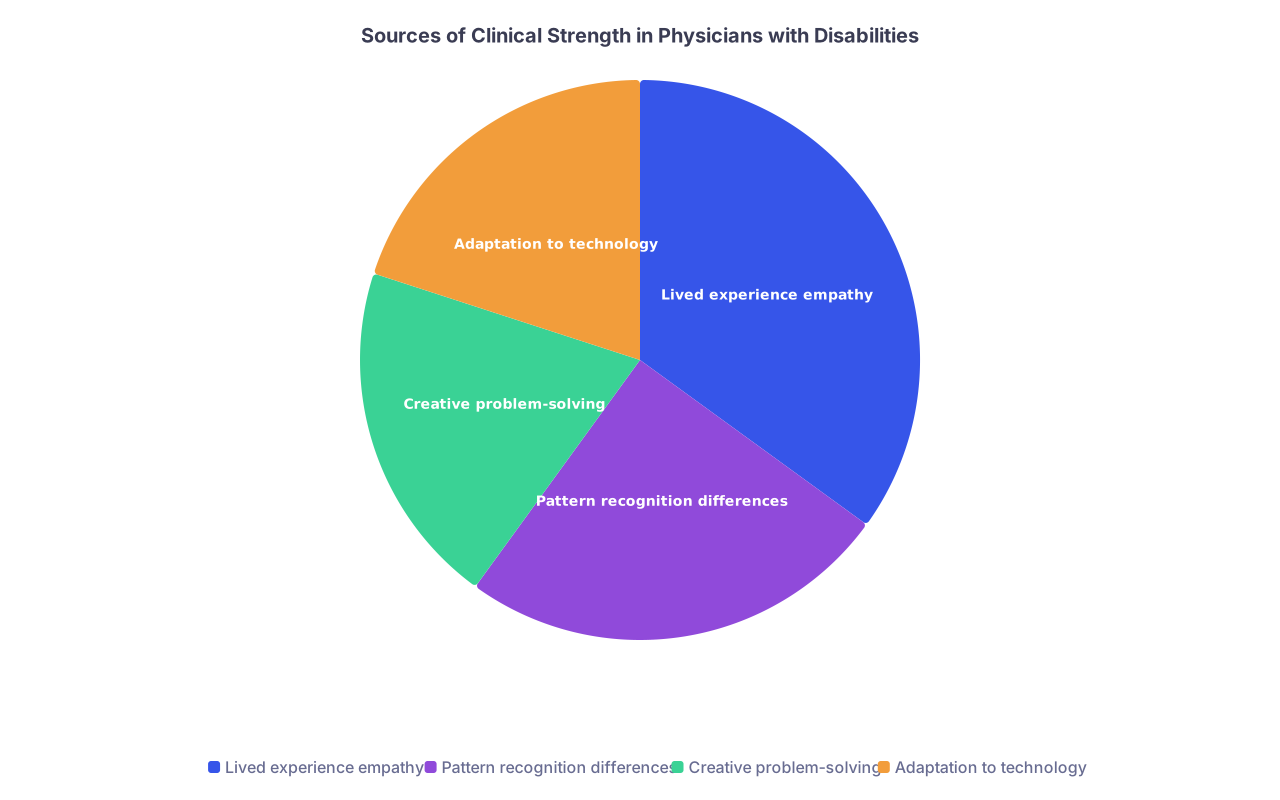
| Category | Value |
|---|---|
| Lived experience empathy | 35 |
| Pattern recognition differences | 25 |
| Creative problem-solving | 20 |
| Adaptation to technology | 20 |
A Quick Reality Check on “Fairness”
The word “unfair” gets thrown around a lot. Let’s examine it.
What’s actually unfair?
- Forcing someone with dyslexia to read at the same speed as someone without dyslexia and then calling the gap “competence.”
- Expecting someone with a mobility impairment to sprint between distant exam rooms and penalizing them for being slower, even if their patient care is better.
- Denying extra time on a written exam while happily giving a slow-typing student extra time to finish notes after clinic because “that’s just how it goes.”
“Same treatment” is not fairness when the starting points are different. That’s just laziness dressed up as rigor.
Fairness is: you and I are both judged on the same standard of competence, but we’re allowed different routes to demonstrate it when our bodies or brains process the environment differently.
That’s what accommodations are. Different routes to the same standard.
| Scenario | No Accommodation View | Accommodation Reality |
|---|---|---|
| Extra exam time | Unfair advantage | Removes speed bias unrelated to knowledge |
| Use of mobility device in clinic | Slowing team down | Enables safe, sustained participation |
| Screen reader for notes/exams | Cheating or shortcut | Alternative access to the same content |
| Modified call schedule | Getting out of hard work | Prevents health decompensation, burnout |
What You Should Actually Take Away
If you’ve skimmed everything else, stay for this part.
Accommodations do not mean you are less competent. They mean:
- The default environment was built around someone else’s body and brain.
- You’re refusing to let a poorly designed system mislabel your ability.
- You’re aligning your training with how you function best, which is exactly what you’d tell a patient to do.
Stop treating accommodations as a confession of weakness. They are a demand for accuracy.
And the data, the law, and actual patient outcomes all point in the same direction: properly granted accommodations preserve standards, not erode them.



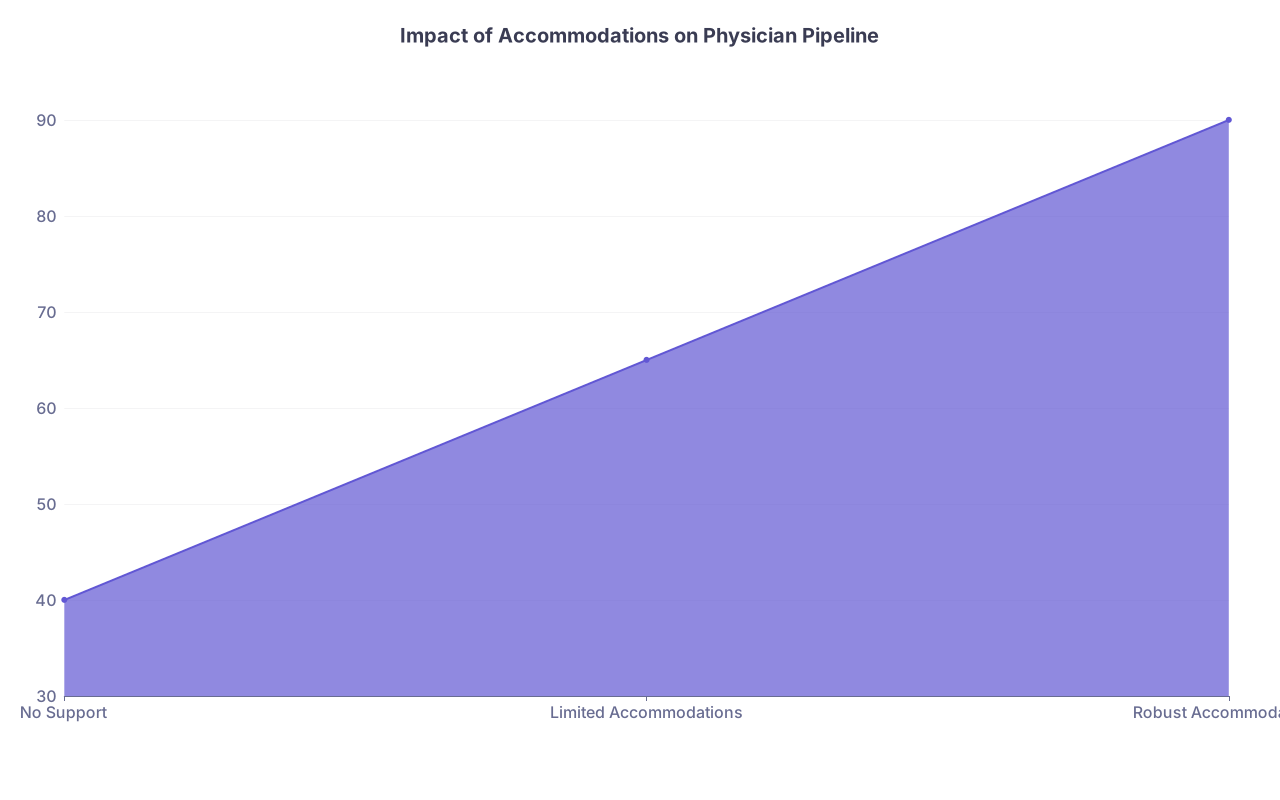
| Category | Value |
|---|---|
| No Support | 40 |
| Limited Accommodations | 65 |
| Robust Accommodations | 90 |
Key points:
- Accommodations don’t manufacture competence; they remove irrelevant barriers so existing competence can show up on exams and in training.
- Data from education and medicine shows that when people with disabilities get appropriate accommodations, their performance and patient outcomes are comparable—not inferior—to peers.
- The real problem isn’t that accommodations lower standards; it’s that “standard conditions” were never neutral or fair in the first place.