
Common Disability Disclosure Mistakes That Alarm Residency Programs
It’s late. You just re-read your personal statement draft for the fifth time.
You’ve got a documented disability. Maybe ADHD. Maybe a mobility issue. Maybe a chronic illness that flares without warning.
You’re staring at one paragraph that talks about it.
And your brain is spinning:
- “If I don’t say anything, will they think I’m hiding something?”
- “If I say it wrong, will they write me off as a liability?”
- “Do I talk about accommodations now? Later? Never?”
Here’s the unpleasant truth: programs do get alarmed by how some applicants disclose disability.
Not because you have a disability.
Because of how you present it.
I’ve watched good candidates hurt themselves with disclosure mistakes that had nothing to do with their actual capability. The problem wasn’t their condition. It was the story they told about it.
Let’s walk through the landmines so you don’t step on them.
Mistake #1: Turning Your Personal Statement Into a Medical Chart
The most common mistake? Oversharing medical details like you’re dictating an H&P.
You’ve seen versions of this:
“At age 9, I was diagnosed with X. After multiple surgeries and a complicated post-op course including Y and Z, I developed chronic A and B. During my second year of medical school, I had a relapse requiring…”
Stop.
Programs don’t want your entire medical history. They’re not your treating team. They’re asking a simple question:
“Can this person safely and reliably function as a resident here?”
When you drown them in medical details, three bad things happen:
- You shift focus away from your suitability for residency and onto your diagnosis.
- You invite them to speculate about risk, reliability, and time off.
- You make yourself sound like a perpetual patient instead of a future colleague.
How to avoid this mistake:
- Do not list every test, medication, or procedure.
- Stay at the level of:
- General category: “a chronic autoimmune condition,” “a physical disability affecting mobility,” “a learning disability (ADHD).”
- Brief functional impact: “This affected my stamina during long days” or “I needed structured support for attention.”
- Then immediately pivot to how you manage it now and how it has shaped skills that matter in residency.
Bad version:
“My depression resulted in hospitalization and multiple medication trials including…”
Better version:
“During medical school, I experienced a significant episode of depression that temporarily affected my academic performance. Since then, with treatment and structured support, I’ve had stable functioning and have successfully completed full-time clinical training.”
If you feel like you’re writing a consult note, you’ve gone too far.
Mistake #2: Disclosing Without Showing Current Stability
This one scares programs the most:
You mention a serious condition but never demonstrate current stability or functional reliability.
Example patterns that alarm committees:
- “My uncontrolled seizures made third year very challenging…” and then nothing about what’s different now.
- “My anxiety often overwhelms me, but I’m trying to work on it.”
- “I still have frequent flares that sometimes keep me from clinical duties” with no explanation of how often, how it’s handled, or how you’re prepared for residency-level responsibility.
Programs are risk-averse. They think in call schedules, patient safety, and duty coverage. If you give them a story that sounds like “this might blow up during intern year,” they will quietly move on to someone else.
You must answer, clearly and confidently:
- What does your functioning look like now?
- What evidence do you have that you can handle residency demands?
- What structures, treatments, or accommodations are already in place and working?
Not perfectly. No one is asking for perfection. But stable and predictable enough.
Better patterns:
- “Since 2022, I’ve had no hospitalizations or interruptions in training.”
- “With my current treatment plan, I’ve completed all clinical rotations without needing additional time off.”
- “With accessible transportation and ergonomic adjustments, I consistently completed full clinical duties on my rotations.”
If you mention a serious past issue and don’t explicitly show stability, programs will assume instability. That’s the mistake.
Mistake #3: Demanding Accommodations Up Front in a Combative Tone
Let me be blunt: you absolutely have the right to accommodations.
You do not need to beg for them.
But the way you mention them early can create unnecessary red flags.
The mistake: using your personal statement or initial contacts to send a defensive, almost adversarial message:
- “I will require strict enforcement of all duty hour regulations.”
- “I expect all call schedules to be modified to accommodate my condition.”
- “Any program unwilling to provide X, Y, Z will be discriminating against me.”
You might be 100% correct on the law. And still lose every program reading that paragraph. Because what they hear is:
- “This person will be hard to schedule.”
- “This person will threaten legal action before we even meet them.”
- “This person hasn’t shown they understand the realities of residency operations.”
Right to accommodations and how you communicate about them are two very different things.
Smarter approach:
- Save specific accommodation discussions for after you have an offer or in confidential channels, not in your main application narrative.
- Speak in terms of what has worked rather than demands:
“With structured reminders and a quiet space for documentation, I’ve been able to perform at a high level in busy clinical environments. I anticipate needing similar supports in residency and am happy to discuss how this aligns with program resources.”
That says: I’m thoughtful, realistic, and solutions-focused. Not adversarial.
You’re not giving up your rights. You’re just not making “I might sue you” the first impression.
Mistake #4: Making Your Disability Your Entire Personality
Another trap: turning your entire application into “The Disability Story.”
You see it when:
- Every essay angle is about your diagnosis.
- Every challenge you describe comes back to the same condition.
- Your takeaway from every experience is “I’m resilient because of my disability.”
Programs want to see you as a resident, not a case study. Over-identifying with your disability in your application can make it sound like you don’t have other dimensions: team member, teacher, proceduralist, leader, whatever your specialty demands.
The quiet worry you trigger when you over-center your disability:
- “Is this person going to interpret every feedback or scheduling decision through the lens of disability or discrimination?”
- “Can they separate patient needs, team needs, and their personal narrative?”
You need balance.
What balance looks like:
- Disability is one important thread in your story, not the entire fabric.
- You still show:
- Clinical competence
- Interest in the specialty
- Evidence of teamwork and reliability
- Growth not solely tied to your condition
One strong, well-crafted paragraph or a short section about disability is usually enough. You do not need a full essay plus three supplemental answers plus a diversity paragraph all on the same theme.
Don’t let a single identity—any identity—eat your whole application.
Mistake #5: Using Disclosure to Excuse, Not Explain
Here’s a line that sends programs running:
“My Step 1 failure was due to my untreated ADHD.”
Or variations:
- “I underperformed because my school wouldn’t accommodate me.”
- “My poor clerkship grades reflect faculty not understanding my disability.”
Is that sometimes true in real life? Yes.
Does it help you in an application? Almost never.
Programs read “excuse,” not “context.” And once they smell excuse-making, they assume they’ll be dealing with blame and defensiveness for the next three years.
You need to thread a tricky needle:
- Acknowledge the reality of disability impact.
- Own your part.
- Show what changed and how you improved.
Better framing:
Bad:
“I failed Step 1 because my anxiety was overwhelming and the school wouldn’t help.”
Better:
“I failed Step 1. At that time, I was struggling with significant, untreated anxiety that I didn’t fully recognize or address. Since then, I sought formal care, developed a concrete study and wellness plan, and passed Step 2 on my first attempt with a score that more accurately reflects my capabilities.”
You’re not denying the impact of your condition. You are refusing to use it as a shield from accountability.
That difference is exactly what selection committees look for.
Mistake #6: Disclosing in the Wrong Place, at the Wrong Time
Another subtle but damaging mistake is where you choose to disclose.
Bad timing moves:
- Dropping new, serious medical information in a post-interview thank-you email.
- Waiting until rank-list time to bring up high-cost or complex accommodations.
- Confessing mid-interview in a rambling way because you were nervous.
Residency programs have rhythms and structures. When you throw heavy, unexpected information at them at odd times, you make them feel blindsided and boxed in.
You need a strategy, not impulse.

| Step | Description |
|---|---|
| Step 1 | Before Application |
| Step 2 | Consider brief written disclosure |
| Step 3 | May wait to disclose |
| Step 4 | Focus on stability and improvement |
| Step 5 | Prepare talking points for later |
| Step 6 | Optional interview clarification |
| Step 7 | Detailed accommodation talk after offer |
| Step 8 | Need to explain major gaps or failures |
Safer timing patterns:
Application stage:
- Use written disclosure mainly if:
- You have major gaps, withdrawals, or repeated exams that need explanation.
- Your disability is clearly visible and omission will seem strange or evasive.
- Keep it brief, focused on stability and competence.
- Use written disclosure mainly if:
Interview stage:
- Optional, and only if:
- You’re asked about academic issues you’ve linked to disability.
- You feel comfortable, and you can speak calmly and concretely.
- Optional, and only if:
Post-match / post-offer:
- Best stage for detailed accommodation conversations with GME, not with the program director alone.
- This is where you bring specifics, documentation, and work through logistics.
If in doubt, move detailed accommodation talk later, not earlier.
Mistake #7: Being Vague or Cryptic About a Clearly Significant Issue
The opposite of oversharing: being so vague that programs smell “something big is being hidden.”
Example:
“I faced significant health challenges during second year that affected my performance, but I’ve grown a lot.”
That line, by itself, is not reassuring. It triggers:
- What kind of health challenge?
- Is it coming back?
- Did it involve professionalism issues? Safety? Substance use?
When your record has notable irregularities—LOA, exam failures, multiple remediation attempts—and you drop only a cryptic hint in your personal statement or MSPE, you look evasive.
Programs are more comfortable with:
- A brief, concrete statement of what kind of issue this was (mental health, physical, family crisis)
- A very short description of impact
- Clear evidence of recovery and sustained functioning
Not details. Just enough to stop their worst-case-scenario imagination.
Example that works:
“During my second year, I experienced a major depressive episode that led to a one-semester leave of absence. I engaged in treatment, returned with structured supports, and since then have completed all remaining coursework and clinical rotations without additional leave.”
You’ve said:
- What it was
- What happened
- That it’s now stable
No mystery. No medical chart. No oversharing.
Mistake #8: Ignoring the Specialty-Specific Realities
Some applicants disclose disability in a way that screams, “I haven’t thought through what this specialty actually requires.”
Classic examples:
- Applying to General Surgery while saying: “Back pain prevents me from standing in one place more than 20 minutes.”
- Applying to EM while saying: “I struggle with unpredictable overnight shifts.”
- Applying to Ob/Gyn while clearly needing only daytime hours and rigid scheduling.
Programs worry less about your label and more about mismatch.
Here’s the quiet calculation they’re doing:
- “Will the core, non-negotiable duties of this specialty collide with this person’s limitations?”
- “Can reasonable accommodations actually make this work, or would we be constantly rearranging the entire schedule around them?”
You must demonstrate that you’ve thought about fit.
| Specialty | Red-Flag Statement | Better Framed Statement |
|---|---|---|
| EM | I cannot tolerate unpredictable nights | I do best with structured patterns and anticipate considering EM programs with more stable shift scheduling |
| Surgery | I cannot stand longer than 20 minutes | I have a mobility limitation, so I am focusing on specialties where prolonged standing is not a core requirement |
| Psychiatry | I struggle to maintain emotional boundaries | I have a history of depression, now well-managed, and have completed full psych rotations without impact on clinical duties |
If you’re applying to a physically or emotionally intense specialty, and your disability clearly intersects with that intensity, you must:
- Show you understand the real demands.
- Show concrete evidence you’ve already handled similar demands in rotations.
- Be honest with yourself if the fit is truly poor.
Programs get anxious when your disclosure suggests you’re walking into the wrong battlefield.
Mistake #9: Letting Someone Else “Out” You in the MSPE or Letters
This one is ugly but real. Sometimes deans or letter writers make clumsy references:
- “Despite her health problems, she persisted.”
- “He struggled with personal issues that affected his attendance.”
- “Given her limitations, her performance was acceptable.”
Now you’ve got a half-disclosure you didn’t control.
The mistake on your side is not taking ownership of that narrative.
If there’s a hint of disability or major health issue in your MSPE or a key letter, and you say nothing anywhere else, programs start guessing. You lose control of the story.
Safer move:
- Brief, controlled acknowledgement in your own words somewhere in the application if the MSPE already opened the door.
- Again: short, functional, focused on stability and performance.
Example:
“My dean’s letter references a period when medical and personal challenges affected my attendance. That semester, I was managing a newly diagnosed autoimmune condition and adjusting to treatment. Since that time, I’ve maintained reliable attendance and completed all required clinical responsibilities without further issues.”
You didn’t volunteer graphic detail. But you also didn’t pretend it wasn’t there.
Mistake #10: Treating Disability Disclosure as a One-Time Emotional Dump
A lot of applicants treat disclosure like ripping off a bandage: “I’ll just pour it all out once and be done.”
They write a long, raw, emotional narrative and then hope never to speak of it again.
Programs hate that. Because they know reality: this will come up again—in interviews, in onboarding, in occupational health, maybe in day-to-day life.
What they want to see is not one big cathartic essay, but evidence you can talk about your disability like a professional:
- Clear
- Calm
- Specific
- Without drama or self-pity
You should be able to do, essentially, a “disability handoff”:
- What’s the condition, in general terms
- How it affected you in training
- What your functioning is like now
- What accommodations or supports have been effective
- How you’ve demonstrated you can do the job
If your only version is the tearful, 1,000-word trauma narrative, that’s not helpful. And it alarms them: they wonder how you’ll respond when things get hard during residency.
Practice a 2–3 minute, matter-of-fact explanation. If you can’t say it out loud without spiraling, you’re not ready to write about it in a way that reassures anyone.
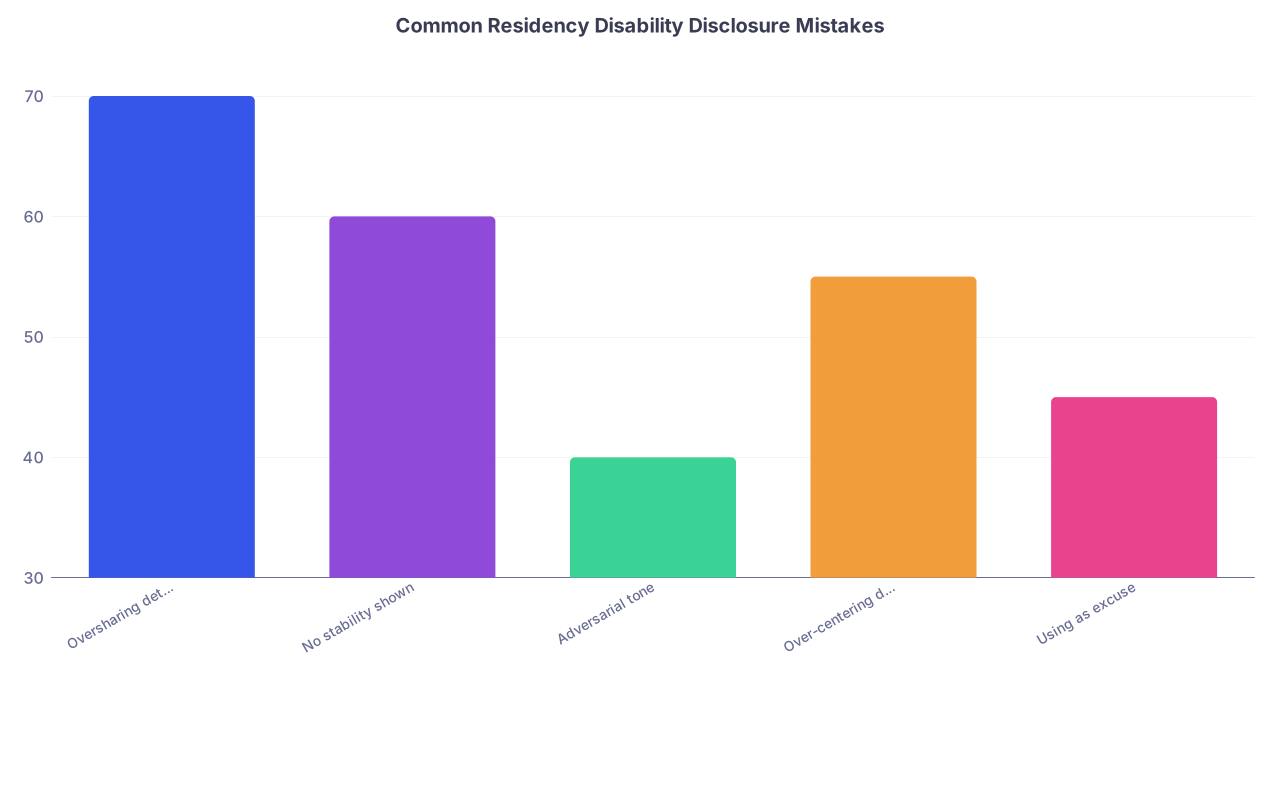
| Category | Value |
|---|---|
| Oversharing details | 70 |
| No stability shown | 60 |
| Adversarial tone | 40 |
| Over-centering disability | 55 |
| Using as excuse | 45 |
Final Thought: Your Goal Isn’t to Hide — It’s to Reassure
You are not trying to “trick” programs by downplaying your disability. You’re trying to:
- Avoid unnecessary red flags caused by poor framing.
- Present yourself as what you actually are: a capable, self-aware future physician who happens to have a disability.
If you remember nothing else, keep these three points:
- Don’t write a medical chart. Brief description, clear current stability, strong evidence of functioning.
- Don’t use disability as either a shield or a weapon. Not an excuse. Not an opening threat. A reality you manage thoughtfully.
- Control the narrative. If you disclose, do it on purpose, in the right place, with the clear goal of reassuring programs you can safely and reliably do the job.
Get those right, and your disability stops being the thing that alarms programs—and becomes just one part of why you’ll be a solid resident.