The biggest mistake disabled students make when transferring is assuming schools will “do the right thing” without being forced to. They will not. You need a tactical plan, not blind faith.
If you’re considering transferring schools or programs because of a disability, you’re probably dealing with at least three problems at once: symptoms, bureaucracy, and fear of retaliation or blacklisting. You cannot fix all three by being “nice” and “understanding.” You fix it by getting organized, strategic, and slightly ruthless about protecting yourself.
This guide walks you through what to do, step by step, whether you’re:
- Preclinical or clinical med student trying to change schools
- Resident trying to transfer programs or switch specialties
- In another health-professions program (nursing, PA, PT, etc.) facing the same mess
I’m going to assume three things about your situation:
- You have a diagnosed or diagnosable disability (physical, mental health, learning, sensory, chronic illness, etc.), OR it’s extremely likely.
- Your current environment is materially harming your health, your performance, or both.
- You’re trying to figure out whether to push for accommodations where you are, or get out and transfer.
We’ll cover both, because the reality is: you usually need to try to fix things before you jump. That’s how you build the paper trail that makes a transfer possible.
Step 1: Get Clear On Your Actual Goal (Not The Fantasy Version)
Most people in your shoes start with a vague goal like: “I just want a program that will support me.” That’s not specific enough. You need to define what “support” means in concrete terms.
Ask yourself:
- What exactly is making my current program incompatible with my disability?
- Is it location (climate, family support, transportation)?
- Is it schedule (overnights, call, rotating time zones, lack of recovery time)?
- Is it culture (harassment, hostility to accommodations, gaslighting)?
- Is it specific policies (mandatory attendance, testing format, rigid rotation assignments)?
Write down 3–5 non‑negotiables for your next place. Examples:
- Must allow remote testing or quiet, distraction-reduced exam environment.
- Must be within 30 minutes of my specialty medical care.
- Must have clear, written disability accommodations process involving a central office, not random deans.
- Must allow flexibility in clinical rotations for medical appointments.
- Must not require overnight call in PGY‑1 (or must allow documented exemptions).
If you cannot define these, you’ll jump from one bad fit to another. Transfer drama, round two. Not fun.
Step 2: Build Your Documentation Arsenal Before You Move A Muscle
No documentation, no leverage. That’s how schools and programs operate.
You need three buckets of documentation:
1. Medical / Psychological Documentation
- A clear diagnosis (or working diagnosis) from a licensed professional.
- A brief letter linking functional limitations to educational/clinical barriers.
- Suggested accommodations. Not just “should have support,” but specific: extra time, reduced call, ergonomic equipment, etc.
If your doctor/therapist has never written an accommodations letter, ask them to focus on:
- “Because of X, this person has difficulty with Y.”
- “Reasonable accommodations may include…”
- Avoid over-sharing personal details; focus on function.
2. Educational / Performance Trail
You want a record that shows: you were doing fine (or reasonably OK), then disability/conditions + lack of accommodations tanked things.
Collect:
- Grade reports, evaluations, dean’s letters.
- Any sudden drops in performance lined up with symptom escalation or denied accommodations.
- Emails where you raised concerns and got dismissive or vague responses.
- Warnings, remediation letters, probation notes (if any) – they matter, and yes, they can be explained.
Do not hide bad documents from yourself. You need to see what they see.
3. Accommodation Request and Response History
If you haven’t formally requested accommodations yet, you should—carefully—before you try to transfer. Programs and schools will ask: “Did you try to resolve this internally?”
You want:
- Written requests to disability services / GME office / student affairs
- Their written responses (approval, partial denial, or total denial)
- Any proof that accommodations were promised but not actually implemented
If your program pushes everything to verbal conversations, you force it back to email:
“Per our conversation today regarding my accommodation request for [X], my understanding is that [summary of what they said]. Please correct anything inaccurate.”
That one sentence generates a paper trail when they reply or stay silent.
Step 3: Decide Your Strategy – Fix, Transfer, or Both in Parallel
Transferring is hard. For med students it’s brutally limited. For residents it’s possible but slow and political. Sometimes your best play is:
- Short term: Maximize accommodations where you are.
- Medium term: Quietly prepare to transfer.
- Long term: Protect your career narrative.
Here’s how the basic options compare:
| Path | Pros | Cons |
|---|---|---|
| Stay & fight | Less disruption, continuity | Emotional toll, possible hostility |
| Transfer only | Clean slate potential | Hard to secure, timing constraints |
| Both in parallel | Backup options, more leverage | More work, must be organized |
If your current place is actively abusive, retaliatory, or dangerous for your health, you lean heavily toward transfer + legal consultation. If they’re clumsy but not malicious, you may try to fix things first while scouting transfer options quietly.
Step 4: Understand Transfer Realities (Med School vs Residency)
Med School Transfers
Transfers between med schools are rare and tightly constrained. They’re usually allowed for:
- Geographic relocation (spouse moves, military orders, major family medical needs).
- Articulation between linked programs (like 3+4 BS/MD pipeline adjustments).
- Sometimes for disability-related reasons, but schools almost never advertise that.
If you’re an M1/M2:
- Lateral transfer options are limited and often require that you’re in good standing academically and professionally.
- You may have to repeat semesters or an entire year.
- Some schools only accept transfers into clinical years.
If you’re in clinical years:
- More schools might consider you, but only if your original school is LCME-accredited and you’ve passed Step 1/COMLEX 1.
- Capacity is the choke point—if they don’t have clinical slots, you’re out of luck even with a strong case.
You should be prepared for:
- A lot of schools simply saying “We don’t accept transfers except XYZ narrow category.”
- A few schools saying “Maybe, send materials,” then going silent.
- One or two realistic options where disability + location + your record line up.
Residency Transfers
Residency is different. Transfers and program changes happen every year. Quietly.
Reasons that actually fly:
- Spouse job relocation or family caregiving.
- Program closure or major instability.
- Documented health/disability issues requiring relocation or different workload.
In residency, you’re mostly targeting:
- Open PGY‑2 or PGY‑3 slots in the same specialty.
- Sometimes a restart in a new specialty (with credit for previous training, maybe).
- Rarely, a structured transfer across institutions at same PGY level.
Your main constraints:
- Timing (positions open off-cycle, not neatly in July sometimes).
- How your current PD describes you. A hostile PD can quietly sabotage transfers.
- Whether your specialty is competitive or more flexible.
Step 5: Quiet Recon – Identify Programs That Actually Support Disabled Trainees
Do not trust glossy DEI webpages. Look for structural signals.
What you want to see:
- Central disability services office with clear processes, not “talk to your dean and we’ll see.”
- Explicit mention of disability accommodations in handbooks and policies.
- Track record: you hear, off the record, that someone with a disability actually made it through there intact.
Use these channels:
- Upperclass students / senior residents who have rotated at other sites. Ask: “Did you ever see anyone with accommodations at that place?”
- Online groups: Reddit (r/medicalschool, specialty subs), Student Doctor Network, Facebook groups for disabled physicians/trainees.
- National organizations: e.g., AMA medical students section, disability in medicine groups, ACGME wellness committees.
Look for patterns in what people say:
- “They were flexible about time off for appointments.” Good sign.
- “If you’re not 100% all the time, they cut you loose.” Red flag.
- “They say they support accommodations, but everything is case-by-case and slow.” Mixed—means you’ll have to fight but might succeed.
Step 6: Build Your Narrative – How You Explain This Without Sinking Yourself
Transferring because of disability is a sensitive story. You need a version that is:
- Honest enough to be consistent with your records.
- Focused on fit and support, not “my old program is evil trash.”
- Emphasizes resilience and what you learned, not just suffering.
Core structure that works:
Briefly state the medical/disability reality.
“I have a chronic neurological condition that affects stamina and requires consistent specialty care.”Connect to specific barriers.
“In my current program, overnight call frequency and distance from my medical team have led to recurrent exacerbations and multiple medical leaves.”Show that you tried to make it work.
“I engaged with disability services and program leadership to explore accommodations, which led to [some] adjustments, but core structural elements—particularly X and Y—remained unchanged.”Explain why their program makes more sense.
“Your program’s [geography/schedule/rotation structure/known accommodations] align better with my medical needs while allowing me to meet all training requirements.”Emphasize performance when supported.
“When my condition is properly managed, my evaluations and exam performance reflect my abilities, as seen in [these rotations/Step scores/feedback].”
That’s it. No long sob story. No dramatic accusations, even if you’re justified. Save the full horror story for your lawyer or therapist.
Step 7: Protect Yourself Legally and Professionally
I’m not telling you to sue anyone. I am telling you to behave like someone who might need to.
Tactical moves:
- Stop doing important business by phone alone. Follow every key call with an email summary.
- Download copies of your evaluations and disability correspondence to a secure personal drive (not on school-owned devices).
- If your health is acutely affected, ask your clinician whether protected medical leave (FMLA, formal LOA) is appropriate. That can freeze timelines and buy you planning space.
Strongly consider at least a consultation with:
- A disability rights attorney who understands higher education or GME.
- Or a legal clinic through your university that handles student rights.
Even a one-hour consult can tell you:
- Whether your accommodations denials likely violate ADA/Section 504 in your jurisdiction.
- Whether to file an internal grievance, OCR complaint, or stay quiet and focus on transfer.
- How to word emails so you don’t accidentally sabotage your own case.
Step 8: The Actual Mechanics – How to Initiate a Transfer
For Medical Students
Your rough sequence:
Make sure you’re formally registered with disability services at your current school and have attempted reasonable accommodations.
Get an updated dean’s letter / MSPE that reflects your status (ask what will be disclosed).
Identify target schools that:
- Accept transfers
- Have open spots at your level
- Are geographically and structurally a better fit for your health
Reach out quietly and directly to the dean of student affairs or admissions at the target school. Example email skeleton:
- One paragraph: who you are (school, year, exam status).
- One paragraph: broad reason for seeking transfer (medical/disability + location/fit).
- One paragraph: ask if they are open to considering transfer applications in your situation.
If they say maybe/yes, they’ll ask for:
- Transcript
- MSPE/dean’s letter
- Step/COMLEX scores
- Possibly a letter explaining circumstances
Do not blast mass emails. A few carefully chosen programs are better than 30 cold shots.
For Residents
Your process is more like a job search:
Quietly update your CV with current training details.
Tell a very small circle of trusted faculty or mentors that you’re exploring transfer for medical/family reasons.
Watch specialty listservs, program emails, and NRMP/ERAS posts for off-cycle positions (PGY‑2+).
Directly email PDs of programs with open positions:
- Short intro with your current level and training background
- Clear, calm mention of health/disability as relocation driver if appropriate
- Attach CV and offer to provide evaluations and PD contact later in the process
Decide when to involve your current PD. This is delicate:
- If your PD is reasonably supportive, loop them in early—they can open doors.
- If your PD is hostile, you may need to secure serious interest from a receiving program before formally requesting a reference, accepting the risk they bad-mouth you.
In both student and resident contexts, remember: programs care mainly about whether you can safely and reliably finish training and meet requirements. Frame everything around how the new setting makes that far more realistic.
Step 9: Timing, LOAs, and Not Burning Yourself Out
Transferring while actively crashing is like moving apartments in the middle of a house fire. You’re allowed to hit pause.
Strategic use of leave:
- Medical leave or LOA can give you 3–12 months to:
- Stabilize your health
- Build documentation
- Explore transfer options carefully
- It also stops the cycle of “I’m barely hanging on, so I can’t plan.”
Downside: LOA can extend training and sometimes complicate funding/visa status. But for many, it’s the only way to get out of constant survival mode long enough to make good decisions.
Consider this rough decision path:

| Step | Description |
|---|---|
| Step 1 | Health and disability problems |
| Step 2 | Request formal accommodations |
| Step 3 | Consider LOA and transfer |
| Step 4 | Stay and reassess transfer later |
| Step 5 | Gather documentation and legal consult |
| Step 6 | Apply for transfers or new programs |
| Step 7 | Can accommodations make current program safe? |
| Step 8 | Accommodations implemented and effective? |
Use that as a mental model. You’re not required to be a hero and suffer indefinitely “to prove you can hack it.” That mindset destroys people.
Step 10: Red Flags and Green Flags in How Programs Respond
When you start having early conversations or reading policies, pay attention to tone and specifics.
Red flags:
- “We handle disability on a case-by-case basis, so we don’t have written policies.” Translation: unpredictable and potentially hostile.
- “We can’t really reduce call or adjust rotations; that wouldn’t be fair to others.” They see accommodations as zero-sum resentment.
- Blaming language: “Are you sure medicine is the right field for you with your condition?” (They’re already halfway to pushing you out.)
Green-ish flags:
- “Our disability services office will guide formal requests; here’s the process and timeline.”
- “We’ve had trainees needing X, Y accommodations before; it takes planning, but we’ve made it work.”
- Specific references to ADA/Section 504 compliance and existing infrastructure.
Do not ignore your gut. If an email exchange feels subtly dismissive now, it will be worse when you’re dependent on them.
Quick Comparison: Pushing for Accommodations vs Transferring
| Path | Best When | Key Risk |
|---|---|---|
| Stay + accommodations | Structure is ok but poorly adjusted | Emotional wear, slow progress |
| Immediate transfer | Environment is toxic or unsafe | Hard to find spot, timing gap |
| LOA then transfer | Health is crashing, need recovery time | Financial/visa complications |
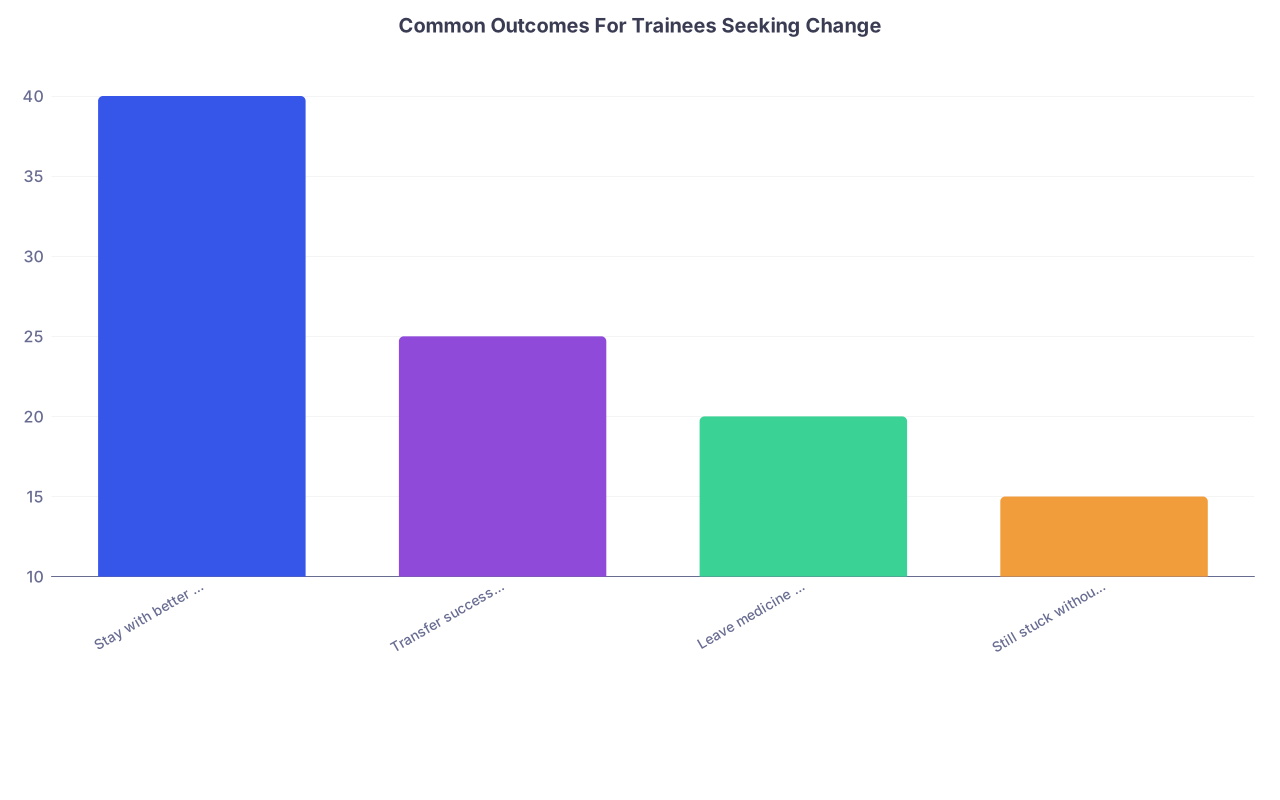
| Category | Value |
|---|---|
| Stay with better accommodations | 40 |
| Transfer successfully | 25 |
| Leave medicine or program | 20 |
| Still stuck without changes | 15 |
(This is illustrative, not exact statistics, but it matches what I’ve seen across multiple programs.)
FAQ (Exactly 4 Questions)
1. Will disclosing my disability to a new school or program hurt my chances of transferring?
It might, and pretending otherwise is naïve. Some programs quietly screen out anyone who looks “complicated.” But hiding it entirely is worse when it’s already in your record or clearly tied to your transfer reason. The tactical move is controlled, purposeful disclosure: you share enough to explain why the transfer makes sense and how you function with proper support, without oversharing raw details. If your disability is already documented at your current institution, assume it will surface and craft your narrative proactively instead of letting others define it for you.
2. Do I need to be in “good standing” to transfer because of disability?
Officially, most schools and programs say yes. Unofficially, people with leaves, remediation, or even probation have successfully transferred when they can clearly link their struggles to insufficient accommodations and show improvement once supported. You’ll have a harder road, but it’s not impossible. The key is a clean, coherent timeline: “I started having X symptoms; I asked for help; I didn’t get adequate support; performance dropped; now with treatment and proper structure, I’m doing Y much better.”
3. Should I get a lawyer before I even request accommodations or talk about transfer?
Not always, but I’d at least consider a consult if: you’ve been openly discouraged from requesting accommodations, threatened with dismissal after disclosing a disability, or repeatedly denied accommodations without clear justification. A short paid consult can save you from sending naïve emails that hurt you later. You don’t need to threaten lawsuits to everyone; you do need to behave like someone who understands they have rights and is documenting violations.
4. What if no school or program will take me—am I just done with medicine?
Not automatically. You may need to widen your strategy: restructure your training timeline with a longer LOA, explore specialty change rather than program change, or consider different but related health careers that are more compatible with your disability. Some people also return to their original program with a stronger accommodation plan and better external medical support after time off. “Transfer or nothing” is often a false binary. Your first job is to protect your health and keep options open; the exact shape of your career can adapt to that reality.
Bottom line, three things matter most:
- Get your documentation and story straight before you start asking for big changes.
- Use accommodations, LOAs, and transfers as tools—not moral tests of whether you “deserve” to be a doctor or clinician.
- Stop relying on institutions to protect you out of kindness. Build your own protection: records, allies, and a clear, tactical plan.