
The worst person to gaslight you about your disability is your program director. And yet it happens all the time.
You walk in with documentation, specific needs, and a reasonable plan. You walk out wondering if you’re “too sensitive,” “not resilient enough,” or “maybe it’s not that bad.” That’s not a personality flaw. That’s a power imbalance being used against you.
Let’s fix that.
This is for the resident or med student whose PD (or clerkship director) keeps minimizing their disability, chronic illness, mental health condition, or neurodivergence. I’m going to give you concrete scripts, step-by-step moves, and ways to protect yourself now and later.
1. Recognize What Minimization Looks Like (You’re Not Imagining It)
Before you can respond effectively, you need to call the behavior by its name. Minimization isn’t always overt abuse. It’s usually subtler.
Here’s what it looks and sounds like in real life:
- “We’re all tired. Residency is hard for everyone.”
- “Plenty of residents have X and never needed accommodations.”
- “Are you sure this isn’t just stress?”
- “If I give you this, everyone will want special treatment.”
- “Let’s just see how it goes for a few more months.”
- “You’re doing fine; I don’t see a problem.”
Or my personal “favorite”:
- “We don’t really do formal accommodations. We just handle things informally here.”
Translation: “I don’t want a paper trail.”
Make no mistake: when you’ve disclosed a disability and requested help, and the response is to downplay, delay, deflect, or compare you to others, that’s not “communication style.” That’s a problem.
Two quick internal checks:
- You leave the meeting feeling confused about what was decided.
- You start doubting whether you “deserve” what your doctor or therapist recommended.
If those are happening, you’re dealing with minimization.
2. Your Immediate Goal: Get Out of the Verbal Wrestling Match
You will not win a feelings-based argument with someone who holds structural power over you. Stop trying to convince them you “really are disabled” or “really do need” accommodations by over-sharing or pleading.
Your goals in the moment are smaller and much more strategic:
- Get clear, specific responses on the record.
- Shift from “you vs them” to “you + written policy + institution.”
- Keep your emotions steady enough to stay factual.
So in the room, you don’t need to win. You need to document.
Core mindset shift
You’re not there to get them to “believe” your disability experience. You’re there to:
- Notify them that you have a disability.
- Request specific, reasonable accommodations.
- Get their response into a form you can use later (email / notes).
That’s it.
3. Before the Meeting: Prepare Like It’s a Legal Document (Because It Might Be)
You don’t walk into a major exam cold. Don’t walk into this cold either.
Collect your ammo
You want three categories of documentation:
Medical/disability documentation
- Letter from your treating clinician specifying:
- Diagnosis (or at least functional limitation, depending on privacy needs)
- Relevant restrictions/limitations (e.g., “cannot safely work more than 24 hours,” “requires predictable start time due to medication schedule,” “needs access to a quiet space 15 minutes every 4 hours”)
- Recommended accommodations
- If you’re not comfortable with your PD knowing the exact diagnosis (e.g., psychiatric), talk to your clinician about language focusing on functional limitations.
- Letter from your treating clinician specifying:
Institutional policies
Find your:- GME handbook
- Institutional disability services page (often “Office of Disability Services,” “Accessibility Office,” or “Employee Accommodations”)
- ACGME requirements (if you’re a resident)
- Medical school disability policy (if you’re a student)
Screenshot or download relevant parts. Highlight phrases like:
- “Reasonable accommodations”
- “Access to disability services”
- “Non-retaliation”
- “Confidentiality”
Your own log
Start a simple but detailed log:- Dates
- Rotations
- Specific tasks that are hard or unsafe because of your condition
- Any times you raised concerns and what was said
This isn’t overkill. It’s self-defense.

Decide your ask
Vague concerns get vague answers. Specific requests force specific responses.
Example “asks”:
- “Shift my call from 28-hour to 16-hour with added short day.”
- “No more than 70 clinical hours per week averaged over a month.”
- “Protected 1-hour medical appointment every other week, scheduled predictably.”
- “Exemption from night float; replacement with additional day shifts.”
- “Permission to sit during long cases due to orthostatic issue.”
Write yours down in bullet form, even if you never show the list. You want to be able to say them calmly without fumbling.
4. During the Meeting: Scripts to Use When Your PD Minimizes You
Here’s where you need actual words. Not vague “just advocate for yourself.” Scripts.
I’ll break it into common scenarios and what you can say. Adjust for your own style, but keep the structure.
Scenario 1: “Everyone’s Tired” / “Residency is Hard for Everyone”
PD: “We’re all exhausted. That’s residency. I don’t think what you’re describing is out of the ordinary.”
You:
“I agree residency is demanding. I’m not asking for less work overall. I’m telling you that because of [my medical condition], the current structure is not safe/sustainable for me, even with maximum effort. My doctor has recommended [X]. I’m requesting that as a reasonable accommodation.”
If they push again:
You:
“I understand you’re seeing this through the lens of what’s typical. I’m working with documented limitations that are not typical. I’m not asking you to judge whether my condition is ‘bad enough’—I’m asking you to work with me and disability services on an appropriate accommodation.”
Scenario 2: “Others Have This and Don’t Need Help”
PD: “We’ve had residents with [same diagnosis] before and they did fine without accommodations.”
You:
“I’m glad things worked out well for them. Disability is very individual—even with the same label, functional impact can be different. My clinician has documented specific limitations that make the current schedule unsafe for me. That’s what I’m basing this request on, not on comparisons with previous residents.”
If they keep comparing:
You:
“I don’t think comparing me to unnamed colleagues is helpful. What matters is my documented limitations and our institutional responsibility to address them.”
Scenario 3: “Let’s Just See How It Goes” (Delay Tactic)
PD: “Why don’t we give it a few months and see how you do. You’re doing well so far.”
You:
“I’ve already been ‘seeing how it goes,’ and what I’m seeing is that without changes, this will lead to [clinical errors / health deterioration / inability to continue long-term]. Accommodations are about preventing crises, not waiting for them. I’d like to put something in place now and we can revisit in [X weeks] if it needs adjustment.”
If they still delay:
You:
“I hear that you’d prefer to wait. I’m not comfortable delaying. I’m going to follow up in writing and also contact [disability services / GME office] so we can get a clear plan in place.”
Scenario 4: “We Don’t Really Do Formal Accommodations Here”
PD: “We don’t usually get disability services involved. We just work things out informally.”
You:
“I appreciate your willingness to be flexible. Because this affects my long-term health and my ability to meet program expectations, I prefer to go through the formal accommodation process with [disability services / HR]. That protects both of us and gives clear documentation of what’s been agreed.”
If they insist:
You:
“I’m going to proceed with a formal request through the proper channels while we continue to talk informally. They’re not mutually exclusive.”
Scenario 5: “Are You Sure This Isn’t Just Stress/Anxiety?”
PD: “This sounds like stress and burnout more than a disability issue.”
You:
“Stress is definitely part of this, like it is for most people here. The difference is that I have [a diagnosed condition] being actively managed by my clinician, and they’ve documented specific restrictions. This isn’t a self-diagnosis or a mood—this is medical. I’m not asking you to treat me; I’m asking you to follow the accommodation process.”
If they try to psychoanalyze you:
You:
“I’m already working closely with my treating clinician on the medical side. From the program, what I need are structural changes that align with their recommendations.”
5. After the Meeting: Put Everything in Writing (Even if It Felt “Fine”)
What you do in the 24 hours after the meeting often matters more than what you said in the room.
Step 1: Send a summary email
Short, factual, no drama. Something like:
“Dr. Smith,
Thank you for meeting with me today about my disability-related needs.
As we discussed:
- I have documented functional limitations that affect [e.g., overnight call, prolonged standing, unpredictable hours].
- I requested the following accommodations: [list them clearly].
- Your response was: [e.g., that the program does not usually provide formal accommodations and prefers informal solutions / that we should wait a few months and reassess / that current coverage makes schedule changes difficult].
I want to reiterate that I am requesting these as disability-related accommodations based on medical recommendations. I plan to contact [Disability Services/HR/GME office] to initiate the formal process and would appreciate your collaboration with them.
Best,
[Your Name]”
Why this matters: if the PD later rewrites history (“You never asked for accommodations,” “We agreed it was just stress”), you have contemporaneous documentation.
Step 2: Expand your log
Add:
- Date/time of meeting
- Main statements made (by both of you)
- Any witnesses present
Do it that same day. Memory gets fuzzy quickly.
6. Use the System Above Your PD: Disability Office, GME, HR, Union
If your PD is minimizing your concerns, stop playing only on their turf. You have other arenas.
Here’s a quick comparison of who does what:
| Office / Resource | Primary Role |
|---|---|
| Disability Services | Evaluate accommodations, coordinate |
| GME Office | Oversee residency programs |
| HR / Employee Health | Employee rights & occupational health |
| Ombuds Office | Confidential, informal conflict help |
| Resident Union (if any) | Contract enforcement, advocacy |
Disability / Accessibility office
They’re usually your strongest ally.
Email them directly:
“Hello,
I’m a [PGY-2 internal medicine resident / MS3] with a documented disability. I’ve discussed needed accommodations with my program director, but I’m encountering resistance and would like to initiate a formal accommodation request with your office.
I can provide medical documentation summarizing my functional limitations and recommended accommodations.
Can we schedule a time to talk?
Best,
[Name]”
Once they’re involved, your PD is no longer the only gatekeeper. That changes the power dynamic.
GME office (for residents and fellows)
You can reach out without making a formal complaint:
“I’d like to speak confidentially with someone about disability accommodations and program expectations. I’ve raised concerns with my PD but feel they’re not being adequately addressed.”
Sometimes a simple call from GME to the PD—“What’s going on with Dr. X’s accommodation request?”—wakes them up quickly.
HR / Employee health
Useful especially when:
- Your PD is saying things that sound discriminatory.
- You’re worried about retaliation.
- You need medical leave or FMLA on top of accommodations.
Union (if you have one)
If your hospital has a house staff union, talk to them early. They’ve usually seen this exact pattern before and can tell you what’s worked with this institution.
7. Handling Subtle or Overt Retaliation
Here’s the ugly truth: some PDs react badly when residents assert their rights. Suddenly you’re “not a team player,” “less committed,” or getting nitpicked on evaluations.
You need to be prepared for that possibility.
Signs of retaliation:
- Abrupt negative shift in written evaluations right after you requested accommodations.
- Comments about your “attitude,” “fit,” or “resilience” that were never mentioned before.
- Schedule changes that feel punitive (e.g., suddenly you’re only on the worst rotations).
Do three things right away:
Document everything
Save evaluations, emails, schedule changes. Screenshot if needed.Expand who knows
- Tell disability services what’s happening.
- Let GME know you’re concerned about retaliation related to a disability request.
Tighten up your own behavior
This isn’t about perfection; it’s about not feeding their narrative.- Show up on time.
- Respond professionally in email.
- Avoid venting to attendings in ways that can be twisted.
If it escalates, you may need formal support from:
- GME
- Ombuds
- Union
- Legal counsel (especially if your job is threatened)
8. When the PD Is Not the Enemy…But Still Not Getting It
Not every minimizing PD is malicious. Some are just ignorant, burned out, or terrified of coverage gaps. The strategy is different there.
Clues your PD might be redeemable:
- They say “I want to help but I don’t know what we can do.”
- They ask questions clumsily but not cruelly.
- They’re responsive to email, even if the content is off.
With these PDs, your scripts can be softer but still firm.
You:
“I hear that coverage is a real concern. I’m not asking you to solve that alone. That’s why I’d like disability services involved—they can help us find options that are fair to the program and safe for me.”
Or:
You:
“I appreciate that this is new territory for you. I’ve done some reading on [institution]’s policies and ACGME expectations about disability accommodations. Would you be open to a three-way meeting with [disability services / GME] so we’re all on the same page?”
Sometimes, giving them cover—“this isn’t your personal decision; this is institutional policy”—lets them support you without feeling like they’re opening the floodgates.
9. Planning for the Future: Letters, Reputation, and Exit Options
You’re not just trying to survive this month. You’re protecting your future fellowship applications, job prospects, and sanity.
Guard your written record
Assume fellowship programs may see:
- Final summative evaluation
- Internal professionalism notes (depending on system)
- Any formal remediation
That’s why you:
- Keep everything about your accommodations clean and professional.
- Respond to unfair criticism calmly and in writing (“Thank you for your feedback. I’d like to clarify…”).
- Avoid emotionally loaded email rants. Vent to friends or a therapist, not your PD’s inbox.
Identify alternative letter writers
If your PD is hostile or minimizing:
- Cultivate supportive attendings early.
- Ask for letters from people who have seen your best work, not just your PD by default.
- For fellowship, you still may need a PD letter—but having strong letters from others can soften any mild negativity.
Know when to consider transferring or changing paths
Brutal honesty: some programs are so hostile or rigid that staying becomes more dangerous than leaving.
Red flags that you might need an exit strategy:
- Repeated refusals to engage with disability services or formal processes.
- Ongoing retaliation despite documentation and outside support.
- Clear written or verbal indications they’re trying to push you out rather than support you.
In those cases:
- Quietly explore transfer options with GME or trusted faculty.
- Protect your health first. Training is long; your body and mind are longer.
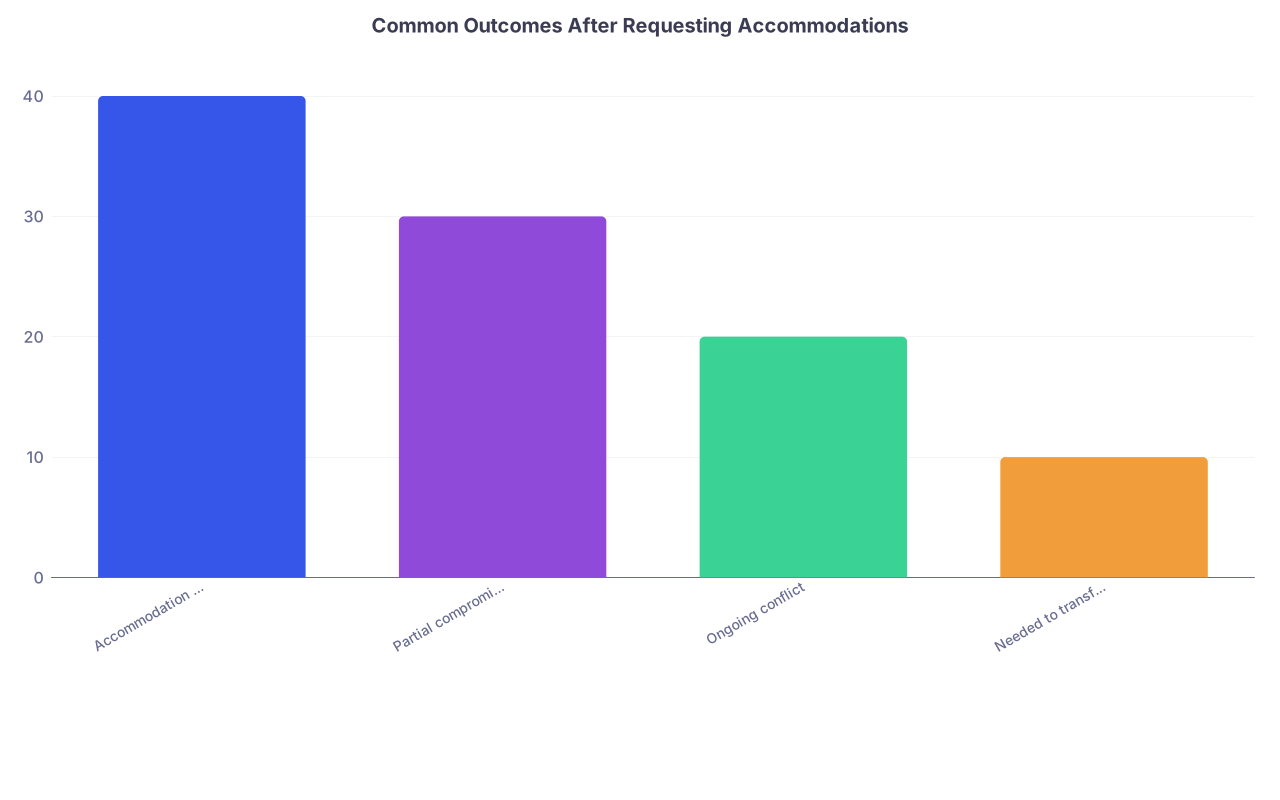
| Category | Value |
|---|---|
| Accommodation granted | 40 |
| Partial compromise | 30 |
| Ongoing conflict | 20 |
| Needed to transfer/leave | 10 |
(The exact numbers will vary by institution, but you get the point—many people do get something, even if it’s not perfect.)
10. Quick Mental Anchors When You Start Doubting Yourself
When a PD minimizes you, the doubt creeps in fast. A few anchors to keep in your pocket:
- “If my condition were visible—on crutches, in a wheelchair—would I still be questioning this ask?”
- “My clinician believes this is medically necessary. My PD is not my treating provider.”
- “Accommodations are about equity, not favors.”
- “If I make a medical error because I worked beyond my safe limits, no one will say, ‘Well at least you didn’t inconvenience the schedule.’”
You don’t need to be on the brink of collapse to qualify for support. You’re allowed to intervene early.
Key Takeaways
- Stop trying to win your PD’s emotional approval; shift to clear, documented requests backed by policy and medical documentation.
- Use scripts that name your disability, separate it from “normal stress,” and repeatedly bring the conversation back to formal accommodations and institutional processes.
- Get everything in writing, involve disability services or GME early, and protect both your health now and your professional record for the future.