
Last year, a third-year at a very well-known East Coast med school sat in my office shaking. Not because of a bad evaluation, not because of a failed shelf. Because her dean had just told her, point blank, that applying for Step 2 accommodations would be “looked at very closely” and “might delay graduation.”
She had a documented learning disability. She’d had accommodations for years. But now? Suddenly there were “optics” and “concerns about professionalism.” Let me tell you what’s actually going on behind all that vague admin language.
This is the stuff nobody at the top schools puts in emails. But the deans say it in closed-door meetings. The program directors complain about it over drinks. And the disability offices sit right in the middle, trying to survive the politics.
The Real Power Players in Step Accommodations
Everyone thinks Step accommodations are just “NBME vs the student.” That’s not how it works in the real world at a top med school.
Here’s the actual triangle of power:
- The NBME/USMLE: decides yes/no on your Step 1/2/3 accommodations.
- The medical school: controls what documentation gets sent, how hard they push, and how much they “support” you on paper vs in reality.
- You: stuck between needing help and not wanting to be labeled a problem.
At most elite schools, the disability office is officially on your side. In practice, they sit under the same institutional umbrella as the dean’s office, student affairs, and the people who sweat about your school’s Step failure rate. That tension bleeds into everything.
At least three unspoken rules are operating in the background:
“We don’t want to create a paper trail that says you’re ‘weak’.”
Translation: If they document your functional limitations too honestly, it might be used later by hospitals, residency programs, or even lawyers. So they soften language. They underplay severity. And then your NBME packet looks lukewarm.“We’re fine giving you school exam accommodations… NBME is a different beast.”
They know full well NBME wants to see consistency over years and very specific testing data. But some schools keep your in-house accommodations vague or informal—email from a course director, “quiet room when possible,” etc.—because it keeps flexibility for them and less liability. Then they act surprised when NBME denies your request: “We tried.”“Delaying Step hurts our metrics and your match.”
At high-prestige schools, delays in Step 1/2 are tracked. Administrators review “time-to-graduation” and board pass rates like a religion. A simple reality: students needing accommodations are statistically more likely to need extra time, sometimes multiple attempts. That makes them nervous, and the nervousness shows up as subtle pressure: “Are you sure you want to do this right now?”
They'll never say “don’t apply for accommodations.” Instead you hear:
“Let’s think carefully about whether this is truly necessary.”
“NBME is very strict, we don’t want you disappointed.”
“Maybe try it once without accommodations and see how it goes.”
I’ve heard every version. They all translate to the same thing: “Your request makes our lives harder.”
How NBME Actually Thinks (Not the Brochure Version)
You can read NBME’s official guidelines. They sound reasonable: provide documentation, show impairment, prove history of accommodations. The problem isn’t what they say. It’s how they apply it.
From the perspective of people who sit on those review committees, the internal questions look more like this:
Is this a lifelong, well-characterized condition?
ADHD documented since childhood with neuropsych testing at 10, 15, and 22 years old? That reads differently than “diagnosed by one psychiatrist six months before Step 1.”Is there a clear mismatch between achievement and effort?
E.g., brilliant med student with strong grades but slow reading speed documented on testing.Have accommodations been consistent across high-stakes exams?
SAT, ACT, MCAT, college exams, med school exams. If you suddenly develop “extra time needs” only for Step 1, they’re suspicious. They won’t say that explicitly. But they are.Does the documentation match the requested accommodation?
Slow reading speed on multiple standardized tests? 50% extra time makes sense. Vague “anxiety” and no performance data? Much weaker.
Now here’s the part most med students never hear:
At top schools, NBME reviewers assume the disability office knows the game. When your school’s documentation is thin, generic, or ambivalent, NBME reads that as a quiet “we’re not fully backing this.” I’ve literally heard:
“If the school isn’t clearly saying this is essential, why should we?”
So when a disability office writes something like, “Student may benefit from additional time and reduced-distraction environment,” instead of “Student requires 50% extended time and private room due to documented impairment in reading fluency,” your odds drop.
The Quiet Calculus at Top Med Schools
At big-name schools—Harvard, Hopkins, Penn, Stanford, UCSF, pick your favorite—there’s a specific reputational dance happening behind closed doors.
They care deeply about three numbers:
- Step pass rate on first attempt
- Median Step score
- On-time graduation rate
Anything that threatens those is treated as a risk. Accommodations, especially for Step, are perceived as risk. Not because these people hate disabled students, but because the system punishes them if your outcome looks bad on paper.
Here’s what actually happens:
A student asks for Step accommodations. The disability officer is sympathetic. The dean quietly asks them in a side conversation, “What’s your sense of their likelihood to pass even with accommodations?” If the answer sounds uncertain, suddenly the conversation with you turns into:
- “Let’s think about taking a research year.”
- “Maybe postpone Step until you’re 100% ready.”
- “We could consider a leave while we get more documentation.”
They frame it as support. Sometimes it is. Often it’s also strategic risk-shifting: if you fail, they want it to be after you’ve taken more time, not “on schedule” when your case hits their statistics.
There’s another layer: concern about residency programs. Some deans still believe, wrongly or not, that requesting Step accommodations will “raise questions” later. Officially, NBME doesn’t flag your score report as “accommodated.” Unofficially, some faculty wonder: if you barely passed with extra time, can you handle a brutal residency with pager chaos and no built-in accommodations?
That bias lives in the back of their heads, even when their mouths say “we fully support you.”
The Documentation Game: What Actually Works
Let’s talk tactics, because hoping the system is kind is naive.
You’re not just proving you have ADHD, dyslexia, a visual impairment, or a psychiatric disorder. You’re proving functional impact under standardized conditions. NBME reviewers are not your therapist; they’re auditors.
There are three documents that quietly matter more than everything else:
Recent, comprehensive neuropsych evaluation
Not a two-page letter. Not a primary care note. A 25–40+ page structured report with:- Objective test scores (WAIS, WJ, etc.).
- Specific findings about processing speed, working memory, reading fluency, or visual-motor integration.
- Explicit language linking those findings to time-based tasks and test-taking.
History of prior accommodations
Not “I used extra time in college sometimes.” They want:- Official letters or forms from college/university.
- Documentation for SAT/ACT, MCAT, LSAT, whatever you took.
- Concrete: 1.5x time, private room, breaks as needed, etc.
Clear, endorsement-heavy letter from your school’s disability office
The strongest letters do not waffle. They say:- “This student has been consistently granted X, Y, Z accommodations on all timed exams, including block exams and NBME subject exams.”
- “In our professional judgment, these accommodations are necessary to ensure equal access.”
What kills applications? Half-hearted, hand-wavy documentation. Things like:
- “Student has some difficulty with concentration in stressful environments.”
- “Student has a diagnosis of ADHD and is on medication.”
- “Student has been successful academically with support.”
That might sound supportive to you. To NBME, it reads: “This student is fine.”
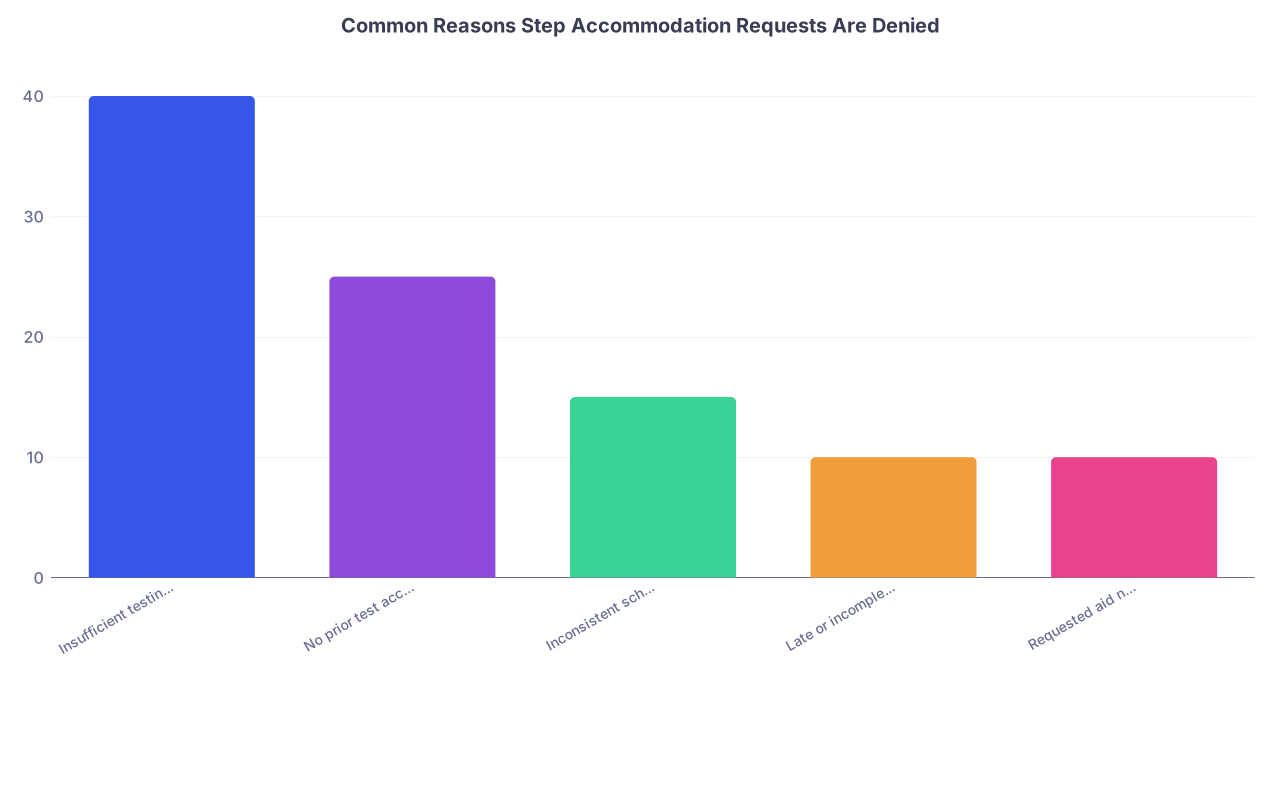
| Category | Value |
|---|---|
| Insufficient testing data | 40 |
| No prior test accommodations | 25 |
| Inconsistent school support | 15 |
| Late or incomplete paperwork | 10 |
| Requested aid not justified | 10 |
The Ugly Truth: How Timing and Strategy Really Work
Everyone focuses on “Do I qualify?” Wrong question. The real questions at a top med school are:
- When do you surface your needs?
- Who do you tell first?
- How much risk are you willing to take now vs later?
Here’s what I’ve seen work best over and over:
You start early, in M1 or M2, even if you don’t feel “bad enough yet.”
You push for formal accommodations on every major in-house exam. Not informal favors. Not “the course director lets me sit in a side room.” You want it documented through the disability office with clear wording and consistent implementation. That becomes your pattern of use, which NBME respects a lot more.
You accept that neuropsych testing is not optional if you’re going to need extra time on Step. You find a psychologist who knows high-stakes testing, not just basic ADHD screening. You do it many months before your Step application, because reports take time and NBME is slow.
You apply for timing accommodations with NBME as early as you can. If you get denied, you have time to appeal or adjust plans. At least two students a year at elite schools end up scrambling because their packet went in late, got denied, and then they’re staring at a test date with no backup.
And here’s the part admin will rarely say bluntly:
If you’re borderline, the safest pattern is often:
- Establish accommodations in pre-clinical years.
- Consistently use them on school/NBME shelf exams.
- Build a strong record before Step 2 CK.
Waiting until you “need” them for Step 2 only, with no history, is about the worst possible strategy.
What Top Schools Don’t Tell You About Internal Politics
Inside faculty meetings, certain phrases come up over and over:
- “Are we over-medicalizing normal performance differences?”
- “We’re setting students up for failure in residency if we protect them too much.”
- “We need to maintain the integrity of our exams.”
That last one—“integrity of our exams”—is often code for “we’re not comfortable giving you the same help NBME might deny, because it makes us look inconsistent.” So some schools intentionally offer less generous accommodations in-house than you might actually need, just so they don’t look “too loose” when NBME reviews their verification letters.
So you get this bizarre scenario:
You’re legitimately disabled. Your neuropsych data screams you need 100% extra time (2x). The disability office quietly says, “We can only approve 50% extra time; anything more will raise flags with the dean and NBME.” The NBME sees 50% time on school exams and now your request for 100% looks like an escalation. Denied.
I’ve seen that exact pattern.
There’s also the hidden fear of precedent. At top schools, administrators talk to each other. If they approve one very generous package, students talk, and suddenly five more show up with, “My friend got that.” Some offices clamp down deliberately to avoid that flood.
No one will put this in writing. But the decisions reflect it.

The Residency Question Everyone Tiptoes Around
Let’s get into the question that keeps students up at night:
Will Step accommodations hurt my residency chances?
Official answer: No. Programs don’t see if you tested with accommodations. They see a score (or pass/fail) and attempts.
Unofficial reality: What does affect your chances is:
- Delays in training (extra year, LOA, large gaps).
- Multiple attempts on Step exams.
- Letters or whispers suggesting “concerns about performance under pressure.”
If accommodations help you pass on the first attempt, on time, with fewer disasters? That’s better for your residency prospects than “toughing it out,” failing, and creating a visible red flag.
Some deans, especially older ones, still operate from a macho mindset: “Residency is hard; real doctors don’t need extra time.” They won’t say that to your face. They signal it with raised eyebrows and questions like, “How will you manage 28-hour calls?” That attitude sometimes translates into subtle discouragement from fully using your rights.
Here’s the actual calculus:
- If your untreated, unaccommodated performance is likely to lead to failure or barely scraping by, and you have a legitimate disability, not using accommodations is self-sabotage.
- If your documentation is thin and the school’s support is lukewarm, pushing for Step accommodations might lead to delays and denials that complicate your timeline.
The smart move is not heroics. It’s strategy: shore up documentation early, normalize your accommodations as part of your training, so by the time Step comes around, you’re not “the student asking for a special deal,” you’re “the student who’s always tested this way.”
| Aspect | Medical School Exams | NBME Step Exams |
|---|---|---|
| Documentation detail | Often minimal or moderate | High, formal, psychometric |
| Flexibility | High, case-by-case | Low, rigid criteria |
| Timelines | Weeks | Months |
| History requirement | Sometimes none | Strongly preferred |
| Appeal process | Informal, local | Formal, slow, high bar |
How to Actually Protect Yourself in This System
Let me be blunt: you cannot trust “it’ll work out.” You need to protect yourself on three fronts—evidence, timing, and narrative.
Evidence means you:
- Get a proper neuropsych eval, not a five-minute convenience diagnosis.
- Keep copies of all documentation—letters, emails, approvals. Never assume the school’s portal will be eternally accessible or complete.
- Track your own performance patterns: time-outs on practice tests, how many questions left blank, how symptoms manifest. That detail helps your clinician and disability office make a stronger case.
Timing means you:
- Engage the disability office early in MS1/MS2, not three months before Step.
- Apply for NBME accommodations with a buffer—if they say “8–12 weeks,” you assume 16.
- Decide about possible delays or LOAs with full information, not last-minute panic.
Narrative means you:
- Stop apologizing for needing accommodations. You frame it as what it is: the legitimate adjustment required for you to demonstrate competence fairly.
- Present a consistent story: documented, longstanding, functionally impactful condition; history of accommodations; stable treatment plan.
- Don’t let administrators gaslight you into thinking you’re “gaming the system” when you’re just asking for what the ADA already gives you.

| Step | Description |
|---|---|
| Step 1 | Recognize consistent test difficulty |
| Step 2 | Contact disability office early |
| Step 3 | Obtain neuropsych testing |
| Step 4 | Establish school exam accommodations |
| Step 5 | Use accommodations consistently |
| Step 6 | Prepare NBME application |
| Step 7 | Schedule Step with accommodations |
| Step 8 | Appeal or adjust timeline |
| Step 9 | Consider delay or alternate plan |
| Step 10 | NBME decision |
Where This Is All Heading: The Future of Accommodations
Step 1 going pass/fail did not fix this, by the way. It just shifted the obsession to Step 2 CK and clinical performance. In some ways, it tightened the scrutiny on accommodations, because schools now defend Step 2 like their ranking depends on it—which it often does.
I see three emerging trends behind the scenes:
More legal pressure
Quietly, more students are talking to lawyers when NBME denies accommodations that are clearly warranted. A few high-profile cases have already made NBME more careful, but they haven’t made the process friendlier. They’ve made it more bureaucratic.Data-driven gatekeeping
Some schools are starting to use their own internal data—who passed, who failed, who needed remediation—to justify being stricter about who they “fully endorse” for NBME accommodations. That can help a few, but it also leads to gatekeeping based on predictions, not just need.Residency programs slowly catching up
As more residents disclose disabilities and request accommodations at the GME level, the whole culture is going to have to shift. But we’re not there yet. Right now, you’re in a transition era where policies are more progressive than attitudes.
If you’re coming up in this system now, your job is not to wait for the culture to evolve. Your job is to play the current game with your eyes fully open.