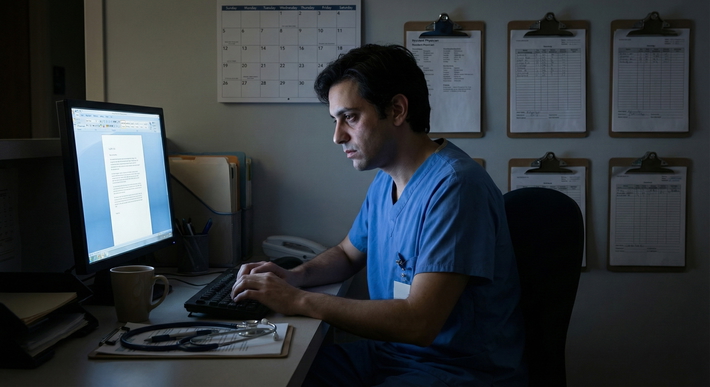
What happens when you wait until after you fail an exam, get written up on a rotation, or bomb OSCEs to finally admit you needed disability accommodations?
Let me be blunt: in medical education, late accommodation requests almost always look worse, work worse, and feel worse than early ones. The system is not kind to “I’ll just push through” people who speak up after everything has gone sideways.
You are not the first student to misjudge this. I have watched people with ADHD, chronic illness, anxiety, hearing loss, learning disabilities, and visual impairments all make the same strategic mistake: they ask for help after there is already a mess on the record.
This article is about avoiding that trap.
The Hidden Timeline You Ignore At Your Own Risk
Most students think there are only two timelines:
- Their personal suffering timeline (when symptoms get bad enough), and
- The official academic timeline (when exams or rotations start going badly).
There is a third timeline that matters far more: the institutional process timeline.
You will underestimate this. Almost everyone does.

| Step | Description |
|---|---|
| Step 1 | You realize you are struggling |
| Step 2 | Contact disability office |
| Step 3 | Collect documentation |
| Step 4 | Formal review by committee |
| Step 5 | Decision and accommodation plan |
| Step 6 | Implement for future exams or rotations |
Here is where people get burned:
- They assume accommodations can be turned on “for next week’s exam.”
- They assume verbal agreements from kind faculty are the same as formal accommodations.
- They assume “I told someone” equals “the institution is now responsible.”
Wrong on all three.
Most schools require:
- Written request
- Recent documentation (sometimes from specific types of providers)
- Internal review meetings (which do not happen daily)
- Communication to course directors / testing services
- Time to actually implement logistics (exam rooms, proctors, assistive tech)
That can easily stretch into 3–8 weeks.
If you are asking two weeks before a shelf exam, or in the middle of a failing rotation, you are functionally asking the school to bend time. Some offices will try to help. Some cannot. And none of them will retroactively rewrite the past.
The Big Misconception: “If I Ask Early, I’ll Look Weak”
This one kills careers.
Many students delay because they are afraid of three things:
- Being labeled “the disabled student”
- Not being taken seriously as future physicians
- Having something “on their record” that might hurt residency chances
So they wait. And wait. And explain away every bad outcome as temporary:
“I just didn’t sleep.”
“That exam was weird.”
“My attending is just hard on everyone.”
Then Step 1, Step 2, OSCE, or the first real inpatient month hits. And the wheels come off.
Here is the part people do not want to hear:
- Residency programs do not see your disability documentation.
- They do see: course failures, repeated rotations, professionalism concerns, extended timelines, leaves of absence, unexplained Step score gaps.
Guess which looks worse?
Late accommodations often increase the risk you will end up with the exact record you were trying to avoid.
How Late Requests Actually Look To The Institution
I am going to say the quiet part out loud.
When you request accommodations after:
- Failing multiple exams
- Being placed on academic probation
- Having multiple “professionalism” flags
- Getting negative evaluations about “engagement” or “reliability”
…your request, fairly or unfairly, is filtered through suspicion.
I have heard versions of this in committee meetings:
- “Why are we only hearing about this now?”
- “Is this an attempt to explain away poor performance?”
- “If it was this impairing, why did they pass the first year without saying anything?”
- “Are we rewarding a pattern of not taking responsibility?”
None of that is kind. It is also real.
Contrast that with a student who comes before problems explode:
- “I have a documented condition and historically have needed X.”
- “Medical school is more demanding than prior environments; I want to set things up properly before exams start.”
- “Here is my testing history and what has worked.”
That reads as proactive, responsible, self-aware.
Same diagnosis. Same needs. Completely different narrative.
The Backfire: No Retroactive Accommodations
You need to understand one ugly rule almost all schools and national boards follow:
Accommodations are almost never granted retroactively.
Meaning:
- You fail an anatomy exam without accommodations → you then get approved → the failing grade usually stays.
- You have a disaster OSCE due to unaddressed anxiety or processing issues → you get extended time for future OSCEs → but that first one? Still counts.
- You bomb Step 1 because you did not request accommodations from NBME/USMLE in time → they do not allow a retake because you “should have had” accommodations the first time.
Testing agencies are especially brutal about this.
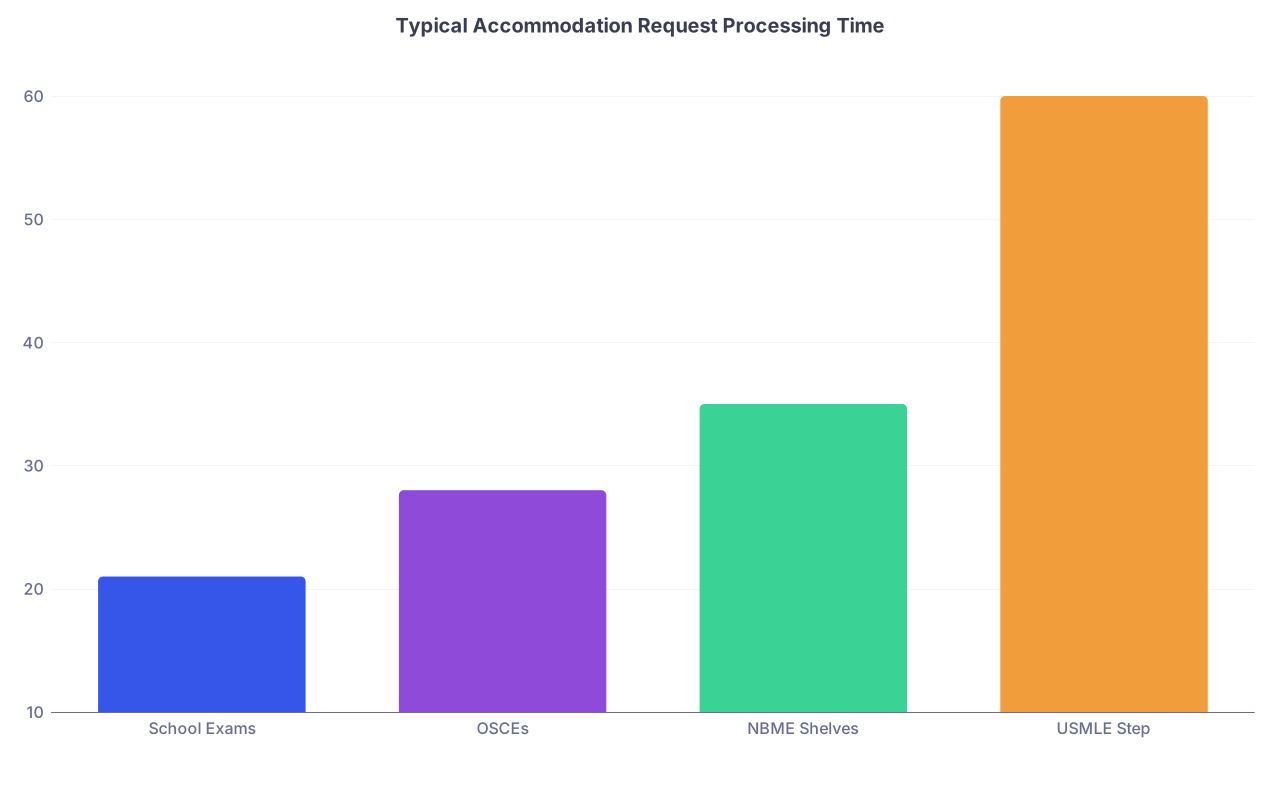
| Category | Value |
|---|---|
| School Exams | 21 |
| OSCEs | 28 |
| NBME Shelves | 35 |
| USMLE Step | 60 |
Those are approximate days. Not hours.
If you send your documentation to USMLE one month before your planned Step exam and expect a quick “yes,” you are gambling with your entire board score. And they do not care that you “did not realize it took this long.” Their position will be: you had years to plan.
Late requests backfire because they:
- Cannot fix what already happened.
- Often cannot be processed before the high-stakes thing you are panicking about.
- Make future appeals sound like damage control instead of legitimate planning.
The Temporary Coping Tricks That Come Back To Bite You
Here is another pattern that fools people: the patchwork coping strategy.
You:
- Ask individual professors informally for extensions
- Get classmates to share class notes or recordings
- Sit near the front, bring your own assistive tech, or over-study to compensate
- Stack caffeine on top of anxiety on top of all-nighters
And you “get by.” Barely.
So you tell yourself:
“I am managing. I do not really need formal accommodations.”
Until you hit something where:
- There is a standardized format (OSCE, shelf, NBME, USMLE)
- Rules are strict, timing is inflexible
- Local professors cannot quietly bend things for you
Then you finally go to the disability office. Now you have a long track record of “you coped without formal help.”
So committees ask:
- “Why is this only a problem now?”
- “They passed everything else under standard conditions. What changed?”
- “Is this really an impairment issue or just a Step-anxiety issue?”
Your past success without accommodations is now being used against your present need for them. Because you tried to be tough and low-maintenance.
Step and Board Exams: The Worst Place To Be Late
If you remember nothing else, remember this:
Do not wait until Step or Level exams to seek accommodations.
USMLE, COMLEX, NBME – they all require detailed documentation, often:
- Neuropsychological testing within a certain number of years
- Clear history of impairment in similar testing conditions
- Evidence that accommodations are consistent with your prior use
If you stroll in as a second-year and say, “By the way, I might have ADHD, can I get extra time for Step 1?” you are putting yourself in a near-impossible position.
You need:
- Time to get evaluated (neuropsych testing often has a months-long waitlist)
- Time for the report to be written
- Time for your school to submit supporting materials
- Time for the testing board to say yes, no, or “give us more data”
Students who delay this end up with three equally bad options:
- Take Step without accommodations and underperform.
- Delay Step (sometimes by 6–12 months) waiting for evaluation/approval.
- Rush through flimsy testing or incomplete documentation that boards reject.
I have seen students stuck in “accommodation limbo” for an entire year because they waited until late MS2 to start this process.
Clinical Years: The Silent Disaster Zone
First- and second-year students often think, “I will see how I do when things get more clinical before deciding about accommodations.”
That sounds rational. It is not.
Clinical years make everything harder to accommodate:
- Rotations are spread across multiple sites with different cultures.
- Schedules change weekly or daily.
- You are now dealing with patient care, not just exams.
If you come to the disability office after a bad eval on Surgery with comments like:
- “Slow to respond”
- “Disorganized”
- “Seems disengaged or fatigued”
…your request arrives with a cloud over it. Especially if there were earlier comments the school can now see as a pattern.
Some accommodations (like protected time for treatment, assistive hearing devices, modified call schedules) need to be baked into your clinical plan before attending physicians start forming impressions. You do not want your first impression to be “unreliable,” and then later say, “Actually, I have a medical condition that explains all this.”
I have watched students try to rehabilitate reputations that never needed to be damaged in the first place.
Documentation Mistakes That Delay Everything
Even when students do finally request accommodations, they often trip over documentation.
Common self-sabotaging moves:
- Submitting a one-line note: “Patient has ADHD.” That is not documentation.
- Using a 7-year-old psychoeducational report from high school without updated testing.
- Getting a letter from a friendly PCP instead of a qualified specialist when the school specifically requires a psychologist, psychiatrist, or relevant subspecialist.
- Failing to clearly state functional impairments (e.g., “requires extended testing time due to documented slowed processing speed”) instead of vague stuff like “anxious under pressure.”
The later you request accommodations, the more every week of back-and-forth over documentation hurts you.
Because while you are hunting down old records, arguing with evaluators, or trying to schedule testing, your exams and rotations keep going. Under unaccommodated conditions. Creating more grades, more evals, more evidence that the school and boards will later use to question how impairing your condition really is.
Why “I Didn’t Know I Could Ask” Will Not Save You
You may be thinking: but no one told me any of this.
I believe you. Many schools bury disability information in orientation slides no one remembers.
But here is the cold reality: systems rarely care that you were confused.
I have seen students try to appeal:
- “I was not aware I could seek accommodations; if I had known, I would have asked earlier.”
- “In my culture/family, disability is stigmatized, so I minimized my symptoms.”
- “My prior school gave me informal extra time without documentation, so I thought that was enough.”
Committees might show some compassion. They will not usually erase failures, board scores, or professionalism flags because you were uninformed.
Waiting and then appealing to ignorance does not work as a protective strategy. It just adds more emotional pain on top of the academic damage.
How To Request Early Without Over-Committing
You might worry: “If I ask now, I’m locked into accommodations forever” or “It will define me as a student.”
No. You can protect yourself without over-pathologizing your entire identity.
A practical approach:
- If you have any prior diagnosis that impacted learning, testing, stamina, or sensory processing, assume you are high risk for needing accommodations in medical school.
- Register with the disability office early (before M1 classes start or early in M1), even if you are not yet sure what you will use.
- Submit documentation and have a formal plan drafted now, with the understanding that you can choose when to actually implement specific accommodations.
You are building an infrastructure. A safety net.
Think of it like malpractice insurance. You hope you never need to lean on it heavily. But you would be reckless to practice without it.
The Real Mistake: Treating Accommodations As a Last-Resort Rescue
The biggest conceptual error I see is this: students treat accommodations like emergency life support.
“I’ll use that if everything else fails.”
That mindset guarantees you will deploy them:
- In a panic
- Under scrutiny
- After damage
- With less institutional sympathy
Accommodations are not a rescue team. They are part of your baseline architecture for functioning in a demanding environment.
When you see them that way, you stop asking, “Do I deserve this?” and start asking: “What setup will give me a fair chance to demonstrate what I actually know and can do?”
That is the right question.
A Simple Rule To Avoid Backfire
Use this rule of thumb:
If a condition has affected your academic performance at any point before medical school, assume it will be magnified in med school. Not reduced.
Do not do the “I did fine in undergrad, so I will be fine here” routine. Medical school compresses content, raises stakes, and disrupts sleep and routines. Under those conditions, mild impairments in easier environments become serious barriers.
One More Harsh Truth: Toughing It Out Is Not Professionalism
Some students frame not requesting accommodations as “being professional” or “not burdening the system.”
That sounds noble. On paper.
In reality, here is what happens when you “tough it out” and collapse in clinical years:
- Colleagues pick up your dropped balls.
- Nurses learn not to trust you with time-sensitive tasks.
- Attendings quietly warn each other that you are “a concern.”
- Administrators spend more time creating remediation plans and documentation around your performance.
That is not professionalism. That is unmanaged impairment.
Professionalism is using every legitimate tool available to ensure you can reliably show up, think clearly, and practice safely. Early accommodations are part of that toolkit.
Your Next Step Today
Do not just nod and move on.
Today, not next month, do this:
Open your school’s website and find the disability or accessibility services page. Read the exact process and documentation requirements, then make a decision: are you going to contact them this week to at least register and ask specific questions about your situation?