
It’s 6:45 pm. Half the team already left. You’re sitting in the call room, charting with one hand and doom-scrolling with the other, staring at the “New Message” window addressed to your Program Director. Subject line: “Request for Meeting (Personal/Health).”
Your finger is hovering over “Send” and your brain is screaming:
“If I tell them I need accommodations, they’re going to think I’m weak. Or unreliable. Or a problem. What if they don’t renew my contract? What if they quietly blacklist me when other programs ask about me? What if this ruins everything?”
That’s the mental spiral, right? You’re not making this up. You’ve heard comments in the workroom:
“Back in my day we just sucked it up.”
“Residency isn’t for everyone.”
“People want special treatment now.”
So you sit there, stuck between:
– Not disclosing and quietly falling apart
– Disclosing and being terrified it’ll tank your career
Let me walk straight into the thing you’re actually afraid of:
What You’re Imagining Your PD Will Think (vs. Reality)
In your head, it goes like this: you disclose, they raise an eyebrow, mentally downgrade you from “strong” to “borderline,” and start looking for reasons to label you a liability.
Sometimes? With the wrong PD, in the wrong program culture? That can partially happen. I’m not going to lie and say there are zero bad actors. I’ve seen residents pushed out under the vague umbrella of “not a good fit” when what really happened was untreated bias plus poor support.
But that’s not the full story. And it’s not even the dominant story anymore.
Here’s the thing no one tells you when you’re spiraling: most PDs already know their residents are not okay. They see the call schedules. They know the burnout rates. They get the emails from GME about mental health, disability law, accommodations, suicide prevention. They’re way more aware of this stuff than your average attending in the lounge complaining about “resilience.”
So when you disclose well—meaning with some clarity, boundaries, and a focus on “this is what I need to succeed”—most PDs don’t think “weak.” They think:
- “Okay, liability if we ignore this. How do we document and support?”
- “What concrete things can we change that still meet ACGME requirements?”
- “Who do I loop in—GME, wellness, disability office, HR?”
They’re looking at you partly as a trainee, yes, but also as someone they’re legally and ethically responsible for.
That doesn’t make it less scary emotionally. But it does mean the script in their head is different than the horror movie playing in yours.
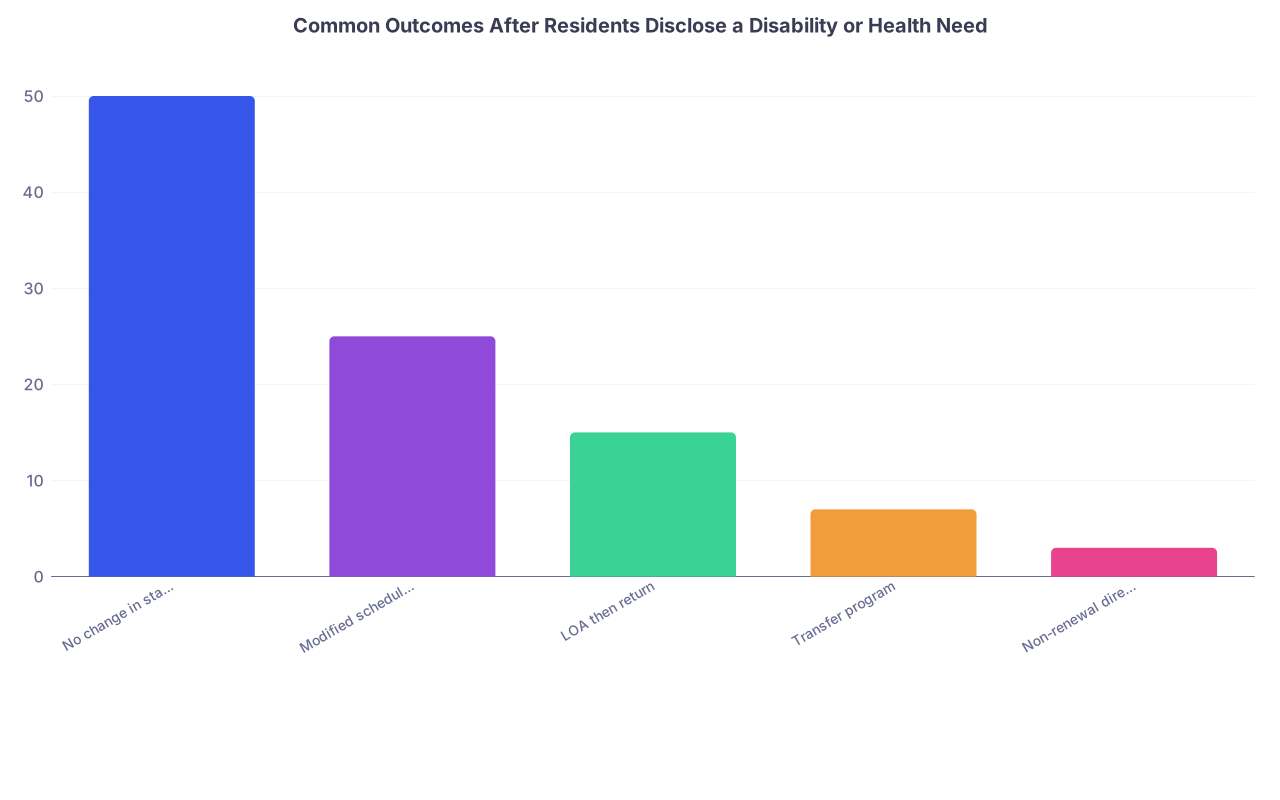
| Category | Value |
|---|---|
| No change in status | 50 |
| Modified schedule/rotation | 25 |
| LOA then return | 15 |
| Transfer program | 7 |
| Non-renewal directly tied | 3 |
Are these numbers exact everywhere? No. But they’re in the ballpark of what I’ve seen across big academic centers: most people who disclose stay, with some modification. Very few get directly pushed out because of the disclosure alone. That doesn’t eliminate risk—but it changes the odds.
What Actually Happens When You Disclose (Step by Step)
Let’s take the drama out of it and just walk through what usually happens in a decent program.
You say something like:
“I’m dealing with a health/disability issue that’s impacting my training. I’d like to talk about potential accommodations and make sure I can keep meeting expectations safely.”
From there, several things tend to unfold:
They loop in the “system”
This might be GME office, a disability services office, HR, or an institutional ADA coordinator. Why? Because PDs are not supposed to be making up accommodations off the top of their head. They need backup and structure.You get asked for documentation
Diagnosis letter, recommendations from your treating clinician, maybe neuropsych testing if it’s ADHD/learning-related, etc. This is where people panic: “If they see the diagnosis, I’m done.” But that information is usually siloed in HR/ADA/disability office, not free-floating in every attending’s inbox.A formal interactive process happens
That’s the legal phrase. You and someone (PD, GME, ADA officer) talk through:
– Essential functions of your role
– What specific barriers you’re facing
– What accommodations might help without breaking ACGME or patient safety rulesThey trial accommodations
Adjust call frequency, tweak rotation order, slightly reduced schedule, extra time on notes, assistive tech, dedicated therapy time blocked, etc. It’s rarely perfect on the first try.Things get re-evaluated
Are you meeting milestones? Are other residents getting crushed by your schedule changes? Is patient care safe? You’re not on autopilot after disclosure; you’re under a bit of a microscope for a while.
None of that screams “weak.” It screams “legal risk management + trainee support.”
The worst feeling is that “microscope” part. The hyper-awareness: “If I’m one minute late now, it looks like I’m using my disability as an excuse.” That’s real. But being watched after disclosure is still usually safer than quietly spiraling without guardrails.
What PDs Actually Care About (More Than Whether You’re “Weak”)
PDs generally care about three big-picture things:
- Can you safely care for patients?
- Are you meeting ACGME milestones/board eligibility?
- Are you going to blow up the program’s life—lawsuits, scandals, constant crises?
That’s it. They don’t need you to be invincible. They need you to be stable enough.
So when you disclose, the real questions in their head sound like:
- “Is this temporary and manageable with some schedule changes, or is this deeply impairing?”
- “Is this person engaging with help, or resisting everything?”
- “Do I have institutional support to handle this without stepping on a legal landmine?”
- “Can I still, in good faith, sign off on them as a safe future attending?”
Your job, in that conversation, isn’t to prove you’re not “weak.” It’s to show you’re:
- Insightful (you can see where you’re struggling)
- Proactive (you’re seeking help, not avoiding it)
- Collaborative (you’re open to solutions, boundaries, and feedback)
Weak is pretending nothing’s wrong, tanking your performance, snapping at nurses, and then acting shocked when you get called into a remediation meeting.
Strong is: “Here’s where I’m struggling. Here’s what I’m already doing. Here’s what I think might help, and I’d like to work with you to make this sustainable.”
The Risks You’re Terrified Of—And How Real They Are
Let’s name the monsters.
“They’ll fire me or not renew my contract.”
Could that happen? Yes. But here’s the part people skip: it almost never happens out of the blue just because you disclosed. It usually follows a pattern:
- You were already having clear performance issues
- You had multiple documented warnings/remediation
- You or the program couldn’t find accommodations that allowed safe practice
- Or you stopped engaging with the process entirely
If you’re currently functioning, passing rotations, not on formal remediation yet, and you disclose with a legit plan and documentation—non-renewal purely for disclosing is a litigation magnet. Most institutions don’t want that fight.
“They’ll quietly tank my career with other programs or employers.”
Backchannel gossip is real. But again, context matters.
If you leave after a documented, collaborative attempt to accommodate, many PDs will say something vague like “needed a different environment” or “personal/health reasons” without sabotaging you. Some will even go to bat for you, especially if you were honest and professional through the process.
If you implode, ghost people, or blow up bridges? Different story.
“Everyone will know, and I’ll be ‘the problem resident.’”
Here’s the hard truth: people probably already know something is off if you’re really struggling. The question is whether the story is:
“Yeah, they’ve been having a rough time but they’re trying, got support, and things are better.”
Or:
“No one knows what’s going on with them, it’s just chaos, and we’re picking up the pieces.”
Your diagnosis details don’t get blasted on a group email. The specifics are usually tightly controlled. Will your chiefs know about schedule changes? Yes. Some attendings? Probably. But vague “health/disability reasons” is typically as far as it goes.
“They’ll think I’m using this as an excuse.”
This one stings because you’ve probably heard someone say it about someone else.
Here’s the difference: excuses avoid responsibility. Accommodations re-shape it.
If you walk in saying, “Because of X, I can’t do nights, can’t do procedures, can’t document quickly, and I don’t really have a plan”—that’s a problem.
If you say, “Because of X, I’m getting these treatments, here’s documentation, and these specific accommodations will help me meet the same standards”—totally different conversation.

What “Reasonable Accommodations” Actually Look Like in Training
People imagine accommodations as some wild special treatment, like you get out of all the hard stuff. That’s not how it works.
Real examples I’ve seen:
- A resident with severe migraines moved away from brutal 28-hour calls to night float, plus designated dark/quiet break space
- A trainee with ADHD allowed noise-cancelling headphones for charting and structured checklists, plus slightly protected start-of-day planning time
- A resident with major depression got weekly protected therapy time (blocked on schedule) and staggered return from leave instead of full-speed immediately
- A trainee with a physical disability got ergonomic adjustments, extra time for procedures initially, and help with physically demanding rotations scheduling
Are there limits? Yes. You still have to meet the essential functions and competencies of your specialty. You still have to be able to manage acute care, work nights in many fields, take call, and make time-sensitive decisions.
But the idea that any accommodation = you’re “not really doing residency” is garbage. Everyone’s training is slightly different anyway; yours might just be more intentional and documented.
| Need Type | Possible Accommodation |
|---|---|
| Mental health | Protected therapy/psych visit time |
| ADHD/learning | Checklists, reduced distractions |
| Physical limitation | Adjusted rotations, ergonomic tools |
| Chronic illness | Clustered appointments, schedule tweaks |
| Sleep-sensitive | Modified call structure when possible |
When You Probably Should Disclose (Even If You’re Terrified)
There are some lines where “just power through” stops being brave and starts being dangerous.
You’re past that line if:
- You’re making or almost making serious patient safety errors because of symptoms
- You’re constantly getting “below expectations” for things tied directly to your condition
- You’ve had suicidal thoughts, plans, or close calls and are still working full blast
- You’re hiding treatments (like meds that affect alertness) from occupational health or your PD
- You’re on the edge of collapse and your only real plan is “hope this magically gets better”
At that point, not disclosing isn’t protecting your career. It’s setting up a crash that will be 10x harder to recover from—professionally and personally.
Preparing for the Conversation So You Don’t Fall Apart in the Chair
If you’re going to do this, don’t wing it.
Before you meet your PD:
- Write down 3 things: what’s happening, how it affects your work, what you’re already doing to manage it.
- Get a letter or note from your treating clinician that includes diagnosis (if you’re okay with that), current treatment, and suggested accommodations.
- Have 1–2 specific accommodation ideas ready, not a wishlist of 10. For example: “One half-day per week protected for appointments for the next 3 months,” or “Temporary reduction in 28-hour calls while medication is being adjusted.”
- Decide what you won’t share. You’re allowed privacy about details of trauma, your entire psychiatric history, or specific therapy content.
And then, in the actual meeting, aim for sentences like:
“I want to make sure I can continue in this program safely and effectively. I’ve been diagnosed with [X] and I’m in treatment. My main challenges on the job right now are [Y and Z]. I’d like to explore accommodations such as [A] to help me meet expectations.”
Not an apology tour. Not a confession. A professional conversation about how to keep doing your job.

The Future: You Are Not the Last Trainee with a Disability
There’s a bigger picture here that your anxiety won’t let you see: you are not an outlier. You’re just one of the few thinking about saying it out loud.
Medicine is slowly, painfully dragging itself into reality: trainees get sick, trainees have disabilities, trainees have psychiatric diagnoses, and pretending otherwise kills people.
You disclosing—carefully, professionally—doesn’t just impact you. It forces your program to clarify their processes. It makes the next resident’s request a little less “unprecedented.” It’s not your job to fix the system, but your existence inside of it is already doing more than you think.
And no, that doesn’t mean you owe anyone your story. Self-preservation comes first. But you’re not weak for needing something different to get through this. You’re human. And humans still make damn good doctors.
FAQ (Exactly 5 Questions)
1. Should I disclose before I even start residency or wait until there’s a problem?
If your condition is stable, well-managed, and unlikely to collide with core duties (call, nights, procedures), I’d usually wait and see how you function in the actual workload before formally disclosing. If you already know you’ll need structural changes from day one (can’t safely work nights, need a mobility accommodation, etc.), earlier is better so schedules can be adjusted without last-minute chaos. But I’d route that through GME or the disability/ADA office, not just an offhand email to your PD with your entire medical history.
2. Will this follow me forever when I apply for fellowships or jobs?
Not in the way you think. Your exact diagnosis is usually not traveling in your letters. What travels is: “reliable vs unreliable,” “safe vs unsafe,” “professional vs chaotic.” If you disclose, get accommodations, and then perform solidly? Most PDs will describe you as someone who dealt with health issues responsibly and is now stable. If you go up in flames trying to hide everything, that story follows you.
3. What if my PD reacts badly or dismissively when I disclose?
Then you escalate. Document the meeting in a neutral email (“Per our discussion today…”) and loop in GME, the institutional ADA/disability office, or even physician well-being services. You’re allowed to say, “I’m concerned my needs aren’t being addressed appropriately and I’d like formal guidance.” You’re not trapped with a single person’s reaction, even if they’re the PD.
4. Can I just go on a leave of absence instead of asking for accommodations?
Leave of absence can be appropriate if you’re too unstable or impaired to function in any reasonable version of the job right now. But LOA is not a magic “I’ll just disappear and come back and everything will be fine.” You still re-enter with the same brain, body, or condition. Often the best path is a combo: brief LOA to stabilize + accommodations and a planned, gradual return. Skipping accommodations entirely just sets you up to crash again.
5. How do I know if what I’m dealing with “counts” as a disability worth disclosing?
The legal language is broad: a physical or mental impairment that substantially limits one or more major life activities. In real life terms, if your condition is significantly impacting your sleep, concentration, movement, emotional regulation, or ability to safely and consistently do your job, it’s probably “enough.” You don’t need to wait until you’re hospitalized or on the edge of getting fired. If you’re asking this question and feeling scared it might be “serious,” that’s already your sign to at least talk confidentially with a therapist, physician, or disability office about your options.
Before you do anything else, pick one low-risk step you can take today:
Open your email, draft a message to yourself with three bullet points—what you’re struggling with, what you’re afraid of if you disclose, and what you’re afraid of if you don’t. Seeing those fears written down will make the next move—whether that’s talking to a therapist, reaching out to GME, or scheduling that meeting with your PD—just a little less paralyzing.