
It’s 11:47 p.m. You’re doom-scrolling Reddit, r/medicalschool and SDN open in ten tabs, searching “Step accommodations residency” like it’s going to give you a straight answer this time. You used accommodations on Step. Maybe extended time, maybe separate room, maybe some assistive tech. And now you’re stuck on one terrifying loop:
“Did I just quietly ruin my residency chances? Are programs going to blacklist me behind the scenes and I’ll never even know?”
Yeah. I know that exact pit-in-stomach feeling. Let’s walk through this like two people who both overthink everything.
First: The Big Scary Question — Can Programs Even See My Accommodations?
Short answer you actually care about: USMLE/Step score reports do NOT list accommodations. Period.
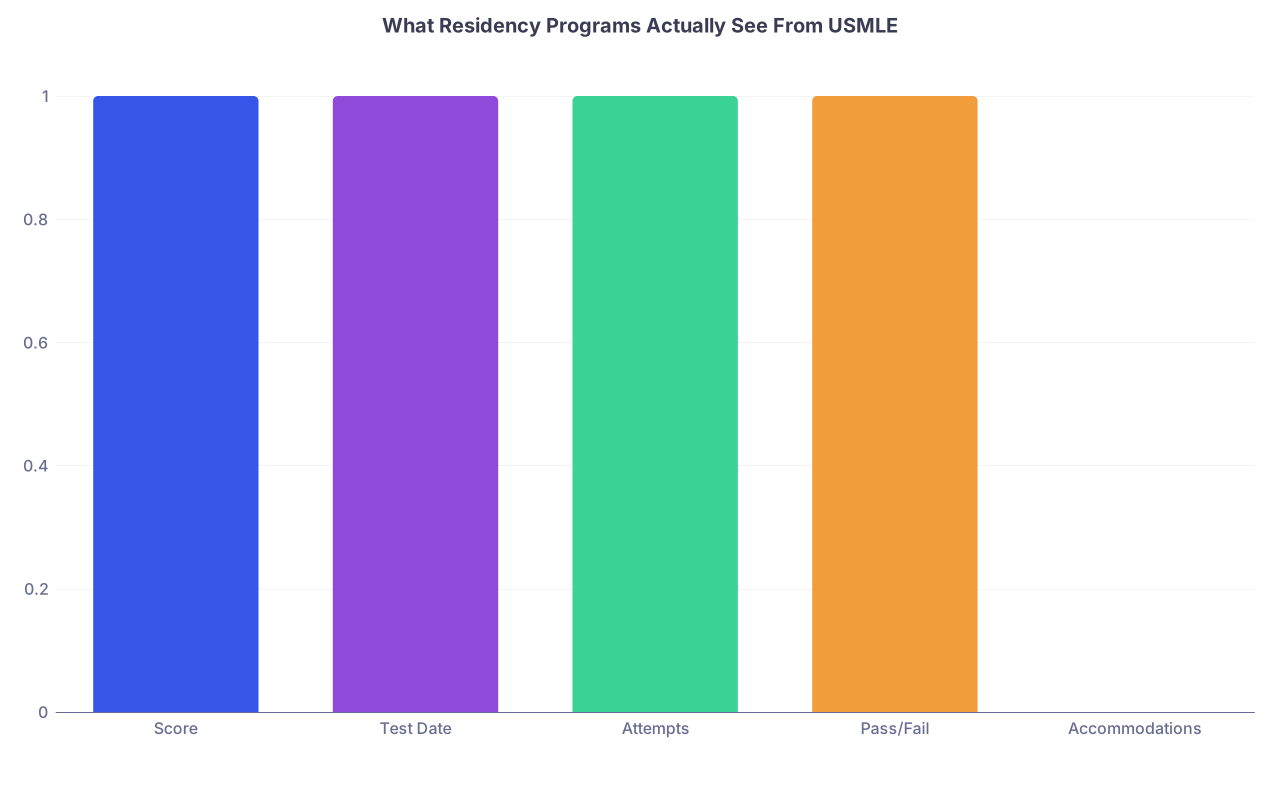
Your Step 1 / Step 2 CK transcript that programs receive shows:
- Your score (or pass/fail)
- Your test date
- Whether you passed/failed
- Number of attempts
What it does not show:
- That you used extended time
- What type of accommodation you had
- The reason for the disability
- Any “flag” saying “this person had help”
Programs get your score. Not your disability file.
Same thing for COMLEX, by the way: accommodations aren’t listed on the score report.
Does this magically solve everything? No. Because then your brain jumps to the next what-if.
“Okay, But… What If My School Tells Them?”
This is the next spiraling thought: My dean’s letter is going to out me. Or my transcript. Or something in my file.
In practice, for most students, schools do not disclose disability or accommodations by default. Reason: it’s walking into massive ADA/Section 504 territory, and nobody wants that lawsuit.
Where disability info might show up:
- If you explicitly disclose it in your personal statement
- If you tell a letter writer and they mention it (“Despite ADHD…” “Despite anxiety…”)
- If you have a leave of absence and your school is vague about why (and you choose to clarify)
- If you specifically ask your dean or disability office to include it somewhere
Otherwise, for the majority of applicants, the dean’s letter (MSPE) is pretty dry: clerkship grades, comments, professionalism issues, academic history. Not “this person had time-and-a-half on Step 2.”
If you haven’t explicitly told people “write about my disability” or “mention my accommodations,” odds are very high nobody is saying anything.
Does every school follow perfect policy? No. I’ve seen clumsy comments before. But that’s an exception, and usually fixable if you catch it early.
If you’re seriously worried:
- Ask your disability office or student affairs: “Is my use of USMLE accommodations disclosed anywhere in my MSPE or transcript?”
- Ask plainly. Get a clear answer in writing if you can.
You’re allowed to want receipts.
How Programs Actually Think (Even If Your Anxiety Doesn’t Believe It)
I’m going to say something that might sting first, then help:
Programs are not sitting around obsessing over whether someone once used 50% extra time.
They’re obsessing over:
- Are you going to show up?
- Are you going to pass your boards on time?
- Are you going to function on call?
- Are you going to get them in trouble with GME or ACGME?
So if they had two files in front of them:
- Applicant A: used Step accommodations, passed first try, strong evals, no professionalism issues.
- Applicant B: no known accommodations, failed Step 2 once, marginal evals.
They’re picking Applicant A. Every time.
I’ve seen program directors literally say: “I don’t care if you take it on Mars, in a sensory deprivation tank, with three sets of earplugs—just pass it.”
That’s the real calculus.
What makes you risky in their eyes is:
- Multiple exam failures
- Inability to complete rotations
- Tons of unexcused absences
- Serious professionalism red flags
Not “needed extra time but passed.”
The Dark Fear: Secret Blacklists
Let’s address the nightmare scenario head‑on: “Are they secretly blacklisting people with accommodations?”
For a residency program to actually “secretly” blacklist you for using legally protected accommodations, they’d need:
- To know you used accommodations (which they typically don’t from your score report), and
- To overtly discriminate against you because of a disability.
Is it theoretically possible someone, somewhere, in some toxic program does something shady? Sure. People are human. Some are trash.
But:
- They’d be legally exposed if there was any evidence.
- They’d need a way to reliably identify who did or didn’t get accommodations. They don’t have that.
- NRMP and ACGME are already intensely nervous about anything that smells like systematic discrimination.
You know what programs do blacklist for?
Major professionalism problems. Documented harassment. Falsifying records. Repeated failure to show up.
Not “this person had 25% extra time on Step 1 that I can’t even see on their report.”
When Could Accommodations Actually Come Up?
Here’s where your anxiety isn’t totally wrong: disability and accommodations might come up in a few real-world scenarios. That doesn’t mean blacklist. It means it may be a conversation.
1. You Voluntarily Disclose During Interviews
Some people choose to say:
- “I have ADHD and I used extended time on exams.”
- “I’m neurodivergent and used specific testing accommodations.”
- “I have a chronic condition, and I worked with my school and NBME for accommodations.”
If you disclose it, yes—now it’s in play. That doesn’t mean rejection. It means the program has to think about:
- Can we reasonably accommodate this resident?
- Do we have prior experience with this?
- Are there any bona fide (legitimate) job requirements that can’t be accommodated?
Most of the time, especially for cognitive/learning disabilities, actual clinical work looks different than standardized testing, and programs know that.
If you’re not sure whether to disclose:
You are not morally obligated to explain your Step exam accommodations to every PD unless:
- You need ongoing accommodations in residency that will materially affect scheduling/duties, and
- You want to make sure the program can realistically provide them.
If you don’t need anything special day‑to‑day? You can keep your Step accommodations entirely private.
2. You Needed Leaves/Remediation Tied to Your Disability
Now we’re in messier territory. Let’s say:
- You took a leave of absence for health/mental health reasons.
- You needed extra time to graduate.
- You failed an exam before you got accommodations.
Those things can show up in your MSPE. Programs may ask, “Can you tell me about this leave?” or “What changed after that Step 1 failure?”
You still don’t have to overshare your entire DSM‑5 story.
You can say something like:
- “I was undergoing medical evaluation and treatment. After that was appropriately managed and accommodations were sorted out, my performance stabilized—as you can see from my later clerkships and Step 2.”
- “I had untreated ADHD that was addressed, I was appropriately accommodated, and since then I’ve passed all subsequent exams on first attempt.”
Clean. Honest. Doesn’t invite prying into deeply personal details.
3. You Need Future Accommodations in Residency
Residency accommodations are a whole separate beast.
Real talk: some programs are good at this. Some are awful. Some have never really handled it before.
If you need:
- Modified call schedules
- Specific shift constraints
- Assistive devices
- Extra time for certain tasks
Then you’ll likely need to:
- Work with GME and the hospital’s ADA/HR office
- Provide documentation
- Negotiate what’s “reasonable” vs what fundamentally changes the job
This is where having already gone through USMLE accommodations can actually help you—because you already have a documented history of disability and prior accommodations that worked.
But again, that’s not a blacklist situation. That’s logistics, bureaucracy, and sometimes ignorance or bias that you unfortunately have to push against. Very different thing.
| Category | Value |
|---|---|
| Score | 1 |
| Test Date | 1 |
| Attempts | 1 |
| Pass/Fail | 1 |
| Accommodations | 0 |
The Legal Reality (That Your Anxiety Doesn’t Find Reassuring, But It’s There)
Residency = employment. That pulls in some heavy legal protections:
- ADA (Americans with Disabilities Act)
- Section 504 (if federal funding involved, which is…basically everyone)
Those say:
- You can’t be discriminated against solely for having a disability.
- You’re entitled to reasonable accommodations if you’re otherwise qualified.
- They can’t punish you just because you needed something different to access the exam.
Does this mean discrimination never happens? Of course not.
But it does mean:
- There’s a legal framework backing you up.
- Programs are advised by lawyers who say: “Don’t write emails that say ‘we won’t rank them because ADHD.’ Ever.”
The days of explicit “no disabled residents allowed” are over. The subtler biases? Still a fight. But you’re not walking in naked here.
A Harsh but Honest Point About Performance
Here’s where I’m going to be blunt.
Programs don’t care that you used accommodations.
They care whether, accommodations or not, you can:
- Pass boards on time
- Function on service
- Not collapse under call
- Be safe with patients
If you:
- Used accommodations
- Passed on first try
- Have solid clerkship comments
- Show up, work hard, get along with staff
Then you’re exactly what they want: someone who knows how to manage their limitations and still get the job done.
If you:
- Needed accommodations
- Still had multiple failures, professionalism issues, or can’t reliably show up
Then yeah, programs will worry.
Not because you had accommodations.
Because your performance record is shaky.
That’s not a secret blacklist. That’s them looking at tangible data.
Should You Ever Hide It? Or Ever Proactively Disclose?
This is the million‑dollar question swirling around your head at 2 a.m.
Let me be very clear:
- You are NOT obligated to disclose your disability or exam accommodations in your ERAS application, personal statement, or interview just to be “honest enough.”
- Telling everyone about your accommodations does not make you more noble. It just makes you more vulnerable to bias.
I’d consider proactive disclosure when:
- You’ll need ongoing, structured accommodations in residency, and
- You’d rather filter out programs that will be hostile or incapable of supporting you, than match somewhere that will fight you every step.
I’d skip disclosure when:
- Your accommodations were primarily test-related (extra time, quiet room, etc.)
- You can function clinically without major changes.
- You don’t need residency-level accommodations beyond small, flexible things you can usually work out informally (e.g., occasional appointments, therapy).
You’re allowed to protect yourself. You don’t owe them your entire medical chart.

| Step | Description |
|---|---|
| Step 1 | Used Step accommodations |
| Step 2 | Programs do not see |
| Step 3 | No direct impact |
| Step 4 | Possible discussion at interview |
| Step 5 | Discuss with GME or PD |
| Step 6 | Shown on score? |
| Step 7 | Do you disclose? |
| Step 8 | Need residency accommodations? |
What I’d Do If I Were You
If I were sitting where you are right now, this is the exact checklist I’d run:
Confirm what’s visible.
Email student affairs / disability office:
“Does my use of USMLE accommodations appear anywhere in my MSPE, transcript, or documents sent to residency programs?”Audit your application for unintentional disclosure.
- Personal statement: did you talk about ADHD, dyslexia, mental health stuff in direct detail?
- Letters: did you ask anyone to mention “overcoming disability” or “despite X diagnosis”? If yes, be sure this is intentional, not accidental oversharing.
Decide your disclosure strategy.
- Need ongoing accommodations in residency? Plan how you’ll explain it in 2–3 sentences without trauma dumping.
- Don’t need ongoing accommodations? Default to silence about Step accommodations.
Prepare one calm, practiced answer in case someone asks about a leave, delay, or bump in the road that’s disability-related.
Something like:
“I had a health issue that’s now well managed. I worked with the appropriate offices, received accommodations, and as you can see from my later performance and exam history, it’s been stable.”Stop reading anonymous horror stories as if they’re universal truth.
People who get burned are louder online than the thousands who quietly used accommodations, matched, and moved on.

Quick Reality Check: What You’re Actually Up Against
Let’s strip this down:
- Programs cannot see your accommodations from your Step score report.
- Most schools do not disclose disability or accommodations unless you ask for it or they’re explaining a major event.
- You are legally protected from overt disability discrimination, even though subtle bias still exists.
- The real deciding factor is your documented performance, not whether you had extra time to click bubbles.
So no, there is not some nationwide secret “accommodations blacklist” that your name just got stamped onto the moment NBME said yes to your request.
Are there biased individuals out there? Absolutely.
Can anyone 100% guarantee you’ll never encounter discrimination? No.
But applying to residency with Step accommodations in your past is not some cursed mark that silently closes all doors.
You got through medical school with a brain that doesn’t fit the cookie cutter, and you still passed the same exams everyone else had to pass. That’s not a weakness. That’s proof you’re resourceful as hell.
FAQ (Exactly 5 Questions)
1. Can residency programs see that I used accommodations on my Step exams?
No. USMLE score reports sent to programs do not show accommodations. They show your score (or pass/fail), date, and attempts. Nothing about extra time, separate room, or other supports is listed.
2. Will I be asked directly if I used accommodations on Step during interviews?
Very unlikely. Most programs know this is legally sensitive territory. You might be asked about leaves, delays, or failures, but “Did you use accommodations?” as a direct question is rare and legally risky for them.
3. Should I mention my disability or accommodations in my personal statement to “explain” things?
Only if there’s a very specific, strategic reason—like a major leave of absence you want to contextualize—and you’re ready for programs to know about it. If your record is solid after you got accommodations, you usually don’t need to bring it up.
4. Can I request accommodations in residency even if I don’t tell them I had Step accommodations?
Yes. Residency accommodations are handled by GME/HR/ADA offices, not USMLE. Your previous Step accommodations can support your case, but you don’t have to pre-disclose them in ERAS for that to happen.
5. Is it true that using accommodations makes my Step score “less legitimate” to programs?
No. A pass is a pass. A 245 is a 245. The exam is still standardized; the accommodations are there to level the playing field, not give an unfair edge. Programs don’t get a “discounted” version of your score because you had extra time—they just see the number.
Key points to walk away with:
- Programs don’t see Step accommodations on your score report, and most schools don’t disclose them.
- Your performance and professionalism matter far more than the fact that you used accommodations.
- You’re allowed to be strategic about disclosure. You don’t owe everyone your entire medical and neuropsychiatric history to have a legitimate match shot.