It’s a Tuesday afternoon at 3:17 p.m. You’re outside the Office of Student Affairs, palms sweating, rehearsing how you’re going to say it: “I need accommodations.”
You’ve got the neuropsych eval. Or the rheumatologist’s note. Or the psychiatrist’s letter. You’ve rewritten the email to the dean nine times.
And now you’re waiting to see what happens behind that door.
You know what they say on the website.
You have no idea what they actually say in the room after you leave.
Let me tell you.
I’ve sat in those meetings. I’ve heard the “we’re so supportive” line in front of students, then the “this is going to be a problem on surgery” comment the minute the door closes.
The process is not random. There is a script, even if they pretend there isn’t one.
This is what really happens when you hit send on that accommodations email, or when you sit down in that office and say, “I think I have ADHD,” or “I’m going through chemo,” or “I can’t do overnight call.”
Step One: The Email That Starts the Machine
You send the email to the dean, the disability office, or some generic “student wellness” address.
Here’s what actually happens next, and in what order, at most med schools:
- A staff member (not the dean) triages your message
- They quietly pull your record
- They figure out: “Is this student already on our radar?”
What “on our radar” means:
- Have you failed anything before? Shelf, OSCE, Step, course.
- Have you had professionalism flags? Late assignments, missed mandatory sessions, odd behavior on rotations.
- Have you taken a leave of absence already?
No one tells you this part. But before anyone frames it as “how can we support you,” there’s another conversation that sounds more like:
“Is this a reasonable request, or is this going to become a long-term problem for the school?”
They’re not just thinking about you. They’re thinking about the school’s board scores, graduation rates, LCME/COCA accreditation, and the “student who ended up on probation and then sued us” they still talk about in hushed tones.
So when you walk in for that “initial supportive conversation,” understand: they’ve already looked you up. They’ve already had at least one offline comment about you.
What They Actually Talk About After You Leave the Room
You meet with the dean or disability coordinator. You tell your story. They nod, say “thank you for sharing this,” and act empathetic. Some of them truly are. Many are also calculating.
The minute the door closes, the real meeting happens.
The Core Questions They Ask
Behind the scenes, the conversation gets blunt very fast. The questions are almost always some version of these:
- “Is this a qualified disability or just a student struggling?”
- “Does this require structural change or just test accommodations?”
- “Will this affect patient safety or clinical performance?”
- “Do we have precedent for this?”
- “Do we want to create a precedent for this?”
If you’re early pre-clinical and only asking for extra time on exams, the tone is very different from a fourth-year asking to be excused from nights or heavy procedural rotations. Deans are very sensitive to what they call the slippery precedent: if we say yes to this one, what do we say to the next?
Let’s be more concrete.
The Real Hierarchy of Accommodation Requests
Deans do not treat all requests the same. There’s a quiet tier system. I’ve watched it play out across multiple schools.
| Type of Request | How Schools Usually View It |
|---|---|
| Extra time on written exams | Low friction, often approved |
| Reduced-distraction test setting | Low friction, often approved |
| Flexible attendance for didactics | Medium friction, negotiated |
| Modified call/overnight schedule | High friction, heavily debated |
| Exemption from essential tasks | Very high friction, often denied |
Now, how they talk about each tier when you’re not sitting in the chair.
Tier 1: “Paper-only” Accommodations (Easy Yes)
Extra time on written exams, distraction-reduced rooms, breaks, separate room, large font. They might still require heavy documentation, but internally?
The conversation is short. Something like:
“They’ve got testing history from undergrad? Fine.
This doesn’t change curriculum or patient care. Disability office can handle it.”
Nobody’s reputation is on the line. No clerkship director has to rearrange schedules.
Schools like these. They count for compliance and cost them very little.
Tier 2: Timing and Attendance (Negotiation Zone)
Now you’re asking for flexible attendance, late start times, reduced mandatory in-person activities, or lighter daily hours in pre-clinicals.
The internal dialogue shifts:
“Can we do this without cracking the door open for half the class to claim they ‘can’t do mornings’?”
“What does LCME say about required contact hours?”
“How did we handle that student two years ago with POTS who needed flexible standing time?”
You’ll see more “we need to think about this” and “let me talk to X” because this is where your request runs directly into school policy and their fear of fairness complaints from other students.
If a school has been burned before—students loudly saying, “Why does she never come to mandatory small group?”—they’re more defensive. And yes, they absolutely remember specific students by name years later.
Clinical Years: Where the Smiles Disappear
This is where it gets sharp.
Accommodations that touch rotations, call, or “essential functions of a physician” trigger a completely different level of scrutiny. I’ve sat in those meetings where the tone flips from “how can we help?” to “how do we protect ourselves?”
The Real Concern: “Can We Still Say This Person Meets Core Competencies?”
They start pulling out their internal checklist, whether written or not:
- Can this student reliably show up early, stay late, and handle 10–12 hour days?
- Can they perform physical exams without restriction that compromises care?
- Can they respond to emergencies?
- Can they participate in overnight responsibilities at least in some capacity?
Then they layer that on top of your request.
Some examples I’ve seen behind closed doors:
Case 1: The student with uncontrolled seizures asking to be excused from nights and high-intensity call
Conversation sounded like:
“Look, we can’t guarantee there won’t be flashing lights, sudden alarms, or sleep deprivation.
If they can’t tolerate those, how are we supposed to sign off on them being safe in an ICU or ED?”
Translation: they’re concerned about liability, not just your learning environment.
Case 2: The student with a significant mobility impairment and requests to skip certain procedural aspects
They’ll ask:
“If they cannot do compressions or position a patient, can we still certify them as competent in core clerkships?
Where does ‘reasonable’ stop and ‘fundamentally altering the program’ start?”
That phrase—fundamentally altering the program—comes straight from ADA language, and they use it like a shield.
The Meetings You Don’t See
After your request touches clinical duties, the cast expands. The dean is not operating alone.
You get:
- Dean of Students or Associate Dean for Student Affairs
- Disability services director
- Occasionally the legal office
- Sometimes clerkship or program directors if it affects specific rotations
And then the tone gets more political.
Someone will bring up “optics.” Someone will say, “What will happen when this student applies to residency?” Someone will worry about “sending someone into surgery who—”
They don’t say this to your face, but they absolutely say it in the room:
“If we give them this now and they fail later, they’ll say we didn’t accommodate enough.”
“If we don’t give this now and they fail later, they’ll say we discriminated.”
So half the game in that room is risk management, not just “support.”
How Documentation Really Gets Read (Not the Way You Think)
You imagine your neuropsych report or specialist letter as a key that unlocks the door. For them, it’s more... ammunition. For whatever side they want.
Here’s how they actually read your documentation:
Is this clearly diagnosable and official?
A formal ADHD evaluation with testing and history? Strong.
A two-paragraph note from a PCP saying “ADHD by history”? That gets side-eyed.Is there a history of accommodations?
If you had accommodations on MCAT, undergrad, SAT, they feel safer replicating.
No prior accommodations, sudden request in clerkships? They start mumbling “performance issue masquerading as disability?”Does the report recommend very specific things?
“50% extra time” is easy.
“No overnight work, limited exposure to emotionally stressful situations” makes them nervous. The more they think it touches “core functions,” the more they push back.Does the language sound permanent or time-limited?
Time-limited depression during a grief period? They’ll look at LOA or short-term scheduling changes.
Chronic, progressive illness? They start quietly wondering if you’ll make it to graduation—and what to do if you cannot.
And here’s the uncomfortable truth: two students with the exact same diagnosis on paper can have very different outcomes based on their past performance and reputation.
If you’re known as “solid, hardworking, professional,” documentation is an extension of that.
If you’re known as “always late, already on academic watch,” they read the same documentation as an excuse.
They will never say this in your accommodation letter. But they absolutely say it to each other.
The Hidden Axis: “Will This Hurt Our Match and Metrics?”
Med schools care about “supporting you,” yes. They also care about their bar graphs.
Board pass rates. Time to graduation. Match percentage. Specialty placement.
When they’re discussing you, there is often a quiet line of thinking: “What’s the trajectory here?”
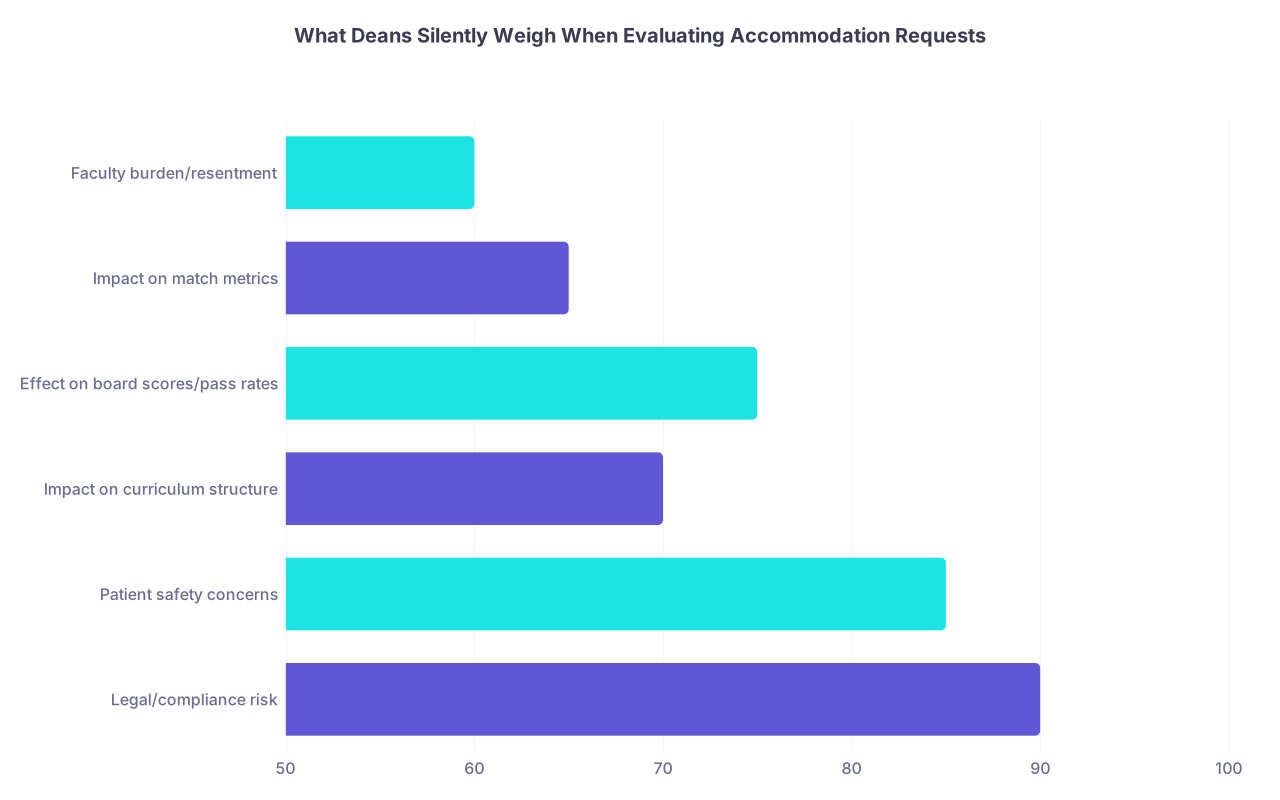
| Category | Value |
|---|---|
| Legal/compliance risk | 90 |
| Patient safety concerns | 85 |
| Impact on curriculum structure | 70 |
| Effect on board scores/pass rates | 75 |
| Impact on match metrics | 65 |
| Faculty burden/resentment | 60 |
If you’re second-year, strong scores, asking for exam accommodations due to recently diagnosed ADHD, they’re thinking:
“Give them what they need, they’ll pass Step 2, match fine. Low risk.”
If you’re fourth-year, already delayed, failed Step once, requesting major reduction in clinical duties, they’re thinking:
“Are we propping up a failing trajectory and buying ourselves a bigger problem later?”
You feel your case as personal and immediate. Their view is institutional and longitudinal.
That’s not fair. It is very real.
Faculty Reactions They Don’t Want You To See
Even when the dean approves accommodations, the execution lands on clerkship directors and attendings. And faculty are… mixed.
Here’s a conversation I overheard almost verbatim in a clerkship directors’ meeting:
Director A: “We have another student who can’t do long cases or late calls for health reasons.”
Director B: “If they can’t handle a 6 p.m. finish, what are they going to do as an intern?”
Director C: “We’re required to work with disability services. Just document everything.”
This is the subtext: some faculty feel resentful but are scared enough of legal consequences to behave carefully on paper, while still letting their feelings leak in subtle ways—evaluations, offhand comments, “concerns” about readiness.
You are not crazy if you sense tension after disclosing accommodations.
Sometimes it’s bias, sometimes ignorance, sometimes just faculty who never learned what the law actually says.
Good deans try to manage this. They’ll do “quiet faculty education”:
- Forwarding sanitized accommodation letters with minimal detail
- Briefly explaining expectations: “You must honor this.”
- Reminding them not to comment on the disability or document anything speculative
Bad deans just dump the email on the clerkship director and move on.
The Politics of Leaves of Absence vs. Accommodations
Once your requested accommodations start to bend the curriculum too far, the conversation in the dean’s office shifts to three words:
“Maybe a leave.”
You hear “supportive time to heal.”
They’re thinking “reset the clock, protect progression metrics, reduce day-to-day complexity.”
The real internal calculus often looks like this:
- “Can we implement this accommodation and keep them on their original timeline without chaos?”
- “If not, is an LOA cleaner, easier, and safer for us?”
- “If they return, will they still need this level of accommodation, or are we just delaying the inevitable conflict?”
For mental health issues, schools are more likely now than a decade ago to offer LOA early, sometimes too quickly.
For chronic physical disabilities, they fear the optics of pushing someone out, so the pressure is more subtle: “You might find it helpful to take some time and reassess.”
You need to understand this: an LOA is both a tool and sometimes a pressure valve for the institution, not just for you.
What Smart Students Do Before Walking Into That Meeting
Let’s flip this from “what they do” to “how you can play this game with open eyes.”
The students who get what they need with the least friction usually do three things:
They come in prepared with clean, specific documentation.
Not a mess of MyChart printouts. A clear letter or report that links diagnosis → functional limitations → recommended accommodations.They separate two conversations in their own mind:
- What the law says (reasonable accommodations, non-discrimination)
- What the school worries about (scheduling, precedent, patient safety, metrics)
Then they frame their ask in a way that sounds workable on both sides. “Here’s what I need” and “Here’s how I imagine this could be implemented without wrecking your schedule.”
They don’t go in alone if things are already adversarial.
They bring documentation, sometimes an external disability lawyer in the background (not mentioned but consulted), or at least written summaries of every conversation.
No, you don’t need a lawyer for your first contact. But if you’re being stonewalled, gaslit (“we don’t really do that here”), or punished socially for asking?
That’s when you quietly get someone external on your side.
The Future: What’s Actually Changing
Med ed is slowly, painfully shifting on disability. Some deans get it. Some directors are vocal advocates and push colleagues hard.
What I’m seeing behind the scenes now:
- More schools creating formal technical standards that explicitly include disability language—and then being forced to defend what “essential” really means.
- More attention to cognitive and mental health disabilities, not just visible ones. ADHD, autism, mood disorders are finally being talked about in policy meetings.
- Quiet benchmarking: “How does UCSF handle this? What does Michigan do? Can we copy their policy so we don’t get sued first?”
The next frontier is not test time. It is clinical structure.
Alternative call models. Flexible clerkship sequences. Structured part-time completion paths that do not destroy your chance at residency.
We’re not there yet. But I’m seeing those conversations start, especially from younger faculty who’ve seen disabled colleagues thrive when the system bends a bit.
That change will be slow, and you can’t wait five years for the system to evolve before you ask for what you need. But understand: the old “if you can’t hack 28-hour call you don’t belong” mentality is starting to crack.

| Step | Description |
|---|---|
| Step 1 | Student emails dean |
| Step 2 | Staff triage and pull record |
| Step 3 | Initial student meeting |
| Step 4 | Disability office standard plan |
| Step 5 | Multi-person review meeting |
| Step 6 | Approved clinical accommodations |
| Step 7 | Pressure toward LOA or denial |
| Step 8 | Implementation by clerkship directors |
| Step 9 | Clinical duties affected |
| Step 10 | Can we keep full competencies |
What You Should Remember Walking Into That Office
You’re not asking for a favor. You’re asserting a right.
But you’re asserting it inside a machine that cares about you and itself, in that order only on good days.
They will:
- Assess your documentation
- Judge your trajectory
- Worry about liability and precedent
- Try to preserve the illusion that everyone in your class is being treated “equally”
You do not control their private conversations.
You do control how clearly you present your needs, how well you document them, and how willing you are to push when “no” isn’t actually legally defensible.
This first conversation—the one where you finally say, “I need accommodations”—is not the end. It’s the doorway.
On the other side are rotation directors, Step exams, residency applications, and eventually attendings who will either be your allies or your obstacles. With a clear understanding of how these decisions are really made, you’re far better equipped to survive what’s coming next.
Because after you get the accommodations letter, you still have to live with its consequences on the wards, in evals, and in your dean’s letter.
That’s the next stage in this journey. And we’ll talk about that one another day.