
The main reason exam accommodations get denied is not bias. It is bad documentation.
I am not saying bias does not exist. It does. But what I see most often—in medical schools, on licensure boards, on high-stakes exams like USMLE, COMLEX, MCAT, LSAT, bar exams—is that people sabotage themselves long before any committee reviews their file. The paperwork kills them.
If you want exam accommodations, you must stop thinking like a patient and start thinking like a reviewer. The reviewer does not know you. The reviewer does not see you struggle. The reviewer sees paper. Your documentation is either airtight and aligned with the standards—or it has holes big enough to drive a denial through.
Let’s walk through the seven documentation errors that get exam accommodations denied, and how to avoid making them.
1. Vague Diagnoses With No Functional Impairment
This is the silent killer of accommodation requests.
You submit:
- “ADHD, combined type”
- “Generalized anxiety disorder”
- “Migraine headaches”
- “Learning disability” And that is it. Maybe a paragraph of “has trouble focusing” or “test anxiety.”
Then you ask for:
- 50% extra time
- Distraction‑reduced room
- Extra breaks
Denied.
Why? Because exam bodies do not grant accommodations for diagnoses. They grant accommodations for functional limitations relative to the exam’s demands.
A report that simply states:
- “Has ADHD and anxiety”
- “Difficulty focusing and managing stress” …tells the reviewer nothing quantifiable.
You need:
- Clear DSM/ICD diagnosis
- Objective evidence of current impairment
- Explicit connection between impairment and exam tasks
Concrete example from a denied USMLE file I saw:
- Report said: “ADHD, diagnosed age 10. Continues to struggle with organization and attention, particularly in testing environments.”
- No test scores under the 16th percentile
- No specific examples linked to timed, multiple‑choice tasks
- No details on how often errors occur, what kind, or how they show up on exams
The board’s summary: “Insufficient evidence of functional impairment requiring accommodations.”
How to avoid this mistake:
- Make sure your documentation answers three questions, explicitly:
- What is the diagnosis, using standard criteria?
- What is the measurable functional impairment right now?
- How does that impairment interfere with this specific exam format (timed, computer-based, long duration, reading load, etc.)?
If your letter could be used interchangeably for the MCAT, the bar exam, and your pharmacology midterm, it is too vague.
2. Outdated or Stale Testing Data
Nothing gets a quick denial like decade‑old testing.
You would be surprised how many professional students submit:
- A psychoeducational evaluation from 4th grade
- Neuropsych testing from high school to justify medical school or licensing exam accommodations
- A one‑page note from a primary care visit five years ago
High‑stakes exam bodies care about current functioning, not who you were at age 10.
Typical time expectations (not hard rules, but common patterns):
| Exam / Context | Common Expectation |
|---|---|
| College exams | Within 3–5 years |
| Graduate/professional | Within 3–5 years |
| USMLE / COMLEX / MCAT | Within 5 years (often 3) |
| Bar exam / LSAT | Within 3–5 years |
I have watched students insist, “But I have always had ADHD,” while clinging to a 12‑year‑old report. The board responds: “No current evidence of functional impairment.” Denied.
Two specific errors here:
- Using very old test data
- Using no test data at all when your condition normally requires it (e.g., LD, ADHD, processing disorders)
For cognitive/learning claims, boards expect:
- Comprehensive psychoeducational or neuropsychological evaluation
- Standardized tests (e.g., WAIS, WIAT, Woodcock–Johnson, specific attention and processing measures)
- Norm‑referenced scores with percentiles
- Interpretation by a qualified clinician
How to avoid this mistake:
- Check the exam body’s documentation guidelines before scheduling testing. They usually spell out:
- How recent
- Which tests
- Who can administer them
- If your testing is older than 3–5 years, assume you probably need updated data, particularly if:
- Your role changed (now in med school, not high school)
- The exam format is more demanding (e.g., Step 1, bar)
- Your symptoms have changed
Do not try to recycle your high school 504 plan as if nothing changed. Reviewers see right through that.
3. Asking for Accommodations That Do Not Match the Evidence
This one is almost guaranteed to get you rejected.
Pattern I see regularly:
- Documentation shows mild difficulty with sustained attention
- Reading speed is around the 30th percentile
- Academic record is strong without accommodations
- Student asks for:
- Double time (100% extra)
- Private room
- Unlimited breaks
- Separate building, special proctor, and basically a different exam experience
The board’s reaction: Overreach = red flag. Denied or sharply reduced.
Your requested accommodations must be:
- Proportional to the documented impairment
- Clearly justified in the report
- Commonly used for that type of impairment
For example:
- If your biggest problem is slow reading speed (10th percentile), 50% extended time may align.
- If you have severe Crohn’s with unpredictable bathroom urgency, flexible breaks and seating near a restroom make sense.
- If your documentation is mostly about test anxiety without objective cognitive deficits, double time is a harder sell.
Common mismatch errors:
- Requesting extended time when testing shows normal or superior processing speed and reading rate
- Requesting a separate room when there is no documented evidence that minor environmental distractions cause substantial functional impairment
- Requesting “stop‑the‑clock” breaks when attention and endurance are normal but the report only mentions “feels stressed”
How to avoid this mistake:
- Sit down with your evaluator ahead of time and explicitly discuss:
- Which accommodations you are seeking
- What specific test results and real‑world examples support each one
- Have the evaluator tie each requested accommodation to:
- Specific scores (e.g., “processing speed at the 6th percentile”)
- Concrete academic examples (e.g., “needed 1.5x time on all proctored exams in medical school to complete them”)
If your evaluator thinks your request is more than your data supports, listen. Overshooting can tank the whole application.
4. No History of Using Accommodations Before the Big Exam
This one is brutal, especially for high‑stakes licensing or admissions exams.
Scenario I have seen over and over:
- No formal accommodations in:
- High school
- College
- Early medical/graduate school
- Student hits USMLE Step 1 / MCAT / bar exam
- Suddenly requests:
- 50–100% extra time
- Private room
- Special breaks
Board response: “Why now?”
Translation: If this impairment is so severe, where is the history?
Is it impossible to get “first‑time” accommodations on a big exam? No. But it is much harder. And when the file shows:
- Strong standardized test performance without accommodations
- Solid GPA in rigorous programs
- No prior documentation
You are fighting an uphill battle.
The mistake:
- Waiting until the biggest exam of your life to formalize what you “have always struggled with”
Boards treat past accommodations as:
- Evidence that your impairment is longstanding
- Evidence that the requested accommodations actually help you
- Evidence that you function in a consistent way across settings
How to avoid this mistake:
- If you are in:
- College
- Post‑bacc
- Medical/graduate school
And you know you have ADHD, LD, ASD, or another condition that impacts exams: - Get formally evaluated now
- Register with disability services
- Use appropriate accommodations on course exams and institutional tests
A common pattern that gets denied:
- Student says: “I did not want to be labeled or get special treatment, but now I need accommodations for the MCAT/Step/bar.”
- Committees rarely reward that delayed disclosure.
If you genuinely did not have access to evaluation earlier (financial, cultural, geographic reasons), that must be documented clearly and thoughtfully by your evaluator. But that is a tougher road.
5. Weak Clinician Letters (Primary Care “Notes” That Look Like Favors)
Let me be blunt: a three‑sentence letter from a primary care doctor that says, “Patient has ADHD and anxiety; I recommend extra time,” is useless. Sometimes it is worse than useless; it signals that you are trying to game the system.
Common problems with clinician documentation:
- No diagnostic criteria listed
- No testing data
- No description of functional impairment during exams
- No history of treatment or follow‑up
- Letters dated right before the application, as if written on demand
Boards are not impressed by:
- “Has been my patient for many years”
- “Reports difficulty with exams”
- “Would benefit from accommodations”
They want:
- How the diagnosis was made (assessment tools, interview, history)
- Objective findings (test scores, observations, rating scales)
- Specific functional limitations relevant to the exam
- Clear, reasoned recommendations that are grounded in data
A sloppy letter hurts you because reviewers start doubting everything: the diagnosis, the severity, your motives.
How to avoid this mistake:
- Use the right kind of clinician for your condition:
- Learning disorders / ADHD: psychologist or neuropsychologist with assessment experience
- Psychiatric conditions: psychiatrist, psychologist, or psychiatric NP/PA with longitudinal treatment
- Medical conditions: appropriate specialist (neurologist, rheumatologist, gastroenterologist, etc.) with clear chart documentation
- Provide your clinician with:
- The exam’s documentation guidelines
- Your own description of past exam struggles (concrete examples, not just “I am anxious”)
- Past testing or school records, if available
Ask for a report, not a perfunctory one‑paragraph letter. The former gets considered; the latter gets filed and ignored.
6. Ignoring the Exam Body’s Specific Documentation Requirements
Every exam body posts documentation criteria for accommodations. They are usually long, boring PDFs that people skim or skip entirely.
That is a mistake.
I have seen denials that literally quoted the guidelines back to the applicant:
- “As stated in our policy, we require standardized test results to document a learning disorder.”
- “The documentation did not include a comprehensive history of the disability, as described in Section X.”
- “The evaluation did not address current functioning within the past three years.”
Common ways people ignore or violate guidelines:
- Using the wrong professional (e.g., life coach “diagnosing” ADHD)
- Not including required tests (e.g., no measures of academic achievement)
- Submitting hand‑written notes or incomplete reports
- Leaving out key sections like developmental history or academic history
- Not signing or dating the report
- Submitting documents in a format the board does not accept (e.g., screenshots, photos, partial PDFs)
Here is the harsh reality: if your file does not meet the format and content rules, nobody will bend those rules just because your story is compelling.
How to avoid this mistake:
- Before you even schedule an evaluation, print or download the exam body’s disability documentation guidelines
- Go through them with your evaluator line by line
- Create a simple checklist:
- Date of evaluation within required timeframe
- Required tests included
- Diagnosis clearly stated with criteria
- Functional limitations tied to exam tasks
- Specific, justified accommodation recommendations
- Clinician credentials and license info included
Think like the person doing the initial screen. If your packet is missing standard elements, they will not “figure it out.” They will move it to the denial pile.
7. No Clear Link Between Disability, Symptoms, and Requested Accommodation
This is the “looks fine on the surface, but still denied” problem.
You might have:
- A legitimate diagnosis
- Current, comprehensive testing
- A qualified evaluator
- A thoughtful letter
And still get denied. Why? Because the report never truly answers the question:
Why does this particular disability require this particular change to the exam?
Example:
- Diagnosis: Major depressive disorder, well controlled on medication
- Functional status: Normal concentration and energy reported at current baseline
- Academic record: Strong performance on timed exams
- Request: 50% extra time due to “stress” and “fear of failure”
The board’s takeaway: The dots do not connect.
Another:
- Diagnosis: Chronic migraine
- Documentation: Frequency and severity of headaches, treatment history
- No discussion of:
- How migraines affect long, continuous testing
- Specific issues (visual disturbance, light sensitivity, need for rest periods)
- Request: Extra breaks and flexible timing
Reviewer: “We do not see evidence that the exam format uniquely disadvantages this candidate.”
How to avoid this mistake:
- Make the evaluator spell out the chain clearly:
- Disability → specific symptoms → functional limitations → specific exam task(s) affected → accommodation that addresses that barrier
Example of a strong linkage:
- “Because of his reading disorder, his single‑word reading and passage reading fluency fall at the 5th and 8th percentiles, respectively. Timed multiple‑choice exams that demand rapid reading of complex passages result in incomplete sections despite sustained effort. In his current medical program, when provided 50% extended time, his exam completion rate and accuracy improve to match his non‑timed performance on coursework and clinical reasoning tasks. Therefore, 50% extended time on the USMLE Step exam is recommended to mitigate the documented reading fluency deficit without providing an unfair advantage.”
That is how explicit it needs to be.
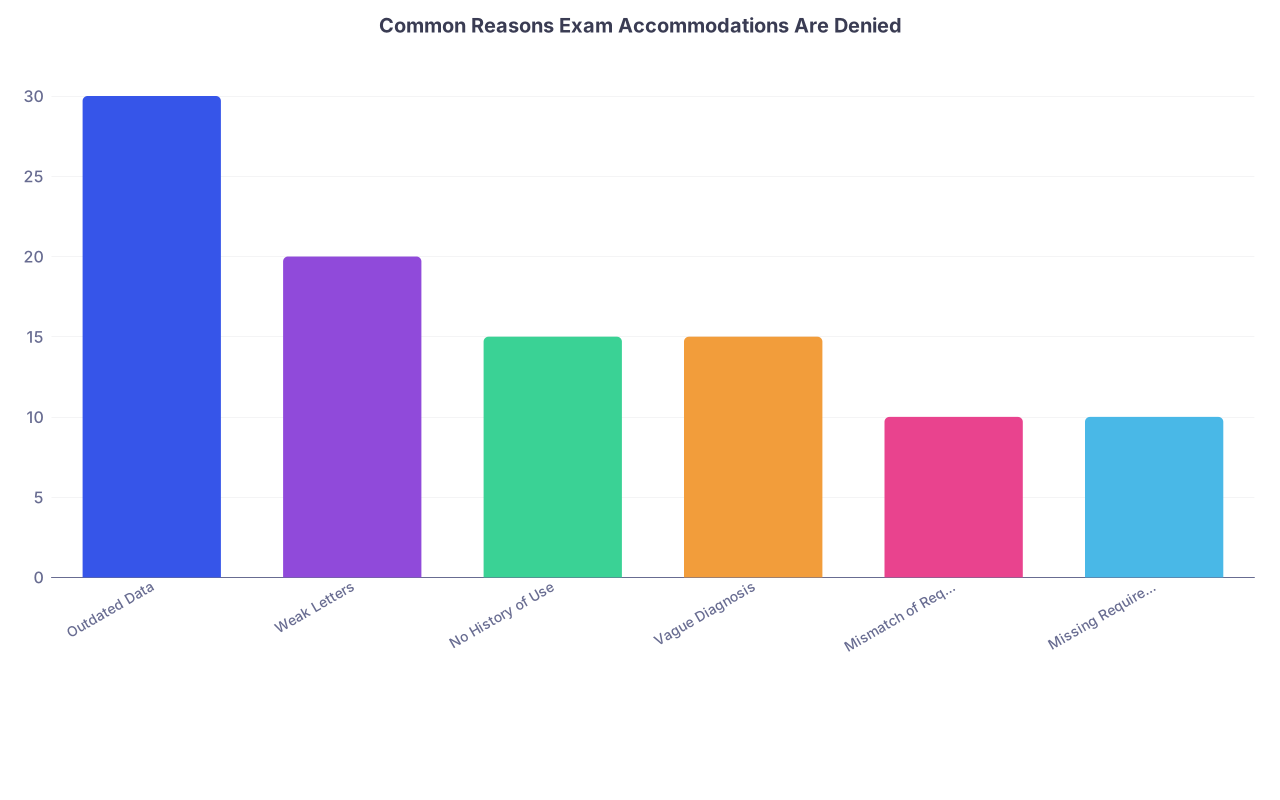
| Category | Value |
|---|---|
| Outdated Data | 30 |
| Weak Letters | 20 |
| No History of Use | 15 |
| Vague Diagnosis | 15 |
| Mismatch of Request | 10 |
| Missing Requirements | 10 |
How to Build a Denial‑Resistant Documentation Packet
Let me lay this out like a checklist, because people get sloppy when they are stressed.
Your documentation packet for a high‑stakes exam should include, at minimum:
Formal Evaluation Report
- Recent (usually within 3–5 years; check your exam’s policy)
- Conducted by a qualified provider
- Includes:
- Diagnostic interview and history
- Standardized testing, where appropriate
- Clear diagnosis with criteria
- Objective evidence of current impairment
- Specific functional limitations
- Detailed, justified accommodation recommendations
History of Past Accommodations (if available)
- Letters from:
- School disability office
- Testing centers (e.g., MCAT, ACT, SAT, previous board exams)
- IEP/504 plans or equivalent records
- Documentation that the accommodations were actually used
- Letters from:
Clinical Treatment Records (where relevant)
- Summaries from treating clinicians, not just “to whom it may concern” notes
- Medication history, treatment response, ongoing symptoms
Your Own Statement (if allowed/appropriate)
- Concise, specific description of:
- How your condition affects you in exam settings
- What has helped in the past
- Any changes over time
- Concise, specific description of:
Do not bury the reviewer in random clinic notes and hope they will build your argument for you. They will not. Your documentation should read like a well‑structured case: clear problem, clear evidence, clear intervention.

| Step | Description |
|---|---|
| Step 1 | Identify Exam Requirements |
| Step 2 | Consult Disability Guidelines |
| Step 3 | Schedule Appropriate Evaluation |
| Step 4 | Gather Prior Records and Accommodations |
| Step 5 | Evaluator Writes Comprehensive Report |
| Step 6 | Align Requested Accommodations with Evidence |
| Step 7 | Submit Complete Packet Before Deadline |
| Step 8 | Use Accommodations Consistently |
| Step 9 | Review Denial and Strengthen Evidence |
| Step 10 | Approved? |
Final Warnings You Should Not Ignore
There are two big traps I see people fall into when they get denied:
They take it personally instead of structurally.
They decide the board is unfair or discriminatory and reapply with the same weak documentation. Same outcome. If you are denied, dissect the decision against the written guidelines. Fix the structural issues.They swing wildly in the opposite direction.
After a denial, they run out and pay for every test under the sun, then submit a 200‑page packet full of data that still does not clearly tie disability → impairment → accommodation. Volume is not the solution; precision is.
Your goal is not “more paperwork.” Your goal is targeted, standards‑aligned evidence that shows:
- This is a real, well‑documented condition
- It substantially limits major life activities relevant to the exam
- The requested accommodations are reasonable, proportional, and consistent with your history
If your documentation does not do that, fix it before you ever hit “submit.”
FAQs
1. Can I get exam accommodations if I was never formally diagnosed as a child?
Yes, but do not pretend that makes things simple. You will need:
- A thorough adult evaluation that addresses why your difficulties were not previously diagnosed
- Clear evidence that your current functioning is substantially impaired
- A strong explanation tying your history, coping strategies, and current demands together
It is possible, but the bar is higher. The documentation must be airtight.
2. Is anxiety or “test anxiety” alone enough to get extra time?
Usually not. Mild or moderate test anxiety without objective evidence of significant functional impairment rarely justifies extended time on high‑stakes exams. To have a chance, you need:
- A formal diagnosis (e.g., panic disorder, generalized anxiety disorder)
- Evidence that symptoms severely disrupt performance despite treatment
- A clear rationale for why the specific accommodation requested addresses that impairment
“Tests make me nervous” does not meet that threshold.
3. If I got denied once, is it even worth reapplying?
Sometimes yes, sometimes no. If your first application was weak—outdated data, vague letters, no history of accommodations—and you now have:
- Updated, comprehensive testing
- Better clinician documentation
- A clearer linkage between disability and requested accommodations
…you may have a very different outcome. But if you change nothing substantial and just “try again,” you are wasting time and emotional energy. Reapply only after you have fixed the specific documentation failures that led to denial.
Key points to remember:
- Diagnoses do not win accommodations. Well‑documented, current functional impairment linked directly to exam demands does.
- Most denials come from sloppy, mismatched, or outdated documentation, not purely from bias.
- You protect yourself by aligning every piece of evidence with the exam’s written standards—before you submit, not after you are denied.