
It is the morning of orientation. You are in a lecture hall packed with 150 strangers, wearing your new badge, trying to listen to the dean talk about professionalism. But your brain is somewhere else.
You are thinking: “I had accommodations in college. I might need them here. But this is med school. Different stakes. Different culture. What if they say no? What if I wait too long?”
At this point, the calendar matters more than your anxiety. Because between orientation and your first med school exam, there is a very short runway to get disability accommodations in place. If you treat it casually, you will be taking that first exam on the school’s terms, not on yours.
Here is the week‑by‑week plan.
Big Picture Timeline
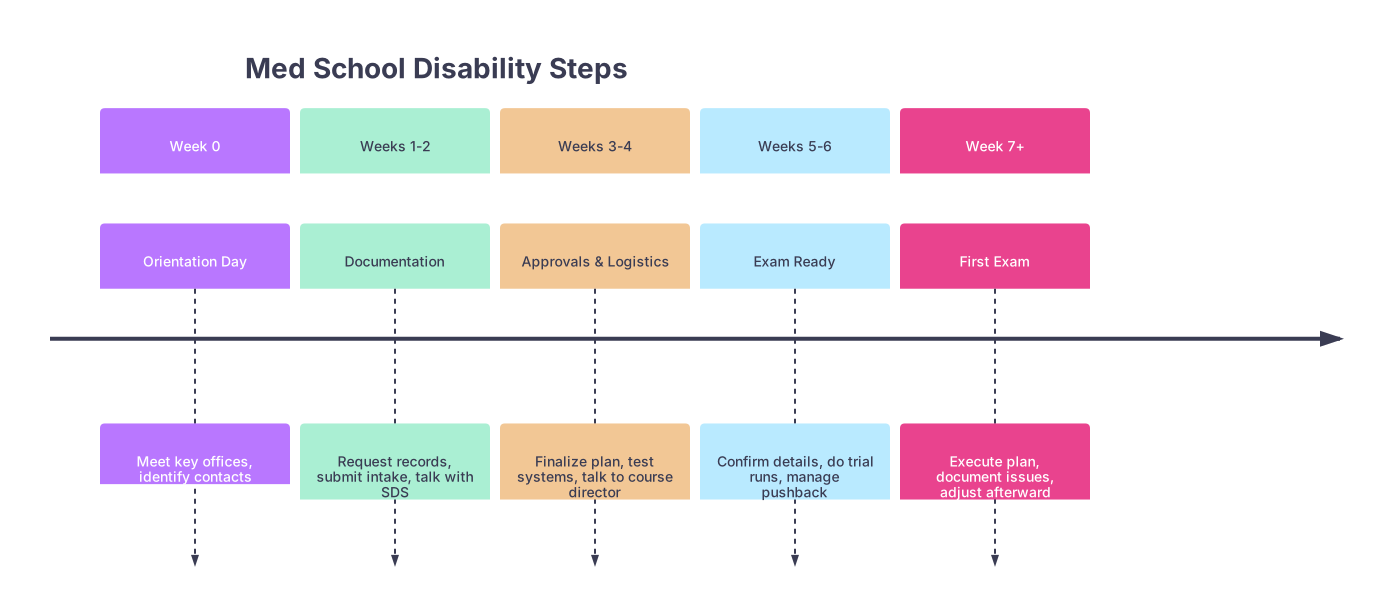
Before we get granular, here is the arc from orientation to your first exam.
| Period | Event |
|---|---|
| Week 0 - Orientation Day | Meet key offices, identify contacts |
| Weeks 1-2 - Documentation | Request records, submit intake, talk with SDS |
| Weeks 3-4 - Approvals & Logistics | Finalize plan, test systems, talk to course director |
| Weeks 5-6 - Exam Ready | Confirm details, do trial runs, manage pushback |
| Week 7+ - First Exam | Execute plan, document issues, adjust afterward |
Most schools schedule the first major exam between weeks 4–8. The safe assumption: you have 4 weeks or less. So I am going to structure this as:
- Week 0: Orientation
- Week 1: Intake and documentation
- Week 2: Negotiation and provisional plan
- Week 3: Operational details
- Week 4–First Exam: Final checks and execution
If your school’s first exam is later, good. You will just have more buffer. Do not use that to procrastinate.
Week 0: Orientation – Laying the Groundwork
At this point you should be collecting names, policies, and deadlines, not making assumptions.
On Orientation Day
Your targets:
- Disability office (often “Student Accessibility Services” or “Student Disability Services” – SDS)
- Curriculum office / Academic affairs
- Course director(s) for the first block
Minimum goals by the end of orientation week:
- You know:
- The exact name and email of the SDS contact for professional programs / med students
- Where the accommodations request form lives
- The deadline (if any) for exam accommodations (common: 1–2 weeks before exam)
- Whether the med school uses the central university SDS or has its own internal office
Scan the orientation slides. They bury this info in one or two slides, usually after wellness and before professionalism. Screenshot that slide. Save it.
Then, send a short email to SDS that same day. Something like:
Subject: Incoming M1 – Disability Accommodations for Exams
Dear [Name],
I am an incoming first‑year medical student and previously received accommodations for [e.g., ADHD, chronic migraine] in undergrad and/or on standardized exams. I would like to ensure exam accommodations are in place before the first assessment in [Block/Course name].
Could you please let me know the steps and approximate timeline for review at the medical school?
Best,
[Your Name]
[Class of 20XX, School of Medicine]
No need to overshare in the first email. The goal is to start the clock.
Also During Orientation Week
At this point you should:
Request prior documentation if you don’t already have it:
- Psychoeducational testing reports (for ADHD, learning disorders)
- Neuropsych reports
- Letters from treating physicians (for physical/psych conditions)
- Prior accommodation letters from:
- Undergrad
- MCAT / LSAT / SAT / USMLE (if applicable)
Clarify how exams are run:
- Are they NBME exams? In‑house?
- Remote or in‑person?
- Proctored in ExamSoft / Examplify?
- Does the school have a separate testing center?
You are not negotiating yet. You are mapping the terrain.
Week 1: Intake, Documentation, and Initial Ask
This is the week where you either move or you get stuck waiting.
Step 1: File the Official Request (Day 1–2)
At this point you should have the SDS intake link. Do the following:
Complete the online intake form
- Be explicit about:
- Diagnosis
- Functional limitations (what actually happens during exams / long lectures / labs)
- What has worked in the past
- Be explicit about:
Upload documentation
- If your documentation is older than 3–5 years, many offices will ask for updated testing. You push back strategically:
- Point to stability of diagnosis
- Provide new clinical letters even if you don’t redo a full neuropsych workup
- If your documentation is older than 3–5 years, many offices will ask for updated testing. You push back strategically:
Specify requested accommodations clearly
Typical starting list for didactic exams:- 1.5x or 2x exam time
- Reduced‑distraction environment
- Use of noise‑reducing headphones or earplugs
- Breaks during exams (with or without clock stop)
- Adjustable seating or ergonomic setup
- Permission to use medication during exam
- Screen reader / text‑to‑speech
- Computer vs paper exam modifications
- Enlarged font / contrast modifications
Do not write “whatever you think is appropriate.” That is how you end up with one token accommodation that does not match your need.
Step 2: Meet with SDS (Day 3–5)
SDS will usually set up a 30–60 minute Zoom or in‑person meeting. This is not a therapy session. It is a functional assessment.
At this point you should:
- Bring:
- A one‑page summary of:
- Diagnosis
- Key exam issues (e.g., “I misread questions under time pressure,” “I have flare‑ups that require bathroom breaks”)
- Prior accommodations that worked and those that did not
- A one‑page summary of:
- Be concrete:
- “Without extended time, I consistently leave 10–15% of questions blank on timed tests.”
- “Without breaks, my migraines escalate and I lose visual focus after 60–90 minutes.”
Your goals in this meeting:
Ensure they understand:
- You are in a high‑stakes professional program with dense, timed exams
- The timeline: “Our first exam in [Block] is on [date]. I would like accommodations in place for that exam if possible.”
Clarify scope:
- Accommodations for:
- Written exams
- OSCEs / clinical skills
- Labs and small groups
- Attendance / flexibility for flare‑ups (if relevant)
- Accommodations for:
Ask directly:
- “Given my documentation and what we have discussed, are these accommodations reasonable for our first block exams?”
- “When should I expect a formal decision letter?”
Week 2: Decision, Pushback, and Provisional Coverage
By now, if you moved quickly, SDS should be in review mode. Some offices are efficient. Some are glacial. You plan for both.
Expect One of Three Responses
| Outcome Type | What It Looks Like |
|---|---|
| Full approval | All requested accommodations granted |
| Partial approval | Some granted, others reduced or denied |
| Delay / provisional | “We need more info” or “temporary measures” |
1. Full Approval
Best case. You receive an official letter/email stating:
- Approved accommodations
- Where and how they will be implemented
- Duration (often 1 academic year, then renewal)
At this point you should:
- Forward the letter immediately to:
- Course / block director
- Curriculum office (if standard practice at your school)
- Any exam coordinator / testing center contact
And you write something like:
Dear Dr. [Name],
I have received my official accommodations letter from Student Disability Services, attached.
Our first exam in [Course] is on [date]. Could you please confirm the process for implementing my accommodations (location, start time, proctor, etc.)?
Best,
[Your Name]
You want written confirmation. Not “sure, we will figure it out.”
2. Partial Approval
Common pattern:
You request 2x time + breaks + private room;
They offer 1.5x time + shared reduced‑distraction room;
They “table” breaks for “later review.”
At this point you should:
- Decide which hills are worth dying on before the first exam. My rule:
- Non‑negotiable: Enough time to actually finish the exam and maintain basic functioning
- Good to have but negotiable for Exam #1: Fine tuning (exact location, perfect break structure)
If they deny an accommodation that directly ties to your documented impairment (e.g., no breaks for a GI or bladder condition), you push back promptly but calmly:
- Ask for clarification in writing:
- “Can you help me understand the rationale for not approving exam breaks, given the documentation on [condition]?”
- Ask what additional documentation, if any, would change that decision. Make them say it.
3. Delay or “We Need More Testing”
This is where students get burned.
- SDS says they need updated testing
- Testing takes months
- First exam is in 3–4 weeks
At this point you should:
- Ask explicitly for temporary accommodations pending full evaluation:
- “Given the time frame before our first exam, are temporary or provisional accommodations possible based on prior records while I work on obtaining updated testing?”
I have seen schools do this when asked clearly. I have also seen schools do nothing when the student stayed vague.
Week 3: Logistics, Trial Runs, and Communication
Assume at this point you have at least some accommodations approved on paper. The danger now is execution failure.
Step 1: Nail Down Exam Logistics
For each exam in the first block, you need:
- Where you will test
- When you will start (often earlier than the main group)
- Who is proctoring you
- What system you will use (same software? different room? paper?)
If no one has told you this by now, you ask. Directly.
Dear [Coordinator Name],
I have approved accommodations (1.5x time, reduced distraction room) for exams. Our first [Course] exam is on [date].
Could you please confirm:
– My testing location
– My check‑in time and exam start time
– The proctor contact on exam dayI want to ensure there are no logistical issues on the morning of the exam.
Best,
[Your Name]
You may feel “high maintenance.” Ignore that. The number of times I have watched a proctor say “I did not get the email about your accommodations” on exam day is not small.
Step 2: Test the Tech (If Possible)
Some schools will allow you to:
- Do a practice exam in the testing software (ExamSoft, NBME, etc.)
- Sit in the testing environment once to see:
- Noise levels
- Lighting
- Desk setup
At this point you should simulate your actual conditions:
- Use your accommodations:
- Extended time
- Break structure
- Noise reduction
- Notice what breaks down:
- Does the software timer actually reflect extended time?
- Does the proctor know you can take breaks without ending the exam?
If something is off, address it before the real test.
Week 4: The Week of the First Exam
You are now in the last 5–7 days before the exam. Content studying is not the only thing happening.
5–7 Days Before the Exam
At this point you should:
Re‑confirm the logistics:
- Date, time, room
- Where you store belongings
- Approved items (water, snacks, meds, earplugs, etc.)
Re‑read your accommodation letter:
- You would be surprised how many students forget what was actually written and argue for things that are not documented.
Decide on your break plan:
- Every 60 minutes, stand up, water, bathroom?
- Quick stretch between question blocks?
- For conditions like POTS, migraine, or chronic pain, plan specific micro‑breaks.
2–3 Days Before the Exam
Now you shift from admin to execution.
At this point you should:
- Lock in your exam routine:
- Wake time
- Pre‑exam meds (if relevant)
- Nutrition and hydration plan
- Identify early‑warning signs that your condition is flaring:
- Vision changes
- Cognitive slowing
- GI urgency
And decide:
- When will you use a break vs. push through?
- What will you do if the proctor disputes your approved accommodation in the moment?
Example script to use on exam day if challenged:
“My accommodations letter from SDS, which the school has on file, includes [1.5x time and breaks with clock stopped]. I need to use those as written. Can we pause for a moment to clarify with [Coordinator / SDS contact] before proceeding?”
You are not asking permission. You are asking them to follow established policy.
Exam Day: Execution and Documentation
You wake up, your exam is at 8:00 am, your group tests in the lecture hall, you test in a separate room at 7:45.
60–30 Minutes Before the Exam
At this point you should:
Arrive early (30–45 minutes). With accommodations, things often take longer:
- Extra forms
- Computer or seating changes
- Confused proctors
Confirm verbally:
- “I am scheduled for 1.5x time and a reduced‑distraction room, correct?”
- “You have me ending at [end time], right?”
If the proctor does not know, you do not shrug. You call or email the coordinator before you sit down. This is annoying. It is also necessary.
During the Exam
Your job is to:
- Use the accommodations you fought to get:
- Take the breaks
- Use the extra time strategically
- Watch for errors:
- Timer set incorrectly
- Room interrupted by late students or staff
- Proctor cutting off breaks or ending the exam early
If something significant happens:
- Do not argue mid‑exam beyond what is necessary to stop the immediate problem.
- After the exam, you document.
Immediately After the Exam
Within 24 hours, at this point you should:
- Write a factual, time‑stamped email if anything went wrong. For example:
Dear [SDS contact and Coordinator],
I wanted to document an issue with the implementation of my approved accommodations during the [Course] exam on [date].
My accommodations letter specifies [1.5x time and breaks with clock stopped]. On exam day:
– The exam timer was initially set for standard time. This was corrected after I pointed it out, but the correction occurred approximately 10 minutes into the exam.
– I was told I could not leave for a bathroom break without ending my exam, which conflicts with the approved break accommodation.I would like to request that this be reviewed and that processes be adjusted so future exams fully reflect the approved accommodations. I am also concerned about the impact on my performance on this specific exam and would appreciate guidance on next steps.
Best,
[Your Name]
You are not whining. You are creating a documented pattern if this keeps happening.
After the First Exam: Adjusting the Plan
Once the dust settles and scores are back, you reassess.
1–2 Days After Score Release
At this point you should:
- Compare:
- How your performance aligned with your practice exams
- Whether the accommodations were sufficient or still left you at a predictable disadvantage
Examples:
- If you consistently run out of time with 1.5x time despite using strategy, and this matches past patterns, you may need to push for 2x.
- If the “reduced‑distraction room” was still chaotic (multiple people, doors opening, overhead announcements), you may need to request a private room.
Then, schedule a follow‑up with SDS:
- “Now that I have taken an exam under the current accommodation set, I would like to review how it went and discuss potential adjustments.”
And be specific:
- “Even with 1.5x time, I completed only 85% of questions and had to guess on the last 15% because of [specific functional issue]. Historically I have needed 2x time (see [prior documentation]). I would like to discuss increasing time for future exams.”
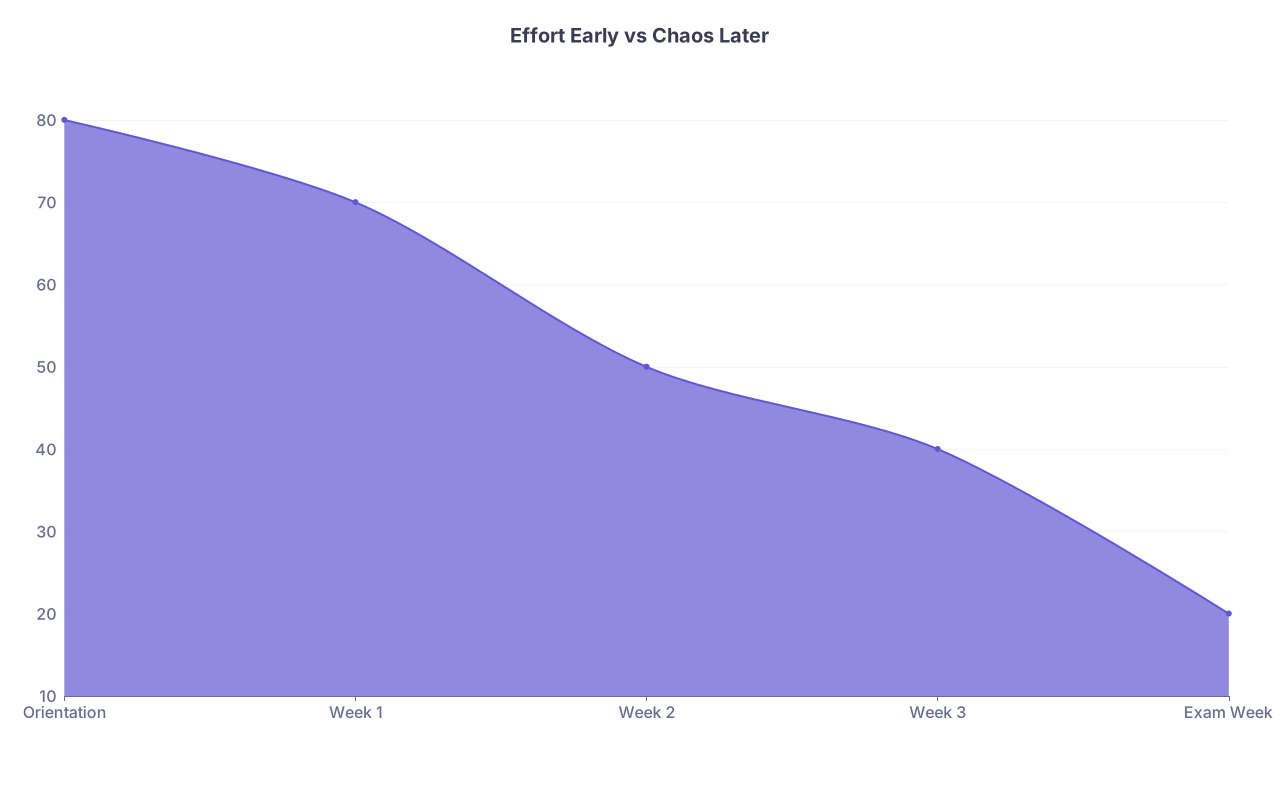
Quick Visual: Effort vs Time Saved
You are investing admin energy early to save chaos later. It looks roughly like this:
| Category | Value |
|---|---|
| Orientation | 80 |
| Week 1 | 70 |
| Week 2 | 50 |
| Week 3 | 40 |
| Exam Week | 20 |
Front‑loading the work (orientation + weeks 1–2) reduces the exam‑week disaster factor dramatically.
Common Landmines (And When They Happen)
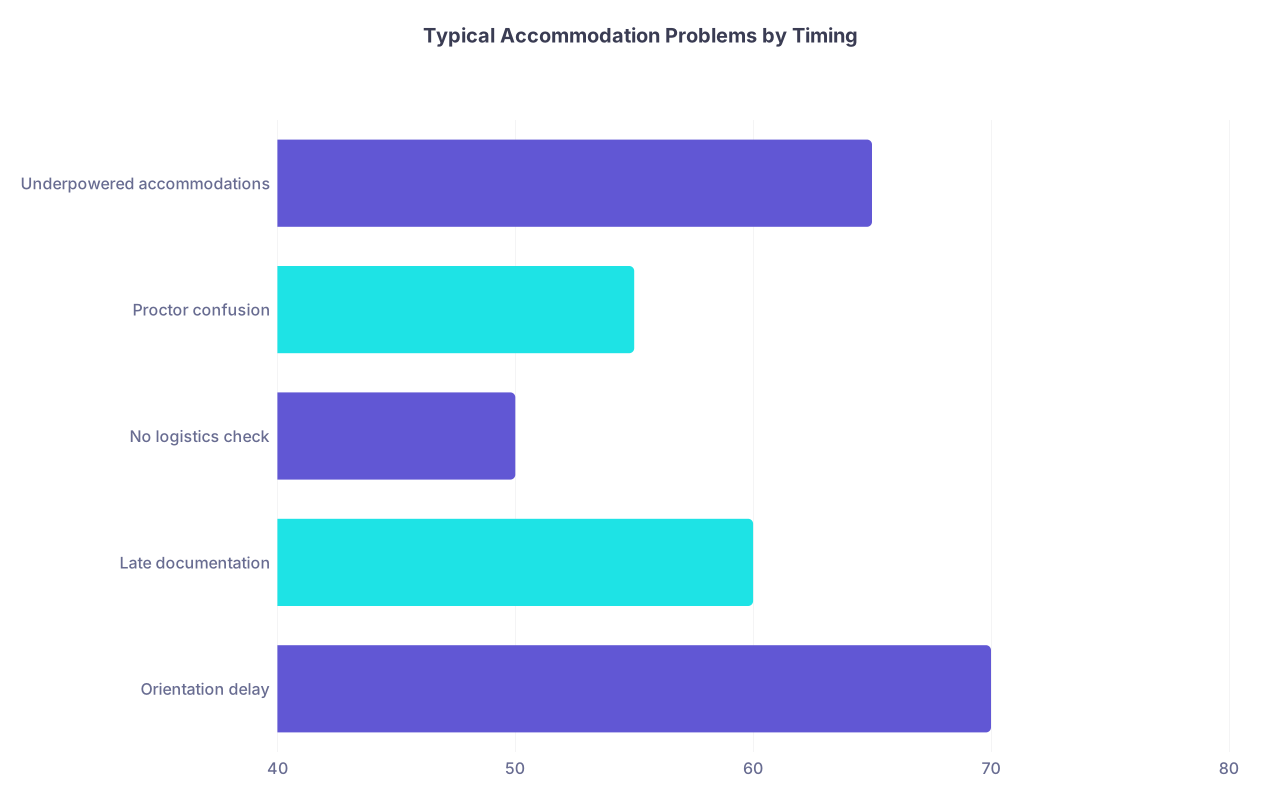
A few trouble spots, in chronological order:
| Category | Value |
|---|---|
| Orientation delay | 70 |
| Late documentation | 60 |
| No logistics check | 50 |
| Proctor confusion | 55 |
| Underpowered accommodations | 65 |
- Orientation delay (Week 0–1): Student assumes “I will do it later,” SDS backlog piles up, first exam hits without approval.
- Late documentation (Week 1–2): Records requested late, neuropsych testing not available, SDS says “we cannot decide yet.”
- No logistics check (Week 3): Accommodations approved but not implemented because no one coordinated room/time.
- Proctor confusion (Exam day): Proctor never saw your letter; timer or location wrong.
- Underpowered accommodations (Post‑exam): Student accepted partial accommodations that are objectively insufficient and did not reassess after the first exam.
You avoid most of these simply by starting during orientation and staying mildly relentless.
Three Things to Remember
- Start during orientation week, not “after things settle down.” Accommodations move slowly; your exam calendar does not.
- Push for concrete, written details: what is approved, where you test, what time you start, who is responsible. Vague promises fall apart on exam day.
- Treat Exam #1 as both a test and a pilot. Use it to fine‑tune your accommodations, document problems, and adjust early, before stakes ramp up later in the year.