
Six-Month Plan Before USMLE to Secure and Test Your Accommodations
It’s six months before your USMLE test date. You’ve just clicked around the NBME site, skimmed the accommodations PDF, and your stomach dropped.
Documentation requirements. Treatment history. “Current functional limitations.” And the quiet panic: What if they say no? What if it’s not approved in time?
You don’t have time to wing this. The accommodations process moves on its own slow timeline, and if you wait, you will back yourself into a corner. I’ve watched people do everything “right” academically and still wreck their exam year because they treated accommodations like a quick form instead of a full project.
So here’s the project plan. Month by month, then week by week as you get closer. What to do, when to do it, and what absolutely cannot slide.
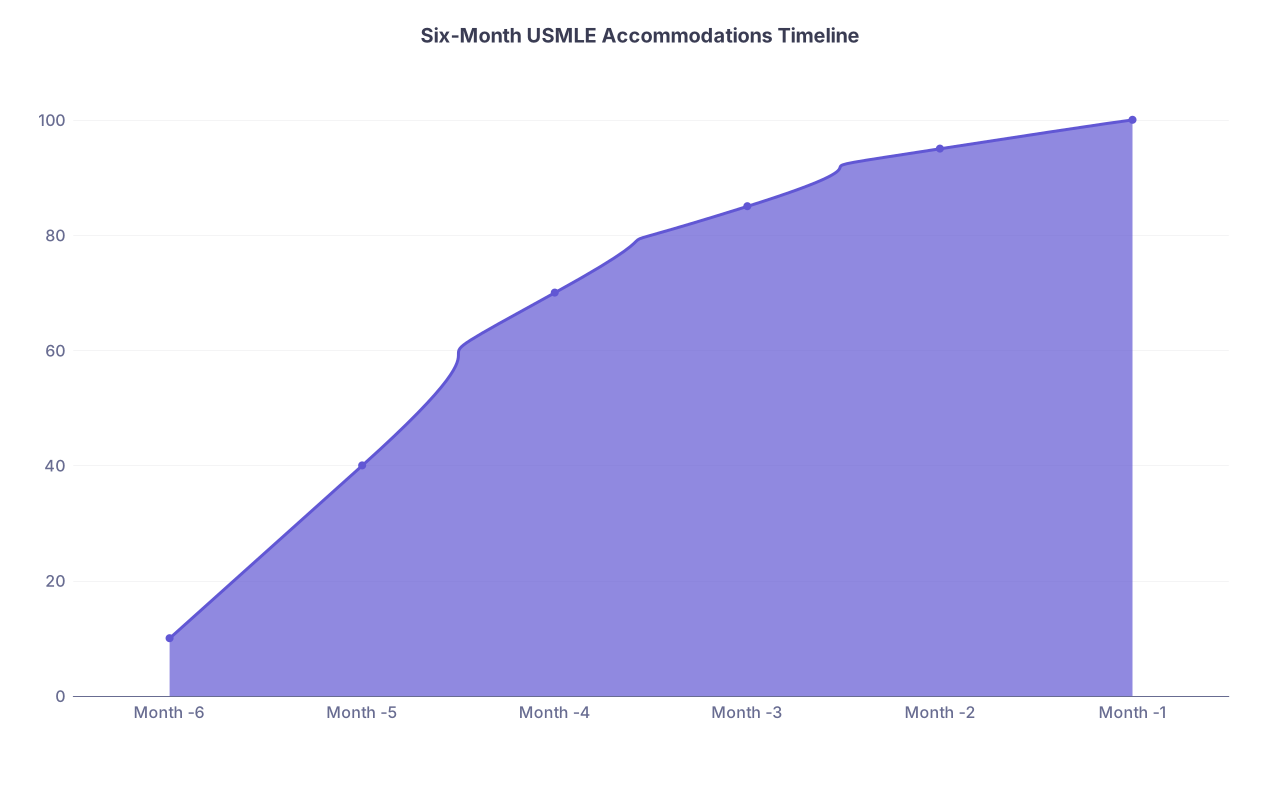
| Category | Value |
|---|---|
| Month -6 | 10 |
| Month -5 | 40 |
| Month -4 | 70 |
| Month -3 | 85 |
| Month -2 | 95 |
| Month -1 | 100 |
Big Picture: How the Six Months Break Down
Here’s the arc:
| Month (Before Exam) | Primary Focus |
|---|---|
| -6 | Decide to apply, mapping requirements |
| -5 | Gather documentation, update testing |
| -4 | Finalize application, submit to NBME |
| -3 | Buffer for questions / appeal |
| -2 | Test logistics, dry-run study days |
| -1 | Confirm details, backup plans |
You’re going to be doing three things in parallel:
- Administrative work – forms, records, letters
- Clinical/diagnostic work – updated evaluations, testing
- Practical prep – actually studying and practicing with your requested accommodations
If you ignore the third one, even if you get approved, you’ll be using unfamiliar conditions on a high‑stakes exam. That’s a good way to underperform.
Month -6: Commit to Applying and Map Your Case
At this point you should not be “considering” accommodations. You either commit to building a serious application, or you accept regular conditions and plan around that. The halfway indecision is what kills timelines.
Week 1: Reality check and decision
- Pull up the actual NBME guide for accommodations (not a blog summary, the real PDF).
- List your disabilities/conditions that affect testing: ADHD, dyslexia, visual impairment, chronic migraine, anxiety disorder, physical mobility issues, etc.
- For each, answer on paper:
- How does this affect reading speed, attention, endurance, or sitting tolerance?
- What has helped in exams before? Extra time? Breaks? Reduced distractions? Paper vs computer?
Then you make two calls:
Call #1: Your disability office (if you’re a student)
Ask specifically:- What accommodations do you currently receive on school exams?
- Have they supported students with USMLE Step 1/2 before?
- Can they provide a history letter summarizing your accommodations and performance?
Call #2: A clinician who actually knows the NBME game
- For ADHD/LD: a psychologist or neuropsychologist who has done testing for standardized exams before (ask them explicitly).
- For psychiatric conditions: a psychiatrist who can speak to functional impairments, not just diagnosis.
- For physical/sensory: your relevant specialist (neurologist, ophthalmologist, rheumatologist, etc.).
If both calls are discouraging or slow, that’s your sign to start aggressively early. The NBME is not quick, and clinicians are often slower.
Week 2–3: Define the accommodations you’ll request
At this point you should have a draft list of exactly what you’re asking for. Not “some extra time”, but concrete items like:
- 50% additional testing time
- Extra break time between blocks
- Screen magnification and adjustable font
- Separate room / reduced distraction
- Permission for food/meds in testing room
- Wheelchair-accessible workstation
- Paper-based exam (rare but sometimes granted in specific cases)
Go through your history:
- What have you had on:
- SAT/ACT/MCAT?
- Medical school exams?
- NBME subject exams?
NBME loves consistency. If you’re suddenly asking for double time with no prior history of any accommodation, you’re starting from a weak position. Not impossible, but weaker.
If your requested accommodations are more generous than you’ve had before, you need a specific rationale and updated data (e.g., new neuropsych testing showing severity was previously underestimated).
Week 4: Map the documentation requirements
This is the part people skim and then regret.
For each condition, list what NBME wants:
- Diagnostic report (who, when, how tested, results)
- Treatment history
- Current functional limitations in testing
- Past accommodation history (letters from prior schools/testing agencies)
Then next to each item, write:
- Do I have this right now? Y/N
- If No: who will provide it, and what’s the lead time?
You’re building a mini Gantt chart in your head:
- Neuropsych eval often has a 1–3 month wait, plus report time.
- Some specialists need weeks to write a proper letter.
- Your school disability office might take 2+ weeks to produce a comprehensive summary.
If any critical element looks like it’ll land later than Month -4, you’re already flirting with a late submission.

| Step | Description |
|---|---|
| Step 1 | Month -6 Decide |
| Step 2 | Define accommodations |
| Step 3 | Identify docs needed |
| Step 4 | Schedule evaluations |
| Step 5 | Gather records |
| Step 6 | Submit to NBME |
| Step 7 | Respond to NBME questions |
| Step 8 | Test accommodations in practice |
| Step 9 | Confirm test day logistics |
Month -5: Get Evaluations and Evidence in Motion
At this point you should be scheduling and collecting, not “thinking about” it.
Week 1–2: Schedule (or confirm) necessary evaluations
For common categories:
ADHD / Learning Disorders
- If your last full psych/neuropsych eval is >5 years old or was done in a casual way (short screening, not standardized testing), you likely need a new or updated evaluation.
- Tell the evaluator explicitly: “This is for USMLE accommodations; NBME has specific requirements. Have you done reports for NBME or other standardized tests before?”
Psychiatric conditions (anxiety, depression, OCD, PTSD)
- Make sure your psychiatrist or psychologist is actively following you.
- They’ll need to describe functional impairment under timed, high‑stakes conditions, not just list DSM diagnoses.
Chronic medical conditions (migraine, GI illness, autoimmune, POTS, etc.)
- You need documentation that connects:
- Symptoms → Impact during prolonged testing → Need for specific accommodations (e.g., breaks for bathroom, ability to lie down, snacks for glucose).
- You need documentation that connects:
Do not assume “my chart is full of notes” is sufficient. NBME wants a structured explanation, not raw EHR dumps.
Week 3–4: Start gathering historical records
At this point you should be:
Requesting:
- Prior testing/evaluation reports (from undergrad, childhood testing, MCAT accommodations)
- Accommodation letters from:
- Undergrad disability office
- Med school disability office
- Other test boards (MCAT, SAT, LSAT, etc.)
Asking your current school disability office for:
- A formal letter summarizing:
- Diagnoses they have on file
- What accommodations you’ve received
- How long you’ve had them
- Whether those accommodations are considered necessary for equal access
- A formal letter summarizing:
If you had accommodations on MCAT, that’s gold. Get the documentation that shows exactly what they gave you.
Month -4: Build and Submit the Application
This month you stop collecting and start assembling. The exam board doesn’t care that your doctor is “working on a letter.” If it’s not in the packet, it doesn’t exist.
Week 1: Draft your personal statement of functional impact
NBME usually expects your own narrative. Do not treat this like a vibes essay. Treat it like a functional report:
Brief history:
- When symptoms started
- When you were formally diagnosed
- What evaluations were done
Concrete impact on testing:
- “On timed exams, I run out of time with 15–20 questions blank despite studying.”
- “After 3 hours of continuous reading on screen, I develop severe eye strain and blurred vision.”
Connection to requested accommodations:
- “Because of my slow reading speed, documented as Xth percentile, I’m requesting 50% additional time.”
- “Due to POTS with presyncope when sitting more than 60 minutes, I’m requesting additional breaks and permission to lie down during breaks.”
Specific, test‑linked, and supported by data. Not “I get stressed and need more time.”
Week 2: Coordinate with clinicians and disability office
At this point you should be:
- Sending each clinician:
- The NBME documentation guidelines
- Your draft list of requested accommodations
- A brief bullet list of how your condition affects exam performance
Good letters:
- Cite test scores and objective measures (e.g., reading speed in words/minute, processing speed percentile).
- Explicitly link impairment → barrier → requested accommodation.
- Address chronicity and treatment history (so it doesn’t look like you invented this yesterday for USMLE).
Bad letters:
- “This student would benefit from extra time.”
- “Patient is anxious and tests do not reflect their true ability.”
If you sense your clinician is going that direction, schedule a short visit and walk them through what’s actually needed. Politely, but very specifically.
Week 3–4: Assemble and submit
At this point you should be:
Double‑checking:
- All forms are complete and signed
- Dates on evaluations are clear and recent enough
- There’s no contradiction between documents (e.g., one note saying “mild situational anxiety” and another claiming “severe long‑standing impairment” with no bridge).
Creating a clean packet:
- Your personal statement
- Disability office letters
- Clinician letters
- Testing reports (psych, neuropsych, etc.)
- Prior accommodation decisions
Then you submit. Ideally by the end of Month -4, not “some time next month.”
Why that early? Because:
- NBME review can take 4–8 weeks.
- They may come back with questions or requests for additional documentation.
- If you get denied, you want time to appeal before your scheduled exam window.

Month -3: Review Outcome, Plan for Appeal, Start Practicing with Your Setup
At this point you should either have:
- An approval letter with specific accommodations
- A request for more information
- Or a denial
Week 1: Parse the decision carefully
If approved:
- Confirm that what they granted matches what you thought you were getting.
- 50% vs 25% additional time
- Extra breaks vs flexible breaks
- Separate room vs “quiet environment” (those aren’t the same)
- Note any conditions: certain sites only, paper vs computer, etc.
- Confirm that what they granted matches what you thought you were getting.
If partial approval/denial:
- Read the reasoning. NBME will usually signal the weak spots:
- “Insufficient evidence of functional impairment”
- “Inconsistent accommodation history”
- “Documentation outdated”
- Read the reasoning. NBME will usually signal the weak spots:
Do not rage‑email. You need a methodical response.
Week 2–3: Decide whether to appeal and adjust exam date if needed
At this point you should be brutally honest:
- Can you realistically gather what they said was missing within 4–6 weeks?
- Does your med school allow you to shift your exam date if this drags out?
- Are you able to take the exam under standard conditions safely and fairly if the appeal fails?
If you appeal:
- Target their objections directly with new data or clearer letters.
- Consider adding:
- Updated testing
- A stronger disability office letter clarifying history
- A more detailed clinician letter
Meanwhile, you don’t stop studying. But you do something most people skip:
Week 3–4: Start studying in your approved (or likely) test conditions
This is where you test your accommodations in practice:
If you got extra time:
- Do at least 1–2 full practice blocks a week at your new time per block.
- Track:
- Focus over the block
- Physical fatigue
- Timing (do you finish early and just get more anxious?)
If you got extra breaks:
- Simulate them during long study days:
- How do you feel coming back from breaks?
- Do you get sleepy? Lightheaded? Distracted?
- Simulate them during long study days:
If you got separate room / reduced distraction:
- Study with noise‑canceling headphones, earplugs, or in a quiet space and see what actually helps.
If, after two weeks of practicing, the accommodations feel off or unhelpful, you have time to:
- Adjust your study schedule to better mimic them
- Talk with your clinician about whether the original request needs revisiting for future boards (Step 2, Step 3, etc.)
Month -2: Dry Runs and Logistics
At this point you should know exactly what you’re getting on test day. The question now: can you function under those conditions for 7–9 hours?
Week 1–2: Full‑day simulation
You’re going to run at least one “mock exam day” with your accommodations:
- Wake up at your planned test‑day time.
- Do multiple blocks of questions:
- Use your approved timing per block.
- Insert your approved breaks at the correct intervals.
- Use:
- The same snacks you plan to use
- The same medications (at the same times, cleared with your prescribing clinician)
Afterward, debrief on paper:
- Where did your focus collapse?
- Did your accommodations help, or did they introduce other problems (e.g., fatigue from a longer total day)?
- Do you need to adjust sleep, caffeine, hydration, or pacing?
If your condition is variable (migraine, POTS, GI), plan two simulation days so you’re not fooled by one “good” day.
Week 3–4: Site‑specific planning
At this point you should:
Call or email your Prometric or testing site:
- Confirm they have your accommodations in their system.
- Ask concrete questions:
- Will I be in a separate room or just a quiet area?
- How are additional breaks handled/logged?
- Can I access my medication during breaks?
- What does the accessible workstation look like?
Plan transport and contingency:
- How you’re getting there
- What happens if a flare / bad symptom day hits the morning of
- Backup meds, comfort items (within rules), clothing layers
Do not assume the center staff “knows what to do.” Most are fine, some are clueless. Clueless plus NBME rigidity is a bad combo unless you’ve clarified in advance.
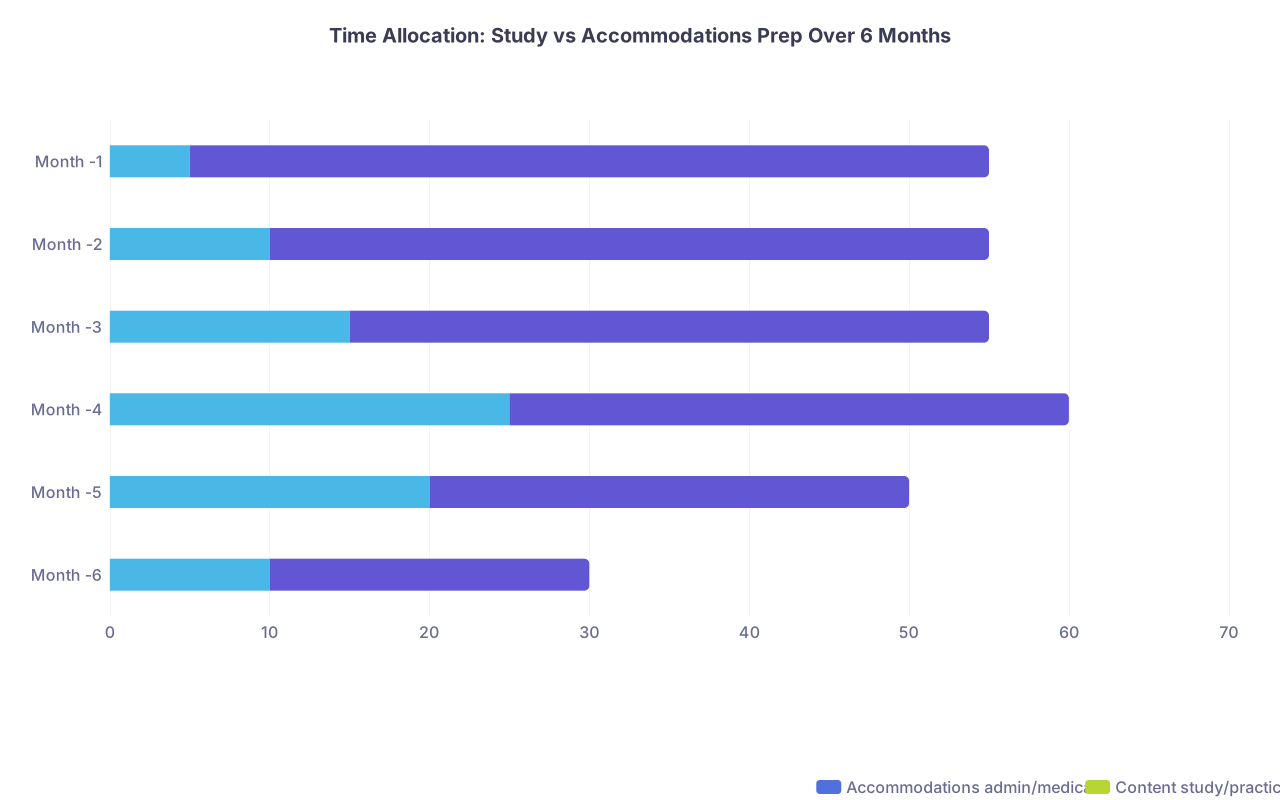
| Category | Accommodations admin/medical | Content study/practice |
|---|---|---|
| Month -6 | 10 | 20 |
| Month -5 | 20 | 30 |
| Month -4 | 25 | 35 |
| Month -3 | 15 | 40 |
| Month -2 | 10 | 45 |
| Month -1 | 5 | 50 |
Month -1: Final Confirmation and Worst‑Case Planning
At this point you should not be dealing with new paperwork. This month is for confirmation and mental prep.
Week 1: Double‑check everything
Log in to your USMLE/NBME account:
- Confirm your assigned accommodations.
- Confirm your exact test date, time, and site.
Reconfirm with the center 1–2 weeks before:
- “I’m scheduled on [date] with approved accommodations for [X, Y, Z]. Can you confirm these are in your system for my appointment?”
If anything sounds off, you deal with it now, not 48 hours before the exam.
Week 2–3: Mental script and advocacy plan
You’re not going in to fight, but you are going in prepared.
Have a simple script in mind:
- If front‑desk staff seem unaware:
- “USMLE/NBME approved me for [X, Y]. It should be in your system. Can you please check under my registration number?”
- If they try to alter conditions:
- “I’m supposed to have [accommodation]. I can’t safely and fairly test without it. Can we pause until we reach your supervisor / NBME contact?”
Know what you will and won’t accept:
- Are you willing to test if they “can’t do” a piece of your approved plan?
- At what point do you walk away and reschedule rather than forcing a compromised exam?
Harsh truth: I’ve seen people try to “push through” missing accommodations and then spend months in appeals afterward. Sometimes your best move is to protect your record, even if it means a delay.
Week 4: Taper accommodations rehearsal, not awareness
You don’t need daily 8‑hour simulations now. But you do want:
- A couple of shorter practice blocks with your exact timing, just to keep the rhythm fresh.
- Clear routines:
- Sleep/wake time
- Breakfast / meds
- Travel plan
And a written, one‑page summary you bring (for yourself, not them):
- Your accommodations list
- Test‑day schedule with breaks
- Key meds and timing
- Emergency contacts if your condition flares
Two or Three Things to Remember
- Accommodations are a project, not a form. Start at least six months out so evaluations, letters, and appeals don’t collide with peak study time.
- You’re not done when you’re approved. You still have to train under your test conditions and prove to yourself that they work for you over a full exam day.
- Test day should feel familiar, not experimental. By the time you sit down at Prometric, you should have already lived your exam routine—timing, breaks, meds, environment—multiple times.