
It’s 9:30 p.m. You’ve just picked an MCAT date. Your browser has twelve tabs open: AAMC accommodations, documentation requirements, Reddit horror stories, your testing account. You know you need accommodations—extra time, breaks, maybe a separate room—but the timeline feels fuzzy and a little terrifying.
Here’s the blunt truth: MCAT accommodations are absolutely doable, but the timeline will make or break you. If you treat this like just another checkbox, you risk getting a denial two weeks before your exam and having no good options.
I’m going to walk you month-by-month and then week-by-week to test day. At each point: here’s what you should be doing, what should already be done, and what’s non‑negotiable if you want a real shot at getting what you need.
Big Picture: How Far Out Should You Start?
For MCAT accommodations, you should be thinking in months, not weeks.
- AAMC strongly recommends: submit 60 days before your exam
- In real life: if you want time for an appeal or extra documentation, you should be starting 5–7 months before test day
Here’s the overall arc:
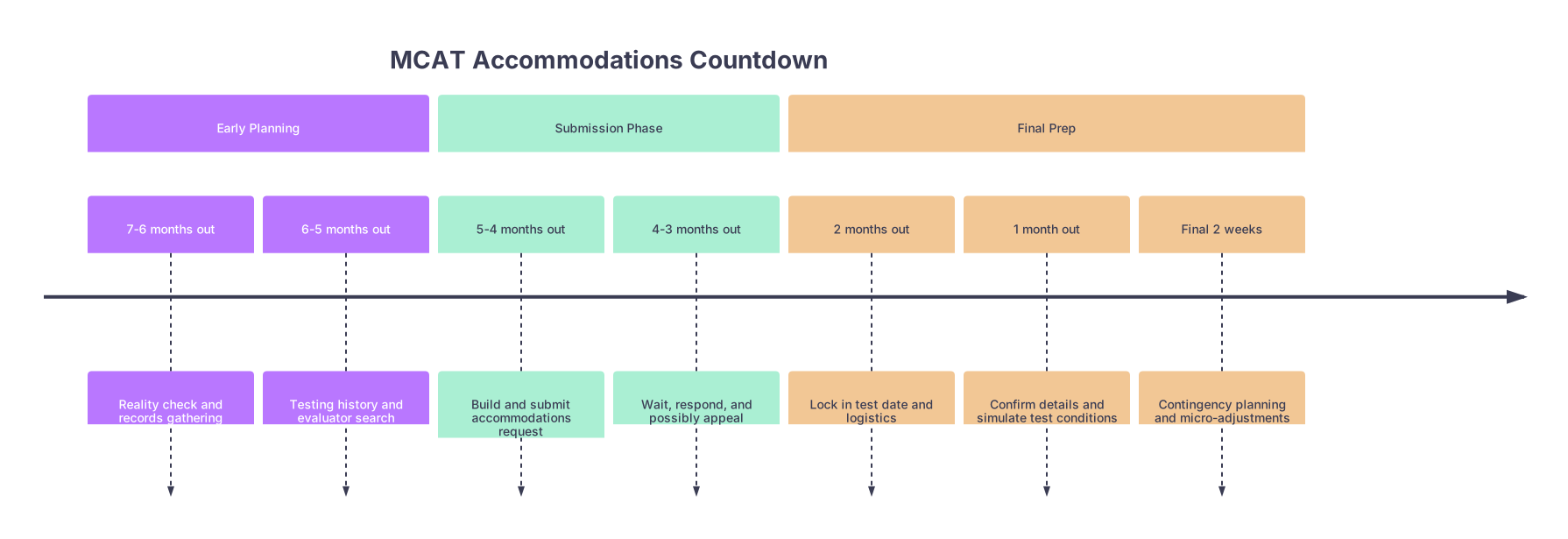
| Period | Event |
|---|---|
| Early Planning - 7-6 months out | Reality check and records gathering |
| Early Planning - 6-5 months out | Testing history and evaluator search |
| Submission Phase - 5-4 months out | Build and submit accommodations request |
| Submission Phase - 4-3 months out | Wait, respond, and possibly appeal |
| Final Prep - 2 months out | Lock in test date and logistics |
| Final Prep - 1 month out | Confirm details and simulate test conditions |
| Final Prep - Final 2 weeks | Contingency planning and micro-adjustments |
We’ll assume a target MCAT in June and count backward. Adjust months as needed, but keep the intervals the same.
6–7 Months Before Test Day: Reality Check and Records Hunt
Let’s say your target MCAT is June 15. At this point, it’s November–December.
At this point you should be:
- Deciding if you’re actually going to pursue accommodations
- Mapping out what you’re going to ask for
- Starting the unglamorous part: hunting down documentation
Step 1: Decide if you’re going to apply (and for what)
Don’t dabble here. A halfway request is how you get denied.
Sit down and list:
- Your diagnoses (formal and suspected): ADHD, dyslexia, chronic migraine, POTS, hearing loss, etc.
- Your functional limitations:
- “Cannot read dense text quickly”
- “Severe fatigue after 20–30 min of concentration”
- “Need to stand/stretch frequently”
- The gap between what a normal test demands and what you can do without accommodations
Then draft your wish list of accommodations, like:
- Extended time (50% or 100%)
- Extra or extended breaks
- Small group or private room
- Paper-based exam or large print
- Screen reader or human reader
- Permission for medical devices, snacks, or meds at the station
You’re not submitting anything yet. You’re deciding what this fight will actually be about.
Step 2: Create your documentation inventory
Open a note or spreadsheet and make columns:
- Provider name
- Specialty
- Diagnosis documented
- Last visit date
- Notes/letter on file? (Y/N)
- School records (IEP/504/college disability services)? (Y/N)
Then hunt down:
- Old IEP / 504 plans
- College/university disability services letters
- Previous standardized test accommodations (SAT, ACT, AP, LSAT, GRE, etc.)
- Neuropsych reports, psych evals, OT/PT reports, audiology/vision testing
If all you have is “My doctor knows I have ADHD” and a 2‑sentence note from 4 years ago, that’s not enough. You’ll need more.
Step 3: Identify documentation gaps
Compare what AAMC wants with what you have. AAMC’s documentation guidelines are very specific about:
- Recency (often within 3–5 years for many conditions, closer for some functional issues)
- Comprehensive testing (for ADHD/LD, they want full neuropsych, not just self‑report and 2 questionnaires)
- Clear tie between your diagnosis → functional limitations → requested accommodations
At this point you should:
- Highlight what’s missing:
- No adult‑age ADHD testing?
- No recent neuropsych testing for dyslexia?
- No formal diagnosis for suspected condition?
- Start emailing/calling providers about:
- Getting updated testing
- Booking a formal evaluation
- Obtaining detailed letters that align with AAMC standards
This is why we’re starting 6–7 months out. Getting in for a full eval can easily take 8–12 weeks.
5–6 Months Before Test Day: Build Your Team and Your Story
Now we’re in December–January for a June exam.
At this point you should be:
- Booking evaluations
- Educating your providers about what AAMC wants
- Building a coherent narrative around your accommodations request
Step 1: Secure the right evaluator(s)
If you need a new or updated evaluation (ADHD, learning disability, processing speed, etc.):
- Book a licensed psychologist/neuropsychologist with:
- Experience doing standardized test accommodations reports
- Familiarity with MCAT/USMLE/LSAT accommodations (ask directly)
Explicitly tell them:
“I’m applying for MCAT accommodations. AAMC requires specific tests and a functional analysis. Can you prepare a report tailored to that?”
If they say “Sure, I’ll just write a short letter,” that’s a red flag. You need data, not vibes.
For physical disabilities, chronic illness, or sensory impairments:
- Identify specialists who know your condition and can:
- Describe fatigue, pain, stamina, or specific barriers
- Connect those to test conditions, not just general life
Step 2: Draft your functional limitations list
While you wait for appointments, write a brutally honest list:
- How long can you read dense text before:
- Pain?
- Eyestrain?
- Brain fog?
- What happens if you sit for 90 minutes without moving?
- What happens if you’re denied snacks/fluids/meds for 60–90 minutes?
- How do distractions or noise affect you?
Tie each limitation to the MCAT format:
- Long passages → reading speed/attention
- 95‑minute sections → stamina issues
- Timed pressure → anxiety spikes or motor tics
- Screen only → visual issues, migraine triggers
This document is for you. It will guide:
- What you ask providers to emphasize
- How you fill out your AAMC forms
- How consistent your whole application looks
4–5 Months Before Test Day: Build the Application Structure
We’re at January–February for a June test.
At this point you should be:
- Setting up your AAMC accommodations account
- Downloading and reading every relevant AAMC PDF
- Outlining your actual submission
Step 1: Study the AAMC requirements like it’s a CARS passage
Log into your AAMC account → Accommodations → Download:
- AAMC Guidelines for Documentation
- Condition‑specific guidance (e.g., ADHD, LD, psychiatric, chronic health)
- Required forms for your providers
Then:
- Highlight exact language:
- “Must include specific tests such as…”
- “Report should address functional limitations in…”
- “Explain why the requested modification is necessary…”
This language is not optional. If your stuff doesn’t directly respond to it, you are handing them an easy denial.
Step 2: Outline your request package
Before you have every document, sketch the structure:
- Your personal statement / history form
- Provider A report (e.g., neuropsych)
- Provider B letter (e.g., psychiatrist or PCP)
- Past testing accommodations proof
- IEP/504/Disability services letters
- Any supporting documentation (surgery dates, hospitalization summaries, audiology reports, etc.)
Match each requested accommodation to:
- At least one objective data point (test score, reading rate, etc.)
- At least one provider statement
- Your own described experience
This is where I’ve seen people fail: they ask for 100% extra time because “I feel rushed,” but their documentation only supports “slowed reading speed” and “severe fatigue after 60 minutes.” That mismatch is a fast denial.
3–4 Months Before Test Day: Finalize and Submit (Do Not Wait Longer)
Now we’re in February–March for a June test.
At this point you should be:
- Collecting final evaluation reports
- Editing your personal narrative to be consistent
- Submitting your request at least 60 days before your exam—ideally more
Step 1: Get and review your evaluation reports
When you receive each report:
- Read it like an admissions committee member.
- Ask:
- Does it clearly state diagnoses?
- Does it list standardized tests with scores?
- Does it describe functional limitations in concrete terms?
- Does it explicitly support the accommodations you’re requesting?
If something’s vague, ask the provider for an addendum, not a total rewrite:
- “Can you add a brief paragraph connecting my slowed reading rate to extended time recommendations, specifically in high‑stakes, long‑form exams like the MCAT?”
You’re not telling them what to say. You’re asking them to be explicit about what they already believe but didn’t clearly put in writing.
Step 2: Write your applicant statement carefully
Your piece should:
- Be consistent with the provider reports
- Describe your history:
- Early struggles
- Past accommodations (or lack thereof)
- Academic workarounds you’ve used
- Focus on function, not just feelings
Avoid:
- Over‑dramatizing (“I literally can’t function at all without extra time”)
- Contradictions (e.g., claiming you always had straight As and couldn’t complete any timed exam ever)
Stick to a clear line:
“Here is how my condition shows up in real life. Here is what testing looks like without accommodations. Here is why these specific modifications make the test equitable, not easier.”
Step 3: Submit your request (earlier is better than perfect)
Aim to submit at least 90 days before your MCAT. That gives you:
- 30–45 days for initial review
- Time to fix issues or appeal
- A buffer before your actual test
Hit submit, save every confirmation email, and download a copy of everything you uploaded.
2–3 Months Before Test Day: The Waiting and Response Window
We’re in March–April for a June exam.
At this point you should be:
- Monitoring your email and AAMC account
- Preparing for two parallel futures:
- Approved accommodations
- Partial or initial denial
Step 1: Watch response times and calendar math
Keep track:
- Date you submitted
- AAMC’s stated review window
- Your exam date
- Deadlines for:
- Asking for reconsideration
- Rescheduling if needed
If you hear nothing and you’re getting close to their maximum review window, politely follow up with AAMC. Bureaucracy rewards squeaky wheels who stay within the rules.
Step 2: If you’re approved
At this point you should:
- Read the approval letter like a contract:
- Exactly what accommodations are granted
- Any conditions or limitations
- How they’ll appear in the test center (e.g., separate room only if available, etc.)
Then immediately:
- Log into your MCAT registration and verify your test date and site are correctly tied to your accommodations
- Start planning practice sessions that mimic your approved setup:
- Use full‑lengths with your extra time/breaks
- Practice with assistive tech if approved (screen reader, etc.)
- Simulate break patterns
Step 3: If you’re denied or partially approved
Do not panic. But also don’t wait.
At this point you should:
- Read the denial letter slowly. They usually tell you why:
- Documentation not recent
- Functional impact unclear
- Requested accommodation not justified
- Make a two‑column list:
- AAMC’s stated concerns
- How you’ll respond (new letter, clarifying statement, additional testing, etc.)
If you have time before your test date, you can:
- Request reconsideration or appeal, focused and targeted
- Ask providers for short clarification letters directly addressing AAMC’s reasons
If timing is too tight, be honest:
- You may need to move your test date to avoid taking the MCAT under conditions that will tank your performance
- Yes, it’s annoying. But a rushed denial + unaccommodated test usually costs more in the long run than pushing the date.
1–2 Months Before Test Day: Lock in Logistics and Test‑Day Systems
Now it’s April–May for a June test.
At this point you should be:
- Confirming logistics with AAMC and Prometric/your testing center
- Building your test‑day routine around your accommodations
- Running at least 1–2 full simulated practice days
Step 1: Confirm test center implementation
Do not assume everyone has their act together.
At this point you should:
- Verify in your AAMC account that your registration reflects approved accommodations
- A week or two later, call the test center (or appropriate contact) and ask:
- “Can you confirm that my MCAT registration shows accommodations for [extended time / extra breaks / private room / etc.]?”
- Clarify anything unusual (e.g., medical device, special seating, medications)
Document the date, time, and person you spoke with. If there’s a mismatch, contact AAMC immediately.
Step 2: Build your personal test protocol
Write out a test‑day script:
- Wake‑up time
- Exact breakfast (practice this on your full‑length days)
- Medication timing (especially if you’re on stimulants, pain meds, beta blockers, etc.)
- What you’ll do on each break:
- Bathroom
- Snack/fluids
- Quick stretch or brief grounding exercise
- Contingencies:
- What if your symptoms flare mid‑section?
- What if your device/mobility aid needs adjustment?
Run 1–2 full practice days that mimic:
- The same start time as your real exam
- The same timing and break schedule as your accommodations
- The same fueling and meds timing
You’re not just training your brain. You’re testing the system.
Final 2–3 Weeks: Micro‑Adjustments and Contingency Planning
We’re in late May–early June now.
At this point you should be:
- Done with bureaucracy
- Focused on execution, not paperwork
Step 1: Double‑check everything
Go down this checklist:
- AAMC approval letter saved and printed
- MCAT registration matches accommodations
- Test center confirmed your setup (if applicable)
- Transportation and timing planned (consider mobility and fatigue)
- Medical supplies, devices, snacks allowed per AAMC rules
Have a folder (physical or digital) with:
- Approval letter
- Any email correspondence with AAMC
- Provider note if you’re allowed specific medical items
You may never need to show this. But if something gets “lost” in translation at the test center, you’ll be glad you have it.
Step 2: Sleep, symptoms, and schedule
Shift your schedule so you’re regularly awake and functional at the exact times you’ll need on test day.
For many with ADHD, chronic illness, or sleep disorders, this takes more than a couple of days. Start now.
- Move your wake time gradually
- Align meds/food timing with exam day
- Note any symptom patterns and adjust your plan
Quick Comparison: Minimum vs Ideal Start Times
| Plan Type | When You Start | Pros | Risks |
|---|---|---|---|
| Last-Minute | 2 months out | Might squeak through simple cases | Almost no time to fix denials |
| AAMC Minimum | 2+ months out | Meets official guideline | Appeals are tight or impossible |
| Realistic Smart | 4–5 months out | Time to refine docs and appeal | Requires earlier planning |
| Best-Case | 6–7 months out | Full buffer for evals + appeals | Needs long-term foresight |
Week‑of and Test Day: Execute, Don’t Experiment
In the final week:
- Stop changing systems
- No new meds, no brand‑new snacks, no last‑second accommodations fantasies
On test day:
- Arrive early enough that any confusion about accommodations can be resolved before your heart rate explodes
- If something is not implemented as approved:
- Calmly show your documentation
- Ask for the test center manager
- If they can’t fix it, complete the AAMC irregularity form afterward and contact AAMC with specifics
You’re not powerless here, but you need to be methodical.
If Your Test Is Farther Out Than 6–7 Months
Good. You’re ahead of most people.
At this point you should:
- Book evaluations now (earliest slot you can get)
- Start a simple Accommodations Binder:
- Tab 1: Diagnoses and provider list
- Tab 2: Old IEP/504/college disability docs
- Tab 3: Standardized test history and any prior accommodations
- Tab 4: Drafts of your functional limitations and personal statement
Use the extra time to clean up your paper trail so when you submit, your request reads like a coherent, well‑supported story instead of a pile of PDFs.
Your Next Step Today
Do one concrete thing now:
Open a document and list every provider, diagnosis, and standardized test you’ve ever taken where accommodations were relevant.
Names, dates (approximate is fine for now), what was done or not done. That’s your starting map. Once that’s in front of you, the rest of this timeline becomes much easier to follow.